My quick thoughts on the fascinating but
problematic Hollywood Reporter podcast interview on 6 July 2021 with the
fabulous Carroll Baker, who I venerate as a trash cinema goddess. (I call her
that with love! It’s a high compliment!). The profile is meant to commemorate the 65th anniversary of Baker's film debut (actually, Baker's show biz roots stretch all the way back to the dying days of vaudeville!) ... but it goes in an unexpected direction towards the end!
90-year-old Baker is impressively sharp-witted, extremely articulate and has a treasure trove of juicy anecdotes from fifties and sixties
Hollywood. Some highlights:
Baker was offered the Natalie Wood part in Rebel
without a Cause (1955) - but turned it down because she disliked the script!
There was talk of Baker playing Madge in Picnic
(1955), but studio mogul Harry Cohn’s protegee Kim Novak got the role instead (Baker
makes a rare bitchy dig at another actress here: “Kim Novak couldn’t act!”).
On Giant (1956): Baker and James Dean were
already friends from their Actors Studio classes in New York, but once they
made Giant together, the social-climbing Dean swiftly dropped her to befriend
the more famous Elizabeth Taylor. Baker admits that at the time, she disparaged
the acting ability of Hollywood movie stars Taylor and Rock Hudson (whereas she
and Dean had "serious" Method training). Looking back now, to her credit Baker admits
she was a snob and appreciates how genuinely good their performances were.
Later, when Baker inexplicably rejected the
role of Maggie in the 1958 film adaptation of Tennessee Williams’ Cat on a Hot
Tin Roof, Taylor was ecstatic, telling her, “Carroll! You’ve given me a whole
new career!” Which was true: Cat reinvented Taylor as a gutsy, risk-taking overtly
sexual adult actress (and began Taylor's fruitful association with Tennessee Williams).
Baker is eloquent and sympathetic regarding
her peer Marilyn Monroe. She recalls how Monroe would drink straight vodka and
pop Seconals while partying with the Ratpack, then at the end of the night the
men would simply pour her into a cab and send her home, so she found Monroe’s
death grimly inevitable.
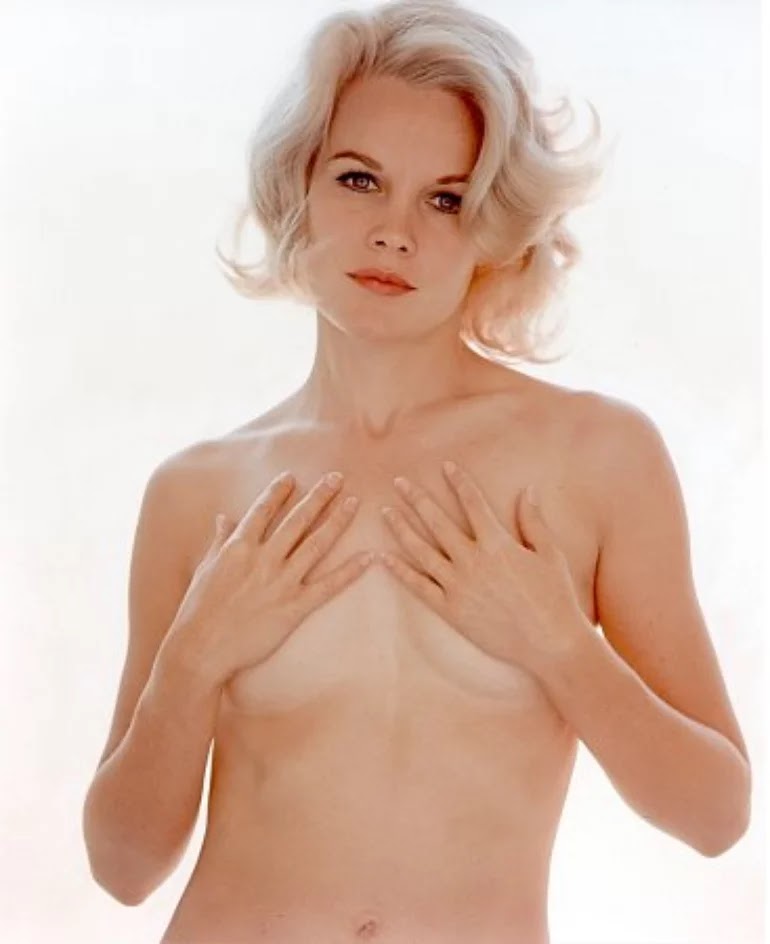
/ Pictured: Baker as a young starlet around the time of Baby Doll /
Obviously, Baker is asked about her most
famous movie Baby Doll (1956), but I loved hearing her discuss the underrated avant-garde
Something Wild (1961). Baker’s ultra kitsch sex kitten-era films The Carpetbaggers (1964),
Sylvia (1965) and Harlow (1965) are routinely dismissed as dreck – but I happen to love
them! Her post-Hollywood Italian filmography is entirely skimmed over.
Then interviewer Scott Feinberg mentions
Harvey Weinstein and inquires whether Baker ever encountered “the casting couch”.
She volunteers, “My heart is broken for Bill Cosby … he’s a wonderful human
being”, does some horrifying victim-blaming and asserts, “He’s a very sexy
man!” Oh, Carroll!
/ Baker (and her sequined nipples) around the time of The Carpetbaggers (1964) /
Make no mistake: as a truthful biopic, the infamous,
ultra-trashy 1965 film Harlow is entirely misbegotten. But as a prime exemplar
of the so-bad-it’s-fabulous camp classic, Harlow - directed by Gordon Douglas, adapted
from Irving Shulman's scurrilous best-selling (and widely discredited) 1964 exposé
Harlow: an Intimate Biography and starring Carroll Baker as doomed platinum
blonde depression-era sex goddess Jean Harlow - belongs in the elite canon
alongside Valley of the Dolls (1967), Diana Ross’ Mahogany (1974) and Mommie
Dearest (1981). In fact, Harlow contains the essential components we demand in
any film-making endeavor: emotions. Conflicts. Wigs!
Seen today, it’s fascinating how recklessly
fast-and-loose the script plays with Jean Harlow's story, as if the facts are somehow
insufficiently dramatic, tragic and action-packed enough. Harlow’s tumultuous, abbreviated
life was marked by two scandals so shocking they’re still swirling with urban
myths decades later. After just two months of marriage, her husband Paul Bern
died of an apparently self-inflicted gunshot wound on 5 September 1932. Because
MGM’s publicity department swept in to “manage” the situation before the police
arrived, the precise circumstances – and Harlow’s role in them – remain one of
Hollywood’s enduring mysteries. Harlow’s own abrupt death of uremic poisoning
aged 26 on 7 June 1937 sparked further speculation. Was it caused by a botched
abortion? Venereal disease? Were her mother’s anti-medicine Christian Science
beliefs to blame? Or did the bleach used to maintain Harlow’s platinum blonde
tresses cause “peroxide poisoning”?
/ A portrait of the real Jean Harlow (born
Harlean Harlow Carpenter, 3 March 1911 - 7 June 1937) in 1933 /
Harlow the biopic displays almost zero
curiosity about these aspects, instead opting to cram the bare bones of
Harlow’s life into a hackneyed rise-and-fall show biz cautionary tale narrative
imbued with the lurid sensibility of Jackie Susann’s Valley of the Dolls. (It’s
astonishing how much Harlow anticipates the hysterical tone and sherbet-coloured
look of the 1967 film adaptation of Dolls. When Harlow hits the skids and begins
drinking heavily, for example, she suddenly becomes Neely O’Hara. Was Dolls' director
Mark Robson carefully scrutinizing Harlow’s formula and taking notes?).
/ Actress Caroll Baker's extensive research for portraying Jean Harlow /
Harlow also makes no attempt to conjure the
real Harlow’s unique brassy and hard-boiled comedic screen persona evident in
her best films like Red-Headed Woman, Red Dust (both 1932) and Dinner at Eight
(1933). Instead, Harlow – an archetype of brazenly overt and unapologetic
pre-Code sensuality, who reportedly “iced” her nipples and eschewed underwear
onscreen - is depicted as a victimized and misunderstood prig constantly
fighting-off the casting couch advances of predatory film executives and
determined to preserve her virtue. One jarring example: Harlow posits that the
twenty-something actress was saving her virginity for her wedding night with Bern.
But because the impotent Bern was incapable of “performing” on their
catastrophic honeymoon, her virginity remained intact. In real life Harlow was
married three times and Bern was her second husband – facts that Harlow
gleefully erases.
Note also that Harlow was made without the
cooperation of Harlow’s real studio MGM. (Her studio is called “Majestic” in
the movie). Perhaps that explains why none of her actual films are cited.
Instead, we keep seeing cinema marquees emblazoned with weirdly generic titles
like Blonde Virgin, Sin City, Yukon Fever,Luscious Lady and Love Me Forever!
/ Baker as Harlow. Considering her wig was styled by the great Sydney Guilaroff, presumably it's meant to be crooked? /
Hilariously, the film also insists Harlow’s
platinum blonde hair is all-natural. (While Harlow was genuinely blonde, she was
also a peroxide pioneer to achieve that not-found-in-nature albino-silver
shade). In any case, Carroll Baker sports a wig to portray Harlow. And what a
wig! It may be styled by esteemed coiffeur-to-the-stars Sydney Guilaroff, but
that ultra-fake acrylic-looking Dynel wig is so distracting it frequently
upstages the actress sporting it. Interestingly, the makers of Harlow skip
Harlow’s signature plucked-out half-moon eyebrows – maybe because they assumed
sixties audiences would find them off-putting?
/ Intriguingly, if you do a deep Google Image search you'll eventually come across these pics of Baker as Harlow (presumably hair and make-up tests?) that suggest initially the makers of Harlow contemplated a more authentic look - and then decided against it /
It must be said that at no point does Baker
resemble Harlow that much.In one
glorious high camp moment, once she finally achieves mega-stardom, we see
Harlow undergo an epic studio-sanctioned glamour make-over. The beautician’s
chair is finally spun around for the big reveal – and the only change is that
they’ve added a little black beauty mark under the corner of her mouth! Combine
the outrageous immobile blonde bouffant wig, the heavy false eyelashes and the
beauty spot, and Carroll Baker looks significantly more like sixties-era jazz
chanteuse Peggy Lee than Jean Harlow.
/ Pictured: Miss Peggy Lee /
Baker also frequently looks gaunt and wan
in Harlow, and so ravaged that it’s startling when Harlow’s mother must co-sign
her studio contract because she’s meant to be a minor. (The film is studious to
never specify what year it is or the characters’ ages). Certainly, Baker’s make-up,
wig and lighting are surprisingly harsh and unflattering. But by all accounts,
she was also stressed and miserable during the production (the script was still
being cobbled-together during filming and Baker was feuding with producer
Joseph E Levine). Her tension is tangible onscreen. Baker valiantly attempts to
breathe some conviction into the material, considering Harlow is written as a
one-note victim. (What counts for character development here: once Harlow becomes
famous, she begins smoking with a long white cigarette holder).
/ A portrait of Baker around the time of Baby Doll (1956) /
Let’s pause here to contemplate Baker, a
strange, distinctive (that weird, unmistakable drawling patrician voice!) and sensual
feminine presence in mid-century cinema. How did Baker - a high-minded, risk-taking
and serious Broadway actress steeped in the New York Actor’s Studio Method
tradition – wind up typecast as a sexpot in so many vulgar melodramas? Certainly,
her career started promisingly. After a breakthrough role opposite James Dean,
Elizabeth Taylor and Rock Hudson in Giant (1956), Baker sparked an
international furor as a thumb-sucking nymphette child bride in the controversial
film adaptation of Tennessee Williams’ Baby Doll (1956). The perverse
Lolita-like image of Baker lounging in a playpen was as scandalous a depiction
of wanton eroticism as anything Brigitte Bardot did in And God Created Woman
(1956) – and that movie was French!
And yet she subsequently wound-up starring
in mostly tepidly received dross. (Although I treasure both Something Wild (1961)
and Sylvia (1965)). Interestingly, the role of “Maggie the Cat” in the 1958
film version of Tennessee Williams’ play Cat on a Hot Tin Roof was reportedly
offered to Baker before Elizabeth Taylor. (Contract disputes with Warner Bros
meant she couldn’t accept it). Maybe that part would have altered Baker’s trajectory?
/ Baker wore this understated ensemble (worthy of Jayne Mansfield!) to promote her "comeback" film The Carpetbaggers /
In any case, within a few years hit movie
The Carpetbaggers (1964) gave Baker’s faltering career a major fillip. Under
the guidance of that film’s producer Joseph E Levine, Baker was now marketed as
“the next Monroe”. She even went so far as posing for a “nudie cutie”
cheesecake pictorial in the December 1964 issue of Playboy magazine entitled
“Baker in the Boudoir.” Baker had played a sexy Harlow type in The
Carpetbaggers, so it made sense to cast her as Harlow herself when the Schulman
biography got optioned. But as Penny Stallings concludes in her 1978 book Flesh
and Fantasy: “the film and the hype were a disaster. There’d been all sorts of
problems with the script and a rival production starring Carol Lynley, but the
main problem was that Carroll’s PTA prettiness and clipped delivery just didn’t
meld with her concocted image. She felt awkward in the role and her discomfort
showed on screen. Perhaps even more to the point is the fact that cultural
styles were rapidly metamorphosing when the film was released, and the public
simply wasn’t in the market for a platinum blonde bombshell in 1965.”
/ "Baker in the Boudoir!" From Carroll Baker's December 1964 Playboy pictorial /
Harlow was savaged by the critics, but it
wasn’t a commercial flop. Nonetheless, it spelled the end of Baker’s career as
a major American leading lady. In 1967 she moved to Rome, successfully re-inventing
herself as the star of Italian giallo horror films before returning to US in
1977 as a gutsy middle-aged character actress (witness her vanity-free performance in the black comedy
Andy Warhol’s BAD). But maybe author Ken Wlaschin is correct when he surmises “(Baker)
is actually at her best in trashy movies.” Is there any higher praise for an
actress? Baker is still with us at 89-years old. Let’s celebrate her as a cult
icon now!
/ Baker's intriguing Italian filmography is ripe for discovery and should most definitely not be regarded as a "step down" for her. Her giallo films aren't easy to see: they sometimes crop up on YouTube, but usually sans English subtitles or dubbing! The only one I've seen to date is the extremely stylish Baba Yaga (aka Kiss Me, Kill Me) from 1973 (pictured). Baker is utterly magnetic as the enigmatic lesbian villainess. Read more about Baker's Italian era here. /
/ Above: Carol Lynley as Jean Harlow /
(As per Stallings’ reference above: there
was indeed a second overlapping biopic (also entitled Harlow!) under production
at the same time. (Isn’t it bizarre to think Jean Harlow was such a hot property
in the mid-sixties, almost three decades after her death?). It’s equally as bad
as the Baker film, just in different ways. This version starred the pallid
Carol Lynley and took a radically different interpretation of the Harlow story.
A visibly low-budget effort shot in eight days in harsh grainy black-and-white
(it looks like a William Castle quickie), it depicts Harlow as a sarcastic, tantrum-throwing
bee-yatch as opposed to Baker’s sinned-against victim. It offers a more factually
accurate account of Harlow’s life, and is notable for being Ginger Roger’s last
major film role (she plays Harlow’s mercenary mother). A true oddity, you can watch it on YouTube. Keep your expectations low!).
/ Above: Carol Lynley in the rival biopic Harlow (1965) /
What I adore about Harlow: Gordon Douglas’
lazily old-fashioned, almost indifferent direction. His motto appears to be, when
in doubt, cut to a montage! He also regularly employs newspaper headlines to explain
what’s happening. There’s great pleasure
in watching the “all-star cast” flailing: Red Buttons as Arthur Landau, Harlow’s
saintly-beyond-belief manager. Mike Connors as suave Jack Harrison (a cynical matinee
idol who seems to be based on Clark Gable?). Angela Lansbury as Harlow’s weak-willed
mother (note: Lansbury was only six years older than Baker) and Italian actor
Raf Vallone as Marino Bello, Harlow’s parasitic lounge lizard stepfather. Puffy
Peter Lawford as Harlow’s ill-fated husband Paul Bern (one of the few occurrences
where a character is named after the real-life person). Did anyone exude jaded hungover
sleaziness onscreen quite like Lawford? He really phones it in. Bern is introduced
and killed-off so abruptly we can only shrug when he dies. Leslie Nielsen as cigar-smoking,
silk dressing gown-wearing film mogul Richard Manley (apparently based on
Howard Hughes) and Martin Balsam as studio head Everett Redman (Louis B Meyer).
/ Angela Lansbury (as Harlow's ineffectual but well-meaning mother) and Raf Vallone (as her stepfather) /
/ Saintly manager Arthur Landau (Red Buttons, centre) eavesdrops while leading man Jack Harrison (Mike Connors, a vision in beige suede) flirts with starlet Harlow /
/ Jack Harrison and Jean Harlow arriving at a premiere /
Harlow was a big-budget film and the lush production
values are up there on the screen. The sensation that envelopes you watching it
feels glossy, ridiculous and sumptuous. In fact, the sets – complete with banks
of floral arrangements, candelabras and grand pianos - are all so garish (Harlow’s
all-mauve dressing room! Richard Manley’s baroque mansion!) it feels like every
scene is unfolding in some rococo brothel. But even with all that money, there
is no sense of period and no attempt to replicate the Art Deco decor associated
with Jean Harlow. The vibe throughout is ultra-sixties atomic-era rather than remotely 1930s. The soundtrack, for example, emphasizes the then voguish sounds of Latin
exotica and bossa nova. There’s a justifiably notorious moment when Harlow appears
to break into the twist – seemingly inventing the dance craze a good thirty
years early! (To her credit, old pro Edith Head designs some spectacular slinky
bias-cut gowns for Baker that successfully emulate the ones Harlow wore).
/ Jean Harlow pouting through the pain in her luxe dressing room (a real tart's boudoir!) /
And the dialogue. The dialogue! Everyone
speaks in cliched show biz platitudes. Some representative samples: “You have
the body of a woman and the emotions of a child!” Landau exclaims to Harlow. “She’s
the girl you want to marry – and have for your mistress!” is how Everett Redman
summarizes Harlow’s allure. “There’s nothing lonelier than a bedroom with only
one person in it,” Harlow laments to her mother. She also admits, “I was
looking at my body in the mirror to see what’s so different about it that makes
the public go crazy over it!” Once Harlow has ascended to stardom, Jack
Harrison snarls, “Welcome to the velvet prison!” Harlow’s dying words to her
mother from beneath her oxygen tent: “Mamma! I’m going to be a good girl … a
good girl!” Landau gets the last word: “She didn’t die of pneumonia. She died
of life!” (Harlow didn’t die of either pneumonia or “life” – she died of uremia).
Just when you think Harlow couldn’t get any worse, in one final flourish of bad
taste, we’re treated to a slideshow of glamour shots of Baker as Harlow
overlaid with the tear-jerkin' musical accompaniment of sappy ballad “Lonely Girl” by Bobby “Blue Velvet” Vinton!
(You can view Harlow on Amazon Prime. Read further analysis of Harlowhere).
Upcoming
British Film Institute season Birth of the Method [25
October – 30 November 2014] explores the intense,
influential and revolutionary school of acting espoused by New York’s legendary
Actors Studio in the 1950s.
Sure,
much of the then-radically naturalistic Method approach looks pretty twitchy
and mannered today (the scratch-your-crotch and mumble clichés started for a
reason), but the season features some genuinely interesting titles starring the
Method’s most notable exemplars: Montgomery Clift, Marilyn Monroe and of course
the Method made flesh, Marlon Brando (at the height of his virile beefcake
beauty inOn The Waterfront).
Particularly
intriguing is the arty and obscure sexploitation vehicleSomething Wild(1961). Starring pouty and perverse Carroll Baker (ofBaby Dollnotoriety, which is also screening) it’s virtually never revived
so seize this rare opportunity to see this curiosity. Cinema’s kitsch king John
Waters has raved aboutSomething Wildas camp-meets-“failed art movie” hybrid and likens Baker in it to
Ann-Margret inKitten with a Whipas “When a Sexpot Emotes.” What more incentive do you need?
Obviously I made a point of seeingSomething
Wild (1961)
at The British Film Institute on 27 November and it was indeed wild and a real experience! I’d never
seen this rarely-revived and obscure psychological drama before but had always
been curious about it.
I was expecting something a bit more sexploitation-y, kitsch andKitten with a Whip. Having now seen Something Wild, I eat the words I wrote above! In
fact it was relentlessly bleak, dark and very much an uncompromising somber European
art film that just happened to be in English and filmed in New York. It stars luscious blonde Carroll Bakerin what must surely be her career-best performance. The film both looks and
sounds incredible. The dissonant jazz soundtrack is by Aaron Copeland. The film’s
stark noir-ish black and white look is via cinematographer Eugen Schüfftan.
Something Wild was apparently his last film. He’d begun his career working in
German silent cinema under Fritz Lang in the 1920s and he invests that
knowledge of German Expressionism to Something Wild, which frequently unfolds
like a dream (or a nightmare). In 1960 Schüfftan had worked on the eerie French horror film Les yeux sans visage – he brings a similar sense
of menace and dread to Something Wild.
Amazingly, the director Jack Garfein (now 85) was in attendance to
introduce the film onstage. He said it took him fifty years to make sense of
why he madeSomething
Wild. As a child he was imprisoned in Auschwitz.
The film was hiscri
de coeur and
attempt to come to terms with those memories.Something
Wild was
a mega-flop when it came out, baffled critics and public alike (as Don L
Stradley put it, “critics reacted to it as if they’d sat in something slimy”) and
was swiftly buried by the studio. As a result, Garfein (who was married to
Baker at the time – it was an intensely personal project for them both) was
never entrusted to make another film again! I'm careful not to give too much away: the film
concerns a girl who gets raped and psychologically unravels – very much
anticipating Roman Polanski’sRepulsion (1965). The ending is genuinely strange and
divisive. It may be over fifty years old, butSomething Wildhasn't lost its ability to disturb.
Further reading: Read Kim Morgan's analysis of Something Wild here
“The final film released under the Andy Warhol moniker is a much more polished affair than Flesh, Trash or Heat, but preserves the oddball wit and eccentric flair that made those films so memorable. A New York housewife has to support a houseful of relatives on her own. She pays the bills by operating an electrolysis service out of her home and by running a murder-for-hire service staffed exclusively by women.” Allmovie Guide
When you watch BAD, “polished” is definitely not the word that spring to mind, although admittedly it’s all relative. And the above description seems to underestimate the poetry of Paul Morrissey’s admittedly rough and unvarnished but frequently beautiful earlier films, which cover similarly lurid subject matter but feel entirely different to BAD (which was directed by Andy Warhol’s then-boyfriend, Jed Johnson, rather than Morrissey). While BAD certainly has a significantly higher budget than the Morrissey films, it frequently feels inept, the performances are mostly grating and it has the smudged, dark, murky and ugly look typical of low-budget films of that period (see also: the el cheap-o drag queen comedy Outrageous! also from 1977 -- perhaps the only true Canadian cult film), although for some that could be part of BAD’s grungey allure.
BAD aims to be a satirical exercise in deliberate bad taste, but (for me) it misjudges the tone. It’s a botched black comedy with gratuitously nasty violence (I’m the first to admit to being ultra squeamish when it comes to violence). BAD’s most notorious sequence shows a woman throwing her baby to its death from a high rise balcony (obviously a doll, but still distressing!). A scene where one of the hit women kills an illegal immigrant mechanic by crushing him under a car and then cutting off one of his fingers (presumably as proof she’s completed the job) is pretty grim, too. (The scene is so badly-lit you mercifully can’t see much, but I can’t get the bone-crunching sound effects out of my head!).
John Waters has always been voluble about how as a youth watching Warhol’s trailblazing 1960s underground films like Chelsea Girls (1966) shaped (twisted? Corrupted?) his aesthetic sensibility. With BAD, it feels like the Warhol crowd was now taking cues from Waters himself, and trying to catch up with the prince of puke. BAD captures the nihilism of early Waters like Pink Flamingos (1972), Female Trouble (1974) and Desperate Living (like BAD, 1977), but with his gleefully campy verve, wit and humour mostly surgically excised. Instead, BAD is just grindingly unpleasant, brutal and bleak.
(Pedro Almodovar was clearly an acolyte of Waters in his scabrous early films; maybe he also saw BAD. If BAD reminds me of any film, it is Almodovar’s deliberately offensive feature debut Pepi, Luci, Bom y otras chicas del montón (1980), made during the post-Franco punk era in Madrid. It’s probably my least favourite film by Almodovar, who I revere).
Bear in mind I’ve always wanted to see BAD (it’s only just recently been reissued on DVD in the UK after being long unavailable). I remember reading about BAD in Danny Peary’s book Cult Films as a teenager and almost physically yearning to see it! And I’m a hardcore Warhol fanatic: I used to watch Warhol double-bills at the much-missed sleaze palace The Scala cinema in London’s Kings Cross. I’d stay until the bitter end of, say, Lonesome Cowboy (1968) when the cinema was virtually empty after most people had long since drifted out, exasperated. (Read this great blog with a contrasting point of view about the merits of BAD).
Warhol films were traditionally enlivened by the presence of his charismatic and freaky stable of Superstars, but their era had come to an end by BAD. Glam rock scene-maker and Max’s Kansas City habitué Cyrinda Foxe (whose admirers included New York Doll David Johansen, David Bowie – she’s featured in his "Jean Genie" video -- and Aerosmith’s Steve Tyler) plays RC, one of the hit women. Foxe looks sensational, a 1950s platinum blonde rockabilly bombshell (in one of the early scenes, she sashays down a Queens street while a group of garbage men hoot at her – it recalls Jayne Mansfield in The Girl Can’t Help It!). But Foxe is no actress, and her mystique evaporates every time she speaks.
Similarly, Perry King as LT, the sole male hit man in Hazel’s doll squad, looks great: a chiselled dark-haired hunk in a muscle shirt, if you squint he resembles Joe Dallesandro (apparently the role of LT was conceived with Dallesandro in mind). But King completely lacks Dallesandro’s strange, torpid almost Robert Mitchum-like magnetism. He may be a charisma bypass, but King does have one nice moment, when he announces completely straight-faced, “I committed suicide last year.”
What BAD can boast is the presence of a genuine Hollywood star, albeit a somewhat faded one down on her luck at the time. Carroll Baker plays homicidal Queens housewife and beauty salon proprietor Hazel Aiken (a role originally intended for Shelley Winters; the fact that Winters, an actress not exactly known for quality control, turned it down speaks volumes. Weirdly, I’ve also read the role was offered to Vivian Vance – Lucille Ball’s I Love Lucy sidekick Ethel Mertz! Now that would have been mind-blowing casting).
Baker first caught the public eye in the 1950s in the deluxe family melodrama Giant (1956) co-starring alongside the likes of James Dean, Elizabeth Taylor and Rock Hudson. Later that year Baker created a sensation as a prototype Lolita in the scandalous Tennessee Williams adaptation Baby Doll, along the way getting nominated for a Best Actress Oscar and enraging the Catholic Legion of Decency. (John Waters has recalled the nuns in his Catholic school in the 50s warning him that to see Baby Doll was a guarantee of going to hell). With the exception of The Carpetbaggers (1964), Baker’s subsequent films (like a 1965 biopic of Jean Harlow) bombed and after legal battles with Paramount she re-located to Rome to salvage her career with kinky / arty Euro-sexploitation giallo films like The Sweet Body of Deborah (1968) and Paranoia (1969).
Pouty and perverse: the famous image of a thumb-sucking Carroll Baker in her crib in Baby Doll (1956)
Returning to the US to star in BAD, the film finds Baker long past her Baby Doll prime: Photographed unflatteringly, she looks frumpy and matronly. To her credit, though, Baker seems to revel in Hazel’s callousness; she re-invents herself as a mature character actress and nails a witheringly aggrieved, acidic delivery. (Baker has a nice Joan Crawford moment towards the end when she snarls at Perry King, "I don't have the luxury of being sensitive!"). And at one point, when alone in her bedroom and feeling nostalgic, Hazel takes a luxurious white fur coat out of the closet and wraps herself in it you suddenly get a brief glimpse of Carroll Baker in her 50s sex kitten heyday.
I tell a lie: there is one true Warhol Superstar in BAD. Amongst the grotesque freak show of clients who hire Hazel’s hit women, blowsy Warhol stalwart Brigid Berlin (aka Brigid Polk) is on blistering form as the racist, misanthropic Estelle who hires the sociopathic sisters Marsha and Glenda (“You’ve got to kill a dog, and you’ve got to do it viciously!” she screams). BAD sparks to life every time she appears: Berlin gets the film’s best lines, and sinks her teeth into them with venomous zeal. “People stink – all they do is eat, fuck and watch TV!” she philosophises. Later, when Estelle violently attacks one of her neighbours, her hateful foul-mouthed tirade (“You dirty old shithead! You Irish bastard!”) includes, “You welfare recipient!”
Another high point is provided by Geraldine Smith and Maria Smith (real-life sisters) playing the sneering, sarcastic killer sisters with Dorothy Hamill haircuts, Glenda and Marsha. (Geraldine had already been memorable as Joe Dallesandro’s venal wife in the 1968 Warhol / Morrissey film Flesh). They maintain deadpan, contemptuous expressions and flat nasal Brooklyn-accented voices (think Penny Marshall in Laverne and Shirley) even while killing and committing arson.
Maria and Geraldine Smith as sullen killers-for-hire Glenda and Marsha. Photo Via
Susan Tyrell also makes a strong impression as Hazel’s much-abused, downtrodden daughter in law Mary. A tremulous, wincing mousey depressive constantly trying to console her crying baby, Mary is apt to lament, “I just can relate to smoking. It’s the only thing that’s always there ...” and then burst into tears.
It’s the traumatised Mary who nails the film’s whole ethos when she whines, “People are so sick. The more you see them, the sicker they look.”
In retrospect, perhaps Andy Warhol's BAD's lasting contribution is ... it made for a great t-shirt.
Vampyros Lesbos (1970)
-
If you’re a eurocult fan you’ve seen Jess Franco’s *Vampyros Lesbos*. And
given that it was one of the first Jess Franco movies to be available on
DVD way...
THE GO-BETWEEN 1971
-
*"You flew too near the sun; you were scorched."*
Spoiler Alert. This is a critical essay, not a review, so plot points are
revealed for discussion
Gee, I...
The end is near
-
Cookie has, for some time now, thought about closing up shop on this blog.
I mean DHTiSH has had a good run, but after 15 years, it's time for a
diff...
Grace Jones
-
Artist: Grace Jones
LP: 7" single
Song: "I've Seen That Face Before (Liber Tango)"
[ listen ]
The incredible Grace Jones turned 76 one month ago today. ...
National Silent Movie Day: Manhandled (1924)
-
Wednesday, Sept. 29, 2021, is National Silent Movie Day. New York City's
beloved Film Forum is celebrating with a screening of Allan Dwan's 1924
silent...
SHABLAM:
-
While we are speaking in onomatopoeia,
"Girl, what did that girl just say, girl?" This queen is giving basic boot
camp for drag queens as she throws an a...
Who was Tamara Matul?
-
[image: Marlene Dietrich, Josef von Sternberg, Rudolf Sieber, Tamara Matul
at Olympic Auditorium, Los Angeles, 1934]
Rudolf Sieber, Tamara Matul, Marlene...
-
Welcome Refugees from tumblr!
[image: Christofascists.]
I'm busy exporting what's left of Drifting over the Ether & A Long Lunch. I
will be posting upda...
My Baking Supervisor
-
Meet Mr. Caspurr Burgers. He says:
"I helped you get up three hours earlier than usual this morning and this
is how you repay me? What is with this glass...
Béatrice Dalle Day
-
'Driving south on the A7 from Lyon to Marseille, I find my thoughts turning
to some of the scenes associated with the name of Béatrice Dalle. They
incl...
A BOGUS SPEECH BY A BOGUS PRESIDENT
-
Yesterday, Obama spoke in New Orleans at the 10 year anniversary of
Katrina. I'm not quite sure why we celebrate disasters' anniversaries, but
it was a ch...
DJ. Journalist. Greaser punk. Malcontent. Jack of all trades, master of none. Like the Shangri-Las song, I'm good-bad, but not evil. I revel in trashiness