/ Beautiful portrait of John Waters by
Sarah Hedlund Design. Be sure to "like" her on Facebook for more like this /
(Note: My interview with John Waters originally appeared on the website of the wonderful alternative art and culture magazine Nude
in 2010. A condensed version eventually appeared in the print magazine as well later. Sadly, Nude
folded in 2011 -- yet another casualty of this damn recession - and just recently they finally tore down the website. I'm posting the article on my blog for posterity. I will eventually do the same for my 2011 Nude interview with Marianne Faithfull)
John Waters was born six weeks early and has been causing
shockwaves ever since. The ultimate cult filmmaker, he’s turned his compulsion
to freak out the squares into a career and an art statement. From 1972’s
notorious breakthrough
Pink Flamingos
to
Polyester, juvenile delinquent
rockabilly musical
Cry-Baby to
A Dirty Shame (his last film to date),
Waters’ movies are delirious, life-affirming exercises in exquisite bad taste
that continue to attract devotees of sensationalism freaks. And now the ongoing
success of
Hairspray the stage
musical (adapted from his 1988 film) has brought him a wider audience than
ever.
If all Waters did was foist the late Divine (his 300 pound
drag queen leading lady of choice) onto an unsuspecting world, his legacy would
be secure. But years ago the trash auteur
diversified, expressing his message of filth in literary form. His sixth and
latest book is Role Models, a wildly
entertaining memoir in which he reflects on the various figures who shaped his
twisted vision. Typically, the role call varies from playwright Tennessee
Williams to deranged Catholic Saint Catherine of Siena, from “outsider
pornographers” to middle of the road balladeer Johnny Mathis and Queen of
Rock’n’Roll Little Richard. He writes
about the denizens of bohemian 1960s Baltimore like teenage transvestite Pencil
and butch lesbian alcoholic stripper Lady Zorro (think Diane Arbus photos come
to scowling life) who sparked his teenaged imagination. On a more sober note,
Waters makes a persuasive argument that his friend, former Manson Family member
Leslie Van Houten, should receive parole after four decades in prison.
I met with Waters when he was in London this month to launch
Role Models. The erstwhile rebellious
and perverse cinematic terrorist whose self-described dress sense used to be
“thrift shop pimp meets hillbilly” is now a soigné 64-year old clad in
head-to-toe Comme des Garçons.
Over coffee Waters proved to be a true raconteur. Welcome to the wit and wisdom of John
Waters.
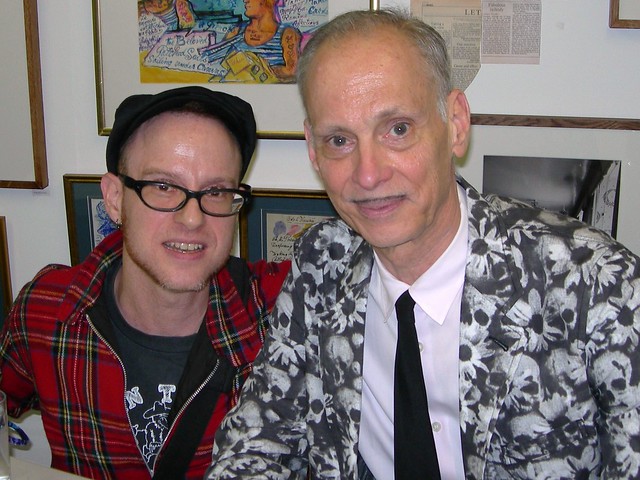
/ Brutal close-up of John Waters and I at the launch party for Role Models at the Comme des Garcons boutique on Dover Street in London. December 2010. Photo by Damon Wise /
Q: You were famously
called “The Pope of Trash” by William S Burroughs. Has that been hard to live
up to?
JW: I think he said it with humour. Coming from William S
Burroughs it was like being anointed by Christ or something! I was thrilled.
It’s fine. I've been called lots of different things, but all in the right
spirit. I was honoured to be called that. I don’t have a pope hat or anything!
I don’t have a throne. I don’t sit in my electric chair from Female Trouble with a pope outfit on,
ordering peoples’ deaths, who didn’t have bad enough taste!
Q: Your book is about role models and the idea of being
inspired by someone. There’s a thin line between being inspired and being
corrupted!
JW: That’s true. I mean, corrupted? Do you mean that in a
good way or a bad way? It depends on how you’re using that word: Leslie Van
Houten was corrupted in a bad way by Charles Manson. I think I was corrupted in
a good way by reading Tennessee Williams. It depends on how you’re using that
word and the results – they’re very important! Like if it inspires you to keep
going and gives you the courage to continue. Nobody said my films were any good
for the first ten years – nobody. In the beginning nobody is going to like you
– that’s what happens a lot. Or the opposite, like Johnny Mathis where from the
beginning he was a huge international success. God knows, read any movie star
biography how that ruins people too.
Q: You write very eloquently in Role Models about finding solace in the work of Tennessee Williams
at the age of twelve.
JW: He’s still good – I still think he’s a really good
writer. The plays will last forever. And I never met him and that’s fine – you
don’t have to meet him.
Q: He was like your gateway into another world.
JW: Because he knew about bohemia. My parents didn't know
about that world, and they certainly didn't want me to go there as a kid. Later
they realised that is the only place I could have survived so they bravely and
tenderly led me there even though they were horrified by it. It took me a long
time to realise what a loving thing it was they did.
/ Carroll Baker in Baby Doll (1956): The kind of tantalising and perverse "forbidden film" that flamed the young John Waters' imagination as a kid /
Q: I love the idea that it was the nuns at your Catholic
Sunday school warning you against seeing sinful “forbidden” films like And God Created Woman and Baby Doll that made you want to be
filmmaker (he deliberately saw every
condemned film he could). They unintentionally set you on your path.
JW: When I think back on it, how could I have seen those
films? I was 8 years old! They maybe played in one theatre downtown. I certainly
didn’t go downtown at 8 years old alone, and my parents certainly didn’t take
me! So I started cutting out the ads and keeping a scrapbook and pretending I
owned a dirty movie theatre – that was part of my fantasy as a child.
Later there was a theatre I wanted to own called The Rex
that started out as an art theatre and failed miserably. So (the owner) took
the Ingmar Bergman film Monika (1953)
and edited out all the dialogue except the topless scenes, and called it The Sins of Monika! And then he turned
it into a “nudie” theatre, but this was way before porn so this was nudist camp
movies. He had a huge influence on me, and I pretended I was him. And then way
later, about ten years ago, I located him. He was in a nursing home and I went
to visit him. He took out all his old scrapbooks and told me great tales. His
scrapbooks had some of the same ads I had cut out! He fought the censor board,
and told me great stories. I was very glad to meet the owner of The Rex, who I
wanted to be as a child! Who started out with lofty intentions and ended up
fighting censorship – and losing, actually.
Q: Well, losing but paving the way for later generations.
JW: Exactly, yeah.
Q: That’s perfect because I was just about to say the key to
your particular sensibility is that you’re equally inspired by the drive-in B-movies and exploitation trash
(Russ Meyer, William Castle, Herschell Gordon Lewis) as you are by, say, the
underground films of Kenneth Anger and Andy Warhol.
JW: And by art movies. That was the weird thing,
because it was all three of those things put together – art cinema, underground
movies and exploitation movies -- and trying to do a satire with them. The
European art films won the censorship wars, because they were “artistic”. The nudist camp movies, nobody wrote about but
they were so funny. The underground movies would get busted. So it was all
three of those influences, which was usually three very specialised areas that
had their own audiences – nobody liked all three. No publication except Variety
would review all three. And that’s why I subscribed to Variety
magazine when I was so young. They covered exploitation and sexploitation films
and they wrote about the business and ad campaigns and the censorship fights.
Q: You've said another key influence on your
filmmaking approach was the cheap “Visit Our Concession Stand” ads that would
show before the main feature.
JW: That certainly was, that was at the
drive-in! I used to go to the drive-in a lot because that was one of the only
places in those days you could go to get away from your parents! We went to the
drive-in every night – sometimes the same movie played all week – we weren't
even watching the movie, we were drinking and partying. But yeah those ads were
so tawdry! And now at hipster art theatres they find those old trailers and
show ‘em. I don’t know about here, but at The Charles, the best art theatre in
Baltimore, they’ll show an old trailer like that. “Visit our concession stand”,
with close-ups of some hideous meatball sandwich!
Q: As a child you’d even stand on a hill and
try to watch Herschell Gordon Lewis films being shown at the drive-in...
JW: Well, I tried that. I think I remember
seeing The
Mole People (1956) (that way). My parents wouldn't
let me go to the drive-in – my parents never went to the drive-in. There was a
drive-in kind of near my family home if you went up to the top of this hill
where they were building The Delaware, this big road, and dangerously beyond
this big trestle, you could see the drive-in screen. I would go up there with
binoculars. Of course I couldn't hear anything! And you could barely see (the
screen). It was ridiculous but I felt, Wow! Forbidden drive-in! I love that I
would go that far.
/ Rockabilly rebel: dangerous young Elvis /
Q: As a child of the 1950s you've written about the impact
when rock’n’roll burst. In Role Models
you write about Little Richard, but in the past you've mentioned seeing Elvis
Presley on TV on The Louisiana
Hayride.
JW: I wish I’d
seen that – I think they only showed The Louisiana
Hayride in the South. I saw Elvis for the first time on Ed Sullivan, when
they wouldn't show him from the waist down. When I first saw Elvis, it did change my life. If you look at those
early films, he was like an alien – you can’t imagine in the 50s how horrifying
he was to people. People have this idea
now that the 50s must have been great, like Happy
Days. It was horrible – everybody had to be like everybody else. It was the
most conformist – that’s why rock’n’roll happened: this explosion of rebellion,
which certainly did influence me heavily. My parents were uptight – all parents were uptight about rock’n’roll,
that’s why it worked! All music should get on your parents’ nerves, even now if
you have very cool parents. Whatever the next music is gonna be, they should
hate or it doesn't work.

/ Georgia Peach / Bronze Liberace: Little Richard at the height of his beauty /
Q: I love the story about you shoplifting the Little Richard
record when you were eleven and sneaking it onto your grandmother’s stereo and
the horrified reaction.
JW: My grandmother heard it – what the hell is that? “Lucille!” I've seen on a website
they've found the footage of him singing “Lucille” from really early. He is as
shocking as Elvis. I didn't know he was gay – but he is beyond gay! He is another alien – a rock’n’roll alien. That’s why
those two to me were so liberating to see at the time, and I still, when I see
old shots of them, marvel -- they look shocking now! Imagine then: how parents,
when they saw that, were just so bewildered and frightened, which is funny.
/ Hair hopping teenage bad girls in Female Trouble (1974): Dawn (Divine), Chiclet (Susan Walsh) and Concetta (Cookie Mueller) /
Q: Connected to that was your fascination with your juvenile
delinquent classmates. You come from a good home, but from early on you were
inspired by trashy people.
JW: But I went to a very fancy private school where they
didn't have juvenile delinquents, I promise you. They did when I went to junior
high, which in America is seventh and eighth grade. So I went to
public school, but I know it’s reversed here – public school is the regular (school).
And there I did see trashy girls, which Female
Trouble is basically about: the girls that look like that. And there was a
girl named Mary Jane I remember, and she would beat up other girls. And I never
talked to her ever, but she knew I was her fan and I would just watch her. She was a violent, lunatic
girl who beat up the head of the student council the day she got voted in. She
was really scary! But somehow (struggling
to explain Mary Jane’s allure) – I’m not a violent person and it’s not like
I was for her violence. She seemed much older – she might have failed
a lot of times. She was really a hillbilly. She wore those real pointy bullet
bras like Mamie Van Doren. She was ugly. I don’t think she had any friends –
not even other bad girls. They had to have special counsellors for her. And
I've always wondered what happened to her, but I've never published her last
name because she’s not a public figure.

/ Chiclet (Susan Walsh) and Concetta (Cookie Mueller) in Female Trouble /
Q: That’s what great about reading Role Models: you get a sense of how real-life Baltimore characters
you knew years ago like Mary Jane, Pencil and Lady Zorro really feed into your
films so much.
JW: Yeah they do end up (in the films). When you’re young
you see things that are so outside how you’re raised, which they certainly
were. And they were so defiant against society. Even though Pencil I never
really ever met. And to find Pencil – well, I found out he was dead. I saw him
on the bus once ten years ago – great, a lead! Pencil’s life was horrible, he
got beat up all the time but he still had
to be like that. Was that foolhardy or bravery? I guess he was a fashion soldier
in a way. Later in life he just looked
like a normal nelly gay man but then (in his teens) he looked very scary,
because he wasn't in drag. He was
real skinny – his name was Pencil because of his weight; he hated the name. But
he was real skinny; he wore skinny black girls’ jeans, girls’ tennis shoes with
no laces, and an angel blouse which is exactly what Ricki Lake wears in Hairspray. And his own hair in a
beehive, but it was man’s hair -- you could tell that when he went home he
combed it out, because he lived with his parents; he’d come out with all these
bobby pins holding (his beehive) up. And he’d walk up and down the main street
– not the nice streets, but the streets that the trucks went by -- screaming,“Aaaah!”and waving. People would beat the shit out of him. It was
I guess masochistical fashion behaviour! But he was driven to do that. I used
to see him and I was shocked as a kid, coming in from middle-class suburbia.
Wow, look at that! He used to hang out with his friend Cleopatra, who just
looked like a big man but wore Cleopatra eye make-up. There would be these band
concerts where all the old ladies went, and they would go to those just to
horrify everyone. I used to go to those band concerts just to see their
entrance. It was very John Rechy, very City
of Night!
Q: The 1950s were a repressive time, but it gave you
something to rebel against. Subsequent generations don’t have as much to lash
out against.
JW: I’m not so sure. There’s always going to be kids who are
going to rebel. I see them all the time when I go to colleges. But there is no
movement right now because of the computer, and that is the most important
thing that’s happening in their lifetime. It’s changed life forever. But it has
not produced fashion. Unless nerd – techie nerd, it is a look. In the gay world
it used to be called “chicken”, now it’s called “twink.” Isn't that a bit of a
nerdy chicken, is a twink? I don’t know, it’s complicated shading. But that’s why,
because I think everybody is rebelling on the computer. And it’s working – look
at this big leak! (WikiLeaks). They used to talk about the Pentagon Papers when
I was younger. It was nothing compared to that!
/ Divine as Babs Johnson (the Filthiest Woman Alive) in Pink Flamingos (1972) /
Q: In your films it’s the “badly-behaved people” who are
truly liberated.
JW: Well, they’re badly behaved but for reasons sometimes.
And sometimes they really aren't bothering others – sometimes they’re attacked
by jealous people or people who don’t understand them. But even in Pink Flamingos, Divine is living with
her family in a trailer writing her memoirs and is attacked, so she fights
back. And the people I write about in the book: I mean, Zorro was a terrible
mother but I didn't know that when I first was interested in finding her
daughter. But now her daughter is giving the book to people who knew nothing
about it, so she’s out of the Zorro closet about her mother. It’s quite a story
– it’s a harrowing story! But she
turned out alright. I mean, the police would have taken her away from her mother
if they knew she was driving a Lincoln Continental when she was 9-years old to
pick her mother up from the bar! But she had a story. In one of my movies, it
would have been funny. In real life it isn't funny. So if my movies were real,
I wouldn't want to live in them! But that’s a big, big difference, is when it’s
on the screen.
Q: It must be rewarding to know that your
early films like Pink
Flamingos (1972) and Female Trouble
(1974) haven’t lost their capacity to startle.
JW: Yeah, they didn't get nicer!
The only thing in Pink
Flamingos that I think has dated is that
lesbians have children – that was supposed to be shocking, that lesbians were
buying children. And now I know
lesbians who've bought children! And it’s perfectly normal. Of course they
didn't get the babies from a kidnapper who’d kept them in a cellar. That’s
probably the only thing that then was thought of as shocking,
lesbians having children. Now it’s shocking when they don’t!
/ Divine laughing maniacally in
Pink Flamingos (1972) /
/ The conniving Connie and Raymond Marble (as portrayed by Mink Stole and David Lochary) in
Pink Flamingos /
Q: It’s interesting how the style and content
of your early films anticipated punk by just a few years.
JW: They did that and I didn't know it
either, because my films were made for angry hippies who were
punks, they just didn't know it yet. And they were Yippies: political hippies.
They weren't the Weathermen, they were humorous terrorists who used humour to
humiliate their enemies – which I think is a very good way to frighten. My audience was always minorities who didn't
fit into their own minorities. Pink Flamingos’ audience was hippies and
bikers. It wasn't just a gay audience at all: it was angry hippies, biker types
and pissed-off hippies who became punks. But yeah: Pink Flamingos
was a punk rock film. First of all, blue hair, red hair: no one had that. And
you couldn't buy dye like that then. (David Lochary and Mink Stole) had to strip their hair
and then dye it. David used blue magic marker and Mink used ink, like for
fountain pens. And Divine’s hair was dyed with food colouring. They couldn't
leave the house like that: people would attack them on the street! They were
really brave; they had to stay in their house except when they were filming.
But then those became punk rock colours – but I don’t think other people dyed
their pubic hair those colours! But now people don’t have pubic hair anymore.
That’s a trend that’s alarming – young people don’t have pubic hair. So I guess
they don’t get crabs anymore! People don’t get crabs anymore. When I was young
we used to get A-200 (to
cure crabs) but now you never hear about
crabs anymore – you hear about bed bugs! They’re everywhere in America.

/ Pretty, pretty? Divine as Dawn Davenport in Female Trouble (1974) /
Q: Another motivation to have had made those
films must have been just to document the incredible charisma of your friends,
who became your stable of stars: Divine, Mink Stole, Mary Vivien Pearce, Cookie
Mueller, David Lochary and especially Edith Massey.
JW: Yes but Divine was completely not like
that in real life – that was a character. He didn't go in drag; he didn't live
like Divine. He was not violent. He was a gentle man. He was a pothead,
basically. He liked to throw parties. He had a lot of success in London – he
lived in London, that’s where his music career was. But then he was not like
Edna (in Hairspray)
either; he wasn't a hillbilly housewife. They weren't like that in real life. I remember Mary Vivian Pearce who played
Cotton (in Pink
Flamingos),
at the time she worked at a racetrack. Mink certainly wasn't a religious whore!
None of them were really like that. Even Edith – Edith had a thrift shop. She certainly
didn't sit in a playpen eating eggs! It was all imagination. Yes, no actors sent
in head shots.
No agents called saying we've got someone we’d like you to put in it. Except my
friend Bob Adams who owned the farm where we filmed it, he owned the property,
knew the guy with the singing asshole. So I guess he was his “agent!” (Pink Flamingos)
was filmed like a political act, but it was totally fictitious – it was in no
way “documentary”. But people really did believe that at the time: they were
really scared of us. They thought we lived in a trailer, ate shit, killed
people. They did, actually! It was amazing. People used to say to me, “So do
you still live up in the trailer?” First of all, didn't you see that it burned
down? But they said that seriously: they thought that I lived up there with
Divine.

/ The cast of Female Trouble (1974): Mink Stole (Taffy), Mary Vivian Pearce (Donna Dasher), David Lochary (Donald Dasher), Divine (Dawn Davenport) and Edith Massey (Aunt Ida) /
Q: One of the things that characterises your
films, especially the early ones, is the perfectly judged bad acting. It’s probably
harder to capture than it looks!
JW: I did encourage them to. And that was the
bad Russ Meyer / Tura Satana influence, is to scream: everyone screams!
And I look back at it now, and it is bad acting and it’s my fault because I
directed them that way. And I don’t direct that way now: I tell them to
downplay. Especially with anybody like Mink, who’s worked with me from those
periods. But Mink was always a really good actress. She usually played the
villain and was usually against Divine, and Divine usually won. But I guess
that added to the Theatre of the Ridiculous, the Artaud, and all that stuff I
read. That confrontation – it’s relentless. You watch Desperate Living
and it’s all this turning and shouting, which I would never do today. But I
guess that was just part of the style that didn't seem to hurt at the time. It
was not ever purposeful bad acting, but I did encourage them to overact and to
say it as if they believed every word of it. And I still do that. Even with
Kathleen Turner, I’d say “Don’t ever wink to the camera.”
Q: No one swears with such venom as Divine.
JW: And Mink’s pretty good at cussing!
/ Mink Stole as Connie Marble in Pink Flamingos (1972) /
Q: No drama teacher in the world could teach
someone to act like Edith Massey.

/ Edith Massey as Mama Edie in Pink Flamingos (1972) /
JW: I always said she was an outsider
comedienne. She could drive the other actors crazy because she really had a
hard time memorising lines. In my earlier movies there was only one take – you
had to do three pages of dialogue and if there was one mistake you had to do
the whole thing over, there was no cut-aways, there was no coverage. It worked
with Edie but usually someone in real life who’s a “character”, it doesn't work
– they can only be themselves and they get upset, they get uptight when the
camera is on them. Edith was a special case, but she was an outsider actress.
She was never quite sure why people liked her so much, but she was in on it. She
wasn't retarded. Some people thought I took advantage of her – I disagree with
that because it made her life better. She toured, she opened her shop because
fans came in all the time, she sold them clothes. Edie wasn't quite sure why it
worked, but she was in on it. I mean, she hated that black leather outfit from Female Trouble,
but later she had to get another one made because everyone wanted her to wear
it and it didn't fit anymore.
Q: But she must have been a tough cookie as
well.
JW: She wasn't a tough cookie. She was very
vulnerable.
Q: But she had a tough life.
JW: She had a tough life. She said to me
once, “I wouldn't have minded if I’d gone to jail. I think that would be a nice
place to retire.” And she wasn't kidding. They would take care of her. Wow,
Edie – aim higher! But she was
in jail – she wasn't someone you’d ever imagine had been in jail, because if
there was ever a person without a mean bone in her body, it was Edith. Except
when she drank: then she’d turn completely and get mean: “I hate eggs!”
I only saw her drunk a couple of times. She knew it wasn't a good idea.
/ Two shots of Edith Massey as Aunt Ida in Female Trouble (1974) /
Q: You've said the morality behind all of your films is
“Mind your own business.”
JW: It is. It’s the politics of it, I think: Don’t just
instantly judge somebody because you don’t really know what’s going to happen.
You don’t know what caused it, what the back-story is. And there’s plenty of
back-story. Don’t be so sure it couldn’t happen to you. Like with Leslie (Van
Houten). Your kid never met Charles Manson. Those kids were not The Village of the Damned. They became that. Cults are a scary thing.
And they’re all the same. The People’s Temple, David Koresh: the isolation, a
leader, the end of the world. It’s all the same all that stuff. Don’t be so
sure. I know when I taught in prisons I met the families – it could happen to your kid. Don’t be judging others,
because it could happen to you –
really! Lots could happen.
/ Divine in perhaps his greatest role, as Dawn Davenport in Female Trouble (1974) /
Q: I remember you saying in Vanity Fair years ago that all your films are about families --
they may be grotesque and dysfunctional, but it’s still about families.
JW: I think people, how they behave with their family is
interesting. And no matter what your parents are like, you’re affected by it.
You become them, you become a different version of them, you become an
anti-version of them. And everybody knows how stressful it can be being with
their family. I think humour is often based on imagining the worst that can
happen: it can be funny, but you don’t want that to happen in real life. And family can be the ultimate support and
very, very important. You don’t get to pick your kids and you don’t get to pick
your parents. There’s a truce that has to happen, and that takes maturity on
both sides to make that happen. And if you’re lucky that comes a little later in
life, if you didn't have it in the beginning.
/ Divine in Female Trouble (1974) /
Q: You've never made a film outside of Baltimore and you've
said you never will.
JW: I would if had to, and I might have to because
Maryland’s not giving the incentives back right now for filmmaking like
Michigan and other places like that are. But I still couldn't get Fruitcake made. If I had to go somewhere
else now I would. I could – it would
still say “directed by”, I’d get to say “Cut!” and “Action!” But usually I
write it for specific neighbourhoods. Like Pecker
(1998) was written for that
neighbourhood. I could make it somewhere else, but I hope I don’t have to.
Q: It’s reassuring to read in the book that the parts of
Baltimore recognisable from your films are still there, if you search for them.
It hasn't been too gentrified.
JW: Yeah, you have to look. Some of them have been
gentrified, but it’s good that parts of it have
been gentrified because if it wasn't the whole neighbourhood would have closed.
It would just be torn down or burned down! In Baltimore way more than any other
city you always have to find those little places that only a native, someone
who really lives there, knows about. But even in Baltimore some nights you go
out and it’s great and some nights it’s terrible. It just depends. It’s
hit-and-miss. But it is definitely still there.
Q: And Baltimore is still inspiring you.
JW: Yes, it does. Really, when I need ideas, I go home. I
always find something.
Q: Are there any of your films you feel is under-appreciated
or in need of reappraisal?
JW: All of them to me are the same. To me, Hairspray (1988), A Dirty Shame (2004), Cecil B
Demented (2000) – they’re all
exactly the same to me. I don’t get why one does better than the other. Even
though I guess in hindsight ... but they’re all the same. If you've never seen
one of my movies, pick the boxed set, close your eyes, pick one, and you’ll get
what I’m about. When they ask me to pick ones when I’m making an appearance,
I’ll always pick ones that maybe you didn't see. I never pick Hairspray or Pink Flamingos because they’re easily available. I always pick
maybe Desperate Living (1977) and a
later one like Cecil B Demented. But
they’re all easy to see, at least in America. They’re all available on DVD -- like
paperback books are, like a back list.
Q: Well, not Mondo
Trasho (1969).
JW: No, that’s because of music rights. That’ll never be on DVD. It’s 90-minutes of
music that we never paid for! To buy that music now it would cost $10 million
for a movie that cost $2000! Even though I stop the pirate versions of Mondo Trasho every day on eBay, that’s
the only way you’re going to see that one.
/
Mondo Trasho (1969) sometimes crops up in its entirety on Youtube and then gets yanked back down again. At the moment there are just fragments, like this truly wonderful scene /
/ Divine as Lady Divine in Multiple Maniacs (1970): proprietress of the carnival sideshow The Cavalcade of Perversion, serial killer and cannibal /
Q: And what about Multiple
Maniacs (1970)?
JW: That’s out of release because of four songs that are not
paid for, too. A UK company was going to release it, but now the DVD business
is so terrible ... Because we’d have to pay for four new songs to put in. Which
I could easily do, it wouldn't make any difference because they’re instrumental
rockabilly songs – not like “How Much is That Doggy in the Window” in Pink Flamingos, a signature song. But I
don’t know if that’s going to happen now because the DVD business is completely
black everywhere. With the recession the first thing people noticed was, “Wait
a minute, I have twenty DVDs still in plastic! I haven’t watched ‘em!” It was
the first thing they stopped buying. Except for TV series boxed sets. The way
things are going, soon you won’t even need DVDs – you’ll be watching them on
your computer.
/ The full version of Multiple Maniacs is currently on Youtube and is a must-see: it represents early, embryonic John Waters in the raw, with great performances from Divine and Mink Stole -- and featuring the screen debut of Edith Massey /
Q: Speaking of music, your films are characterised by
wonderful soundtracks: rockabilly, twang-y surf instrumentals, 1950s rhythm
and blues.
JW: I've used everybody from Little Richard to The Locust to
Country & Western music. My favourite to use is vintage novelty – that’s
what I like best! I love all that stuff. It’s all from my own record collection
– I've plucked that clean through the years! The music is very important when
I’m writing the script. I use it as a narrator. It’s telling the story, too.
The words and music are advancing the narrative.
/ Denizens of Mortville in
Desperate Living (1977). L-R: Grizelda Brown (Jean Hill), Peggy Gravel (Mink Stole) and Mole McHenry (Susan Lowe) /
/ Peggy Gravel (Mink Stole) being tormented by Liz Renay's boobs in
Desperate Living (1977) /
Q: You told Bruce La Bruce that Desperate Living is “the worst of all my films. And it’s the
grimmest!”
JW: It did the
worst. It’s the only one of my films to never get a TV deal anywhere. Pink Flamingos is shown uncut on the
Sundance channel in America a lot, which I’m
shocked by and if Pink Flamingos can,
Desperate Living can – Pink Flamingos has blow jobs! Divine was
supposed to play Mole, which would have been Divine as a butch lesbian. But
Divine was doing this play and couldn't. So thank God for Susan Lowe who was
not a lesbian, who was a straight woman who completely shaved her head (for the
role) and got turned into that: her children were sobbing, her boyfriend broke
up with her. It ruined her life during that period – sometimes you have to
really suffer to be in my films! It does have an audience now. It did the worst
financially when it came out. Variety called it “amateur night on the
psycho ward”, it was really dismissed. Looking back at it now, out of all of my
movies it was the least commercial. And screaming constantly in that movie! But
I don’t dislike it. Some people like it best!

/ The glorious cast of Desperate Living: Susan Lowe (Mole McHenry), Liz Renay (Muffy St Jacques), Jean Hill (Grizelda Brown) and Mink Stole (Peggy Gravel) /
Q: That first twenty minutes or so, of Mink Stole having a
nervous breakdown in her bedroom. That’s just brilliant.
JW: What’s weird is that was my mother’s house! That’s my
parents’ bedroom!
/ The performance of a life time: Mink Stole on majestic form as Peggy Gravel in Desperate Living (1977) /
Q: Your early work is more violent and has a nihilistic angry
edge. I get the impression you worked out some issues making your films as they
became less violent as time went on. True?
JW: Well who wants to be an angry 64-year old? But A Dirty Shame, though – is that angry? I
guess not, but it had more censorship problems practically than Pink Flamingos because of the Motion Picture
Association of America. If you look at why I got an NC-17 rating for that
movie, it’s still ridiculous to me. You
look at Jackass, at Black Swan: they got an R. And I think
they deserved an R, but I did too! ‘Cause there’s no sex in that movie – you
don’t even see sex. I asked, “What
can I cut?” And they said, “We stopped taking notes”. Liberal censors are the
scariest. London has them too. They said about Pink Flamingos, “We don’t know how to deal with intentional bad
taste.” Liberal censors are scary because they make sense. There’s another side
to that argument which you never get to say. A dumb censor just says, “We can’t
have this!” and it’s a joke and everybody laughs and they help your movie – and they lose. Liberal censors win!
Q: But did you work out some of your issues from making
those earlier angrier films?
JW: Certainly. As you get older you should get less angry. When you’re 20 you can be a drunk, you can
be a drug addict and you can still be cute and funny and pissed-off. But at 64
to be angry and a drug addict? I don’t know too many 64-year old drug addicts,
but the few I know are no fun to be around, I promise you! I’m not saying I’m
not interested in angry people, and I’m certainly not saying I’m a mellow
person but I’m a fairly happy person. I don’t think I was ever that unhappy. Maybe
when I was young and figuring stuff out I was pretty nutty. I did a lot of
drugs but nothing bad ever happened to me. I was never drug addict, never an
alcoholic – I was a cigarette addict.
Q: And you kicked that.
JW: Yeah. But I figured my life out how it works for me to
live. I’m not saying everybody should live the life I live. I live in four
cities. Most people would hate that. I like
it ‘cause I have four different lives. I live alone. And I’m quite happy to
live alone. Not everybody would want to live their life the way I do, but I
don’t expect people to. So I think each person has to figure out their own
happiness, their neuroses, their strong points, put them all together – because
you’re never going to change that much – and figure out how to live so they’re
not doing self-destructive things.
Q: At the end of Role
Models in the acknowledgements you describe your readership as “healthy,
happily damaged readers.”
JW: I think they are! A happy neurotic: it’s a concept
that’s palpable. They realise maybe we’re never going to fit in, but then we
don’t want to. But now everybody
wants to not fit in. It’s no longer a badge of honour to be a misfit. It’s
almost required in any business to do something “outside of the box” or “edgy”.
They always say they want “edgy”, until you give it to them! That’s what I've
learned! But I think my career’s been understood. I've been doing this for a
long time. And I've got a lot of different careers. I can tell a story in a
book, or I could make a movie. Or maybe I couldn't make a movie right now. I couldn't get it funded because the last one didn't
make money (2004’s A Dirty Shame remains Waters’ last film to date). And
that’s how long they think back in any business today, even in books. You don’t
get a career view; you get the last thing you did. And that’s why in Hollywood
now they just want you to sign up someone who was in a hit movie with young
people within the last 6 months. If Katherine Hepburn came back to life and
climbed out of the grave in a resurrection, she couldn't get a job! You could
try to explain who she was, they’d still say no. Or let’s just say Elizabeth
Taylor – they would never go for that. It’s a very, very different market place.
I recognise that. I’m not whining about it. It should be.
/ Trailer for A Dirty Shame (2004) /
Q: You've touched on something in there, about how much you've diversified over the years. Not just films, but books, teaching in prison...
JW: I haven’t done that too much lately, but I've counselled
people from prison my lawyer has sent me to talk to. I have a visual art
career. I've curated things. I have two different spoken word careers: I have a
Christmas show and a “This Filthy World” show.
Q: You've acted in other peoples’ films.
JW: I've been in The
Simpsons. I've been in a Woody Allen movie (Sweet and Lowdown, 1999), I was in a Herschell Gordon Lewis movie (Blood Feast 2: All U Can Eat, 2002). I
was in Danielle Steel’s Family Album (1994)
– there’s one you won’t know about! I did a TV show for an entire year; it was
called Love You to Death (2006-2007).
It was on Court TV, which is now True TV. I played the “Groom Reaper”. I did a whole season of that, it was shot in
Canada. I was in one of the Chucky films, Seed
of Chucky! (2004). I act once in a while. I don’t seek it out. I don’t read! Although I did read for a Cadillac
commercial last week that I wanted to get, but I didn't get.
/ Zap! Waters' guest appearance in the memorable 1997 Simpsons episode "Homer's Phobia" /
So I always think there are new careers, and ways to take my
twisted brain! I teach first grade class sometimes, in a public school in
Baltimore. I've gone in four times.
Q: (Stunned at the
incongruity) Teaching little kids?
JW: Yeah. It was great. They were hanging off me. We make
little fake movies and we do improv. But yeah, I go in there – I mean, I’m appropriate! I don’t say inappropriate things. Well, I used to do that as a hobby – say inappropriate things to children,
but not damaging things! And I don’t want a kid, but I like kids and
kids generally like me – ‘cause I just treat ‘em like adults! I bring a little
camera, I bring a little clapstick, fake microphones and we pretend to make
films. There’s no film in the camera. We did one about a boy who couldn't stop
lying, a boy who flew who couldn't convince anybody, airplane crash – they love doing airplane crash. Red carpet –
they love red carpet! They pretend to
be Brad and Angelina, or Justin Bieber, who I’m on TV with tonight (they were both guests on The Graham
Norton Show).

/ I'm a Bad, Bad Girl: Susan Tyrrell as Ramona Rickettes and Traci Lords as Wanda Woodward in
Cry-Baby (1990). Tyrrell died last summer: read my obituary for her
here /
Q: For a while in the late 80s / early 90s when you made Hairspray (1988) and Cry-Baby (1990) back to back, it looked
you were on a one-man mission to revive the musical in a really interesting way.
JW: When you think about it,
Cry-Baby was a musical –
Hairspray
was a dance movie. There were no original songs in it, except Rachel Sweet
doing the
Hairspray theme song. Yeah,
I was – but I did it and I’m not going to do another one. And plus
Cry-Baby didn’t really work at the time.
But now it’s still probably seen more than any other movie I've ever made, including
Hairspray, because of television and
the whole world of Johnny Depp.
Q: I’m really into the rockabilly scene, and trust me that
film is beloved.
JW: Well, I love rockabilly. To me, I still like it. That’s
what Elvis was. The rockabilly thing – I remember they were really uptight when
I put the rebel flag behind things (in some scenes). But they do! That’s totally realistic -- but
touchy! And Amy Locane, there was one scene they were uncertain about but let
me keep in, where she drinks her tears! And then it became a musical too on
Broadway (in 2008), and I liked what they did. But it was not a success.
Q: I remember reading about that in The Village Voice. In a fairer world, Cry-Baby should be more famous than Grease. Grease is a
stupid movie!
JW: Well, but Grease came
first and it made John Travolta a star. I’m friends with the director (Randall Kleiser) and Allen Carr, the
lunatic producer of that movie. But that’s the thing; my movies always have
that irony and that edge in them. We’re doing
the genre but Grease isn't
parodying the genre, it is the genre.
So Cry-Baby is parodying Grease in a way, because Grease came first. But what I was really
parodying in Cry-Baby was Elvis
movies, and nobody got that because the big fans of Johnny Depp then were all teenage
girls. The big mystery was we had one test screening, the first one. As soon as
he came on the screen it was like an Elvis movie: every girl started screaming.
It never happened again, not at one screening ever again. And they realised
eventually that I was making fun of them. That’s why it didn't work,
commercially. Although in the long run it did work. It still plays all the
time.
Q: Is it still true the biggest budget you've ever worked
with was for Serial Mom (1994)?
JW: Yeah. $13 million.
Q: I thought it
would've been Cry-Baby because it looks
so luxurious.
JW: But it was also later, so it was just inflation. And to
be honest, Kathleen Turner got a lot – which she deserved. She got more than
Johnny Depp at the time. Because Kathleen Turner had been a star for a long
time and Johnny Depp, it was his first movie outside of his hit television
show, which he hated, 21 Jump Street
-- which I see they’re re-making as a movie now.
Q: So by now you've worked with both extremes – almost no
budget, low-budget and $13 million. What’s preferable? What are the pros and
cons?
JW: What I want to do now is make what I've been doing for
the past five films, is what used to be called moderately budgeted independent
movies, roughly $5 or $6 million dollars. Used to be, but not anymore. Now they
want movie stars, full unions, teamsters. There are no movies like that (being
made) anymore – that is eliminated, because of foreign sales. New Line, the
company I was always with, isn't there anymore. People say why don’t you go
back and do what you used to do? I've got four employees. I can’t afford to
take off two years for no money. I live in four places! I've got to have a pay
cheque! And I've done that: it would
be like faux rebel. I don’t want to go back and do a movie that cost $50
thousand on my cell phone. It wouldn't work.
Q: In an ideal world, what are the films you’d be making these
days?
JW: Fruitcake, the
film I've been trying to make for three years. I got a great development deal
with it, they liked it, they liked the script, they paid me and then they went
out of business when the recession happened. So I don’t know if that film will
ever get made. I’m not even actively trying right now, because everyone’s said
no. But that doesn't mean ... it’s still there.
Some success sparks other success. We’ll see. I think it’s a commercial movie –
it’s a children’s Christmas movie, but with an edge! It’d be PG-13, but I’d
like to push the limits of PG-13 for children! Johnny Knoxville was going to be
the father and Parker Posey was going to be the mother.
Q: How has the success of Hairspray the stage musical changed your life?
JW: It bought me an apartment in San Francisco. I made more
money out of that than any film I made in my life. And I learned so much about
a world I knew nothing about, the Broadway world. It was like going to graduate
school for three years. And it worked from the very beginning. I don’t ever
expect to get that again. Because nobody gets that: every single thing worked. And
I think they did a great job, because they re-invented my movie into a Broadway
musical. Then they re-invented that into a Hollywood movie, and it worked. It
has to change again – mutate!
Q: For the most part, I hate musicals...
JW: I do too! But that’s why Hairspray was a hit: even people who hated musicals liked it. And
I've seen it now with a skinny black girl as Tracy Turnblad – that is the most
shocking thing! I don’t know what to say – that really shocks me. She’d be
singing “Big, Blonde and Beautiful” and all the stuff about being overweight! I
thought it was great; it was almost like an art project. Change it around
completely. But that really shows how much it works. I've very rarely seen it
with bad actors, but it still works even if they are.
Q: People who discover you through Hairspray, do you think they work their way backwards and track
down your earlier work?
JW: Well, that causes trouble. Like friends of my parents
say, oh we loved Hairspray, so then
they rent Pink Flamingos and they’re
horrified, which gives me a certain perverse chuckle. It depends which one they
pick. All of them, even Cry-Baby,
would be less “friendly”.
/ Elizabeth Taylor and Richard Burton in the awesomely terrible but compelling
Boom! (1968), one of Waters' most cherished films. Read my analysis of the film
here /
Q: Tell me what happened when you met Elizabeth Taylor at a
party and you told her your favourite films of her was Boom! (1968’s Boom! was a Tennessee Williams adaptation and
mega-flop starring Taylor and Richard Burton, which Waters celebrates as an
ultra campy “failed art movie”).
JW: And she was mad,
at first! She said, “That’s a terrible
movie!” She thought I was making fun of her. Then she got nicer when I told her
I really liked it, I toured festivals
with it, I liked Joseph Losey. I think it was the first thing I said to her,
and it caught her off guard. But then she was nice. I only met her once, and I
was there because of her staff. I don’t know if she knew who I was – I’m not sure
they told her! At that party I was nobody. I mean, Johnny Depp was there, Tab
Hunter, Jennifer Jones, Gregory Peck. It was amazing. And it was the day after
Princess Diana died. She didn't cancel the party. She didn't care, she partied
anyway! But it was like Apocalypse Now,
because there were helicopters overhead (with
paparazzi) and they got all the pictures. I had to cover my bald spot
because they were shooting down. It was great – it was like a party at Divine’s
house! She had hot dogs!
Q: You've described yourself as a“filth elder.” Define that.
JW: A filth elder is a role model. I’m trying to be humble
and not to say I’m someone’s role model because I don’t want to sound
conceited! I think I am, and I’m proud to be that, but it sounds too grandiose
for me. I've learned a long time ago to
be humble – it works better. So to say that I’m a filth elder, I’m trying to
guide you in your neuroses in a good way, so that it works for you and you can
have a happy life. I’m a self-help person!
Postscript: Reunion with the Prince of Puke! I got to meet up with Waters again when he returned to London in May 2011 to launch the paperback edition of
Role Models. Read about it
here. Photo below by Damon Wise
Bonus extra material: Read about
John Waters' reflections on the time he met Nico (our mutual favourite singer)