It’s been suggested that – while Fontaine’s bar is temporarily shuttered due to the coronavirus scourge and the world is socially-isolating itself – the Lobotomy Room film club (specializing in the cult, the kitsch and the queer!) could continue online for the time being. I’ll be occasionally posting fun oddities and obscurities that are viewable on YouTube for your delectation. Remember: Lobotomy Room is the home of Bad Movies We Love (our motto: Bad Movies for Bad People) so watch at your own risk!

There’s putrid trash … and then there’s Sins of Rachel (1972). Tagline: “Oh Rachel, my love, the lives you shatter … if you should die, would it really matter?” Brief synopsis: in an unnamed Los Angeles suburb, blowzy middle-aged cocktail lounge singer Rachel Waring is found brutally murdered in her home. Could it be because Rachel was about to write her salacious tell-all memoirs, blowing-open the town’s long-suppressed secrets? The intrepid police inspector interrogates various potential suspects (including her sensitive and sexually uncertain son, her parasitic younger lover and the local reverend) and in flashbacks we see their tortured relationships with the dead woman and their motivations for why they might have killed her.
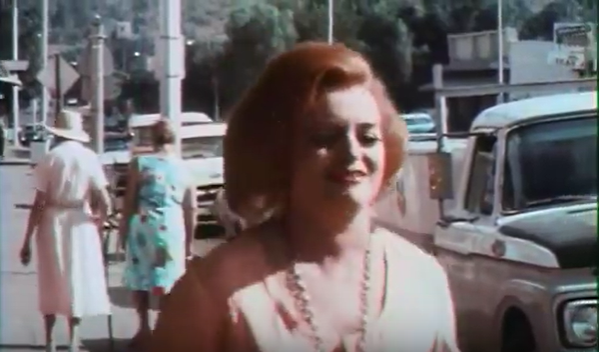
/ Our first glimpse of a carefree, fun-loving sensualist Rachel Waring in the film's "cold opening". Little does Rachel suspect she has a date ... with death! (Note: Sins of Rachel is so obscure there are no decent stills or photos online, so these are my own inexpert screen grabs) /
Filmed in a process called “Texturetone”
with the threadbare production values and grungy vibe of a seventies porn film, Sins
of Rachel is sometimes misrepresented as a gruesome horror movie (it could be
loosely categorized as “hagsploitation”, and there is one gory Herschell Gordon
Lewis-style close-up of the murder victim’s blood-drenched face, but the
special effects ain’t exactly convincing). Sins is truthfully more of an ultra-lurid,
heavy-breathing soap opera crossed with a crime who-done-it, all overlaid with
a frankly queer sensibility and an ineffable veneer of sleaze. In other words:
our kind of movie!


/ Above: the blood-drenched fate of Rachel Waring /


/ Above: the blood-drenched fate of Rachel Waring /

/ What was Texturetone? If Sins of Rachel is meant to be an example of the glories of Texturetone, no wonder it never caught on! Zenith Films was the same production company director Richard Fontaine used to release his earlier beefcake homo porn short movies like A Date with the Boys (1956), Days of Greek Gods (1954) and Hot Harem (1965) /

/ The emphasis on homoerotica already begins in Sins' opening credits with shots of Peter Thomas (Chase Cordell) moodily roaring down the freeway on his hog. The theme tune is a gorgeous adult contemporary ballad called "What Does a Bird Do?" by Jerry Kane. There is virtually no information on the song or the singer online, sadly /

The director Richard “Dick” Fontaine, an associate of Athletic Model Guild’s Bob Mizer, had an extensive background in the realm of mid-century beefcake homoerotica and Sins’ cast is “fleshed-out” with a lusciously buff selection of sinewy male actors who certainly look like escapees from a hardcore gay porn set of the period (think shaggy hair, mustaches, mutton chop sideburns). Clearly a connoisseur of firm male flesh, Fontaine finds copious opportunities for them to do things like strip down to their tighty whitie underwear, ride shirtless on motorcycles and exchange sexually-charged glances, and keeps his camera securely focused on their pert asses in tight pants. (No complaints here!). I own a DVD of Fontaine’s vintage homo physique work (Thirteen Apollo Films: 1954 – 1965) and he displays genuine flair and artistry in baby oil-and-posing-pouch territory. As a “regular” mainstream director, though, he’s catastrophically Edward D Wood Jr-level inept. (At one point, two characters exchange some crucial dialogue and Fontaine films them at length completely obscured by a fireplace in the foreground).

/ The framing I refer to above, worthy of Ed Wood or Doris Wishman - this is actually a key scene! /

/ Director Richard Fontaine's "queer eye" for sun-kissed male flesh (actor Bruce Campbell as Rachel's nubile son Jimmy Waring in The Sins of Rachel) /

/ An example of the beefcake / physique photography of Richard Fontaine. Model: Clark Hunter, circa 1968 /
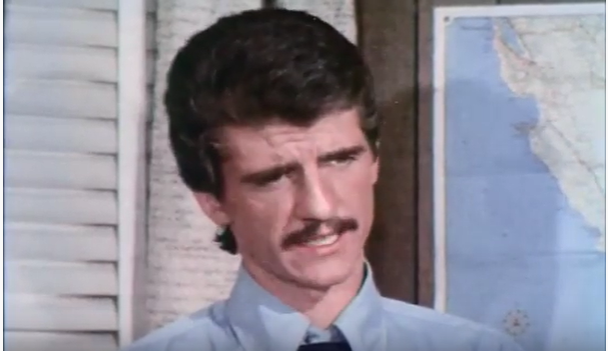
/ Detective Bruce Jennings, investing Rachel Waring's grisly murder. As far as I can discern, actor and mustached cutie Brett Marriott made only one further film after Sins - the intriguing Blood Orgy of The She-Devils in 1973 /
The suspects include:

/ Rachel's grasping lounge lizard toy boy lover Hank. Actor Jerome Scott had already collaborated with director Richard Fontaine and Ann Noble on the 1971 short film Threads of Man and went on to make just one further film appearance (as "Adult Film Director" in something called Drop Out (1973)). His nude scene is one of Sins' highlights /
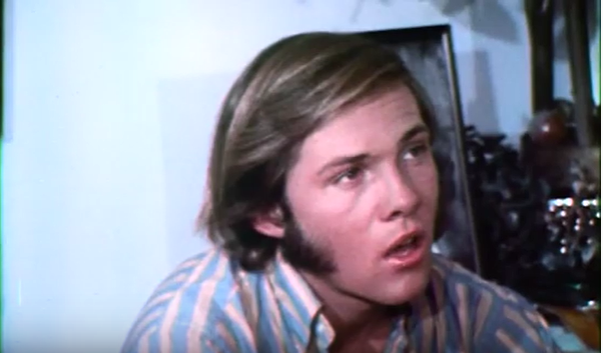
/ Rachel's sensitive, closeted gay son Jimmy Waring. Did Rachel's dysfunctional, borderline incestuous relationship with him push Jimmy over the edge?! Sins is the sole film appearance by Bruce Campbell. Cute as he is (those thick lush sideburns!), acting wasn't really his forte /

/ Patricia Rees as Jimmy's sexpot blonde girlfriend Shirley Taylor - who does not appreciate having to share him with his needy mother Rachel! According to IMDb, Rees may have gone on to make fleeting appearances on TV shows like Cagney & Lacey and Growing Pains in the eighties /

/ Swiftly to replace Shirley in Jimmy's affections - the ruggedly handsome and brooding Peter Thomas (I'm unsure why some characters are afforded surnames and others aren't?). We've already seen the enigmatic Peter driving his motorcycle over Sins' opening credits (sans shirt and helmet). Director Fontaine also seems to delight in showing Peter doing shirtless martial arts. The skimpy filmography of actor Chase Cordell (great name worthy of Henry Willson!) is sprinkled with titles like The Curse of a Faithful Wife (1972), November Children (1972) and Track of the Moon Beast (1976) /

/ Or could it be Chester Brown - the suave and urbane publisher of Rachel's sensational autobiography? (Actually, no - that makes no sense and the character has zero motivation). Making his film debut in Sins, durable actor Fred D Scott would proceed to have the most impressive acting career of anyone in the cast. His numerous acting credits on IMDb encompass blaxploitation cinema (Black Shampoo (1976)) and numerous television roles on everything from Sanford and Son, Roots, Knot's Landing and Murder She Wrote! /

/ And what's the deal with Reverend Taylor, father of Shirley ... who recoils in undisguised horror when Jimmy confides in him about his homosexuality? Reverend Taylor is (hammily) portrayed by actor Stephen Lester - who was Ann Noble's off-screen husband! More about him later on /

/ Jimmy halfheartedly attempting a facade of heterosexuality with Shirley /

/ Below: the scenes between Peter and Jimmy crackle with homoerotic tension /


/ The look of love /

An admission: I’ve become fixated on portly leading lady-of-a-certain age Ann Noble, who not only stars in the title role as the doomed Rachel, but wrote the screenplay (take that, Barbra Streisand!). For Noble, Sins was clearly a profound personal statement, a labour of love a and a cri de coeur. But who was this unsung Renaissance woman? What motivated her? Noble has no Wikipedia page and the information on her IMDb profile is sparse to say the least. (For example, it provides no birth and death dates for her. Noble is presumably long dead by now). She made only a handful of movie appearances in the early seventies when she appeared to be already in her fifties, all on the grubby outer fringes of reputable film-making: horror movie The Corpse Grinders (1971) (seemingly her debut), Threads of Man (1971) (a homoerotic short film also directed by Richard Fontaine, unavailable online), Sins of Rachel (1972) and two triple-x gay porn flicks, Hollywood Cowboy (1972) (in which her character is credited only as “Barfly”) and The Light from the Second Story Window (1973). After that – total silence. An outrageous and bizarre queer Valley of the Dolls-style exposé about the sheer hell of getting ahead in the cutthroat show business glamour jungle, The Light from the Second Story Window merits its own blog post (and will get one!). Billed as “Vicki Mills”, Noble’s performance in the secondary role of Alma is equal to her efforts in Sins (her opening line: “I’ve been waiting all night to get fucked!”) and let’s just say she seems convincingly intoxicated in her drunk scenes. (I haven’t explored Hollywood Cowboy yet).


/ Director Richard Fontaine's "queer eye" for sun-kissed male flesh (actor Bruce Campbell as Rachel's nubile son Jimmy Waring in The Sins of Rachel) /

/ An example of the beefcake / physique photography of Richard Fontaine. Model: Clark Hunter, circa 1968 /

/ Detective Bruce Jennings, investing Rachel Waring's grisly murder. As far as I can discern, actor and mustached cutie Brett Marriott made only one further film after Sins - the intriguing Blood Orgy of The She-Devils in 1973 /
The suspects include:


/ Rachel's sensitive, closeted gay son Jimmy Waring. Did Rachel's dysfunctional, borderline incestuous relationship with him push Jimmy over the edge?! Sins is the sole film appearance by Bruce Campbell. Cute as he is (those thick lush sideburns!), acting wasn't really his forte /

/ Patricia Rees as Jimmy's sexpot blonde girlfriend Shirley Taylor - who does not appreciate having to share him with his needy mother Rachel! According to IMDb, Rees may have gone on to make fleeting appearances on TV shows like Cagney & Lacey and Growing Pains in the eighties /

/ Swiftly to replace Shirley in Jimmy's affections - the ruggedly handsome and brooding Peter Thomas (I'm unsure why some characters are afforded surnames and others aren't?). We've already seen the enigmatic Peter driving his motorcycle over Sins' opening credits (sans shirt and helmet). Director Fontaine also seems to delight in showing Peter doing shirtless martial arts. The skimpy filmography of actor Chase Cordell (great name worthy of Henry Willson!) is sprinkled with titles like The Curse of a Faithful Wife (1972), November Children (1972) and Track of the Moon Beast (1976) /

/ Or could it be Chester Brown - the suave and urbane publisher of Rachel's sensational autobiography? (Actually, no - that makes no sense and the character has zero motivation). Making his film debut in Sins, durable actor Fred D Scott would proceed to have the most impressive acting career of anyone in the cast. His numerous acting credits on IMDb encompass blaxploitation cinema (Black Shampoo (1976)) and numerous television roles on everything from Sanford and Son, Roots, Knot's Landing and Murder She Wrote! /

/ And what's the deal with Reverend Taylor, father of Shirley ... who recoils in undisguised horror when Jimmy confides in him about his homosexuality? Reverend Taylor is (hammily) portrayed by actor Stephen Lester - who was Ann Noble's off-screen husband! More about him later on /
Full credit where it’s due: Sins of Rachel
is laudably positive about the erotic awakening of anguished mama’s boy Jimmy
and his eventual acceptance of his own homosexuality in the arms of his buddy
Peter. (This was, after all, the post-Stonewall era of gay liberation and Sins seems clear-eyed about who its intended audience is). Ann Noble was clearly an ally! Not that the word “gay” is ever uttered,
and Jimmy and Peter never kiss onscreen. (Seriously! I was shouting, “Kiss!
Kiss!” at the screen).
/ “I’m all mixed up inside!” The adorable Jimmy /

/ Jimmy halfheartedly attempting a facade of heterosexuality with Shirley /

/ Below: the scenes between Peter and Jimmy crackle with homoerotic tension /


/ The look of love /

An admission: I’ve become fixated on portly leading lady-of-a-certain age Ann Noble, who not only stars in the title role as the doomed Rachel, but wrote the screenplay (take that, Barbra Streisand!). For Noble, Sins was clearly a profound personal statement, a labour of love a and a cri de coeur. But who was this unsung Renaissance woman? What motivated her? Noble has no Wikipedia page and the information on her IMDb profile is sparse to say the least. (For example, it provides no birth and death dates for her. Noble is presumably long dead by now). She made only a handful of movie appearances in the early seventies when she appeared to be already in her fifties, all on the grubby outer fringes of reputable film-making: horror movie The Corpse Grinders (1971) (seemingly her debut), Threads of Man (1971) (a homoerotic short film also directed by Richard Fontaine, unavailable online), Sins of Rachel (1972) and two triple-x gay porn flicks, Hollywood Cowboy (1972) (in which her character is credited only as “Barfly”) and The Light from the Second Story Window (1973). After that – total silence. An outrageous and bizarre queer Valley of the Dolls-style exposé about the sheer hell of getting ahead in the cutthroat show business glamour jungle, The Light from the Second Story Window merits its own blog post (and will get one!). Billed as “Vicki Mills”, Noble’s performance in the secondary role of Alma is equal to her efforts in Sins (her opening line: “I’ve been waiting all night to get fucked!”) and let’s just say she seems convincingly intoxicated in her drunk scenes. (I haven’t explored Hollywood Cowboy yet).

From my own online sleuthing, I’ve deduced
that Noble originally hailed from Portsmouth here in the United Kingdom (hence
the unmistakable plummy British accent) and her “government name” was Mrs Irene
Philcox. (Ann Noble. Vicki Mills. Irene Philcox. She was a woman of many
aliases). A local newspaper article from
1972 headlined “Movie star came home to Portsmouth” documented a rare visit
home to see her parents, Mr and Mrs P Noble-Airy, as if Noble was a noteworthy local
dignitary (it must have been an extremely slow news day?). Presumably Noble fudged
the precise nature of her movie work, but the piece does mention Sins of
Rachel: “Miss Noble carried out promotional work, and made personal appearances
in connection with Sins of Rachel, an intriguing look at life, death, social
morality and love, which she wrote and starred in.” The article also mentions “for
the second successive year, she received a best-actress-of-the-year award in
Hollywood.” What could this weirdly non-specific award have been? I love how
they leave it vaguely unclear, as if it may well have been an Oscar! Also
name-dropped is Noble’s husband, Mr Lester Philcox “who was also in show
business.” His stage name was Stephen Lester – and he appeared onscreen opposite
Noble in The Corpse Grinders, Threads of Man, Sins of Rachel (he plays Reverend
Taylor), Hollywood Cowboy and The Light from the Second Story Window. So, the
duo was clearly the low-rent sexploitation equivalent of Laurence Olivier and
Vivien Leigh or Liz Taylor and Richard Burton. (One possible theory: Mr and Mrs
Philcox were financial investors in these shoe-string movies – on the condition
they also got to appear onscreen?).

/ Ann Noble (or should that be "Irene Philcox"?) en famille. At left is her husband, Lester Philcox (aka Stephen Lester) /
Anyway, back to Sins. Noble had clearly
watched and absorbed her share of old Joan Crawford, Lana Turner and Elizabeth Taylor melodramas over the decades and seized this opportunity to make her own “star
vehicle” in this vein (albeit updated for the "permissive age"). Sins was filmed on location in Noble’s own home, which
explains all the flattering and idealized portraits of herself bedecking the
walls. (Her choice in interior décor is as frou-frou and chi chi as you’d
expect). She also inevitably wears her own personal wardrobe onscreen and frolics
in all her best finery: ruffled blouses, chic pantsuits, cocktail dresses,
peignoirs trimmed with feathers and – in one eye-popping sequence – spilling out
of skimpy lingerie.


/ Glimpses of Rachel Waring's / Ann Noble's interior decor: note the flattering photos and portraits of herself displayed everywhere /

/ “I need someone! I’m a lonely woman! I need
the warmth of another human being!” At her most tormented, hot-pool-of-woman-need Noble seems to be channeling Elizabeth Taylor in Who's Afraid of Virginia Woolf? (1966) /

/ The manipulative Rachel quickly deduces that Peter represents a threat to her unhealthy hold over Jimmy in this high-voltage confrontation /

Sins’ script takes pains to stress that the
volatile Rachel was a local celebrity (as well as being – as a bartender
bluntly puts it – “a pretty good lay”), with awe-struck characters repeatedly emphasizing
what a great “star” she was in her prime (“she was quite a performer in her
day!”). And Rachel – who certainly behaves like a queenly grand dame - maintains
a voluminous scrapbook filled with clippings about herself. (But then she also argues, “As far as this town is concerned, I’m more
“notorious” than “prominent””). The evidence for
this stardom is weirdly unclear, though. Rachel was supposedly a celebrated nightclub
chanteuse, but Noble never once sings in the film. But then neither does her scheming,
much-younger stud muffin gigolo lover, aspiring singer Hank (although on the plus
side, director Fontaine ensures we get a lingering look at actor Jerome Scott’s
memorable naked ass). Throughout, Noble’s cat-on-a-hot-tin roof performance - clearly striving for Bette Davis-like intensity - is gloriously overripe, whether chain-smoking
and swilling sherry (it must be said that Noble’s demeanor is believably “tipsy”),
engaging in shrewish mood swings or lustfully groping her significantly younger
leading men (including – gasp! – her own son!). Credit where it’s due – Noble
grasps her moment in this film, understandably earning comparisons to fellow “outsider
actress” Edith Massey, "Hermione Baddeley crossed with some moldy Yorkshire pudding" and even “Marlene Dietrich after a two-week bender.”

/ Rachel in seduction mode /

/ Rachel in seduction mode /

/ Coquette-ish Rachel toys with her with sherry glass when she encounters Hank for the first time /

/ The film could just have easily been entitled Vices of Rachel. Was the alcohol in these glasses real, I wonder? /


/ Below: raw sensuality, scorching the screen! Last of the red-hot mamas Rachel and Hank romping in bed together /


/ Your reward for reading this far: Hank's memorable nude scene. I don't know about you, but I'd like to see more of actor Jerome Scott /

Sins is what trash auteur John Waters would admiringly term a “gutter film”, and it abounds with Waters-style moments (especially the broad, shout-y acting. Watch for the secondary characters of Rachel’s gossipy female neighbour and her housekeeper, who bitchily speculate that Rachel “wears padded bras”). Like its star Ann Noble, the film is simultaneously appalling and majestic. The Sins of Rachel is a rancid cult film waiting to be discovered.

/ Refugees from a John Waters movie? Rachel's nosy neighbour and her cleaning lady gossip about her /

Watch Sins of Rachel here!
Read more here.