Let’s reflect on ineffably suave Canadian poet, novelist and singer Leonard Cohen - an artist synonymous with bohemian integrity and dignity – who died on 7 November 2016 aged 82. In particular, his relationship with inscrutable German chanteuseNico (1938 - 1988). They first met in 1966 in New York before Cohen was famous. Nico had just left The Velvet Underground and was striking out on her own. He called her "The most beautiful woman I'd ever seen." But then he also added, “Nico was very strange.”
As Cohen himself recalled: “When I first came to New York - I guess it was around 1966 - Nico was singing at The Dom, which was an Andy Warhol club at the time on 8th Street. I just stumbled in there one night and I didn't know any of these people. I saw this girl singing behind the bar. She was a sight to behold. I suppose the most beautiful woman I'd ever seen up to that moment. I just walked up and stood in front of her until people pushed me aside. I started writing songs for her then. She introduced me to Lou Reed at that time."
The song Cohen wrote for Nico was “Take This Longing.” Cohen claims she used serenade him with it, but Nico never recorded it or added it to her repertoire. Can you imagine: Nico singing the words of Leonard Cohen in that sibilant vampire priestess voice? (Instant goose bumps). He would later compose another melancholy ballad inspired by Nico, “Joan of Arc.” The lyrics certainly evoke Nico: “And something in me yearns to win / such a cold and lonesome heroine / And who are you? she sternly spoke …”
(The enigmatic Nico was one of the great rock muses. Musicians like Lou Reed, Jim Morrison, Jackson Browne, Iggy Pop, Marianne Faithfull and others would all go on to write songs about her).
In some accounts, Cohen and Nico were lovers. They certainly would have made for an exquisitely gloomy, romantically-despairing deep-voiced couple. It was not to be. In truth, she rebuffed his overtures. “Somehow I managed to meet her. And within five minutes of our conversation she told me to forget it, because she was only interested in young men. But she said, I'd love to be a friend of yours - and we became friends". Nico’s preferences for ‘em young and pretty are well documented: her boyfriend at the time was doe-eyed 18-year old musician Jackson Browne (who wrote the song “These Days” for her). A few years later she would turn her cougar-ish attention to nubile punk Iggy Pop. Bear in mind “older man” Cohen was 33 at the time – a grand total of four years Nico’s senior!
“I was madly in love with her. I was lighting candles and praying and performing incantations and wearing amulets, anything to have her fall in love with me, but she never did …,” Cohen would ruefully confess. “The years went by and we became quite tender with each other, but nothing romantic ever came of it.”
Cohen’s first album The Songs of Leonard Cohen (released December 1967) owed a significant debt to Nico’s solo debut Chelsea Girl (released October 1967). Think plaintive urban-beatnik folk music with coolly compassionate deep sonorous vocals, sparse musical accompaniment and downbeat glass-half-empty lyrics. The poet who’d not yet sung in public had learned, observed and absorbed while watching Nico perform at The Dom. Andy Warhol perceptively noted of Cohen’s album “it’s like Nico with whiskers.” In his 1980 memoir POPism: The Warhol Sixties, Warhol went further, recalling: “Leonard Cohen the Canadian poet was there (The Dom) quite a few nights in the audience down at the bar, just staring at her. Later on when he cut a record album I read a review that said his singing was like he was “dragging one note over the entire chromatic scale,” and I couldn’t help thinking of all those hours he’d spent listening to Nico …” . The Songs of Leonard Cohen created a sensation and launched him on his path. Although recognised as a classic today, Nico’s Chelsea Girl met with indifference at the time. It proved prophetic: cult diva Nico was destined to toil in obscurity during her lifetime.
For Cohen, his liaison with Nico would shape his musical direction and lead to an enduring (if sometimes stormy) friendship. (Nico had a penchant for violence in her volatile later years: during a misunderstanding, Cohen says Nico once “hauled off and hit me so hard it lifted me clean off the bed”). For Nico, the legacy would be more prosaic: in the sixties, Cohen turned her onto macrobiotic food, a diet she would stick with for the rest of her life. Over the years they would occasionally reunite when they both found themselves staying at The Chelsea Hotel in New York. "She's a great singer and a great songwriter,” Cohen said of Nico. “Completely disregarded from what I can see. I mean, I don't think she sells fifty records, but she's I think one of the really original talents in the whole racket.”
This website devoted to Nico. The 1993 biography Nico: The Life and Lies of An Icon by Richard Witts. POPism: The Warhol Sixties by Andy Warhol and Pat Hackett
Tuesday night (15 November) was the private
view of “Capital Improvements”, a solo art exhibit by provocative New York
performance artist and punk front-woman Kembra Pfahler at Emalin gallery in
Shoreditch at Emalin gallery in Shoreditch (from 16 November – 21 December
2016).
The Facebook event page promised the
private view would incorporate a live performance by the perennially-fierce Pfahler’s
theatrical glitter-punk revue The Voluptuous Horror of Karen Black. I’ve been a
hardcore fan of VHKB since the nineties, have all their CDs and often a drop a
song of theirs into my sets when I DJ at Lobotomy Room. What an exciting
development! VHKB almost never perform in London. The last time was their
triumphant appearance at The Meltdown Festival in 2012 – an unforgettable shimmering
spectacle of decadence! (Read about it here). Would this little independent gallery in East London have
the budget to fly over the whole band and backing dancers that make up VHKB for
a free one-off performance?
The private view party was meant to last 6
pm – 9 pm. Pal and I rocked up shortly past six to get a look around and scope
a good spot to watch the performance. The exhibit itself is fascinating:
Pfahler has lived in the same tiny rent-controlled studio apartment in New York
for many years and the gallery has faithfully recreated her living space.
(Pfahler’s life is her art statement: she’s one of those people who looks
like a walking piece of art. Her idiosyncratic apartment and its artefacts is
part of her performance). It’s a beautiful, compact space with every surface
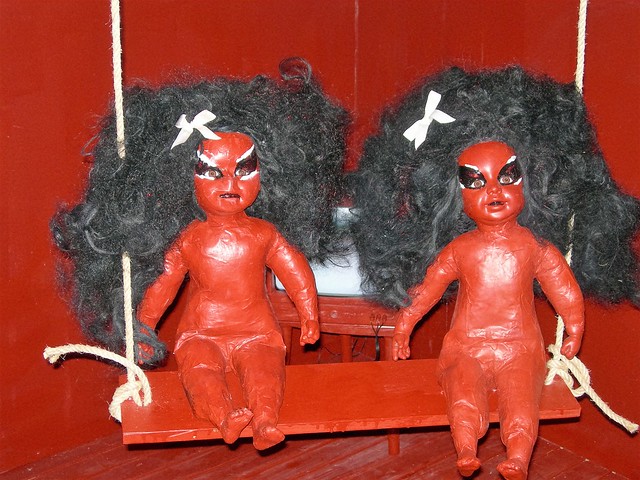
painted the deep shade of dried blood, surrounded by eerie dolls and multiple
portraits of Pfahler in all her ghastly, macabre beauty.
Promisingly, the makeshift performance
space in the corner was a decent set-up: a tiny high stage with the official
VHKB logo (Batman with a pendulous pair of female tits) emblazoned on a flag
behind it. (You must exclaim, “A little stage!” like Dawn Davenport in Female Trouble at this point). There was three microphone stands lined up and no
musical equipment, so clearly the actual band wasn’t there and Pfahler would be
singing to taped musical accompaniment, which was fine by me.
My friend Emma and her girlfriend Pippa
joined us. Princess Julia and Marc Almond were both there too. Time started to
drag. And then drag some more. There was no sign of the artist herself. The venue
started seriously filling up with a nice mix of freaky club kids, punks, Goths,
androgynes and the kind of weirdos who only emerge by night you hope to
encounter at events like this. Talking amongst ourselves we started
speculating, “I wonder when this thing is actually going to start?”
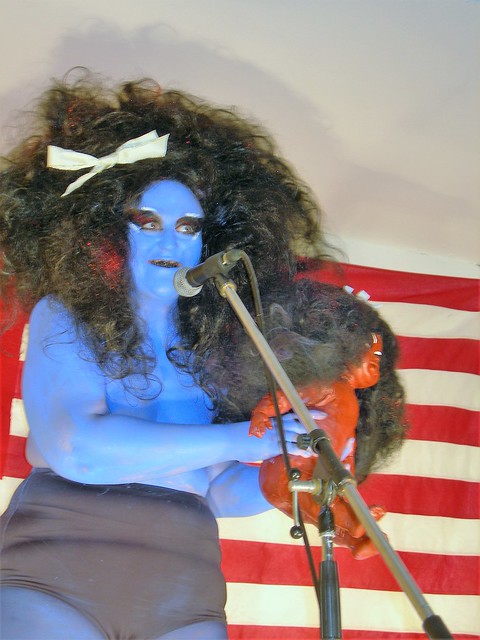
Finally, a glimpse of a huge exploding haystack
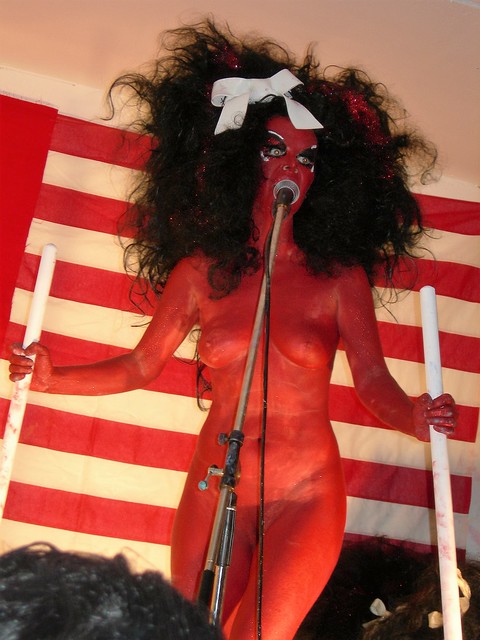
of black bouffant hair emerged from around the corner. It wasn’t Pfahler – it
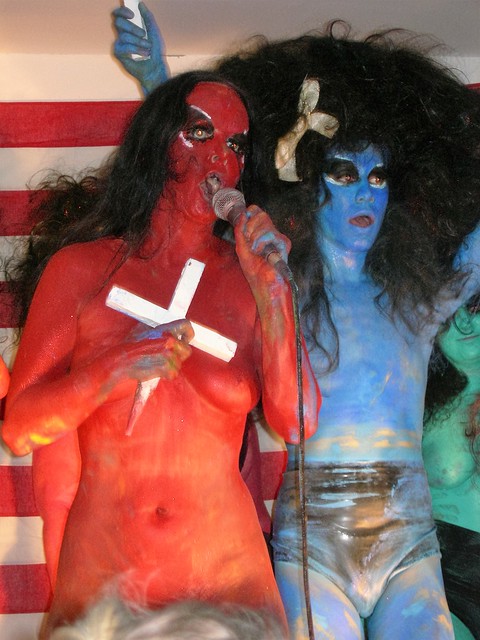
was one of her troupe of backing dancers. (Pfahler always performs accompanied
by a gang of identical semi-naked dancing girls styled to look just like her –
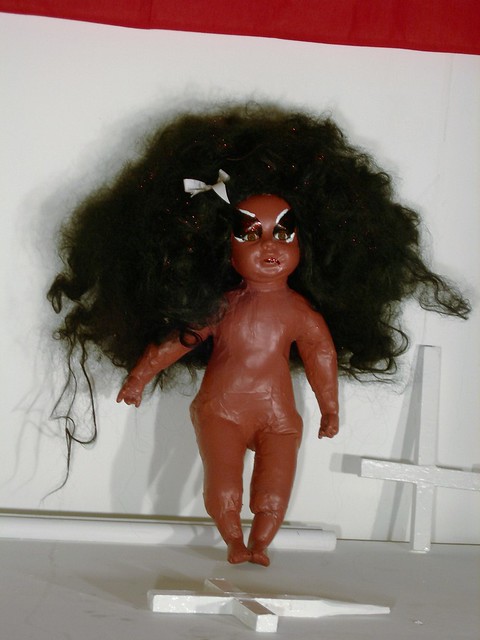
the VHKB equivalent of Ike and Tina Turner Revue’s Ikettes). She came out and
cavorted a bit wielding one of the VHKB dolls. I think this one was called
Phoebe. Grateful for the spectacle, everyone cheered when she announced the
show would begin shortly. People snapped her photo. Phoebe grinned with
blacked-out teeth. But time stretched on with nothing happening. There wasn’t
even music playing to create a bit of atmosphere. Occasionally another VHKB dancer
would appear, introduce themselves and promise the show would start imminently.
By now we were getting seriously impatient
and pissed-off and the gallery was growing hotter and more claustrophobic. Eventually
another VHKB dancer came onstage (this time, a guy in drag. The troupe was
mixed gender), introduced himself and announced the show would begin shortly
but first – some go-go dancing! This is what I can piece together in retrospect:
Pfahler herself was missing in action and not even on the premises at this
point. The go-go dancing was intended to pad things out while they tracked down Pfahler. Her “backing dancers” were local London-based people assembled at the
last minute (apparently) for this performance. (There wouldn’t have been the
budget to fly over Pfahler’s regular New York girls). I suspect the auditioning
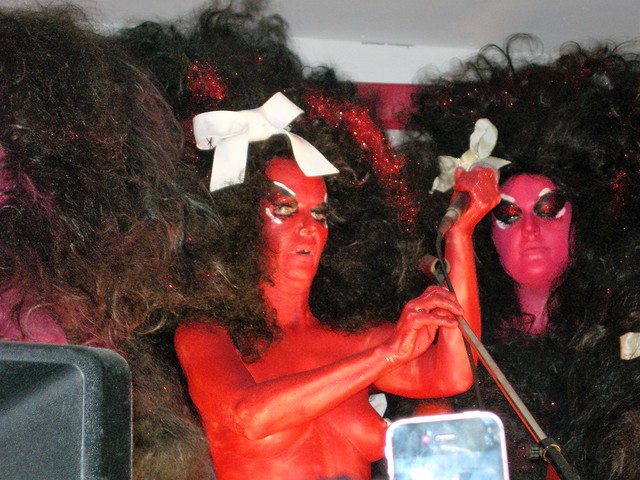
process for them wasn’t terribly rigorous. The first glimpse of them in their identical
virtually-naked, body-painted and bewigged get-ups was genuinely dazzling. That
image – sexy alien, zombie woman, devil doll, voodoo dolly – is powerful and
alluring. But it got tired fast with no
substance or action behind it. For what seemed like an eternity, we were
subjected to a cavalcade of onstage exhibitionists not exactly burdened with
talent, charisma or even basic dancing ability listlessly jiggle around a bit (you
wouldn’t call it “go-go dancing”) to whatever Pfahler’s agent or manager or
whoever it was happened to have on the iTunes library on his iPad (“Paranoia”
by Black Sabbath. “You Really Got Me” by the Kinks. Loads of terrible seventies
stadium cock rock). They fanned each other with feathers, yawned, lit candles,
sat on each other. More frequently, they just stood around onstage talking
amongst themselves, slack-jawed and gormless. Up close you could see where
their body paint had worn off in patches. It was frankly embarrassing.
Things felt increasingly shambolic and inept. The
gallery had zero control over the event and seemed out of their depth. The
night began with such optimism but all good will was evaporating fast. I had
visions of it descending into a club kid equivalent of Day of the Locust-style
chaos. I assured Pal (a VHKB virgin), “This will be over by 9 pm! Something must be happening
soon!” But he left and I couldn’t blame him. You know that sense of blind rage
you feel when you’re trapped on a train platform and the indicator shows
“cancelled” and “delayed” but you get no other updates or useful information
and you get so furious you want to strangle someone? I can only compare it to
that.
The nadir was when another dancer took the
mic to promise, “Kembra is on her way! She should be here in at least thirty
minutes!” That’s when we realized she wasn’t even there. A fed-up Emma and Pippa left, certain Pfahler
probably wouldn’t even turn up at this stage. Luckily I found another friend to
hang out with – Nicole. By now, all the complimentary booze had long since run
out. The door to the sole toilet had a sign announcing it was out of order. Nicole
and I were bursting for a slash. We left the gallery and found a pub around the
corner where we could go for a piss and drink a half pint killing time. Before we split, we cornered one of Pfahler’s
dancers in the crowd and asked for any kind of update. She confessed she had no
clue what was going on or where Kembra Pfahler was. No one was telling her
anything either.
There was still no change when Nicole and I
got back to the gallery but we both decided to stick it out a bit longer to see
what might happen. Finally, there was a ripple of excitement: Kembra had
arrived! Another sighting of a jet-black, glitter-dusted wig slicing through
the crowd. After so many false starts, this time it was attached to Pfhaler
herself. She finally took the stage at 9:15 pm. Her set was short (maybe 25-30
minutes), but mercifully it was good and did compensate for the preceding
fiasco up to a point. On the downside, Pfahler seemed distracted and
scatter-brained (perhaps her default setting?) and apologised they’d done no
rehearsals. (By this point she’d been in London for about a week to prepare for
the show. I wonder how she spent her time?). Pfahler admitted they were
“unprepared” and encouraged people to return the following night and she’d do a
few more performance pieces to compensate.
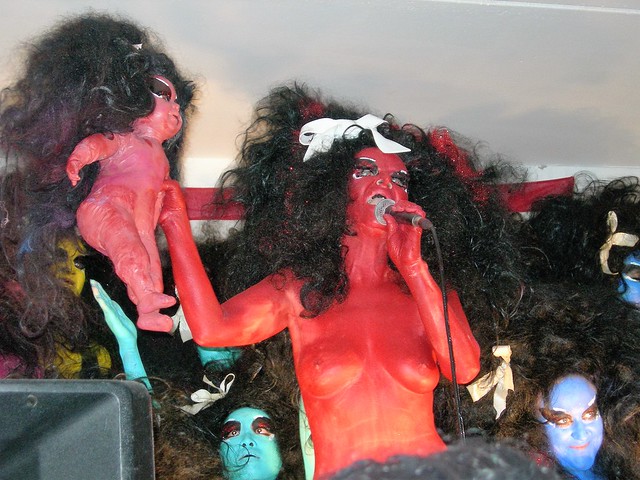
Pfahler sang maybe four songs, focusing on new
(unreleased) material. The song where she enthused about her favourite scenes
from Blade Runner while hobbling around with her feet duct-taped to bowling
balls was genuinely weird and funny. She did some onstage butt-printing (where
Pfahler smeared finger paint on her ass and pressed it onto paper). I forgave Pfahler
almost everything for her inspired screeching death metal version of Celine
Dion’s love theme from Titanic. It culminated with Pfahler standing on her head
with legs spread and genitalia exposed. One of her dancers stood over her threateningly
wielding a white wooden crucifix whittled into a sharp point at the end. We all
gasped – and sure enough, she abruptly spiked it hard downwards directly into
Pfahler’s anus! It was genuinely shocking, like something out of the Ken
Russell film The Devils. (Afterwards the crucifix got flung into the audience –
someone claimed the crucifix that had been jabbed into Pfahler’s ass hole).
They all filed offstage to Benny Hill’s theme tune.
So … Voluptuous Horror of Karen Black. In the
past year Pal and I have seen topnotch queer-punk performance art by the likes of
Christeene and Peaches in London. Like VHKB, they all incorporate various
degrees of onstage nudity, mixed-gender scantily-clad backing dancers and confrontational
punk minimalism. Pfahler is an
undisputed doyenne or godmother of this whole genre or approach - in fact maybe
she invented it! Peaches and Christeene came in her wake - and have now raised the standard and overtaken her with tighter, slicker and frankly better shows. Most importantly
– they turn up on time! In New York Pfahler is justly regarded as performance
art royalty. But her lateness at Emalin was borderline contemptuous. Judging by
Tuesday night, in 2016, Kembra Pfahler needs to significantly raise her game.
Lobotomy Room Goes to the Movies is the film club devoted to Bad Movies We Love (our motto: Bad Movies for Bad People), with an emphasis on
the cult, the queer and the kitsch. This month we’re really scraping the barrel
with perhaps the worst film we’ve screened to date – Mae West’s infamous final
film Sextette (1978)! Wednesday 23 November in the basement Bamboo Lounge of Fontaine's! Think of it as an unintended camp classick – or a freaky Diane Arbus photograph come to life! Full respect to screen legend Mae West (1893 – 1980): in her
thirties heyday, she was a gleeful pioneer of sexual liberation and a true
original who wrote all her own wisecracking material. West was also one hip cosmopolitan
sister, drawing on African-American and queer subcultures for inspiration. By
1978 though the desiccated 84-year old diva was living in a seriously self-enchanted
bubble (think Nora Desmond in Sunset Boulevard) with a seemingly shaky grasp on
reality.
Persuaded to make one last film, the geriatric sex kitten made
zero concessions to her advanced age and cast herself as a much-lusted after
bombshell surrounded by besotted male admirers (in some cases young enough to
be her grandsons). Leading man is 34-year old Timothy Dalton as her husband - 50 years her junior. (Presumably the future James Bond would love
to burn every last negative of Sextette in existence! The truly oddball cast
also includes Ringo Starr, Alice Cooper, Keith Moon, Tony Curtis and George
Hamilton).
/ “She won’t be satisfied until she’s loved by all mankind - one man at a time!”/
Bewigged, carefully shot in ultra-soft-focus, virtually immobile and never making eye contact with any of her co-stars, West frequently looks like she has been mummified or taxidermied. Just how nutswasWest? When West and Dalton duet on the Captain and Tennille soft rock hit “Love Will Keep Us Together” (did I mention Sextette is a musical?), West insisted the original lyric “young and beautiful / someday your looks will be gone” be changed to “young and beautiful / your looks willneverbe gone!”
/ Any gerontophiles out there? / Fun facts: Sextette is directed by Ken Hughes – who also
directed sixties children’s classic Chitty Chitty Bang Bang! The awful musical
numbers are choreographed by the same guy who did The Sound of Music and Mary
Poppins! West’s gowns are by legendary Hollywood costume designer Edith Head! In
the segment where West serenades a gang of semi-naked bodybuilders, some of the
baby-oiled muscle men are alumni from the world of seventies gay porn! For
everyone involved, Sextette represents the nadir of their careers!
/ Who's up for an evening of old-school muscle worship, Mae West style? / Gasp in astonishment at the mind-boggling Sextette – one of
the most wildly misjudged films ever made! See the movie that made The New York Times
declare, “Granny should have her mouth washed out with soap, along with her
teeth!"
Wednesday 23 November at Fontaine's. Admission: Free! Doors to the Bamboo Lounge open at 8 pm. Film starts at 8:30 pm. Arrive early, order your cockails and venture downstairs: I'll be projecting grainy black and white vintage homo porn and playing punk music before the film starts.
From the Facebook events page: Raise the ghosts of Lux Interior and Jayne Mansfield Friday 28 October when Lobotomy Room presents a special putrid Halloween spectacular in the Polynesian-style basement Bamboo Lounge of Fontaine’s bar in Dalston!
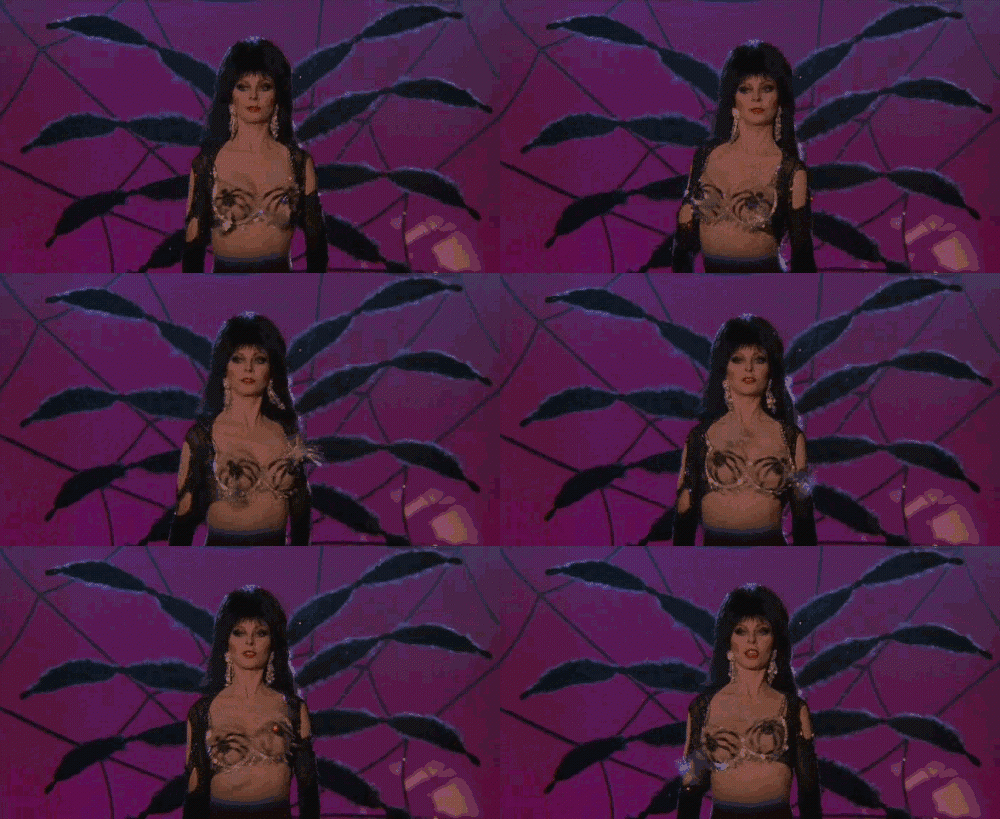
COME for the film club! Lobotomy Room Goes to the Movies is the FREE monthly film club with an emphasis on the cult, the kitsch and the queer. Embracing the spirit of Halloween, the October presentation is … Elvira: Mistress of the Dark (1988)! A gleefully low-brow, raunchy broad comedy starring buxom, beehive-haired horror movie hostess Elvira, the beloved cult figure for generations of punks, psychobillies, Goths and misfits of all description. In the film Elvira inherits a haunted house en route to making her Las Vegas debut – but really, it’s all mainly an excuse for endless boob jokes. If you’re a fan of trashy eighties cinema or the humour of Pee-Wee Herman and John Waters, this is the Halloween movie of your (wet) dreams! Doors to the Bamboo Lounge will open by 8 pm for the film to start at 8:30 pm.
STAY for the FREE dance party afterwards! Once the film finishes, we’ll quickly shove the seating out of the way in time for the Lobotomy Room club night! Wilder than you can imagine! Explicit beyond belief! Revel in sleaze, voodoo and rock’n’roll! Lobotomy Room! Where sin lives! A punkabilly booze party! Sensual and depraved! A spectacle of decadence! Bad Music for Bad People! A Mondo Trasho evening of Beat, Beat Beatsville Beatnik Rock’n’Roll! Rockabilly Psychosis! Wailing Rhythm and Blues! Twisted Tittyshakers! Punk! White Trash Rockers! Kitsch! Exotica! Curiosities and other Weird Shit! Think John Waters soundtracks, or Songs the Cramps Taught Us, hosted by Graham Russell (of Dr Sketchy and Cockabilly notoriety). Expect desperate stabs from the jukebox jungle! Savage rhythms to make you writhe and rock – with an added macabre twist for Halloween (think “Goo Goo Muck”, 1950s Halloween novelty tracks like “Graveyard Rock” by Tarantula Ghoul, The Munsters' surf instrumental theme tune. And yes I will play "Monster Mash"). With vintage erotica projected on the wall all night long for your adult viewing pleasure!
A tawdry good time guaranteed! Fancy dress is encouraged but entirely optional!
Calling all crypt-kickers, coffin cuties, glamour ghouls and
creatures from the (black leather) lagoon!
This was the second time I’ve thrown a Halloween Lobotomy Room club at Fontaine’s. Halloween is of course “gay Christmas” so I decided to go
full bat shit and embrace it by combining the monthly Lobotomy Room Goes to the
Movies film club (usually last Wednesday of every month) with the actual
incredibly strange dance party Lobotomy Room on the same night as one Halloween
spectacular – and it worked reasonably well! It could have done with even more
people rocking up (that’s the mantra of all club promoters). There was a lot of
good stuff happening that Halloween weekend in London to compete with. But the
attendees who did show up were certainly hip and enthusiastic. And most
importantly – they danced! Right up until 1:30 am!
I may have over-estimated the allure of Elvira! For me, Elvira
(the inspired comedic creation of erstwhile Las Vegas showgirl turned actress Cassandra
Peterson) is one of the great pop culture cult figures du nos jours, belonging
to the same punky, deliberately-bad-taste pantheon as Pee-Wee Herman, Divine,
Lux and Ivy of The Cramps and Vampira. (Yes, I know you’re not meant to mention
Elvira and Vampira in the same breath! Let’s not open that whole can of worms –
I revere them both). But then I’m also North American and of a certain
generation: I used to love Elvira’s TV show as a kid in the eighties and my
friends and I eagerly embraced her deliciously crude 1988 film Elvira: Mistress
of the Dark as a trashy camp classic (there are whole stretches of dialogue I
can recite from memory! Q: “How’s your head?” A: “Well I’ve never had any
complaints!” “Grab a tool and start banging!” “When I want your opinion I’ll
beat it out of you!”). The movie is so brazenly boob-fixated it rivals
anything from the filmography of Russ Meyer! (And it’s also tighter and funnier
than most late-period efforts by John Waters).
But I got the impression that for Brits as a whole and
millennials in particular, Elvira’s oeuvre is pretty much an unknown commodity.
There was nowhere near the fervour for this screening as there was for Blonde Venus the month before. And perhaps the humour of Mistress of the Dark is an
acquired taste. The film is intentionally bad: it takes seriously smart people
to make a film this enjoyably dumb. Midway through my friend Eric whispered to
me, “This is the worst film ever made!” Shortly after he left. Ah, well. To me,
Elvira’s persona (equal parts Morticia Addams and Mae West) and her flippant, wise-cracking comedy stylings are like catnip. I’m still glad I picked it for
the Halloween Lobotomy Room! There’s so much comedy mileage in the preternaturally
ageless Elvira’s image, it’s a shame she didn’t make more films. After Mistress
of the Dark, there was only one more – the little-seen belated sequel Elvira’s Haunted Hills in 2001. (Tag line: “Evil. Terror. Lust. Some girls really know
how to party!” It’s worth seeking out).
/ Above: Elvira's climactic Las Vegas spectacular /
Once the film credits rolled, I leapt into action, quickly
replacing the DVD with some grainy black-and-white vintage homo porn and stacking
the chairs to make space for dancing. My musical policy for the night was to
mix some abrasively kitsch Halloween novelty songs from the fifties and sixties
with the customary Lobotomy Room rancid cocktail of punk, rockabilly, rhythm and blues and
surf. (I know "Hard Magic" by Divine doesn't qualify as a "Halloween tune", but it does have those howling werewolf sound effects so it fit!). Obviously, a generous sprinkling of tracks by The Cramps – the much-missed archetypal voodoobilly band for
whom every day was Halloween - felt de rigueur. It was especially gratifying to
look out and see everyone jump up and dance to “Monster Mash” by Bobby “Boris”
Pickett. I knew they would!
Night of The Vampire - The Moontrekkers
Graveyard Rock - Tarantula Ghoul
Monster in Black Tights - Screaming Lord Sutch and The Savages
Bloodshot - The String Kings
She's My Witch - The Earls of Suave
Rigor Mortis - The Gravestone Four
Creature from the Black Leather Lagoon - The Cramps
Rockin' in the Graveyard - Jackie Morningstar
The Munster's Theme - Milton DeLugg and The All-Stars
Spooky - Lydia Lunch
Vampira - Bobby Bare
Theme from The Addams Family - The Fiends
King Kong - Tarantula Ghoul
Feast of the Mau Mau - Screamin' Jay Hawkins
Alligator Wine - Johnny Thunders and Patti Palladin
Midnight Stroll - The Revels
Anastasia - Bill Smith Combo
Monster Surfing Time - The Deadly Ones
Scream - The 5,6,7,8s
Sunglasses After Dark - The Cramps
Vampira - The Misfits
Surf Rat - The Rumblers
Monster's Party - Bill Doggett
Hard Magic - Divine
Forming - The Germs
The Way I Walk - The Cramps
Your Phone's Off the Hook - X
Jukebox Babe - Alan Vega
Rock'n'Roll High School - The Ramonetures
Viva Las Vegas - Nina Hagen
Bossa Nova Baby - Elvis Presley
You Sure Know How to Hurt Someone - Ann-Margret
You're Driving Me Crazy - Dorothy Berry
Boss - The Rumblers
He's the One - Ike and Tina Turner
Be Bop A Lula - Alan Vega
Funnel of Love - Wanda Jackson
Breathless - X
Rock Around the Clock - The Sex Pistols
Whistle Bait - Larry Collins
Somethin' Else - Sid Vicious
Touch the Leather - Fat White Family
Harley Davidson - Brigitte Bardot
Monster Mash - Bobby "Boris" Pickett and The Crypt-Kickers
Do the Zombie - The Symbols
Teenage Lobotomy - The Ramones
I Walk Like Jayne Mansfield - The 5,6,7,8s
That Makes It - Jayne Mansfield
Viens danser le twist - Johnny Hallyday
Peter Gunn Twist - The Jesters
Peter Gunn Locomotion - The Delmonas
Gunnin' for Peter - The Fabulous Wailers
I'm a Woman - Peggy Lee
Hipsville 29 BC - The Sparkles Gostaria de saber (River Deep Mountain High) - Wanderlea
Under My Thumb - Tina Turner
Shout - Johnny Hallyday
Bombora - The Original Surf-aris
Big Girls Don't Cry - Edith Massey
Suey - Jayne Mansfield
Can Your Pussy Do The Dog? The Cramps
Here Comes the Bug - The Rumblers
Wiped-Out - The Escorts
These Boots Are Made for Walkin' - Mrs Mills
Somethin' Else - Sid Vicious
Atomic Bongos - Lydia Lunch
Hanky Panky - Nancy Sit
Viva Las Vegas - Elvis Presley
Jim Dandy - Ann-Margret
[Illegible]
Big Bounce - Shirley Caddell
Blitzkreig Bop - The Ramonetures
Let's Go - Billy Eldridge
My Way - Nina Hagen
Downtown - Mrs Mills
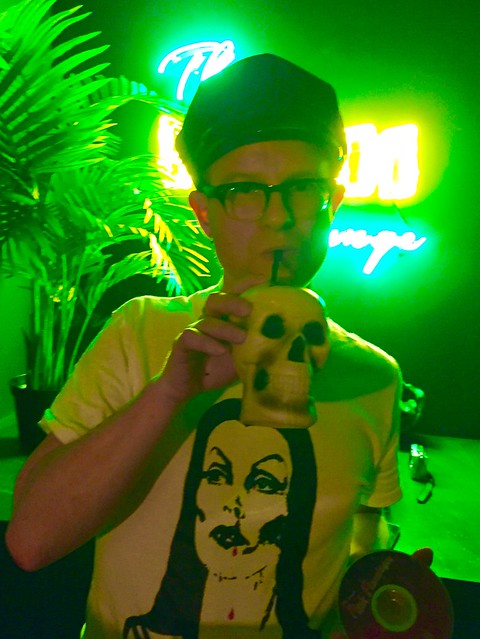
/ Everything tastes better drunk out of a skull. Your intoxicated host and DJ at Lobotomy Room on 28 October at Fontaine's! How could I not wear my Vampira t-shirt for Halloween (the same one Lux Interior of The Cramps used to wear)? Note that I happen to be holding the soundtrack to Pink Flamingos in my hand! /
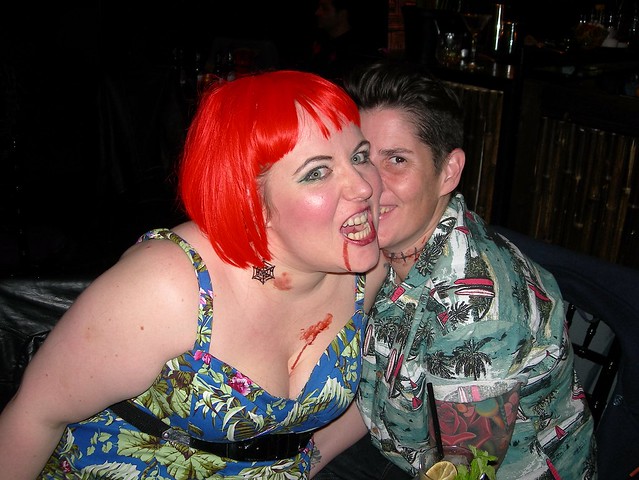
/ Below: I was too busy behind the DJ booth to take many shots on the night, but I had to take a pic of these two. They managed to come to Lobotomy Room in spite of clearly life-threatening bloody injuries! Such commitment! /
Lobotomy Room Goes to the Movies is the FREE monthly film
club with an emphasis on the cult, the kitsch and the queer. This month’s
presentation is … Blonde Venus! Wednesday 28 September in the Polynesian-style
basement Bamboo Lounge of Fontaine’s bar in Dalston!
Of the seven sublime films director Josef von Sternberg and leading lady / muse
Marlene Dietrich made together, surely the wildest and weirdest is Blonde Venus
(1932). It stars sultry German glamour puss Dietrich as a hausfrau and mother
forced to resume her career as a nightclub chanteuse due to circumstances
too complicated to go into here – and then finders herself entangled in a
romantic triangle between her sick scientist husband and a suave millionaire
(played by a very young Cary Grant). But none of that is important! It’s mainly
an excuse to luxuriate in Dietrich’s shimmering close-ups, multiple extravagant
costume changes and sensational musical numbers. Most notorious of the latter
is the riotously kitsch and freaky “Hot Voodoo” sequence. If you’ve never seen
it before I won’t spoil it for you, but 1) “Hot Voodoo” is the campiest thing
you’ve ever seen, 2) watching it might turn you gay and 3) over eight decades
later, the likes of Grace Jones, Madonna and Kate Moss are still referencing it
in videos, concerts and photo shoots.
/ Kate Moss does Marlene Dietrich in "Hot Voodoo" in for W Magazine in October 2007 / Not to divulge any plot spoilers, but midway through Blonde Venus Dietrich has
to take her child and go on the run and she gradually sinks to ever more
squalid and impoverished circumstances (at one point she seems to be living in
a chicken coop!). The way Sternberg films it, the more sullied Dietrich
becomes, the more radiantly beautiful she looks (and her outfits become more
artfully dishevelled). Degradation never looked so good!
Anyway, Blonde Venus is the absolute summit of sinful 1930s Art Deco glamour
and therefore the perfect film to watch in the decadent environs of Fontaine’s.
Now – sing along with me: “Hot voodoo / dance of sin / Hot voodoo / worse than
gin / I’d follow a caveman right into his cave …"
As usual: arrive circa 8 pm to order your drinks and grab the best seats. The
film starts at 8:30 pm prompt. The film is FREE and seating is limited. If
you’re feeling proactive, contact Fontaine’s to reserve a seat in advance:
email ruby@fontaines.bar or call 07718 000546.
Blonde Venus - the fifth of the seven intoxicating films
visionary director Josef von Sternberg (1894 – 1969) and actress Marlene Dietrich (1901 – 1992) made together between 1929 and 1935 - is considered a
minor work in their canon, chiefly remembered for the spectacular “Hot Voodoo”
musical sequence. It bombed at the box office in 1932 and received mostly
withering reviews. Blonde Venus has a reputation as a lurid, sentimental
potboiler (in his definitive 1992 biography Marlene Dietrich: Live and Legend,
Steven Bach positions it as belonging in the “mother-love sobber-weepers”
genre).In fact, it’s one of my
favourite of the Dietrich-Sternberg collaborations and - as I said in my
introduction to the sold-out Lobotomy Room audience - it’s their wildest and
weirdest film. Blonde Venus, I’d argue, is a strange and complex film roiling
with tensions and conflicts and ripe for queer and feminist appraisals.
Blonde Venus is a pre-Code film (made during the brief,
heady period roughly between 1929 – 1934 when actresses like Jean Harlow went bra-less and it was still like the Wild West
in terms of what films could show onscreen), so it’s ripe with an ambiance of
sleaze and some deliciously kinky moments. It opens, in fact, with a skinny-dipping
scene in the Black Forest when visiting American scientist Ned Farady (Herbert
Marshall) encounters German cabaret performer Helen (Dietrich) swimming nude in
a lake with her fellow showgirls. (He calls her “my little water nymph”). The action
then cuts abruptly several years forward to Helen – now married to Ned - as a dutiful
aproned hausfrau and mother (of a 5-year old son) in a tenement apartment in
New York. Their modest but idyllic family life is shattered when Ned is struck
down with “radium disease.” To pay for the experimental medical treatment in
Europe that might save Ned’s life, Helen is forced to resume her career as a nightclub
chanteuse.
Sternberg packs even these early wholesome domestic scenes with
macabre and perverse touches. As Ethan Mordden points out in his 1983 book
Movie Star, “Sternberg was the champ of weird. Stop the projector during a
medium shot in any of his films and you’ll see a crammed picture, every piece
in it doing something. Graffiti, toys, masks, light fixtures, bowls of things:
the sets are alive.” When we see housewife Helen demurely embroidering, she
actually seems to be cross-stitching black crows in a pattern worthy of Morticia
Addams. The doctor that Ned consults keeps a human skull displayed on his desk
(he even absent-mindedly picks it up and plays with it while speaking). Helen
and Ned’s cherubic little boy Johnny plays with eerie German Expressionist toys (watch
for the demonic grinning papier-mache mask Johnny wears at
one point – a jarring moment).
Of all the films Dietrich and Sternberg made together, only
Blonde Venus is set in contemporary Depression-era US. It has some genuinely hard-boiled
and gritty moments, with Helen motivated by the very real threat of
destitution. The cut-throat world of show business Helen returns to is shown to
be competitive, exploitative and sexist. “Let’s see your legs!” a
cigar-chomping manager commands. Helen obliges, lifting her skirt (“Is that
enough?”). “You certainly got me hopped-up, baby,” he growls in response.
/ The Blonde Venus backstage in her dressing room pre-show /
Re-christened with show biz name “Blonde Venus”, we finally
see Helen in action as a nightclub diva with the film’s show-stopping first
musical number – the truly freaky and berserk “Hot Voodoo”. It plays like a
pagan, taboo and primitive beauty and the beast-style ritual, with Dietrich as
an albino goddess or priestess shedding her gorilla fur disguise. All these decades later “Hot Voodoo” is still
deliriously weird, and perhaps the first incidence of deliberate, knowing camp
in popular culture. (It’s easy to imagine Sternberg and Dietrich looking at
each other across the camera and thinking, “Can you believe we’re getting away
with this?”). As Bach describes:
“The notorious Hot Voodoo is simply unforgettable, despite
or because of its absurdity. Marlene emerges from a gorilla suit to don her
silver-blonde Afro (suggesting Harpo Marx) against a Cotton Club background of
African “native” girls. There are tom-toms, palms, the black bartender with a
stutter… Helen’s – Dietrich’s – astonishing confidence in her allure is
near-dictatorial with star presence. She shifts her weight from one hip to
another as she sings. She need not do more; her voice insinuates the rest. The
absurd lyric – “Hot Voodoo gets me wild / Oh, fireman save this child!” – goes
on for five minutes in two long takes intercut with shots of Cary Grant paying
stunned attention. This is a witch casting her spell; that hip-to-hip sway is
the mesmerising come-on of a blonde cobra.”
/ I’ve always been curious about the above photo when it appears
online or in books: it’s clearly an entirely different outfit to the black
sequinned one Dietrich wears onscreen in “Hot Voodoo.” Is this shot a “wardrobe
test” of a potential costume that got rejected? In his book, Bach provides a
clue: production of Blonde Venus was a long rancorous ordeal with Sternberg
(and Dietrich) feuding with studio heads. (At one point Paramount threatened to
sack Sternberg and replace him with another director). There were so many
script re-shuffles that “major sequences (including the “Hot Voodoo” number) were
completely recostumed and reshot.” So, the famous version of “Hot Voodoo” we’re
all familiar with is actually the second reshot version. This pic above was presumably what
Dietrich wore in the original scrapped number that was resigned to the cutting
room floor. Imagine – an alternate unseen version of “Hot Voodoo”! In an ideal
world, that would resurface and be included as a DVD extra. Or even better – a “director’s
cut” of Blonde Venus true to Sternberg and Dietrich’s original vision! /
Afterwards, suave young millionaire politician Nick Townsend
(Cary Grant) takes a keen interest in Helen and visits her backstage.
As soon as Ned departs to Europe for his cure, Helen embarks
on an affair with playboy Nick. Helen’s almost instant romance with Nick reportedly
caused executives at Paramount to panic. Considering Helen is meant to be a
sympathetic romantic heroine, she is weirdly unknowable and amoral. She’s never
shown, for example, having any serious qualms or pangs of guilt about her
infidelity. The script can’t contain or resolve this contradiction. This is
often described as one of the film’s flaws. I’d maintain it’s what makes it
fascinating. “Give me a little kiss,” Nick implores, after ushering Helen into
a luxe life as a kept woman. Helen hesitates then submits. The camera cuts away
tactfully as they embrace. He asks Helen directly: does she love Ned? She
replies, “He needs me.”
/ Best use of rear projection (and a wind machine) ever / “I wish I was someone else,” Helen admits to Nick. “Then I
could stay with you here forever.” Helen’s unfixed, constantly shifting
identities are one of the most interesting aspects of Blonde Venus. Nude water
nymph. Cabaret star. Housewife. Mother. Later, fallen woman. Prostitute.
Androgynous pansexual in male drag. She even goes under multiple names: Helen
Faraday. (Faraday is her married name; presumably before that Helen had a
German maiden name). Helen Jones. Blonde Venus. Later, on the run, she checks
into hotels with the pseudonym Helen Blake.
The jig is up when the cured Ned arrives back in New York
unexpectedly early. Discovering Helen has been unfaithful, he turns vindictive.
“You took up with the first man who could give you the things I couldn’t”. Calling
her “a rotten mother”, he threatens to take Johnny away. Helen responds by kidnapping Johnny and
fleeing. (Cut to screaming newspaper headline “Police Hunt Cabaret Girl” with
huge photo of Helen wearing her “Hot Voodoo” Afro wig).
On the lam from her husband (and - symbolically – patriarchy,
heterosexuality and the male establishment as a whole), Helen now takes a journey
into the underbelly of thirties America with Johnny in tow. At this point
Blonde Venus turns very noir, very
desperate against a sordid backdrop of seedy hotel rooms, dive bars and
flophouses depicted in deep atmospheric chiaroscuro. When it’s no longer safe
to perform in cabarets, Helen takes odd jobs where she can (I love the
thought of Continental exquisite Dietrich labouring as a farmhand in Galveston!
If only Sternberg had given us a glimpse of Helen milking a cow or plucking
poultry). At their lowest point, Helen and Johnny appear to be living in a
chicken coop!
On the run Helen finds support and sisterhood with other disenfranchised
“outsider” women on society’s margins, including African Americans (one of
them, Cora, is played by Hattie McDaniel years before her Academy Award-winning
role as Mammy in Gone with the Wind) and a lesbian. (The gruff-voiced, short-haired nightclub
proprietoress in masculine clothing warns Helen police have been enquiring
about her. “Don’t worry, I’ve got a kid of my own. Good luck.” I studied Blonde
Venus many years ago at university. My professor maintained thirties audiences
would have instantly recognised her as a lesbian character). For Helen at this
point men are predators to be wary of and out-smarted. “Are you going to wash my dishes?” a restaurant manager leers suggestively
when penniless Helen admits she can’t pay the cheque at his diner. Men keep
recognising Helen’s face from the “Wanted” signs and newspaper headlines (“that
dame looked like the Venus woman …”), eager to hand her in for the reward.
Perversely, the lower Helen sinks, the more radiant Sternberg
makes Dietrich look. As Bach jokes, “no one ever made squalor more decorative
than Sternberg”. Wreathed in cigarette smoke with artfully dishevelled hair and torn garments, the
low-down and dirty Helen drinking a schooner of beer (“I’ll have some beer.
Cold beer”), coquette-ishly fanning herself truly represents Dietrich at her most beauteous.
Finally tracked down by one of Ned’s detectives, Helen surrenders
and hands over Johnny, convinced it’s for his own good. Fed-up with male
disapproval, she snarls, “What does a man
know about motherly love?” (This same racist detective – a real piece of work -
repeatedly addresses Cora as “Annie” – as if “they’re all the same” to him. Cue the Nina Simone song "Four Women").
At this point it could be argued Helen is shown belatedly “paying”
for her unfaithfulness. Her heartbreak when she gives Johnny back to Ned,
watching their train depart with glistening eyes, is palpable. At this point
the film seemingly breaks down. It cuts from drunken, broken bag lady Helen
departing a flophouse for homeless women vowing to get herself back on her feet
(“just watch me!”), to the Atlantic Ocean viewed from a ship by night, to a
montage of neon Art Deco nightclub signs in Paris heralding the Blonde Venues
Revue. No explanation is offered; it feels like a few essential scenes are
missing. How much time has elapsed? How did Helen manage to afford this trans-Atlantic
journey? Prostitution? Rich sugar daddies? It’s left tantalisingly unclear.
/ The Blonde Venus re-surfaces in Paris / In any case, as “the toast of Paris” the Blonde Venus
persona is revived, but the updated version is dramatically different. The new
Helen is tough, independent and androgynous, a butch drag king in ice-white top
hat and tuxedo imperiously smoking a cigarette in a long holder. (The “I
Couldn’t Be Annoyed” musical sequence deliberately references Dietrich’s famous
earlier “lesbian number” in one of Sternberg and Dietrich’s earlier triumphs, Morocco
(1930). Sternberg loved dropping hints of Dietrich’s real-life bisexuality in
their films together). Nick and Helen are re-united in her dressing room. (“I
seem to recall you came backstage before,” she purrs). “Nothing means much to
me now. It’s better that way. I haven’t a care in the world,” Helen insists. Nick
sees through her steely, world-weary facade, knows she’s yearning for Johnny.
Once again Helen crosses the Atlantic Ocean, from Old World to New World.
Back in New York, Blonde Venus now hurtles toward
its conclusion. For some reason Helen opts to dress like a glamorous angel of
death for the family reconciliation scene in fur and black satin. The ending was
a compromise forced by the studio. (According to Bach, Dietrich herself wanted
the film to finish with Helen not having to pick between Ned and Nick, but having simultaneous
ongoing relationships with both men – very much how she conducted her own non-monogamous
open marriage with multiple lovers off-screen. Obviously that couldn’t fly in
1932). It’s a “happy” ending with nothing truly resolved. Helen is never shown
breaking up with Nick - it’s merely implied. Why would she choose killjoy prig Ned
over chivalrous, gallant and undemanding Nick? (Who’s not only a millionaire,
but looks like Cary Grant!). Will Helen be absorbed back into family and domesticity
and abandon show business for good? She’s most fully herself (or most fully
Dietrich), liberated and vital when onstage performing. How can a woman capable
of “Hot Voodoo” not be allowed back onstage?!
/ Above: Helen and Johnny reunited /
Blonde Venus is wildly entertaining. Sternberg’s storytelling
is vivid, fluid and concise. Visually, he is an untouchable stylist. Watch Blonde Venus more than once and you begin to notice
how Sternberg’s own personal preoccupations or fixations abound. There are two
noteworthy recurring motifs. One is the
Atlantic Ocean: characters cross it multiple times in the film. For the
characters in Blonde Venus, criss-crossing the ocean from Europe to North
America seems to represent opportunities for transformation and reinvention. (Continental
types Sternberg and Dietrich had made that life-changing journey themselves many times). And
the German lullaby that Helen croons to Johnny at pivotal points in the film
seemingly signifies a yearning for pure unconditional love, innocence and
nostalgia. But mainly Blonde Venus works as a sleek showcase for the heavy-lidded
magnetism of Marlene Dietrich. Her coolly inscrutable, feline self-possession as
Helen is simply magnificent. Like a female version of Robert Mitchum, she underplays
everything. You never catch Dietrich “acting”: she’s far too cool to emote. In
particular, check out Dietrich’s superb nonchalance in the musical segments, basking in adoration.
She is mesmerising to watch throughout.
This was the second recent sold-out instalment of the Lobotomy Room film club.
(The previous one was Faster, Pussycat! Kill! Kill! in July). Maybe it was their
cocktail-induced stupor, but the hip, full-capacity Bamboo Lounge crowd at
Blonde Venus sure was enthusiastic for a night of old-school diva worship. In
fact, after the film with minimal persuasion I got loads of ‘em to pay tribute
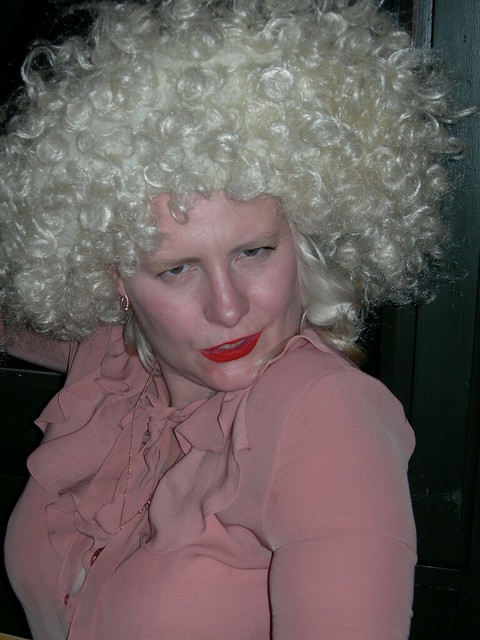
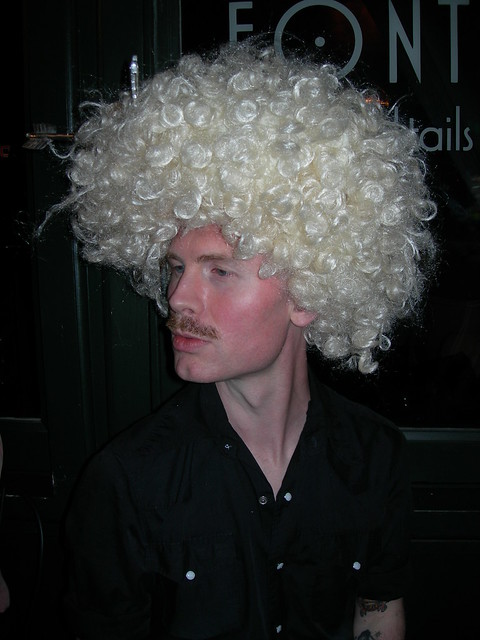
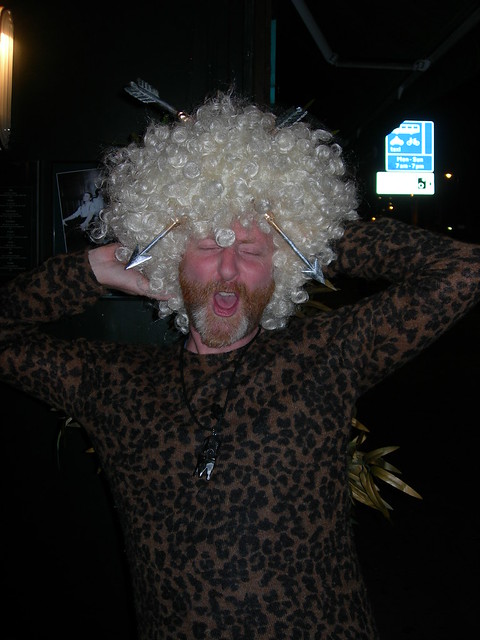
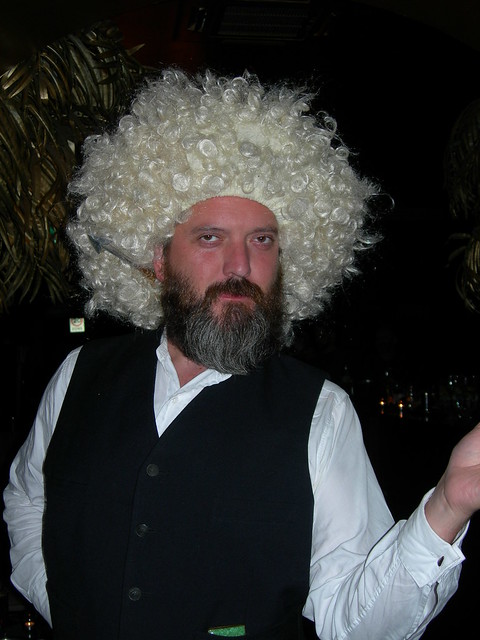
to Marlene Dietrich by donning a replica of the exploding platinum blonde Afro
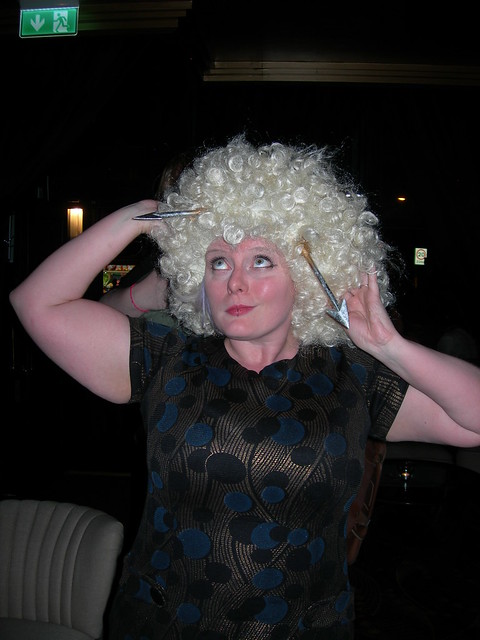
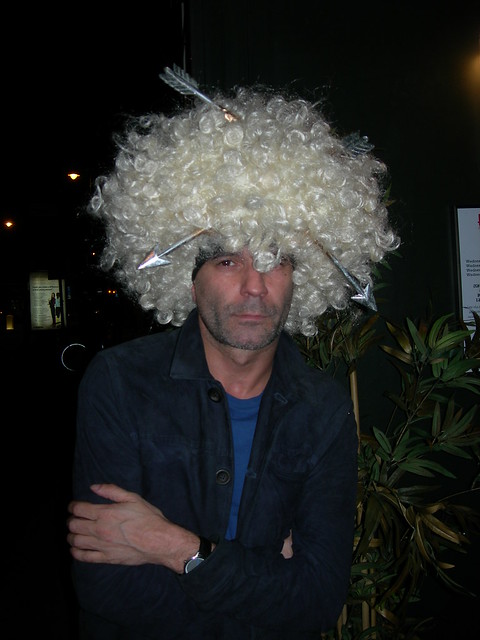
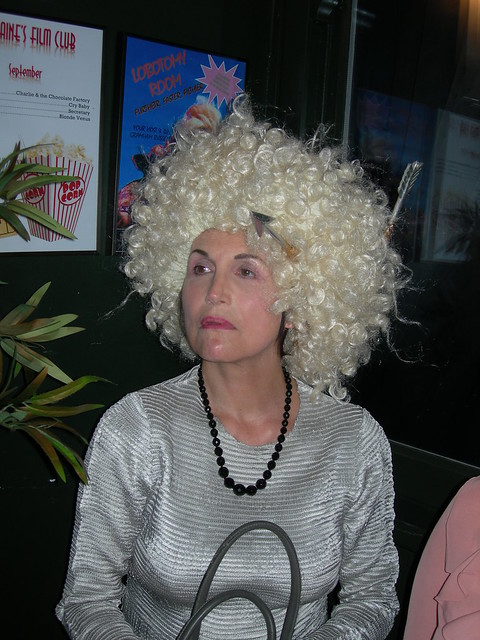
wig she wears in the "Hot Voodoo" number (complete with glittery arrows!)
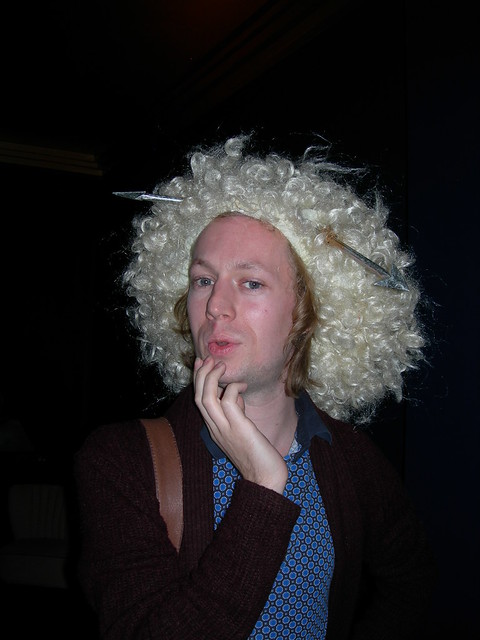
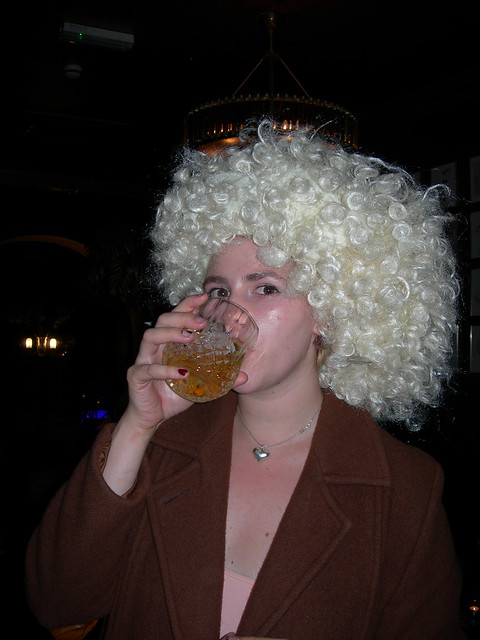
for a red-hot camera session. Here are the resulting glamour shots! What a diverse
variety of Marlenes of all genders! And funny how the wig can also evoke The
Simpson’s Sideshow Bob!
Hard Target (1993)
-
*Hard Target* is a 1993 action movie directed by John Woo and starring
Jean-Claude Van Damme. This is obviously yet another adaptation of the
classic 1924...
NEGATIVES 1968
-
Spoiler Alert. This is a critical essay, not a review, so plot points are
revealed for discussion
*Vivien: “Something is going on, and I want to know what...
The end is near
-
Cookie has, for some time now, thought about closing up shop on this blog.
I mean DHTiSH has had a good run, but after 15 years, it's time for a
diff...
Grace Jones
-
Artist: Grace Jones
LP: 7" single
Song: "I've Seen That Face Before (Liber Tango)"
[ listen ]
The incredible Grace Jones turned 76 one month ago today. ...
National Silent Movie Day: Manhandled (1924)
-
Wednesday, Sept. 29, 2021, is National Silent Movie Day. New York City's
beloved Film Forum is celebrating with a screening of Allan Dwan's 1924
silent...
SHABLAM:
-
While we are speaking in onomatopoeia,
"Girl, what did that girl just say, girl?" This queen is giving basic boot
camp for drag queens as she throws an a...
Who was Tamara Matul?
-
[image: Marlene Dietrich, Josef von Sternberg, Rudolf Sieber, Tamara Matul
at Olympic Auditorium, Los Angeles, 1934]
Rudolf Sieber, Tamara Matul, Marlene...
-
Welcome Refugees from tumblr!
[image: Christofascists.]
I'm busy exporting what's left of Drifting over the Ether & A Long Lunch. I
will be posting upda...
My Baking Supervisor
-
Meet Mr. Caspurr Burgers. He says:
"I helped you get up three hours earlier than usual this morning and this
is how you repay me? What is with this glass...
A BOGUS SPEECH BY A BOGUS PRESIDENT
-
Yesterday, Obama spoke in New Orleans at the 10 year anniversary of
Katrina. I'm not quite sure why we celebrate disasters' anniversaries, but
it was a ch...
DJ. Journalist. Greaser punk. Malcontent. Jack of all trades, master of none. Like the Shangri-Las song, I'm good-bad, but not evil. I revel in trashiness