Showing posts with label Elizabeth Taylor. Show all posts

Thursday, 12 June 2025

Reflections on ... The Only Game in Town (1970)


Recently watched: The Only Game in Town (1970). Tagline: “Dice was his vice. Men hers.” 


/ Pictured: George Stevens and Elizabeth Taylor during production of The Only Game in Town /

Director George Stevens and leading lady Elizabeth Taylor triumphed collaborating on A Place in the Sun (1951) and Giant (1956). Far less well-remembered is this downbeat Las Vegas-set character study about two losers tentatively embarking on a love affair. I say “losers” – the two main characters are portrayed by ultra-glamorous and photogenic international movie stars Taylor and Warren Beatty. Joe Grady (Beatty) is a jaded lounge pianist saddled with crippling gambling debts. (The role was originally intended for Frank Sinatra). Fran Walker (Taylor) is a chorus girl who’s been waiting for her wealthy married business executive lover to leave his wife for the past five years. (To establish that Fran is a showgirl, Stevens clumsily splices fleeting close-ups of Taylor in sequins “dancing” into long shots of a huge lavish production number. It is unintentionally hilarious). Both yearn to leave Vegas and start over. 


/ Above: the leading man and leading lady of The Only Game in Town

(An aside: if you do any researching on Game, you’ll frequently see Fran described as an “ageing showgirl”. Taylor would be only 36 years old here! Thank God the parameters of “ageing” have changed over the years. But in this regard, Game has thematic parallels with the 1973 made-for-TV Kim Novak movie Third Girl from the Left and, more recently, The Last Showgirl (2024) starring Pamela Anderson). 

Fascinatingly, the budget for this small-scale and intimate comedy-drama promptly spiraled to $11 million. Game was made when Taylor and then-husband Burton – as author Lee Server wrote – were at “their jet-setting, conspicuously consuming, bad-movie-making height.” Taylor was still able to command her mega-star $1.125 million salary and demanded Game be filmed in Paris where Burton was currently making his own flop movie (Staircase (1969)), necessitating the construction of an “ersatz Vegas” on a French sound stage. (I’m hypnotized by the fake rear projection view of the Sahara casino from Fran’s living room window). As Wikipedia concludes: “The Only Game in Town was the second-worst financial failure for Fox, behind Cleopatra, also starring Taylor. Stevens did not direct another film.” 

/ Miss Taylor's wigs by Alexandre of Paris! / 

Anyway, Game is inconsequential and wispy but suffused with retro charm (the décor of Fran’s apartment, her groovy wardrobe of ponchos, muumuus and mini dresses. Taylor’s wild coiffures and wigs are via Alexandre of Paris). The contrasting acting styles of Taylor and Beatty is fascinating (he’s only five years younger, but Beatty embodies “New Hollywood” whereas she’s old-school). The melancholy opening montage of Fran walking through a seedy neon-lit and deserted (actual) Vegas by night is gorgeous.

Watch The Only Game in Town here:


/ Further listening: the reliably excellent Karina Longworth devotes an installment of her You Must Remember This podcast to the late-period career of George Stevens here. 

Saturday, 2 March 2024

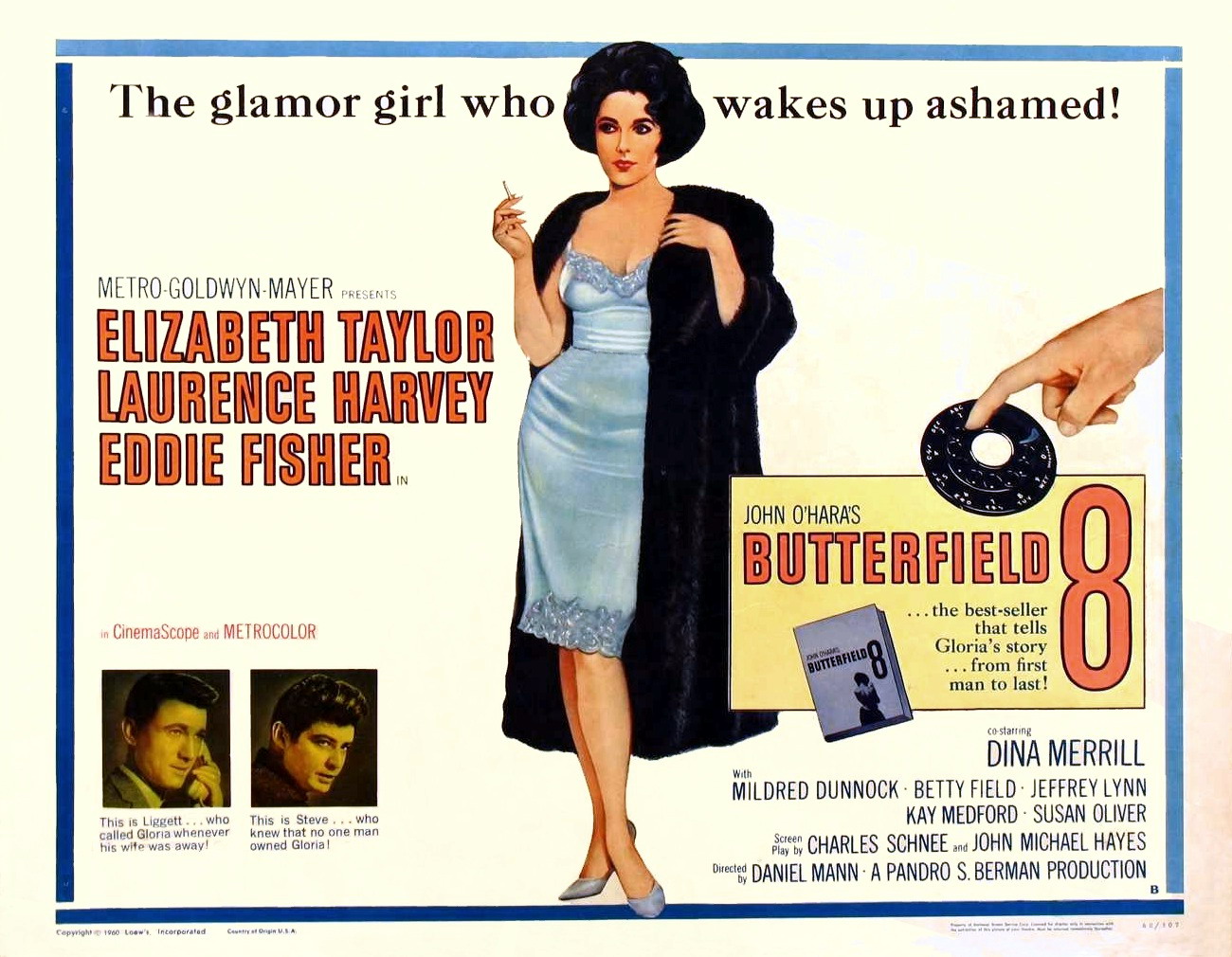
The Next Lobotomy Room Film Club ... Butterfield 8 (1960) on 21 March 2024

“The John O'Hara novel that seemed perfect for the movies, plus the role that seemed perfect for Elizabeth Taylor - and this is the garish mess it became,” is how the reliably terse Pauline Kael dismissed Butterfield 8. “Daniel Mann's direction is maybe even worse than the Charles Schnee-John Michael Hayes script. With Laurence Harvey; Dina Merrill, doing a noble wife to end all noble wives; and a vacuum on the screen that is said to be Eddie Fisher.” 

Almost no one has a good word to say about this lurid, wildly entertaining 1960 melodrama (including leading lady Taylor herself) – so of course Butterfield 8 is absolute catnip for me and it’s the March 2024 selection for the Lobotomy Room cinema club devoted to Bad Movies for Bad People! 


To its advantage: Taylor is sublime as wanton high-priced, high-class New York call girl Gloria Wandrous (tagline: “Gloria is the glamour girl who always wakes up ashamed!”). And the script co-authored by John Michael Hayes (the genius behind camp classicks (sic) Torch Song, Peyton Place, The Carpetbaggers, Where Love Has Gone and Harlow) features dialogue like “Face it, mama! I was the slut of all time!” and “I’ve had more fun in the back of a ’39 Ford than I could ever have in the vault of the Chase National Bank!” 


The opening moments alone are spellbinding: as Edward Margulies and Stephen Rebello recount in their 1993 book Bad Movies We Love, “Taylor awakens alone in her married lover’s bed, wraps herself in only a sheet, lights a cigar, drains a glass of whiskey, discovers her torn dress on the floor, brushes her teeth with booze, finds an envelope with $250 cash, scrawls “No Sale” in red lipstick across a mirror, leaves the money and instead steals the absent wife’s mink coat, calls her answering service and hails a cab to the apartment of … Eddie Fisher (by then, he was the real life Mr. Taylor).”  


So, join us on 21 March 2024 to watch Butterfield 8 over cocktails at Fontaine’s in Dalston! In my intro, I’ll provide context on Eddie Fisher leaving his then-wife Debbie Reynolds for Taylor in 1958 (the red-hot showbiz scandal of its time) and how Taylor almost dying of pneumonia helped win her a “sympathy Oscar” for her performance in Butterfield 8 in 1961! 

Lobotomy Room is the FREE monthly film club devoted to cinematic perversity! Third Thursday night of every month downstairs at Fontaine’s cocktail lounge in Dalston. Numbers are limited, so reserve your seat via Fontaine’s websiteAlternatively, phone 07718000546 or email bookings@fontaines.bar. The film starts at 8:30 pm. Doors to the basement Bamboo Lounge open at 8:00 pm. To ensure everyone is seated and cocktails are ordered on time, please arrive by 8:15 pm at the latest.


“By the odds, it should be a bomb. But a bomb it is not, let us tell you. At least, it is not the sort of thing to set you to yawning and squirming, unless Elizabeth Taylor leaves you cold. In the first place, it has Miss Taylor, playing the florid role of the lady of easy virtue, and that's about a million dollars right there. "I was the slut of all times," she tells her mother in one of those searing scenes wherein the subdued, repentant playgirl, thinking she has found happiness, bares her soul. But you can take it from us, at no point does she look like one of those things. She looks like a million dollars, in mink or in negligée. When she sits at a bar with Laurence Harvey, who is not just any Joe but a millionaire with a ten-room Fifth Avenue apartment and "caves all over town," and she lets her eyes travel up and down him, measuring not the bulge of his pocketbook but the bulge of his heart - well, all we can say is that Miss Taylor lends a certain fascination to the film. Then, too, it offers admission to such an assortment of apartments, high-class bars, Fifth Avenue shops and speedy sports cars, all in colour and CinemaScope, that it should make the most moral status seeker feel a little disposed toward a life of sin. Brandy, martinis and brittle dialogue flow like water all over the place.”  

/ Bosley Crowther reviewing Butterfield 8 in The New York Times, 17 November 1960 /


“In both Cat on a Hot Tin Roof and Butterfield 8, Taylor appears in a tight white slip that looks as if it were sewn onto her body. What a gorgeous object she is! Feminists are currently adither over woman’s status as sex object but let them rave on in their little mental cells. For me, sexual objectification is a supreme human talent that is indistinguishable from the art impulse. Elizabeth Taylor, voluptuous in her sleek slip, stands like an ivory goddess, triumphantly alone. Her smooth shoulders and round curves, echoing those of mother earth, are gifts of nature, beyond the reach of female impersonators. Butterfield 8, with its call-girl heroine working her way down the alphabet of men from Amherst to Yale, appeared at a very formative moment in my adolescence and impressed me forever with the persona of the prostitute, whom I continue to revere.” 

/ From "Elizabeth Taylor: Hollywood’s Pagan Queen" by Camille Paglia, Penthouse magazine, March 1992 /


Monday, 28 August 2023

Reflections on ... the Diva exhibit at The V&A Museum


/ Grace Jones with flowers at the Drury Lane Theatre, London, October 1981 by David Corio /

Who’s up for some “diva worship”? My quick review of the Diva exhibit at The Victoria & Albert Museum (Pal, Fenella and I went on Sunday 27 August). 

The first floor (featuring early divas of opera, stage, silent cinema and golden age Hollywood) is a treasure trove. Things fall apart somewhat on the second floor, which brings us to the present day and the concept of “diva” seems to stretch to any random modern female pop star with a vaguely “empowering” message (or at least the ones who’ve loaned outfits for the exhibit. Let’s be grateful at least that Taylor Swift and Dua Lipa weren’t included. I wonder if the V&A regrets the emphasis on Lizzo given her current blizzard of bad publicity and legal woes). We could all bicker about our personal favourites not being featured, but it feels like glaring omissions that Marlene Dietrich and Madonna are barely represented (surely the Cinema Museum in Berlin could have loaned a Dietrich costume from their permanent collection?). And Eartha Kitt is represented by just an album cover! If they’re going to declare Elton John, Freddie Mercury, Prince and Lil Nas x honorary “male divas”, then why not include Divine, who was a diva of both cult cinema and hi-NRG disco? 

Conclusion: The Diva exhibit is enjoyable but ultimately superficial and best approached as "eye candy". It’s on until 7 April 2024. 

Here are my highlights:


/  Theda Bara in Cleopatra (1917) /

/ Costume designed for Carole Lombard by Paramount’s Travis Banton, 1930s / 


/ Left to right: gown worn by Judy Garland at Carnegie Hall (1961). The cocktail dress Bette Davis wears as Margo Channing (designed by Edith Head) in All About Eve (1950) and a dress worn by Joan Crawford in Mildred Pierce (1945) by Milo Anderson (that particular costume choice feels a bit underwhelming, huh?) / 


/ Closer look at Davis' "Margo Channing" dress /


/ One of the costumes Marilyn Monroe wears as Sugar Kane in Some Like It Hot (1959), designed by Orry-Kelly /

/ Mae West’s Travis Banton-designed costume for I’m No Angel (1933) /


/ Costume worn by Elizabeth Taylor in Cleopatra (1963) by Irene Sharaff /

/ Costume worn by Vivien Leigh in a stage production of Duel of Angels (1958) /

/ The “flame dress” Bob Mackie - maestro of the strategically-placed sequin! - designed for soul queen Tina Turner to wear onstage in 1977 /


/ Above: two Bob Mackie creations for his definitive muse and collaborator - Cher! /


/ Dolly Parton in doll form (circa 1978) /


/ Now THESE represent religious artifacts! Edith Piaf's little black dress (and tiny shoes!) alongside her comb, hairbrush, throat spray and make-up bag /

/ High priestess of punk Siouxsie Sioux’s harlequin catsuit by Pam Hogg circa 2007 / 


/ Deborah Harry's acid-yellow punk ensemble by Stephen Sprouse / 


/ Outfit worn by Lil Nas X to the MTV Awards, 2021 /


/ That's all that Queen Eartha Kitt gets - an album cover! (Albeit a gorgeous one!) / 

Wrapping things up on a high note: moulded acrylic breastplate by Issey Miyake as worn by glamazon Grace Jones /

Read more here. 


Saturday, 1 April 2023

The Next Lobotomy Room Film Club ... Secret Ceremony (1968) on 20 April 2023


Prepare to be comprehensively freaked-out this April when the free monthly Lobotomy Room film club (our motto: Bad Movies for Bad People) presents the peculiar London-set late 1968 psychodrama Secret Ceremony! It's precisely the type of film John Waters would describe as a “failed art movie” – but that’s one of my favourite genres, and if you’re going to make a failed art movie, make it this wildly baroque, inscrutable and claustrophobic! 

Screen diva Elizabeth Taylor (costumed by Dior and coiffed by Alexandre de Paris) stars as Leonara, a blowzy middle-aged prostitute tormented by the death of her young daughter by drowning. One day profoundly disturbed poor little rich girl Cenci (post-Rosemary’s Baby Mia Farrow at her most waif-like) latches onto her, decides Leonara represents the return of her recently deceased mother and drags her back to her haunted art nouveau mansion in Holland Park. Once installed there, Leonora soon clashes with Albert (Robert Mitchum), Cenci’s sexually predatory stepfather. From there things just get progressively more twisted … (To put Secret Ceremony into context: the same year, Taylor and director Joseph Losey collaborated on the even more berserk Boom! (1968), the flop film based on a Tennessee Williams play - another movie I love!). 

So, won’t you join us to watch Secret Ceremony downstairs in the glittering surroundings of Fontaine’s bar in Dalston on Thursday 20 April 2023? Perhaps the £6 cocktail menu will help make Secret Ceremony more comprehensible!  Numbers are limited, so reserving in advance via Fontaine’s website is essential. Alternatively, phone 07718000546 or email bookings@fontaines.bar to avoid disappointment! The film starts at 8:30 pm. Doors to the basement Bamboo Lounge open at 8:00 pm. To ensure everyone is seated and cocktails are ordered on time, please arrive by 8:15 pm at the latest.

Read more about Secret Ceremony here. 

Sunday, 17 February 2019

Reflections on ... Secret Ceremony (1968)


/ Italian movie poster for Secret Ceremony via /

Glittering hedonists Elizabeth Taylor and Richard Burton were the foremost show business power couple of the last century. (I’m sorry, but Kanye and Kim who?). As world-famous and tabloid-friendly as the tempestuous, jet-setting and hard-drinking duo were, the actual films they made together and individually during their marriage were mostly notorious mega-bombs. Some, though, were genuinely interesting and deserve reappraisal. Take, For instance, Secret Ceremony (1968).


Pop culture theorist Camille Paglia has rhapsodized about the impact of seeing Secret Ceremony on its original release. “One of the most spectacular moments of my movie-going career occurred in college as I watched Joseph Losey’s bizarre Secret Ceremony,” she would recall in her essay “Elizabeth Taylor: Hollywood’s Pagan Queen” in the March 1992 issue of Penthouse magazine. “Halfway through the film, inexplicably and without warning, Elizabeth Taylor in a violet velvet suit and turban suddenly walks across the screen in front of a wall of sea-green tiles. It is an overcast London day; the steel-grey light makes the violet and green iridescent. This is Elizabeth Taylor at her most vibrant, mysterious and alluring at the peak of her mature fleshy glamour. I happened to be sitting with a male friend, one of the gay aesthetes who had such a profound impact on my imagination. We both cried out at the same time, alarming other theatregoers. This vivid silent tableau is for me one of the classic scenes in the history of cinema.”


/ A vision in violet: via /

Seen today, peculiar London-set late 1960s psychodramas Secret Ceremony is the type of film John Waters would describe as a “failed art movie” – but that’s one of my favourite genres, and if you’re going to make a failed art movie, make it this wildly baroque, weird and claustrophobic! Screen diva Taylor (at the zenith of her zaftig double-chinned, caftan-wearing era) stars as Leonara, a blowsy middle-aged prostitute tormented by the memory of the death of her young daughter by drowning. One day profoundly disturbed and deluded poor little rich girl Cenci (post-Rosemary’s Baby Mia Farrow at her most waif-like) latches onto her and decides Leonara represents the return of her recently-deceased mother, dragging her back to her haunted art nouveau mansion in Holland Park. Leonora soon clashes with Robert Mitchum as Albert, Cenci’s sexually predatory stepfather. From there things just get progressively more twisted!


/ Elizabeth Taylor: the caftan years (albeit a caftan by Dior) /


/ Frankly psychotic nymphette Cenci. You may find Farrow's performance begins to grate as the film progresses /

Secret Ceremony keeps threatening to turn into a horror movie and never quite delivers – but it is satisfyingly jarring and gothic, nonetheless. Taylor in shrewish bitch goddess-mode is hypnotically compelling as only she can be. At one point, Leonara hungrily gobbles a big fried breakfast and loudly belches – a moment worthy of Divine! There’s a reason Taylor is revered as a campy queer icon! (Cruelly, the film repeatedly draws attention to Taylor’s matronly weight. “I’m so fat!” Leonara wails to Cenci, surveying herself in a mirror. Later, Albert tells Leonara “You look more like a cow than my late wife. No offense - I'm very fond of cows”).  The fragile and intense Farrow hams it up as a demented child-like pixie. Secret Ceremony is effortlessly stolen from them both, though, by the torpid Mitchum, who breathes complexity and humanity into the perverse role of Albert.  


/ Gruesome twosome: Albert (Robert Mitchum) and Cenci (Mia Farrow) /


/ The bathtub scene was apparently considered the hint of depravity in 1968, hinting at both lesbianism and incest /

No spoilers, but out of this freakily dysfunctional trio, only one will survive and they will mutter to themselves, “There were two mice fell in a bucket of milk. One yelled for help and drowned. The other kept pedaling around until, in the morning, he found himself on top of butter”. Watch for the closing credits, which announce Taylor’s wardrobe is via Dior and her hairstyles by Alexandre de Paris. The film is like a lesbianic, female-centred version of director Joseph Losey’s earlier, more celebrated movie The Servant (1963). Secret Ceremony almost certainly suffered at the box office by the failure of the even-more berserk Boom! (1968), the flop film based on a Tennessee Williams play Losey made with Taylor and Burton that same year - another movie I love!


Further reading:

My analysis of the other Elizabeth Taylor / Joseph Losey "failed art movie"of 1968 - the infamous Boom! - here.

The essential Dreams Are What Le Cinema is For blog goes in-depth on Secret Ceremony here.


Sunday, 18 October 2015

The Complete Films of John Waters (Every Goddamn One of Them ...): John Waters at The BFI


For London-based sensationalism freaks like me, surely the cultural highlight of autumn 2015 was The British Film Institute’s exhaustive John Waters retrospective It Isn’t Very Pretty: The Complete Films of John Waters (Every Goddamn One of them...) from 1 September – 6 October. The acme of the season saw the Sultan of Sleaze himself jet into London to make personal appearances on the weekend of 18-20 September. And once again I managed to bask in my filth elder’s ambiance.


/ The early years: John Waters and his ultimate leading lady and muse Divine photographed in San Francisco in 1970 /

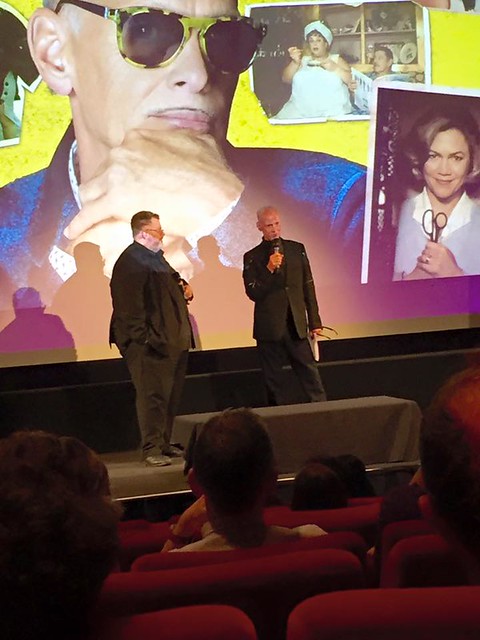
Courtesy of my film journalist friend Damon Wise (a long-time Waters confidante), I got into the 100% sold-out "John Waters in Conversation" event on Friday 18 September as his “plus one” guest. Waters was interviewed onstage about career (illustrated with well-chosen clips from his films) and then fielded questions from the audience. The “peoples’ pervert” was on scintillating form throughout – the man is a supreme raconteur.

My favourite part of Waters’ onstage discussion: he was asked about the inspiration behind Divine’s striking appearance as bitch goddess extraordinaire Dawn Davenport in his 1974 masterpiece Female Trouble. He explained that while Divine revered Liz Taylor (to the point that Divine smoked Salems - the same brand of cigarettes Taylor was known to prefer - in tribute) and that the fatter Taylor got, the more she actually began to resemble Divine – the real source for Dawn Davenport was the beehive-haired, heavily made-up mother in Diane Arbus’ famous 1966 photo “A Young Brooklyn Family Going for a Sunday Outing, N.Y.C.”


/ A Young Brooklyn Family Going for a Sunday Outing, N.Y.C (1966) by Diane Arbus /


/ Divine as Dawn Davenport in Female Trouble (1974) /

Afterwards Damon smuggled me into The BFI’s elite VIP green room (as you may recall, the last time I was in there I was seated directly opposite Fifties Hollywood heartthrob Tab Huntersigh!). Waters was holding court amongst his entourage before introducing a screening of Serial Mom and then doing a book-signing session. (He’s the hardest working man in show business!).  It was a strange and interesting mix of people. Water’s London friends included Helena Kennedy QC (Baroness Kennedy of The Shaws), fuchsia-haired fashion doyenne Zandra Rhodes, talk show host Graham Norton and (most glamorous of all) transgender pioneer April Ashley (with a mane of silver bouffant hair, clad in a flowing green caftan).  I only spoke to Waters very briefly on the Friday night. I told him that when I was in New Orleans in April I made a point of going to his two favourite seedy dive bars – the Corner Pocket (hustler bar where the boys dance on the bar in the underwear – reportedly the inspiration for The Fudge Palace in Waters’ film Pecker) and The Double Play (clientele is mainly trans prostitutes, hustlers, their johns and junkies). “Isn’t the Corner Pocket great?” Waters enthused.

The night of Saturday 19 September saw the high potentate of trash taking the stage at The BFI again (he wore a different striking Comme des Garcons ensemble at every appearance), this time to introduce his freaky and deliciously nasty raw early film Multiple Maniacs (1970). I was accompanied by Mia, part of the duo behind The Amy Grimehouse interactive cult film collective. It’s a sentimental favourite of mine (I first saw it on VHS as a university student in Canada – it truly warped me), sadly unavailable on DVD. The close-ups of Divine – still an embryonic young starlet on the ascent – grinning maniacally and foaming at the mouth and hippie-punk bad girl Cookie Mueller go-go dancing topless are life-affirming sights.  The vomit-eater, bicycle seat-licker, junkie in withdrawal and two men kissing on the lips like lovers in Lady Divine’s Cavalcade of Perversions warmed my heart. And crucially, Multiple Maniacs represents the film debut of the much-loved gap-toothed “outsider” character actress and punk pensioner Edith Massey.


/ Above: David Lochary in Multiple Maniacs (1970) /


/ Joan Crawford in her final film Trog (1970) /

The Complete Films of John Waters (Every Goddamn One of Them ...): John Waters at The BFI

/ John Waters introducing Trog onstage at The BFI on Sunday 20 September 2015. Photo by Pal /

Sunday afternoon I returned to The BFI with my boyfriend Pal to see Waters introduce one of his specially-chosen, personal favourites Trog (1970). (As a kind of side-bar to the main event, Waters curated his own mini-season of his much-loved British films called Teabaggin’ in the Kitchen Sink). I’d never seen Trog before:  the low-budget, ultra-kitsch (and very enjoyable) British sci fi / horror film starring a desiccated and down-on-her luck Joan Crawford (in her last-ever screen role) opposite a guy in a gorilla mask, loincloth and fur booties playing a “missing link” troglodyte on-the-rampage. Crawford is actually majestic in Trog: such steely conviction and professionalism in spite of the mortifying circumstances. We’d been promised that a secret special guest would join Waters onstage afterwards. It turned out to be Trog himself – the man behind the gorilla mask! The role was played by wrestler Joe Cornelius (stage name: The Dazzler). Now in his eighties and very hard of hearing, Cornelius nonetheless looked great in a shiny gold suit (very old-school Vegas showman) and regaled us with stories about the making of Trog - in particular his leading lady. (He was very gracious and chivalrous discussing Crawford – who, he insisted, was not drunk the whole time nor a temperamental Hollywood diva. Apparently she sent him Christmas cards for years afterwards!).


/ Above: Wrestler Joe Cornelius (aka The Dazzler) in his prime /

That Sunday afternoon after Trog represented the last opportunity to see Waters’ rarely-seen early short films:  the Super 8 home movie juvenilia he made as a teenager fired up by the underground cinema of Andy Warhol and Kenneth Anger, which we've all only read about in his 1981 book Shock Value. These works are sealed in Waters’ personal vault and almost never get public airings – they represent year zero for John Waters fanatics like me. Frustratingly, The BFI made seeing them as difficult as possible: they were shown in the cinema’s smallest room and tickets were sold on the day in a first come-first serve basis. Managing to get a ticket was the equivalent of winning the lottery! Sadly, the final screening sold out even before I could attempt to queue for the tickets! So I'll probably never see Hag in a Black Leather Jacket (1964), Roman Candles (1966) or Eat Your Make-Up (1968) now – they will exist only in my imagination! Damon even went to the box office to plead on my behalf – but with no success.

The silver lining: instead, Damon snuck me back into the green room and we got to hang out with Waters again.  This time there were only maybe five of us in there and Waters was on relaxed, loquacious form while he autographed stacks of his books (mainly Carsick) for the BFI's book store and killed time until he introduced a screening of Cecil B Demented later on. I told him I went to see his friend, veteran sex kitten and camp icon Pia Zadora's jazz revue at Italian restaurant Piero’s when I was in Vegas in April 2015. Waters spoke about her with genuine affection and concern (“Did it do well? Did people like it?” Apparently Zadora’s recent residency in Los Angeles wasn’t so successful. I suspect Vegas is her natural habitat).

Interviewed for the September 2015 issue of Sight & Sound magazine to promote The BFI retrospective, Waters had reminisced about how as teenagers he and Divine used to attend Ike and Tina Turner gigs in the sixties when they’d perform in Baltimore and what a big influence feral wigged-out bold soul sister Tina was on his aesthetic. He told us he was flying to Switzerland the following morning for an art exhibit and spoken word gig. Switzerland is, of course, also where retired rhythm and blues tigress Tina now resides. Waters has written about how over the decades he managed to meet most of his heroes: the disparate likes of Little Richard, Nico, Johnny Mathis, Elizabeth Taylor, William S Burroughs. I asked him if he's ever met Tina Turner and Waters exclaimed, “No!” He admitted he’s afraid to in case he's disillusioned - or if Turner was angry with him. Considering Waters has said in the past that Tina was at her best when she was still with Ike, wearing a ratty wig and still had a moustache, Turner’s reaction to meeting him would bound to be interesting. Waters also pointed out for one of his earlier art exhibits he commissioned a conceptual sculpture of a giant Ike Turner manipulating a marionette puppet of Tina. He suspected she wouldn’t see the funny side of that! Finally, we all bade Waters goodbye when the car arrived to take him back to the hotel. It was a truly great end to the weekend.


Postscript: Waters may have departed London, but for me The BFI season properly ended the following Sunday (27 September) when Pal and I went to see Boom! (one of Waters’ Teabaggin’ in the Kitchen Sink selections).


/ Elizabeth Taylor in Boom! (1968) /

“If you don’t like this film, I hate you.” John Waters

Boom! The shock of each moment of still being alive!

It was a real trip to re-visit Boom!, the berserk and baroque 1968 Joseph Losey-directed film adaptation of the flop Tennessee Williams play starring Liz Taylor (in her fleshy, caftan-wearing era) and an alcohol-ravaged Richard Burton. The brawling, hard-drinking Taylor and Burton were reportedly drunk for most of the filming of Boom! (Pal and I got into the spirit of things by downing powerful Bloody Marys beforehand). I’d only ever seen Boom! once before – and that was way back in 2011 when I saw it at The Institute of Contemporary Art with my much-missed late friend Alison. (Alison was a major Liz Taylor fan – I’ll always associate Boom! with Alison).  Trying to make sense of it, I blogged about Boom! at the time. You can read it here. 

Boom! is, of course, one of Waters’ most-cherished films – he appreciates it as a “failed art movie” and has written extensively and eloquently about it and even taken the film on tour, introducing it beforehand. (Famously, Waters once attended a July the fourth party at Liz Taylor’s Hollywood home in the eighties. He made the mistake of telling her how much he loved Boom! Assuming he was making fun of her, Taylor took offence, flew into a rage and shouted, “That’s a terrible movie!”).

Yes, Boom! is awful in many ways, but it’s toweringly, majestically, compellingly bad. It’s mind-boggling. And no one delivers Williams’ most overwrought dialogue quite like Taylor in full scenery-chewing mode. “You can watch [Boom!] a hundred times and never know if Losey meant it to be camp,” Waters has mused. “Camp isn’t the right word. Camp means “so bad it’s good.” This is not “so bad it’s good.” This is so bad it’s art. This is so bad it’s confusing. Or this is so great it’s confusing. You don’t ever know the tone of it. It is, to this day, mysterious to me.”

Further reading: I've blogged about John Waters - one of my key and most treasured inspirations - many times over the years. Read 'em all! My epic 2010 interview with Waters for Nude magazine. When John Waters Met Nico. A Reunion with the Prince of Puke Part 1 (2011). John Waters' Christmas Show at The Royal Festival Hall in 2011. The Amy Grimehouse John Waters Filth Festival in 2014. Reunion with the Prince of Puke Part 2 (2014). Reflections on John Waters' book Role Models