Showing posts with label gay. Show all posts

Wednesday, 3 January 2018

Reflections on ... episodes 1-4 of Feud: Bette and Joan


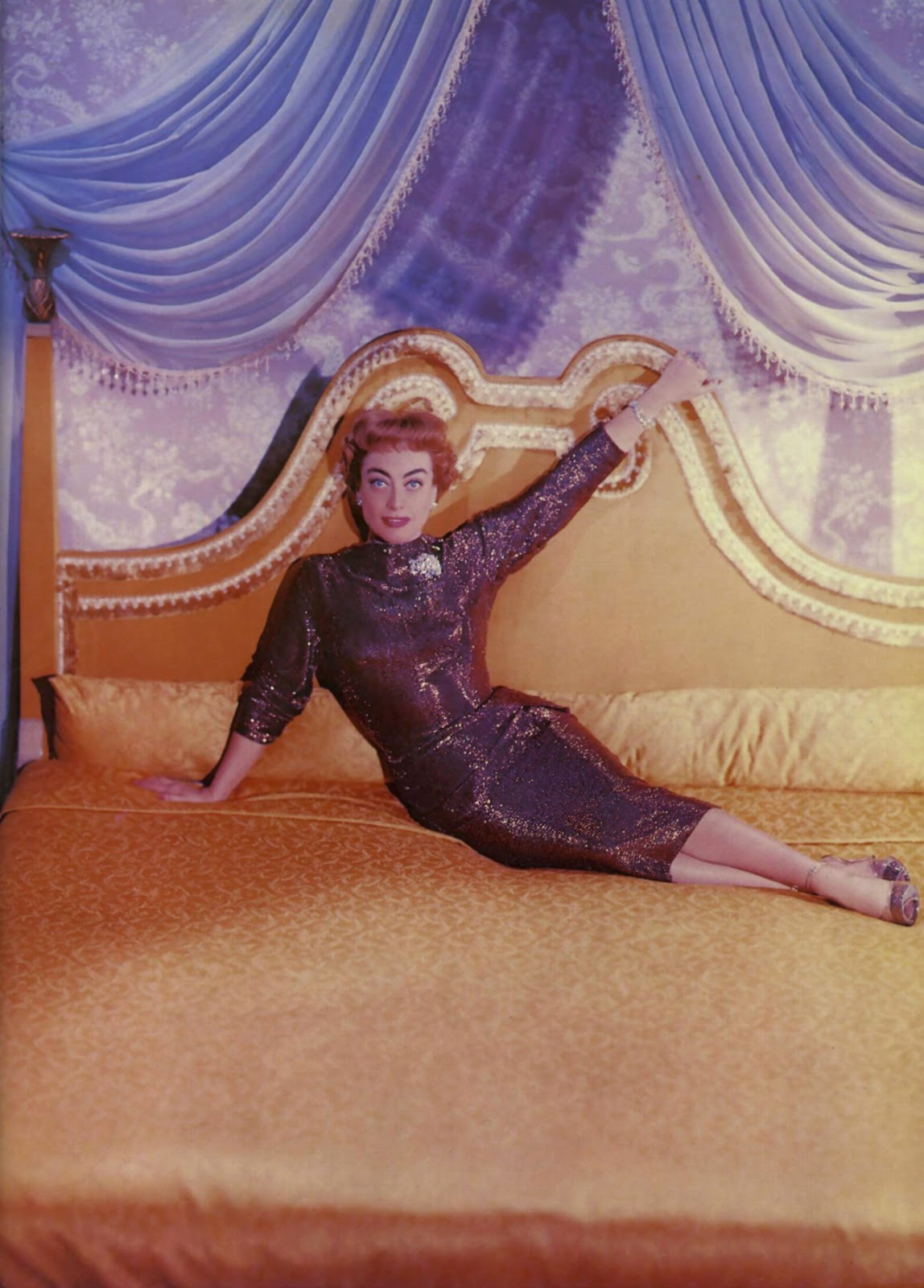
Just some random thoughts, musings and reflections on re-visiting the first four episodes of the insanely enjoyable Feud: Bette and Joan (2017) -  Ryan Murphy’s deluxe eight-part TV mini-series covering the rivalry between veteran screen queens Bette Davis and Joan Crawford (above) during the making of What Ever Happened to Baby Jane? (1962) - on BBC2. (I originally watched Feud when it was first broadcast by FX in Spring 2017).


/ Above: the real Bette Davis, Jack Warner and Joan Crawford at press conference announcing What Ever Happened to Baby Jane? /


/ Joan Crawford (Jessica Lange) and Bette Davis (Susan Sarandon) in Feud /

First two episodes: Sui Generis and The Other Woman

The costumes and set design (by Judy Becker, who also designed the mid-century look of Todd Haynes’ film Carol) are glorious. Any time one of the characters click-on a pair of severe vintage cat’s eye sunglasses, I involuntarily gasp. Even the food is immaculately retro: when Crawford and Davis dine at gossip columnist Hedda Hopper’s, Davis kvetches, “Fish Jell-o?” (Hopper corrects her: it’s salmon in aspic. Or “en gelée” as I prefer). As you can see from the photo above of Bette Davis, Jack Warner and Joan Crawford at the press conference announcing What Ever Happened to Baby Jane? some of the outfits have been meticulously recreated. I especially love Crawford’s palatial cream-and-turquoise Hollywood mansion with the cherry tree, the Chinese interior motifs and the white grand piano in the living room. Like any self-respecting diva, she has an ultra-flattering glamorous portrait of herself (complete with museum lighting) above the mantelpiece. 


Davis addresses Crawford as “Lucille”. (Crawford’s real name was Lucille Fay LeSueur). Was that true? In the Hollywood film community, did people routinely call Crawford “Lucille” – or was that Davis’ way of undermining her? On film sets, was Cary Grant referred to as "Archie" or Marilyn Monroe as "Norma Jean"?

Exemplary, stylish use of atmospheric period music on the soundtrack: Nat King Cole, Mel Torme, Perry Como, Sarah Vaughan, Brenda Lee, Paul Anka, “Itsy Bitsy Teenie Weenie Yellow Polka Dot Bikini”, “Wives and Lovers” by Jack Jones.

Feud freely takes liberties with (or "streamlines") the facts or at least chronology for maximum dramatic impact and greater psychological truth. For example: in episode one we first encounter a drunken Crawford in 1961 at the Golden Globe awards silently seething with resentment as a gold lamé-clad Marilyn Monroe shimmies past her onto the stage to accept an award. (No one seethes with drunken resentment quite like Jessica Lange). This incident did happen, but much earlier – at the 1953 Photoplay Awards when red-hot newcomer Monroe won the Rising Star award and earned Crawford’s disapproval. But who can blame Ryan Murphy for shuffling the time frame around for his own narrative purposes? In episode one, this scene perfectly establishes how sidelined and embittered Crawford felt at the time. 


/ "Hebrews and Sodomites, greetings!” / 

In episode one we see a fleeting glimpse of director Robert Aldrich working on a tacky “sword-and-sandals” Biblical epic, which is meant to represent the mortifying nadir of his career. (Like Davis and Crawford, he is also desperate for a comeback pre-Baby Jane). This film was in fact 1962’s Sodom and Gomorrah (also known as The Last Days of Sodom and Gomorrah) – and as far as these things go, it’s not half bad! I enjoyed it when I watched it several years ago. (It used to be available on YouTube). I liked its camp value, but perhaps mainly because of the presence of exquisite, inscrutable French actress Anouk Aimee as the depraved villainess Bera, Queen of Sodom. For a film of its time, it’s surprisingly overt about Bera’s lesbianism (she is always surrounded by an all-female entourage and appreciatively ogles belly-dancers and pretty slave girls). When people write about the history of LGBTQ representation in Golden Age Hollywood films, how come Sodom and Gomorrah never rates a mention? Aimee spoke perfectly fine French-accented English but weirdly, Aldrich opted to have her dialogue dubbed by an American actress. And – as a coincidence – with her dark eyebrows and sculpted cheekbones, doesn’t Aimee slightly resemble a young Joan Crawford?

Susan Sarandon and Jessica Lange were justifiably praised for their performances as Davis and Crawford when Feud premiered on FX in March 2017, but watching it again so should be the supporting actresses Judy Davis (malevolent gossip columnist Hedda Hopper) and Jackie Hoffman (Crawford’s ultra-efficient German maid Mamacita). Watch Davis’ perfectly-judged split-second horrified reaction when Lange complains about the pressures of stardom and breezily tells her, “You’re so lucky you weren’t successful as an actress.” And Hoffman’s deadpan Teutonic line delivery: telling the gardeners impatient to get paid, “It’s an honour to trim Miss Crawford’s bush.”


/ The long-suffering Mamacita with Miss Joan /

Vanity Fair vividly describes Lange’s tremulous, frequently drunk, almost operatic Joan Crawford as “a booze-saturated, violently wilted flower” and “a volatile hurricane, an addled tragedy in a musty dress.” Someone else (I forget who) described Lange’s representation of Crawford as almost being like a Tennessee Williams character, which raises the intriguing question: imagine if Joan Crawford had ever played a Tennessee Williams role! What would Crawford have been like as Violet Venable in Suddenly Last Summer (1959) instead of Katharine Hepburn? Or as Karen Stone in The Roman Spring of Mrs Stone (1961) instead of Vivien Leigh? It’s also, of courses, fascinating to compare Lange’s Crawford with Faye Dunaway’s berserk Kabuki representation of her in Mommie Dearest (1981).


Sarandon’s portrayal of Davis is more dialed-down and lower-key. (In interviews Sarandon was insistent she deliberately avoided slipping into a Bette Davis impersonation). I happened to love Sarandon's interpretation of Davis - some found it underwhelming. She nicely captures Davis’ flat-footed waddling walk, low-slung bosom, gimlet-eyed stare, clipped speech patterns and innate blunt, emotionally direct toughness. Within Feud Davis is depicted as relatively sane, level-headed and stable in comparison to Crawford. In real terms, Davis was probably just as much of a frequently hard-drinking and temperamental holy terror as Crawford, just in a different way. For example: we see a glimpse of Davis onstage in 1961 as Maxine in a stage production of Tennessee Williams’ play Night of the Iguana (the role Ava Gardner would later play onscreen). Read any Tennessee Williams biography and it’s well-documented that Davis was an absolute nightmare to deal with, loathed by the cast and crew for her spoiled movie star antics. (This is the single best profile of Davis I've ever read. It gives a real sense of what a difficult, tormented woman she would have been off-screen).


/ Above: Bette Davis onstage in Night of the Iguana /


Davis was 53 during the making of Baby Jane. Sarandon was 71 when she played her. And yet Sarandon throughout looks considerably younger and more glamorous than the defiantly, unapologetically frumpy middle-aged Davis. (Even made up as Baby Jane Hudson with the ringleted little girl wig and chalky white powder, Sarandon never matches Davis’ grotesquery in the role). Who Sarandon really resembles is Tallulah Bankhead. (The makers of Feud seem to have decided that the Davis of 1961 should resemble Davis as Margo Channing in All About Eve (1950) – who was overtly based on Bankhead).


/ Above: the dissolute Tallulah Bankhead /

Episode 3: Mommie Dearest


/ Jessica Lange as Joan Crawford holding court at Perino's /

Feud repeatedly shows the luxe Art Deco cocktail lounge and restaurant Perino’s in Los Angeles (now long defunct) as one of Crawford’s frequent haunts. But would Crawford really have gone there accompanied by her housekeeper Mamacita to drink Martinis? (Perino’s also featured in the 1981 film Mommie Dearest. In one scene after Louis B Meyer takes her to dinner there, an enraged Crawford fumes, “Perino’s is my place!”). Interestingly, I don’t think Feud ever depicts Davis there, but in real life she was a habitué of Perino’s and maintained her own permanently-reserved personal booth. Perino’s closed in 1986, was razed in 2005 and is now the location of an apartment complex.

“I’ve always been a strict disciplinarian. Some people perhaps find I’ve been too strict, especially with my first two, Christina and Christopher …” There’s something ballsy about how Feud directly tackles the legacy of Mommie Dearest in this episode. Crawford’s adopted daughter Christina Crawford’s tell-all misery memoir came out in 1978. The notorious film adaptation starring Faye Dunaway followed in 1981. One of the most positive aspects of Feud is how Murphy and Lange rehabilitate and humanize Crawford as a complex, tragic and flawed figure. Mommie Dearest no longer has the last word.

The sequence where Davis and Crawford temporarily bury the hatchet long enough to have drinks alone together after work and really let their hair down is a high point of the entire series. This would never have happened in real life - these highly competitive sworn enemies confiding in each other about their relationships with their mothers and their children, their childhoods and their sex lives over cocktails? (Crawford shocks Davis by admitting she lost her virginity to her stepfather aged 11. Davis waited until she was 27 on her honeymoon). And yet who could quibble when the scene is so beautifully written, acted and directed, effortlessly cramming-in several biographies worth of info about the two women and their lives?


Kiernan Shipka (aka Sally Draper from Mad Men) co-stars as Davis’ teenage daughter BD Hyman. The inexperienced, non-professional Hyman wound up in a supporting role in What Ever Happened to Baby Jane? as the neighbour’s adolescent daughter – and she was a notoriously inept actress. Re-watch Hyman in Baby Jane and Shipka only hints at just how outrageously sub-Edward D Wood Jr-level bad Hyman is in her few brief scenes. The constant eye-rolling! Aldrich actually compensates by cutting away from Hyman while she speaks! I loved Sarandon’s blankly horrified reaction as it dawns on her just how incompetent BD is, and her later motherly attempts to reassure her with tactful faint praise. “You spoke clearly. You hit your marks. You didn’t look into the lens once – not once!”


/ The real BD Hyman and Davis /

Davis and Crawford clash when Davis complains that she was “robbed” for not winning Best Actress in 1950 for All About Eve.  “It was Gloria Swanson who was robbed in 1950, not you, bitch!” Lange shrieks, her voice dramatically swooping on you. Sheila O’Malley in The New York Times: “Lange catapults her voice up into the stratosphere, with the final words elongated into a near-operatic screech. It’s such a bizarre and brilliant choice, the hugeness of expression matching the hugeness of the emotion.”

“That face right into camera. This really is a horror picture!” Crawford watching Davis film that famous Baby Jane shot of her applying lipstick straight into the the camera is if facing a mirror. Below: the genuine article. 


Davis showing maternal concern for gay Baby Jane co-star Victor Buono. “All the queens love me!” she proudly declares, acknowledging, “I only really knew I’d made it when the female impersonators started doing me in their acts.” It’s probably true that Davis was already a cult figure amongst queers by the early sixties alongside Judy Garland and Tallulah Bankhead. Buono asks her to do the “What a dump!” line from Beyond the Forest and she obliges. Buono to Davis: “I think it’s so admirable the way you’ve embraced my tribe.”

Insight beyond Davis’ hard-boiled veneer:  we witness her private guilt and anguish over her disabled daughter Margo, who lives in an institution. One of Davis’ pressures to keep working – even when the good roles have dried-up – is to continue paying the bills for Margo’s special school.

Crawford also has some wrenchingly sad moments. “The mad rush that was once my life … all you’re left with is yourself” she laments to Mamacita as she mourns her twin daughters leaving home for boarding school, the death of her husband (Pepsi magnate Alfred Steele) and the decline of her acting career. Later, we see Crawford attempting to adopt another baby. When the she is refused (“You’re simply too old”), Crawford responds like the words are a slap across the face. (Lange excels at wordless moments like these).

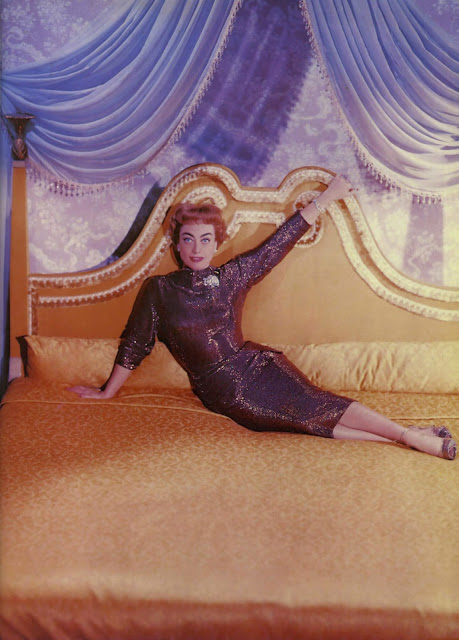
/ Below: might the design of Crawford's ultra-glamorous boudoir in Feud have been influenced by ...


... Joan Crawford in Queen Bee? (1955) /


“All those years of alcohol abuse have exacted a terrible price …” Crawford unkindly says to Hedda Hopper about her ravaged co-star Davis.

Funniest moment: Crawford and Mamacita are on location at the beach for Baby Jane’s climactic finale. “It’s warm, Mamacita. I’m going to need my water standing by.” By this point the alcoholic Crawford has been seen repeatedly availing herself of her secret flask of vodka. Mamacita warily asks, “Which water?”

Episode 4: More or Less


/ Lange recreating an iconic moment as Crawford in Baby Jane /

The episode mainly explores the indignities and vagaries of fame when stardom is on the wane. (Baby Jane was yet to be released; advance word anticipated it would flop). Feud is at its least engaging when it imposes its present-day feminist theme too heavy-handedly, overly eager to cast Davis and Crawford as casualties of Hollywood misogyny and ageism. (The other weakest aspect: the sequences with Joan Blondell and Olivia de Havilland reminiscing). In this episode, we see the fictional character of Aldrich’s assistant Pauline – an aspiring director – stymied by industry sexism.

Aldrich’s next film after Baby Jane was the 1963 rat-pack Western 4 for Texas. Feud captures what an arrogant prick that movie's prima donna leading man Frank Sinatra was. It gradually dawns on Aldrich that sure, Davis and Crawford were difficult, demanding and needy, but paragons of professionalism compared to Sinatra’s bullying man-child tantrums.

My personal highlights:  Crawford’s angry meeting with her agents at the William Morris agency deliberately echoes the scene in Mommie Dearest where Faye Dunaway rages at the Pepsi executives (“Don’t fuck with me, fellas!”). A nice touch.

Mamacita vacuuming the spectacular grand staircase to the strains of Gene Pitney’s “Town without Pity.”

When a distraught Crawford wails, “It’s just like 1937 all over again.” Mamacita replies, “When Hitler took Austria?” Crawford (ever the self-absorbed film diva): “No, when they labelled me box office poison.”

Davis on The Andy Williams show warbling her outrageously campy Chubby Checker-inspired novelty twist song in powder-blue pleated chiffon. What a bonanza of camp! No wonder the queers of 1962 had already embraced Davis as their queen! Watch how Sarandon lovingly recreates every swirling arm gesture and grimace.


/ Update! Read my analysis of episodes 5-7 of Feud here /

Thursday, 26 October 2017

Reflections on ... Valley of the Dolls (1967)


Lobotomy Room Goes to the Movies is the FREE monthly film club downstairs at Fontaine’s devoted to Bad Movies We Love (our motto: Bad Movies for Bad People), specialising in the kitsch, the cult and the queer! And on Wednesday 20 September, we commemorate the fiftieth anniversary of Valley of the Dolls (1967)!

Before Mommie Dearest ... before Showgirls ... the original “What the hell were they thinking?” Bad Movie We Love was show business cautionary tale Valley of the Dolls. A perennial favourite of drag queens and a cult classic for connoisseurs of kitsch, the unintentionally hilarious and wildly entertaining 1967 film adaptation of Jacqueline Susann’s scandalous 1966 bestseller took the already lurid source material – and went even trashier with it! (An enraged Susann herself called the film “a piece of shit”!).

Throw on a bouffant wig, get yourself a stiff drink and strap yourselves in for a wild ride when Lobotomy Room Goes to the Movies presents Valley of The Dolls! 

As usual: arrive circa 8 pm to order your drinks and grab the best seats downstairs in The Bamboo Lounge. (Seating is limited! First come, first serve!). The film starts at 8:30 pm prompt.


“Bitches in wigs!” Drag queen Jackie Beat

“You’ve got to climb Mount Everest to reach the Valley of the Dolls …” Barbara Parkins' spoken introduction to the film Valley of the Dolls (1967)

“Boobies. Boobies. Boobies. Nothin’ but boobies. Who needs ‘em?” Patty Duke as Neely O’Hara in Valley of the Dolls

“Adult books / I don't understand / Jackie Susann meant it that way …” from the 1981 song “Adult Books” by Los Angeles punk band X


/ Casualties of the glamour jungle: Valley of the Dolls covers the show business travails of our three heroines (left to right) Anne Wells (Barbara Perkins), Neely O'Hara (Patty Duke) and Jennifer North (Sharon Tate, centre) /


Valley of the Dolls is a legendarily bad film with a terrible reputation. It is frequently categorised – albeit usually with affection – as a “bad film we love”, “so-bad it’s good” or “guilty pleasure.” But I’m ready to out myself: I’d genuinely rank Valley of the Dolls as one of my all-time favourite films. In fact, for me it’s as addictive as the fistfuls of “dolls” (pills) the film’s three main characters pop as casually as Tic Tacs.


Watching Valley of the Dolls lulls me into a trance of pure pleasure. The film unspools like a shimmering, hallucinatory pink fever dream. Like Mommie Dearest (1981) or Mahogany (1975), it’s an allegedly “bad movie” that is so wildly entertaining on every level, it collapses conventional distinctions between “bad” and “good”. The far more tasteful and respected 1952 talkathon All About Eve (1950), for example, covers much of the same “show-business-is-hell” thematic territory as Dolls (especially the bitchy antagonism between ageing veteran actress Helen Lawson and young upstart Neely O’Hara). Eve is heralded as a Golden Age Hollywood classic, but I’d argue the trashier Dolls is infinitely more enjoyable.


And it improves with repeated viewings. Dolls is a truly life-changing film! The insane dialogue was surely meant to be memorised and quoted. Along with the oeuvre of John Waters, I’d argue watching Dolls should be an essential rite of passage for all self-respecting queers. Sound-tracked by the haunting and ethereal Dionne Warwick theme tune (which you hear over and over and over again), the movie adaptation takes outrageous liberties with Jacqueline Susann’s sizzling original 1966 source novel. (If you haven’t read the book I highly recommend you do). Entire characters and subplots are excised – and the ending is radically changed. No wonder Susann hated the film! It’s not so much a faithful adaptation as a frantic summary of the book’s emotional climaxes as lurid bullet points. Think 123 spellbinding minutes of teased hair, bouffant wiglets, mood swings, mink coats, love affairs, emotional meltdowns, catfights, pill-popping, abortions, drug overdoses, nervous breakdowns, terminal illness, rehab, drunkenness, and slaps across the face.


Undistinguished hack director Mark Robson is usually blamed for the hypothetical flaws of Dolls (and he was reportedly nasty and bullying towards the lead actresses). But he’s also responsible for the film’s berserk, wildly lurching tone and the hammy performances (he apparently encouraged everyone to over-act) – so I am forever in his gratitude! It’s precisely his lack of judgement and control over the sensational material that makes Dolls so pleasurable. And to his credit, Robson shows some unusual, creative, and stylish flourishes too. When Neely recounts her hellish stint drying-out in a sanatorium to Anne and Lyon, the flashbacks are hazy and almost hallucinatory. And the glimpse of Jennifer’s subtitled French “nudie” art film is a viciously funny parody of almost every Brigitte Bardot film ever made (most overtly, Bardot’s nude sequence at beginning of Le Mepris).


/ He's just not that into you: that cad Lyon Burke and Anne Welles in Valley of the Dolls. Via /

Special mention must be given to Dolls’ several music numbers. Except for Anthony Scotti as Tony Polar, no one does their own singing - which really adds to the film’s artifice. (Speaking of artifice: when one character has her wig yanked off in a fight, she’s wearing another wig underneath!). Saturated in faux-Continental sophistication and Vegas lounge schmaltz, the middle-of-the-road quasi-show tunes belted by Neely, Helen and Tony are gloriously unmoored from the real-life youthquake pop culture of 1967. (Remember: this was the era of psychedelia, protest music, The Velvet Underground and Nico). This strange, campy ersatz “swinging” music (by Andre and Dory Previn) exists entirely in its own realm. Neely’s star-making performance of the perky “It’s Impossible” has an almost Eurovision vibe. (My favourite moment: when the strands of beads Neely is wearing around her neck miraculously suddenly loop perfectly around each boob like a bra. I love that this unintentionally hilarious shot was left in! It never fails to make me guffaw aloud). Fierce stage diva Helen working herself up into a frenzy squawking about planting her own tree (“my tree will not be just one in a row!”) is one of the great kitsch moments ever captured on celluloid. (Michael Musto has noted that Susan Hayward embraces the lip-synching so avidly that her mouth gapes open long after the final triumphant note she’s miming to has ended).


The chief pleasure of Dolls is the performances of its lead actresses. Susann’s novel had caused a sensation in ’66, so the film was a red-hot film property, every bit as hyped as Gone with the Wind had been in the 1930s. Just as with the hunt for Scarlett O’Hara, every happening young actress of the period was up for consideration for the main characters. It’s fun to imagine the various casting combinations that were proposed: Candace Bergen for Anne. (Susann herself wanted Mia Farrow). Natalie Wood or Ann-Margret as Neely (Susann would have preferred Barbra Streisand). Raquel Welch or Jane Fonda as Jennifer (Fonda was also considered for Neely. Susann’s own choice for Jennifer: Tina Louise – Ginger from Gilligan’s Island!). You can also throw Tuesday Weld, Liza Minnelli and Faye Dunaway into the mix. Meanwhile, Bette Davis, Joan Crawford and even Lucillle Ball reportedly vied to play Helen before the part went to Judy Garland (and then Susan Hayward). Fun as it is to speculate how Dolls would have turned out with these alternative rosters of actresses, for me the final cast is perfection.


/ Barbara Parkins as Anne Welles: Good girl with all the bad breaks! /

As prim, long-suffering good girl Anne Welles, Barbara Parkins is superbly inexpressive and wooden with an immaculate frost-bitten lady-like demeanour. No matter what travails Susann’s plot throws at her, no matter how badly the callous Lyon Burke treats her, Anne’s face remains a rigidly-composed mask. Parkins - styled to evoke Jackie Kennedy -  also seems to occasionally slip into a patrician British accent. Her best line: “Neely, you’re being obnoxious!” Parkins’ performance is pretty terrible by most standards, but her lustrous bouffant mane is impeccable, and she stares out of train windows and suffers in mink beautifully. And her Gillian Girl hairspray advertisement is a mind-blowing camp extravaganza.


/ Sharon Tate as Jennifer North: Sex symbol turned on too often! /

The acting of Sharon Tate as doomed sex bomb Jennifer North is hesitant, remote, and uncertain in the fragile tradition of Kim Novak. Is Tate “good” or “bad” as Jennifer? Certainly, she imbues Jennifer with a dopey Marilyn Monroe-like child-woman vulnerability. Watching her, you’re reminded me of Pauline Kael’s review of Some Like It Hot: “Monroe gives perhaps her most characteristic performance, which means that she's both charming and embarrassing.” Tate has two undeniably great moments. When hip-swiveling smoothie nightclub singer Tony serenades her with the ballad “Come Love with Me” and they instantly fall in love, Tate does dewy-eyed, besotted wordless simpering better than any of the ingenues in an Elvis musical – and that includes Ann-Margret and Nancy Sinatra. (Susann originally modeled Tony on the old-school suave Brylcreemed likes of Dean Martin and Frank Sinatra but as portrayed in the film, he’s a macho crotch-thrusting Vegas stud more in the tradition of Tom Jones or Engelbert Humperdinck). And Tate is genuinely tragic in Jennifer’s suicide scene in that orange and brown hotel room, gulping down a fatal dose of pills while staring at herself in the mirror.


/ Above: "At night, all cats are grey ..." Lee Grant as Miriam. Via /

Honourable mention must go to Lee Grant in the supporting role of Jennifer’s scheming and secretive sister in law Miriam. Like her peer Shelley Winters, Grant is from the intense, nostril-flaring Method school of acting. And like Winters, Grant demonstrates no one hams it up quite like a Method Actor. It’s been noted that even when completely silent and standing completely still, Grant still manages to overact furiously in Dolls. Whether eavesdropping on conversations, hovering around corners, having tense telephone conversations with doctors, heating-up lasagna or just lounging at home alone in a bathrobe (while wearing a thick glossy chestnut wig and false eye-lashes), Grant approaches the role like she’s in a Greek tragedy. In her 2014 memoirs Grant admitted she underwent her first face lift when she was still in her thirties. Certainly, her face in Dolls is stretched as taut as a drum. Grant’s best moments: when she cryptically warns Tony, “How many times do I have to tell you? At night all cats are grey” as if imparting ancient mystical wisdom. (What does that even mean?). And - when Tony’s medical bills begin piling up - Miriam shamelessly pimps Jennifer to a high falutin’ French pornographer (I mean, film director) with, “You’ve posed undraped on the stage before.” Miriam would be Grant’s ultimate role until she played the drunk rich bitch slapped around by stewardess Brenda Vaccaro in Airport ’77. (I also love Grant’s brief, ghostly appearance in David Lynch’s 2001 tour de force Mulholland Drive).


Susan Hayward as Helen Lawson: A gut, fingernail, and claw fighter who went down swinging /

Judy Garland was initially cast as scary show business dragon woman Helen Lawson, but she was fired for drunkenness and clashing with the director. (Garland got revenge by swiping her Travilla costumes). Reliable pro Susan Hayward was drafted in to replace her at the last moment. While it’s a great cinematic “What if?” for Garland fans, I think the hard-boiled, tough-as-nails Hayward is majestic as unapologetic bitch Helen. Defiant and abrasive with a butch, rasping chain-smoker growl, Howard savours every barbed line. “The only hit that comes out of a Helen Lawson show is Helen Lawson, and that's me, baby, remember?” she rages. “Neely hasn't got that hard core like me. She never learned to roll with the punches. And, believe me, in this business they come left, right and below the belt!” she gloats about her vanquished nemesis. “I'm a barracuda!” Howard snarls triumphantly, swilling champagne while wearing a green sequined caftan. Her Helen is a bitch goddess extraordinaire. And the fuss over Helen Lawson’s auburn wig is unfair: everyone in the film wears wigs and hairpieces throughout! In fact, in that infamous wig-tearing scene Neely’s own hair appears to be augmented with a wiglet. And the powder room attendant who comforts Helen is sporting an acrylic orange Ronald McDonald clown wig. (Seriously – check her out!). Wigs. Wigs. WIGS!


/ Patty Duke as Neely O’Hara: Nice kid turned lush /

Ultimately, though it’s Patty Duke who owns Valley of the Dolls as show business monster Neely O’Hara. Duke had won a Best Supporting Actress Oscar aged just 16 for playing Helen Keller in The Miracle Worker (1962) and then starred between 1963-1966 in the pert ultra-kitsch Patty Duke Show on TV (as identical twin cousins!). At 20, Duke was perhaps understandably eager to jettison her teenybopper image. A meaty, challenging role like Neely must have looked like the perfect chance to prove herself as a serious dramatic adult actress. And boy did Duke seize the opportunity with both hands! She doesn't so much act as rampage through Dolls. The more pill-head Neely unravels, the more magnificent Duke is. Gritting her teeth, screaming her lines, flailing and thrashing, Duke’s portrayal of Neely is like one continuous whiplash mood swing or temper tantrum (or what John Waters would call a “glamour fit”).  I read someone somewhere describe Duke’s Neely as a “sequined terrorist”, which is totally accurate. This is a truly towering, unfettered wild display in the tradition of Ann-Margret in Kitten with a Whip (1964) or Tommy (1975), Diana Ross in Mahogany (1975) and Faye Dunaway in Mommie Dearest (1981). At the time Duke’s performance was widely ridiculed. Even though Dolls was a commercial hit, there was speculation it would destroy her career. (Like Dunaway with Mommie Dearest, for years the mortified Duke refused to talk about Dolls. To her credit, towards the end of her life Duke embraced the film’s kitsch devotees). Today, her depiction of Neely O’Hara appears fearless and risky, nobly unafraid to appear foolish, pathetic, or desperate. Patty Duke died in 2016. I’d argue her crowning achievement was her incarnation of Neely O’Hara, destined to be continuously re-discovered by new generations of aficionados of "a lavender persuasion". Sparkle, Neely – sparkle!


Further reading and viewing:

There is a bonanza of documentaries about Valley of the Dolls on YouTube. Designing Valley of the Dolls emphasises designer William Travilla’s deluxe eye-popping costumes. (Travilla is best-remembered for his collaborations with Marilyn Monroe on eight of her films. His most famous creation is the white pleated halter-necked dress Monroe wears in The Seven Year Itch). It offers a goldmine of juicy gossip and insight. One fun factoid: $25,000 of the film’s budget was set aside for wigs and hairpieces. Sharon Tate was paid $35,000. Patty Duke was paid $75,000. Poor Barbara Parkins was paid just $20,000. More money was spent on wigs than one of the film’s leading ladies! That reveals so much about the filmmaker’s priorities! Designing also includes stills from deleted scenes. For example, that famous image of an anguished Neely reaching for the giant jar of red pills never actually appears in Dolls: that’s a hallucination scene from the sanatorium, cut from finished film. I’d love to see all these deleted scenes! If the scrapped footage still exists someone should compile them as a DVD extra. Or better yet, assemble a three-hour “director’s cut” with all the deleted scenes re-inserted!


/ Below: A prime example of Travilla's understated costumes in Dolls, as worn by Anne Welles in the Gillian Girl hairspray advertisement /


This documentary (below) offers an insanely entertaining, concise analysis of Dolls’ enduring cult status through the prism of a true queer eye. Contributors include Bruce Vilanch, Michael Musto, drag icon Jackie Beat – and Barbara Parkins (Anne Welles herself!). The present-day Parkins (who’s seemingly styled herself as Madonna circa 1984 with the crucifix and sheer lace) is a revelation: self-aware, perceptive, funny, hip and appreciative of Dolls’ camp reputation. The footage from Theatre-A-Go-Go's legendary low-budget Dolls stage production is hilarious. Surely this play is overdue for a revival? I'd be in the front row every night.


Read the essential Dreams Are What Le Cinema is For blog’s astute examination of Dolls here. The author Ken Anderson first saw Valley of the Dolls as an 11-year old at The Castro Theatre in San Francisco. Beat that!

Perhaps the oddest Dolls-related artefact is the 1968 tie-in album Patty Duke Sings Songs from The Valley of the Dolls and Other Selections. Duke’s singing abilities can charitably be described as modest, which didn’t prevent her from scoring a hit single in 1965 with the Lesley Gore-like teen ballad “Don’t Just Stand There” (on which her voice is wreathed in forgiving reverb and cooing backing vocalists).  The far more challenging material on Patty Duke Sings horribly exposes Duke as way out of her comfort zone. Whose idea was this? The makers of the film clearly recognised Duke wasn’t capable of singing Neely’s musical numbers (which is why she was dubbed). So why let Duke tackle this misbegotten record? Her pained renditions of “It’s Impossible” (certainly it’s impossible to sing!) and “I’ll Plant My Own Tree” (Duke doesn’t stick just to Neely O’Hara’s songs – she massacres other characters’ as well) are so bad they wind up being horribly compelling. See if you’re masochistic enough to endure the entire album!


/ If you can't manage the whole record, here is a sampler: "It's Impossible" delivered in own Duke's own strident tones. /


/ Bonus material: in the film Susan Hayward mouths along to Margaret Whiting's belting delivery of "I'll Plant My Own Tree". However, before she was fired Judy Garland recorded her own version. This clip syncs Howard's performance with Garland's voice in an intriguing hint of what might have been. Wow! /


Read more about the Lobotomy Room film club here

Follow me on tumblr for all your vintage homo porn and retro sleaze needs!

"Like" and "Follow" my Facebook page for Lobotomy Room updates if you dare!

Sunday, 8 October 2017

Reflections on ... Tally Brown, New York (1979)


/ Tally Brown photographed by Francesco Scavullo in 1969 /
"... but the most magnificent, inimitable fräulein is the zaftig subject of Tally Brown, New York (1979) - a must-see for all those interested in performance and the cultural history of New York in the 70s. The bewigged Miss Brown, with false eyelashes capable of sending her short, round body aloft, is the most mesmerising raconteur and cabaret artist you’ll hear all year. Opening the film with her indelible cover of David Bowie’s “Heroes,” Tally concludes with “Rock ‘n’ Roll Suicide,” performing that song’s line – “You’re not alone! / Give me your hands”—as a rallying cry far more rousing than several decades’ worth of tepid gay-rights chants."
Melissa Anderson reviewing Tally Brown, New York in The Village Voice in 2003


/ Tally Brown photographed by Francesco Scavullo in 1969 /

Watching Tally Brown, New York (1979), I couldn’t help but think: thank god, a filmmaker documented this remarkable, charismatic and completely original woman. And that it was someone as simpatico as queer New German cinema maverick Rosa von Praunheim.

Von Praunheim weaves a revealing portrait of chanteuse, actress, show business doyenne, bohemian earth mother and all-round diva Tally Brown (1924 – 1989), preserving both her riveting nightclub act and her personal offstage life. And good thing he did as Brown -  a vivid scene-maker in New York’s underground art subculture in the sixties and seventies - seems to have completely fallen through the cracks in the decades following her death. A Torch for Tally – the blues album she recorded in the fifties – is long forgotten. The Andy Warhol art movies she appeared in like Camp (1965) and Ari and Mario (1966) languish unseen in locked vaults at The Warhol Foundation (I managed to catch them when the British Film Institute held a comprehensive Warhol retrospective about ten years ago. Brown is magnetic in both). In 2017, Tally Brown barely seems to exist as a footnote.


/ Tally Brown photographed by Francesco Scavullo in 1969 /

The Barbican screened this ultra-rare documentary (in a grainy 16-millimetre print on loan from The New York Public Library for the Performing Arts) on 4 October as part of it’s The Grime and The Glamour:NYC 1976 – 1990 series devoted to “the wild days and night of New York’s coolest era”. As the title implies, von Praunheim positions flaming creature Brown - a native New Yorker - as the personification of her city’s decayed glamour. In atmospheric and beautifully degraded footage, we see seventies New York at its most gloriously scuzzy, grungy and decrepit: the porn cinemas and peepshows of Times Square, gay bathhouses, The Chelsea Hotel, neon signs, dive bars, dissolute nightclubs. And it all looks heavenly!


/ Tally Brown photographed by Billy Name in the sixties (almost certainly at Max's Kansas City). This shot is in Name's 1997 book All Tomorrow's Parties - the first time I ever heard of Tally Brown /


/ Lady sings the blues: Tally Brown in her youth /

Brown was a classically-trained (at Julliard) and adventurous singer with a disparate repertoire who regularly performed at venues like Reno Sweeney’s, SNAFU and gay bathhouse The Continental Baths. Onstage, we see Brown deliver jazz and blues standards (like “Goody Goody” and an intense, emotionally tormented version of Kurt Weill’s “Surabaya Johnny”) with commanding authority. But she also had a penchant for wittily and radically re-interpreting modern rock music like “Love in Vain” and “You Can’t Always Get What You Want” by The Rolling Stones. She was especially partial to David Bowie. In the film we see her cover “Heroes” (she sings the final verses in Marlene Dietrich-like German), an eerie “Lady Grinning Soul” and “Rock’n’Roll Suicide.” Accompanied only by a pianist, Brown transforms the Bowie tracks into perverse torch songs. Call me a heretic but I’m no “rockist” or Bowie fan, so I prefer Brown’s slinky, dramatic, tortured and Eartha Kitt-like versions to the originals.


Brown moved in avant-garde circles and in von Praunheim’s film we encounter a pantheon of the era’s countercultural hip queer elite, including her friends Taylor Mead (his drooling village idiot antics are either enchantingly childlike or grating depending on your sensibility) and the effervescent, self-deprecating Holly Woodlawn. A silent Andy Warhol is briefly seen (but not interviewed). At one point No Wave “it girl” Anya Phillips performs an abject burlesque routine to a bar full of indifferent men. A glittering, turbaned Eartha Kitt is viewed carried aloft on the shoulders of a semi-naked African-American bodybuilder (she was then starring in the Broadway production of Timbuktu). For Divine fans the film offers a bonanza. We see him offstage with his own cropped greying hair, clad in a red kaftan and then onstage in full drag in a fragment of the 1978 stage production The Neon Woman. Post-show Brown “interviews” Divine backstage and jokes about regularly getting mistaken for him - and even signing autographs as him.


/ Above: Eartha Kitt as she appears in Tally Brown, New York (costumed for the musical Timbuktu) /


/ Divine and Tally Brown /


Divine (as Flash Storm) backstage during a performance of The Neon Woman at Hurrah in New York, 1978 /


/ Grace Jones and Tally Brown /

In an ideal world Brown would be revered as a LGBTQ icon. Certainly, she has qualities that should make her catnip for aficionados of camp. For one thing, Brown looks like an escapee from a John Waters film. Squint and she can resemble both Divine and Edith Massey. Her highly individual and distinctive appearance is extreme and drag queen-like. She favoured white powder, heavy black eye shadow, false eyelashes as thick as tarantulas and huge, ratty bouffant wigs. (Judging by the film, she also chain-smoked like a demon).  Brown’s plump feline face can evoke both Kewpie doll or Kabuki mask.


/ Tally Brown in the underground film Scarecrow in a Garden of Cucumbers (1972) /

And she was zaftig. Or Rubenesqe. Hell, the rotund Brown was frankly and defiantly fat and owned it. Von Praunheim shows her visiting a much-younger artist ex-lover who lives in The Chelsea Hotel. Asked what attracted him to Brown, he explains it was her sensuality and confidence about her size, likening her to “a fertility goddess … like the Venus of Willendorf.” Unfortunately, by the time von Praunheim made this film, Brown’s body was a ruined temple. Following an accident that shattered her knee, she relied on a cane and lived with a degree of immobility and pain.


Tally Brown, New York is most enthralling when von Praunheim simply follows Brown wandering around her local neighbourhood as she shields her vampiric pallor with a pink parasol, just like Vampira or Lily Munster. Or visiting her elderly mother in Florida (which Brown dismisses as “a geriatric ghetto”). The Floridian sunbathing seniors in pastel-coloured leisurewear stare aghast as Brown passes by. During these segments, accomplished raconteur Brown extemporises on the soundtrack about the vagaries of life on fringes of show business (she speaks with maternal tenderness about fallen Warhol superstars doomed to die young like Ingrid Superstar, Andrea Feldman and Candy Darling), her encounters with the Mafia, her love of marijuana (she was initiated into smoking reefer by jazz musicians and is contemptuous of “the Woodstock generation” embracing it). Her speaking voice is posh, cultured (she’s clearly had elocution lessons) and reminiscent of Eartha Kitt’s or Elizabeth Taylor’s. Brown got her start singing rhythm-and-blues in sleazy burlesque joints and her preferred audience was old strippers and young sailors. Asked about singing at The Continental Baths, she purrs that it turned her on. (“I love real decadence …”). As well as New York and Florida, the film shuttles to other places Brown lived over the years while touring in theatrical productions such as The Pajama Game, Medea and Mame, including Las Vegas, Hollywood and New Orleans. Wherever she performed, Brown immersed herself in the local demi monde. In Vegas she embraced a nocturnal lifestyle, performing three or four shows daily and then not sleeping for days at a time – perhaps outing herself as speed freak? Brown reminisces about partying with the drag queens of New Orleans’ French Quarter while von Praunheim shows us a leather man in chaps loitering outside a gay bar, his furry ass exposed in a pair of chaps. Ah, the low-life of Bourbon Street! Basking in Tally Brown’s ambience for 93-minutes is intoxicating.


Friday, 25 August 2017

The World of the Heterosexual ...


The Problem with Women Today, According to Daily Mail Readers. Aunt Ida in Female Trouble was right! The world of the heterosexual is a sick and boring life.

Wednesday, 9 August 2017

The Glory Gala featuring Liza with a Z: 7 July 2017


As promised on the Facebook event page: 
THE GLORY GALA Featuring Liza with a Z
The Glory is excited to announce its first ever ‘GLORY GALA’ in the beautifully restored Art Deco ballroom of Stoke Newington Town Hall on Friday 7th July
Following on from the amazing success of LIPSYNC1000, Jonny Woo will stage a re-enactment of the award-winning 1972 TV special Liza with a Z. Featuring 25 of the LIPSYNC1000 stars and some extra special guests, hosted by The Glory’s own John Sizzle, Liza Minnelli is getting a 21st Century makeover!
Alongside the ‘Liza’ centrepiece, The Glory Gala brings our favourite DJs and a selection of the new Drag King Stars from this year’s season of MAN UP! who will be showcased in the 'Glory Gentlemen’s Club"
The Glory Gala heralds our first celebration of Pride in London with a showcase of everything you love about The Glory. Spectacular, riotous, joyous cross-dressed party carnage. And with over 25 Liza Minnellis on show, what isn’t there to love?


/ Freida Slaves: one of the many facsimiles of Liza Minnelli! /

The Glory’s Pride 2017 Gala at Stoke Newington Town Hall on 7 July was a  truly glorious freaking tour de force! Or as my boyfriend Pal put it: amazing with a Z!

The evening incorporated a painstaking and imaginative recreation of Liza Minnelli’s 1972 TV special Liza with a Z musical number-by-musical number live onstage. Think of it as a night of 1001 Lizas: the huge cast (including Jonny Woo, Jayde Adams and La JohnJosephincorporated a disparate crew of multiple Minnellis of all genders and ethnicities, many of whom sporting luxuriant facial hair. (All of the surrounding wig emporiums from Dalston to Peckham must have sold out of short, perky Liza Minnelli-style pixie Dynel wigs).


/ Friend of Dorothy: effervescent emcee John Sizzle channeling Liza. Or is that mama Judy? /

While I treasure Minnelli as a kitsch figure of fun (she personifies pill-popping Valley of the Dolls-style smiling-through-your-tears glitzy old-school show biz corniness), I also mainly know her for her dysfunctional hot mess years: terrible films like Rent-a-Cop (1988) and Stepping Out (1991), her highly publicised stints in rehab, her mortifying short-lived marriage to the repellent David Gest and that befuddled, heavily-medicated episode where she hawked her own line of clothes on the Home Shopping Network. This night was a good reminder that in her seventies prime (around the time of Cabaret (1972) and when she was rubbing shoulders with the Warhol crowd at Studio 54 clad in head-to-toe Halston), Minnelli was a vivid, original and credible performer. (It’s got to be said, though: Pal and I watched Minnelli’s 1972 TV special in bed on the iPad the night after. In some cases, The Glory’s performers improved on the original!).  


/ Above: Liza Minnelli Polaroid by Andy Warhol. Let's remember her this way / 


/ Above: Jonny Woo and co recreating the "Ring Them Bells" musical number /

And – judging by the enthusiastic and diverse crowd’s hunger for jazz hands, sequins and tremulous emoting - Minnelli’s enduring status as a cherished gay icon is clearly unassailable. Anyway, everyone was great. Or “terrific” as Minnelli herself would say. Pal (who has a dance background) is ultra-critical of other dancers and even he said he was dazzled by how they’d nailed the slinkily sinuous Bob Fosse choreography.


Much as I loved Freida Slave’s interpretation of “Bye Bye Blackbird” (above) my highlight was the finale (which most definitely had nothing to do with the original Liza with a Z!): an anguished John Sizzle in a ratty fright wig, hospital gown and wheelchair seemingly in throes of a nervous breakdown and en route to rehab, tormented by dancers in David Gest wigs to a soundtrack of Liza belting out the 1989 Pet Shop Boys-produced synth-pop version of “Losing My Mind.” 


/ Liza Minnelli in hell: John Sizzle tormented by the David Gest dancers. (These two pics swiped from Hackney Pride 365 Facebook page. Photos by Georgi Banks-Davies) /

I didn’t catch his name, but I also loved the queen with the tinsel wig and glitter-dusted mustache who performed a berserk lip-synch to the title song “Liza with a Z” in which Minnelli works herself up into an increasingly foaming-at-the-mouth frenzy explaining how to spell and pronounce her name. (When I was posting photos on my phone onto Facebook, auto-correct kept changing “Liza” to “Lisa” and I thought, “That’s exactly what Liza was protesting about!”). I don’t have any footage of him, but here is the original. 


The aftermath: afterwards, drunk, we did precisely what Liza Minnelli herself would have done - rampaged through the streets of Stoke Newington on the hunt for fried chicken.


/ Above: Chris, Pal and I /


/ Louise, Chris and Pal /


/ Louise, Chris and Pal /


/ Me, Louise and Chris /


/ Chris and I, recreating that old Mickey Hargitay / Jayne Mansfield party trick /


I think I'll just leave this historic queer encounter here: John Waters and Liza Minnelli /


/ In closing: Liza Minnelli jumping (belatedly) on the disco bandwagon and absolutely slaughtering Donna Summer's "Bad Girls" in 1980 /