Tuesday, 27 July 2021

Reflections on ... my podcasting debut!


Hear me rant like a lunatic on my podcasting debut! 

The suave host of the Soho Bites podcast attended the 15 July 2021 Lobotomy Room film club screening of British sexploitation b-movie Too Hot to Handle (1960) at Fontaine’s bar and afterwards we discussed the film, the club, Jayne Mansfield, the representation of Soho onscreen – it’s divoon! And when he calls me “sleazy evil genius” in the introduction, I feel seen!


Listen to the episode of Soho Bites here.


Read my reflections on Too Hot to Handle here. 

Saturday, 10 July 2021

Reflections on ... The Hollywood Reporter's interview with Carroll Baker

/ Pictured: Carroll Baker in the sixties /

My quick thoughts on the fascinating but problematic Hollywood Reporter podcast interview on 6 July 2021 with the fabulous Carroll Baker, who I venerate as a trash cinema goddess. (I call her that with love! It’s a high compliment!).  The profile is meant to commemorate the 65th anniversary of Baker's film debut (actually, Baker's show biz roots stretch all the way back to the dying days of vaudeville!) ... but it goes in an unexpected direction towards the end! 

90-year-old Baker is impressively sharp-witted, extremely articulate and has a treasure trove of juicy anecdotes from fifties and sixties Hollywood. Some highlights: 

Baker was offered the Natalie Wood part in Rebel without a Cause (1955) - but turned it down because she disliked the script! 

There was talk of Baker playing Madge in Picnic (1955), but studio mogul Harry Cohn’s protegee Kim Novak got the role instead (Baker makes a rare bitchy dig at another actress here: “Kim Novak couldn’t act!”). 

On Giant (1956): Baker and James Dean were already friends from their Actors Studio classes in New York, but once they made Giant together, the social-climbing Dean swiftly dropped her to befriend the more famous Elizabeth Taylor. Baker admits that at the time, she disparaged the acting ability of Hollywood movie stars Taylor and Rock Hudson (whereas she and Dean had "serious" Method training). Looking back now, to her credit Baker admits she was a snob and appreciates how genuinely good their performances were. 

Later, when Baker inexplicably rejected the role of Maggie in the 1958 film adaptation of Tennessee Williams’ Cat on a Hot Tin Roof, Taylor was ecstatic, telling her, “Carroll! You’ve given me a whole new career!” Which was true: Cat reinvented Taylor as a gutsy, risk-taking overtly sexual adult actress (and began Taylor's fruitful association with Tennessee Williams). 

Baker is eloquent and sympathetic regarding her peer Marilyn Monroe. She recalls how Monroe would drink straight vodka and pop Seconals while partying with the Ratpack, then at the end of the night the men would simply pour her into a cab and send her home, so she found Monroe’s death grimly inevitable. 


/ Pictured:  Baker as a young starlet around the time of Baby Doll / 

Obviously, Baker is asked about her most famous movie Baby Doll (1956), but I loved hearing her discuss the underrated avant-garde Something Wild (1961). Baker’s ultra kitsch sex kitten-era films The Carpetbaggers (1964), Sylvia (1965) and Harlow (1965) are routinely dismissed as dreck – but I happen to love them! Her post-Hollywood Italian filmography is entirely skimmed over.  

Then interviewer Scott Feinberg mentions Harvey Weinstein and inquires whether Baker ever encountered “the casting couch”. She volunteers, “My heart is broken for Bill Cosby … he’s a wonderful human being”, does some horrifying victim-blaming and asserts, “He’s a very sexy man!” Oh, Carroll! 


/ Baker (and her sequined nipples) around the time of The Carpetbaggers (1964) /

Listen for yourself here.

Further reading:

My reflections on Something Wild (1961).

My reflections on Harlow (1965).

My reflections on Andy Warhol's BAD (1977).


Sunday, 9 May 2021

Reflections on ... Homicidal (1961)


Recently watched: Homicidal (1961). Tagline: “The story of a psychotic killer!” I’m using this period of enforced social isolation to explore the weirder corners of YouTube for long forgotten and obscure movies. (My boyfriend is accompanying me only semi-willingly).  


This simultaneously tense and campy exploitation shocker directed by William Castle opens with a prologue set in 1948. A little girl is playing “tea party” with her doll. Her reverie is shattered when an evilly grinning little boy enters and steals the doll. "Warren! Warren! It's mine!” she shrieks, bursting into tears. We then flash forward to present day Ventura, California. In a genuinely jarring and effective introduction, we follow an icily secretive mystery blonde in the Hitchcock tradition (she even speaks in the same breathless whisper as Kim Novak in Vertigo (1958), although her stilted acting style owes more to Lana Turner. She also resembles one of Cindy Sherman’s “film still” self-portraits come to life). 


/ Above: Jim (Richard Rust) and Emily (Joan Marshall) in Homicidal /

There’s something ineffably “off” about this woman who is on some inscrutable mission. Her rigid blonde coiffure is obviously a wig, and she seems hesitant to remove her long white gloves. After purchasing a wedding ring, she checks into a hotel using the alias Miriam Webster, then persuades the sexy bellboy (Richard Rust) into marrying her with a $2000 cash bribe on the understanding the wedding will be immediately annulled afterwards. Once the wedding ceremony is hastily completed later that night, to everyone’s shock “Miriam” abruptly pulls out a knife, fatally stabs the justice of the peace and - amidst the screaming and bloodshed - flees the scene. The next time we see her, Miriam is now identified as “Emily” and she’s menacing Helga, a mute, disabled elderly woman confined to a wheelchair. (The scenes of a vulnerable woman in a wheelchair being terrorized anticipate What Ever Happened to Baby Jane? (1962). As Helga, Russian actress Euginie Leontovich manages to overact wildly while never uttering a single line of dialogue).  


What, you may ask, the hell is going on and who are these people? The real Miriam Webster, it transpires, is a virtuous brunette florist (Patricia Breslin), engaged to dreamboat local pharmacist Karl Anderson (Glenn Corbett). The children in the introductory flashback represented Miriam and her half-brother Warren. Warren Webster (Jean Arless) is due to inherit the $10 million family fortune following his upcoming twenty first birthday. (Miriam and Warren shared the same father, who is now dead. Weirdly, the will stipulated only the male heir would inherit anything. Goody two-shoes Miriam is remarkably unperturbed about this). Why their childhood nanny Helga – now an invalid following a stroke – still lives with Warren is never adequately explained, but we do know that William and Helga only recently returned from a long sojourn in Denmark. In fact, they brought back the murderous nurse and housekeeper Emily from Denmark. Just how does she figure in all this?  


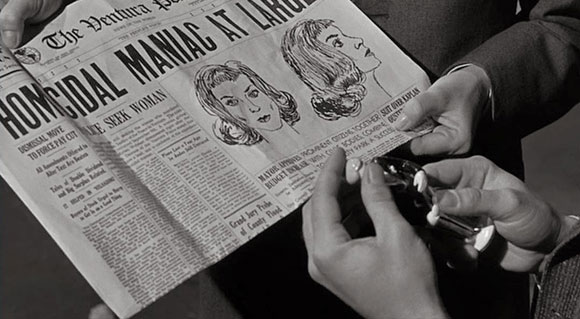
Decapitated heads! A newspaper headline exclaiming “Homicidal Maniac at Large!” Lingering close-ups of knives! Dark family secrets! Wigs! Homicidal has it all! John Waters has been voluble in his praise for William Castle, citing him as a primary influence and even declaring, “In fact, I wish I were William Castle.” (In 2017 Waters portrayed Castle in the TV anthology series Feud: Bette and Joan). Castle is probably best-remembered for hits like House on Haunted Hill (1959) or 13 Ghosts (1960), but I’d argue Homicidal is his meisterwerk, alongside Strait-Jacket (1964) starring Joan Crawford as an ax murderess. Castle was also, of course, the king of the attention-grabbing publicity stunt. The gimmick here is the “fright break”. (As Homicidal builds to its climax, the action pauses for 45-seconds and a clock ticks down as Castle himself announces that if you don’t want to be “frightened to death”, you are eligible for a full refund).   


/ John Waters as William Castle in Feud: Bette and Joan / 

Seen today, Homicidal is most interesting as an exemplar of “transploitation” or “gender reveal horror”. Other examples in this subgenre might include Psycho (1960), The Name of the Game is Kill (1968), Miss Leslie’s Dolls (1972) or Sleepaway Camp (1983). One clue is the repeated references to Denmark: transgender pioneer Christine Jorgensen underwent her reassignment surgery in Copenhagen in 1952. (The Jorgensen story also inspired Ed Wood Jr to make Glen or Glenda? (1953)). You’ll immediately notice that one character has markedly androgynous characteristics. And that no one questions that two certain characters never once appear in the same room at the same time. (But then, no one ever thinks to hand Helga a pen and paper – she could instantly explain everything!). Homicidal hits a crazed pinnacle when Emily runs amok in Miriam’s florist shop, vindictively destroying the floral arrangements. She focuses her rage on the wedding displays, snapping-off the heads of the little groom figurines. Take that, heteronormativity!  


/ Above: Emily (Joan Marshall) and Jim (Richard Rust) in Homicidal /


/ Emily (Joan Marshall) and Karl (Glenn Corbett) in Homicidal /

The cast of Homicidal is noteworthy for the presence of two exceptional paragons of male pulchritude. Early in his career, bodybuilder Glenn Corbett posed for Athletic Model Guild wearing nothing but a posing pouch, a sheen of baby oil and a smile. (Do a Google image search. You’ll thank me!). As the bellhop, Richard Rust possesses the hooded eyes, snarling voice, cruel smirking mouth and greased-back hair of the perfect delinquent thug. But ultimately, it’s the menacing and strange portrayal of Emily by actress Joan Marshall who makes the greatest impression. (Fun trivia: in 1964, Marshall would play Lily Munster (then called Phoebe Munster) in the unaired colour pilot episode of The Munsters. She would subsequently be replaced by Yvonne DeCarlo).

/ Glenn Corbett in his beefcake modelling days, posing for Bob Mizer of Athletic Model Guild /

Homicidal is viewable on Amazon Prime.

Further reading

Read a perceptive and in-depth analysis of Homicidal on the essential Dreams are What Le Cinema is for blog here. 


Tuesday, 27 April 2021

Reflections on ... Glamour Ghoul: The Passions and Pain of the Real Vampira, Maila Nurmi


 / The woman behind Vampira: Maila Nurmi photographed at the Seventh Primetime Emmy Awards on 7 March 1955 at the Moulin Rouge nightclub in Los Angeles. As her biographer Sandra Niemi recalls, "She wore an ice-blue evening gown, her hair dyed to match, and a rented fur stole draped around her shoulders." /


My ruminations after reading the 2020 biography Glamour Ghoul: The Passions and Pain of the Real Vampira, Maila Nurmi by Sandra Niemi. 

First, some caveats about this account of the life and times of wraith-cheekboned atomic-era horror movie hostess, pin-up model and actress Vampira (aka Maila Nurmi, 1922 - 2008). That title is unwieldy. The misjudged cover design is offputtingly amateurish. The prose would have benefited from the hand of a professional ghost writer. Author Sandra Niemi (Maila Nurmi’s niece-turned-biographer) frequently gets bogged-down in minutiae, especially (and perhaps understandably) when it comes to the Niemi family history. (A quick explanation: Maila Nurmi’s real name was Maila Elizabeth Niemi). All you really need to know about Nurmi’s origins is that she emerged from a poor family of Finnish immigrants, with a deeply conservative and disapproving father and an alcoholic mother. 

But stick with Glamour Ghoul. It’s clearly a labour of love and ultimately a gripping account of an eccentric and tenacious survivor (some might say “failure”) who existed on the fringes of Hollywood for decades. Like the doomed Barbara Payton or her one-time director Ed Wood Jr, Nurmi endured obscurity and grinding abject poverty for most of her life. Yes, The Vampira Show on KABC-TV in Los Angeles rocketed her to fame and made her a pop culture sensation, but that success was ephemeral (her show was only on air between 1954 -1955) and Nurmi never made a cent even at her fleeting apex. 

When The Vampira Show was abruptly cancelled following a dispute with the broadcasters, Nurmi’s career dramatically fizzled-out and never recovered. She also alienated many by seemingly exploiting for publicity her friendship with James Dean following his death in 1955. By the time Nurmi appeared in Plan 9 from Outer Space she was widely considered washed-up and a show business pariah. All her scenes were filmed in one day, she was paid a grand total of $200 for her performance (the union minimum) and she was presumably glad to get it.


Plus, the volatile Nurmi was nuts and self-sabotaging, burning bridges and making terrible career decisions at every turn. (Boy, did Nurmi need good management and financial advice). It also didn’t help that she lost her health and looks early. While still in her forties Nurmi was struck down with the debilitating autoimmune disease pernicious anemia. The side effects included losing many of her teeth and meant she walked with a cane for rest of her life. Niemi speculates her aunt’s illness was caused by malnutrition, partly from sheer poverty and partly from Nurmi starving herself to maintain the freakily emaciated 19" waist that was an essential component of the Vampira image. (By today's standards, we'd say Nurmi had an eating disorder).  

/ Kim Novak and Vampira /

Nurmi was terminally unlucky in love, too - with one exception. God knows Marlon Brando was a messy, complicated and deeply flawed person but he was a rare savior in Nurmi’s life. To his credit, once their brief romance cooled, they remained long-term platonic friends and he just about kept Nurmi afloat in later years by paying her a modest allowance. (Brando did eventually cut her off, though). Otherwise Nurmi’s taste in men (with a preference for younger pretty boys) was disastrous. (Interestingly, she clashed with powerful gay agent and “the man who invented Rock Hudson” Henry Willson: they liked the same type). While Niemi herself never comes to this conclusion, it’s clear Nurmi either possessed defective “gaydar” or was primarily sexually attracted to unavailable gay men. For example, she was obsessed with the manipulative and sexually ambivalent young Antony Perkins and seethed with frustration that he didn't return her ardor. 

If Brando was the hero, then Orson Welles was the villain of Nurmi’s life. She first encountered him aged 18 when she arrived in Hollywood in 1940 in pursuit of stardom. Welles took the naïve starlet’s virginity – and impregnated her. Unfortunately for Nurmi, he was engaged to Rita Hayworth at the time.  After Welles callously abandoned her, the baby boy was quietly put up for adoption. Once Niemi uncovers this long-suppressed family secret, she commits herself to locating and contacting the long-lost son of Orson Welles and Vampira. (Did she succeed? I won’t spoil it. You’ll have to read the book). 

On a lighter note, in 1956 Nurmi enjoyed a short-lived fling with 21-year-old Elvis Presley in Las Vegas. At the time, Nurmi was guest starring in Liberace’s spectacular revue at The Riviera and the embryonic Elvis was bombing nightly to hostile audiences at The New Frontier. Recognizing a kindred spirit, Nurmi was initially dazzled by the rockabilly hepcat’s rebel style (she admired his turquoise dinner jacket and noted, “Never before had I seen a straight man … and I assumed he was … wear eye shadow and eyeliner and was that mascara as well?”). But she was bluntly critical of his sexual expertise (“he made love like an adolescent”) and their relationship ended abruptly one night when in a fit of pique (Elvis was paying her insufficient attention), Nurmi - in her own words - “grabbed his pee-pee in a public place and he never forgave me.” But never mind that. Imagine the hallucinatory trio of Vampira, Liberace and Elvis hanging out together in Las Vegas in the fifties. The mind reels! 


/ Above: Liberace and Vampira /


/ Above: Maila Nurmi with an adorable young Elvis in Las Vegas /

/ The February 1956 issue of gossip magazine Whisper via /

The other essential male presence in Nurmi’s life, of course, was her friend James Dean. They met when she was 31 (and finally finding belated success on television as Vampira after years on the margins) and he was still an unknown 23-year-old actor on the ascent. Just how intimate they were is contested (some Dean biographers argue Nurmi embellished their friendship). Niemi takes her aunt’s version as gospel (and doesn’t question Nurmi’s claims that Dean’s ghost repeatedly contacted her from beyond the grave). For what it’s worth, on the topic of Dean’s much-debated sexuality, Nurmi was succinct: “At the time I knew him, he was seeing women, but he was basically bisexual.” 

In her later years, with considerable justification Nurmi sued Cassandra Peterson (aka Elvira, Mistress of the Dark) for copyright infringement. (Nurmi lost, even though she had an overwhelmingly persuasive case. If – like me – you revere both Vampira and Elvira, the chapter about how Nurmi got swindled makes for painful reading. Nurmi was frail and destitute at the time, while the savvy Peterson would go on to amass a fortune from Elvira merchandise. We’ll inevitably get Peterson’s side of the dispute when her impending memoirs come out in September 2021). 

/ Maila Nurmi as a beatnik poetess (with a pet rat) in The Beat Generation (1959) /

More happily, in the seventies and eighties Nurmi would be embraced by her spiritual offspring, punk musicians, particularly the bands inspired by lowbrow culture and horror b-movie imagery like The Misfits, The Screamers, The Damned, The Cramps and surf band Satan’s Cheerleaders (Nurmi recorded several tracks with the latter, which you can listen to on YouTube). Nurmi herself was obviously a punk ahead of her time. One thing Glamour Ghoul clarifies: there are some startling photos circulating online of a virtually bald Nurmi in the fifties sans the Vampira wig with brutally shorn hair, seemingly anticipating punk by about twenty years. Out of Vampira drag, Nurmi favoured a low-maintenance beatnik look of cropped-short blonde hair, Capri pants, sandals and shapeless sweaters. (You get a good impression of what the real Nurmi looked like in her cameo appearance as a beatnik poetess in 1959 film The Beat Generation). Niemi explains that when Nurmi’s stormy marriage to screenwriter Dean Riesner broke down, she chopped all her hair off in a bout of depression. 


/ Maila Nurmi sans the trademark Vampira wig, 1955 / 


/ Above: Lux Interior and Poison Ivy of The Cramps. Note Lux's t-shirt - original Vampira merchandise that Nurmi made herself and sold at public appearances in the punk era. In 2015 I managed to pick up a reproduction of this t-shirt at Viva Las Vegas rockabilly weekender, and I wear it with pride! /


/ Above: Vampira and Tor Johnson in Plan 9 from Outer Space (1959) /


/ Above with Edward D Wood Jr in 1955 /

Weirdly, Niemi seems to skim over some intriguing aspects of Nurmi’s life and career. She doesn’t offer much insight into Nurmi’s participation in Ed Wood’s notorious 1959 sci-fi atrocity Plan 9 from Outer Space (to be fair, that’s been extensively documented elsewhere). We don’t glean much about how Nurmi came to be the live action model for the animated evil queen Maleficent in the 1959 Disney classic Sleeping Beauty. And I’d read elsewhere that Tim Burton exploited Nurmi badly when he made his 1994 biopic Ed Wood. If so, Niemi doesn’t mention it. 

While Niemi strives to present her aunt in a sympathetic light, Nurmi doesn’t always emerge as terribly likable. Many of her career disappointments were self-inflicted. In the forties director Howard Hawks wanted to groom Nurmi for stardom as his next protegee (as he’d recently triumphantly done with Lauren Bacall). Nurmi scuppered that opportunity by flouncing off in a huff, complaining Hawks was taking too long. She also rarely had a good word to say about other women.  Consider Nurmi’s scathing assessment of  fiftysomething Mae West (one of Nurmi’s first acting breaks was appearing onstage in West’s 1944 play Catherine Was Great). “I saw that her movie star stature was only an illusion of the camera. She was really a tiny little biscuit of a girl. She wore an Aunt Jemima scarf tied round her weary peroxided hair and walked on tall awkward platform shoes. She wore a faded peignoir that likely began its life as pink but had since greyed with age. The garment was cut on the bias, revealing a surprisingly buoyant cleavage even as her pot belly gave away her age. She wore no makeup save for a huge pair of black nylon eyelashes. I didn’t understand why a purported legend could not afford a new bathrobe.” 

Adopting the morbidly beautiful Vampira persona never made Nurmi rich or assured her stardom – but it gave her immortality. Still vivid, cartoon-ish, sexy and perverse, the irresistible image she created never grows stale, appealing to b-movie connoisseurs, punks, psychobillies, goths and the fetish subculture (with her extreme waist-cinching, Nurmi was a pioneer in body modification). And remember: at the time, she was perceived as a gimmick or one-woman publicity stunt. Decades later, Nurmi’s cadaverous cutie still haunts popular culture. The spell Vampira cast is seemingly eternal.

Further reading:

My analysis of Plan 9 from Outer Space (1959).


Wednesday, 21 April 2021

Reflections on ... Tempest Storm (29 February 1928 - 20 April 2021)

Farewell to doyenne of burlesque, Rita Hayworth lookalike and undisputed Queen of Exotic Dancers Miss Tempest Storm (née Annie Blanche Banks, 29 February 1928 - 20 April 2021).

The death of “the torrid tornado from out West” aged 93 conclusively ends a chapter in striptease history (Storm outlived all her contemporaries including Russ Meyer, Bettie Page and Blaze Starr).


What a life! At her peak Storm earned $100,000 a year, making her the highest-paid striptease performer in history. Her last performance was in 2010. And she had a fling with young Elvis!

I used to love catching glimpses of bouffant-haired eternal showgirl Storm at the annual Viva Las Vegas Rockabilly Weekenders over the years, consistently looking immaculately groomed and fiercely glamorous. This shot of Storm and I was taken at Viva Las Vegas 2017 at the car show. I call this "touched by a goddess" because when we posed together Storm placed her hand on my lower back! Tempest Storm was a woman and a half!


For my social media tribute posts to Storm today, I really wanted to post these glamour shots taken by sexploitation maestro Russ Meyer in 1952 - but I was afraid they were too "boob-tastic" and would instantly send me to Facebook (or Instagram) jail!


Read the New York Times obituary for Tempest Storm here.