Recently watched: Shock Treatment (1964).
Tagline: “The Nightmare World of the Mad ...” “You won’t be the same … when you
come out of Shock Treatment!” I’m using this period of enforced social
isolation to explore the weirder corners of YouTube for long forgotten and
obscure movies. (My boyfriend is accompanying me only semi-willingly).
An overlooked black-and-white psychological-exploitation
film, Shock Treatment starts on a wonderfully lurid note even before the opening
credits roll. A homicidal maniac gardener (played by a bug-eyed Roddy McDowall)
sneaks up behind the elderly Beverly Hills millionairess he works for – and in a
moment worthy of William Castle’s Strait-Jacket, abruptly decapitates her with
his gardening shears!
/ Lauren Bacall, Roddy McDowell and Stuart Whitman in Shock Treatment /
McDowell is Martin Ashley, a freshly
released psychiatric patient. His ill-fated employer was Mrs Townsend. At the
subsequent trial, it’s revealed that Martin - convinced that money is "the root
of all evil" - burned one million dollars of Townsend’s fortune after killing
her. At least two people doubt Martin’s account. Harley Manning - the executor
of Mrs Townsend’s estate - is convinced he’s faking and has hidden the money
somewhere. And the icily efficient and untrustworthy Dr Edwina Beighley (Lauren
Bacall), who oversees the high security mental institution where Martin is a
patient, has her own nefarious designs on the $1 million.
/ "To hell with conformity!" Gorgeous Stuart Whitman displaying his "chest meat" in Shock Treatment /
Manning’s solution is to hire a struggling
actor Dale Nelson (Stuart Whitman) to feign insanity, go undercover as a
patient in the asylum to befriend Martin and learn where the $1 million is hidden.
There’s an unintentionally campy moment when Dale asks Manning why he picked
him for the job. “You’re a convincing actor,” Manning replies. (This is ironic
because in terms of acting ability, hunky Whitman mostly coasts on his rugged
square-jawed good looks). Anyway, it proves remarkably easy for Dale to get
committed. He plays “mad” by smashing a store window in broad daylight, tearing
off his shirt, donning a pair of sunglasses and berating the cops in beatnik
lingo about conformity (“Why must you gentlemen conform?” he implores, “Why not
turn to these peasants, look them in the eye and say, “To hell with conformity?”
The disciples of conformity are bleeding from the narrowness of your mind!”). For
this little outburst, the judge determines, “His antisocial behavior indicates
a disturbed state of mind” and sentences Dale to ninety days.
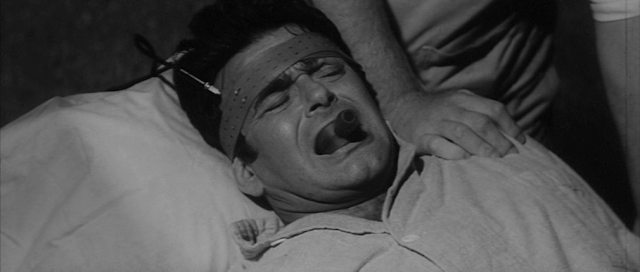
Shock Treatment follows the same narrative
as Samuel Fuller’s far more highly-regarded and famous Shock Corridor (1963):
someone is hired to infiltrate and investigate what’s happening in a sanitarium
– and then they can’t get out! Rest assured Shock Treatment won’t win any
awards for sensitivity for its sensational representation of mental illness. McDowell
plays psycho killer Martin with such sexual ambiguity that his scenes with Dale
throb with a homoerotic tension the script probably never intended. Meanwhile, Carol
Lynley is a female patient who serves as Dale’s love interest. Her psychiatric condition
seems to consist of whiplash mood swings between frigidity and nymphomania. “I
just dislike being touched!” she exclaims. “Kissing and touching are sins!” but
then moments later, she pleads, “I want you to touch me, Dale! To hold me and
touch me – now! Love me, Dale! Love me!” Luckily, Lynley’s problems are easily cured:
as the script hints, all she needed was the love of a good man. (Watch also for
a fleeting but vivid appearance by eccentric character actor Timothy Carey).
Shock Treatment may be low-grade schlock,
but it’s compelling schlock suffused with genuine tension and paranoia, tightly
constructed, wreathed in menacing film noir shadows and genuinely suspenseful. And it features a magnificent turn by Lauren
Bacall as the manipulative Dr Beighley, scheming to test her experimental drugs
on a human guinea pig. Bacall made her film debut in 1944. It’s a sign of how
far the Hollywood diva’s stock had fallen that twenty years later she was
reduced to acting in b-movie fare like Shock Treatment. But the husky-voiced
Bacall is utterly mesmeric in a rare villainous role, playing it with a malevolent,
steely composure and poised elegance (she makes her white lab coat look like
haute-couture). Call me perverse, and I’m probably in a minority of one, but
it’s one of my favourite performances by Bacall.
Watch Shock Treatment here: