Showing posts with label Lobotomy Room Goes to the Movies. Show all posts

Wednesday, 2 August 2023

The Next Lobotomy Room Film Club: Girls Town (1959) on 17 August 2023


Contrary to received wisdom, Grease (1978) didn’t pioneer the concept of casting adult actors as high school students. It was already a long-held Hollywood convention. Take, for example, Girls Town (1959). The quintessence of the fifties drive-in juvenile delinquent flick, it boasts teenage thugs running amok, girl-on-girl cat fights, frantic rock’n’roll music, drag races, nuns, the threat of sex trafficking in Tijuana – and wanton platinum blonde leading lady Mamie Van Doren as 16-year-old hellcat Silver Morgan. Even with her perky ponytail and tight Capri pants, 28-year-old Van Doren is perhaps the most overripe, fleshy and mature adolescent in cinematic history. (And as Freddie, 34-year-old jazz crooner Mel Tormé (below) seems positively wizened). 


But frankly who cares when Girls Town is such a delirious wild ride? These delinquents have impeccable sartorial taste in striped t-shirts, gabardine jackets and saddle shoes. Vocal group The Platters coo ethereal doo-wop in a nightclub sequence. And everyone speaks in ultra-camp hepcat beatnik lingo like “No dice!” “You dig me?” “It’s real gone, ma!” “Not wonderful – crazy! Cool! Fantabulous!” “I’m blasting out of here!” and “You’re in Queersville, man! You’ve flipped!” (Where is this “Queersville” Silver speaks of and how do I get there?). Girls Town is precisely the kind of film that John Waters parodies in his 1990 rockabilly musical Cry-Baby (and the Traci Lords character is directly modeled on Van Doren). See for yourself when the free monthly Lobotomy Room film club (motto: Bad Movies for Bad People) presents Girls Town at Fontaine’s bar (Dalston’s most unique nite spot) on Thursday 17 August! 


/ Above: Mamie Van Doren as Silver Morgan (“who didn’t want to know right from wrong!”) and John Waters' homage / 

Lobotomy Room Goes to the Movies is the FREE monthly film club devoted to cinematic perversity! Third Thursday night of every month downstairs at Fontaine’s cocktail lounge in Dalston! Numbers are limited, so reserving in advance via Fontaine’s website is essential  Alternatively, phone 07718000546 or email bookings@fontaines.bar. The film starts at 8:30 pm. Doors to the basement Bamboo Lounge open at 8:00 pm. To ensure everyone is seated and cocktails are ordered on time, please arrive by 8:15 pm at the latest.


What happens when youthful rebels go bad? Can you handle this explosive drama of youth racing down the road to nowhere? Join us on Thursday 17 August 2023 to find out! Facebook event page. 


Saturday, 18 April 2020

Reflections on ... Pitfall (1948)


/ A girl and a gun ... Lizabeth Scott and Raymond Burr in Pitfall (1948). Interestingly, this publicity still bears no relation to anything that happens in the film itself! /

A Lobotomy Room film recommendation: tense and compelling 1948 film noir Pitfall, directed by Andre de Toth. Thematically and stylistically it may remind you of two movies we’ve already screened at the monthly Lobotomy Room film club (currently on hiatus due to coronavirus pandemic!). Like Too Late for Tears (1949) – also starring the luscious croaky-voiced Lizabeth Scott – Pitfall is a film noir rooted in a degree of relative plausibility and set in the milieu of comfortably affluent sun-lit middle-class suburbia (suburban Los Angeles in this case). And married middle-aged protagonist John Forbes (the Olympic Insurance Company employee played by Dick Powell) finds himself in the same dilemma as Fred MacMurray’s character in the 1956 Douglas Sirk melodrama There’s Always Tomorrow (1956): he’s ostensibly achieved the American dream (good “white collar” salary, a beautiful house in the ‘burbs, dutiful wife, a cute child) but is consumed with a gnawing dissatisfaction with the ordered routine of his life and a yearning for excitement. Investigating what appears to be a standard embezzlement case, Forbes becomes entangled with alluring fashion model Mona Stevens (Lizabeth Scott) and soon finds himself unwittingly caught-up in adultery, crime – and murder! To considerably complicate proceedings, corrupt private eye Raymond Burr - erotically fixated on Mona (this was before the concept of “stalking”) - is lurking on the sidelines. (Burr makes for a genuinely ominous villain not just due to his menacing physical bulk, but his eerily calm, unblinking demeanor).


/ Dick Powell and Lizabeth Scott in Pitfall (1948) /

What's also noteworthy: for a Production Code-era film, Pitfall takes a remarkably non-judgmental and adult perspective on Forbes' extramarital affair. 

The whole cast is exemplary (including Jane Wyatt as Forbes’ unsuspecting wife) but Scott is heart-wrenching as Mona. In contrast to Too Late for Tears, here she’s a good girl – well, a complicated, sinned-against and down-on-her-luck girl striving to be good. (At every turn, Mona strives to do the honorable thing - which never does her any favours). It’s astonishing to reflect that years ago Scott was routinely dismissed as an ersatz Lauren Bacall. An all-too typical assessment is writer Penny Stalling’s: “Scott ... churned out twenty-two films between 1945 and 1953, but few are memorable.” How could a filmography studded with gems likes Pitfall, Too Late for Tears and Desert Fury be “unmemorable”? Even Scott’s lesser films (like The Strange Loves of Martha Ivers and Dead Reckoning) are at least interesting! In Pitfall, Scott is particularly seductive when extolling the virtues of day-time drinking: “Have you ever noticed if for some reason you want to feel completely out of step with the rest of the world, the only thing to do is sit around a cocktail lounge in the afternoon?”


High quality version of Pitfall on YouTube here. 


Saturday, 28 March 2020

Reflections on ... Queen of Blood (1966)


It’s been suggested that – while Fontaine’s bar is temporarily shuttered due to the coronavirus scourge and the world is socially-isolating itself – the Lobotomy Room film club (specializing in the cult, the kitsch and the queer!) could continue online for the time being. I’ll be occasionally posting fun oddities and obscurities that are viewable on YouTube for your delectation. Remember: Lobotomy Room is the home of Bad Movies We Love (our motto: Bad Movies for Bad People) so don’t “at” me if you wind-up hating the movie and asking yourself, “What the fuck did I just watch?”

Our first film selection is Queen of Blood (aka Planet of Blood), an el cheapo 1966 science fiction movie (the meagre budget was reportedly $50,000) directed by Curtis Harrington. Not to be confused with Queen of Outer Space (1958) starring Zsa Zsa Gabor! Tagline: “Hideous beyond belief … with an inhuman craving!”


As was a common convention for producer Roger Corman’s b-movies of the period, this American flick incorporates (or “recycles”) footage from a 1959 Russian film. (The special effects and relatively impressive “outer space” scenes spliced-into the action are from the bigger-budgeted Soviet source). This ultra-terse synopsis I found online is more succinct than anything I could come up with: “astronauts go to Mars and return with a green vampire woman.” And boy, does she stir up trouble! In fact, in no time the corpses of astronauts begin piling-up, mysteriously drained of blood! (It takes everyone a while to discern the alien woman is a vampire. It’s been noted this aspect of Queen’s plot – the vulnerable space crew being picked-off one by one by a monster - anticipates Ridley Scott’s Alien).


Director Harrington (1926 - 2007) was a genuinely maverick, intriguing and durable talent with an overtly queer / camp sensibility. Queen is very much an example of Harrington being handed lemons and attempting to impose a bit of flair to the material. His wayward career encompassed the occult / underground art film fringe (he was an associate of Kenneth Anger, and appears in Anger’s 1954 film Inauguration of the Pleasure Dome) to wildly entertaining hagsploitation horror movies in the early seventies (What’s the Matter with Helen? and Who Slew Auntie Roo? both starring Shelley Winters, Killer Bees with Gloria Swanson) to mainstream television establishment (he directed episodes of TV series Charlie’s Angels, Wonder Woman and Dynasty!).


The pleasures of this film: 

Some of the cannibalized Russian special effects are genuinely haunting, eerie and dream-like. (In fact, my tip is to drown-out the wooden acting and tedious dialogue, don’t try to make sense of the narrative and just let the movie wash-over you like a dream). 

The soundtrack of spooky “the-future-is-scary!” theremin music. 

Queen has a fun, kitschy sherbet-coloured retro-futurist look (it’s meant to be set in the year 1990 – which must have felt like the distant future in 1966), with lots of starkly minimalist space-age décor in the control centre and spaceships, and the astronauts wearing cling-y quilted athleisure wear outfits.  

Judi Meredith as coolly efficient astronaut Laura James sports truly impressive immobile and gravity-defying bouffant helmet hair that screams “1966”. 


It offers a sweet reminder of just how dreamily cute young heartthrob leading men John Saxon and Dennis Hopper were at this early point in their careers.


/ The look of love: Florence Marly and Dennis Hopper in Queen of Blood / 


But truthfully, the film is owned by the Queen of Blood herself. Honey, she is fierce! Played entirely mute (like Vampira in Ed Wood Jr’s Plan 9 from Outer Space) and possessing a glistening livid green complexion, sunken Marlene Dietrich cheekbones, glowing blood-shot eyes and a remarkable vertical fright wig hair-do (think troll doll), she is the film’s single greatest special effect. (I’d argue she’s an influence on the Martian vixen Lisa Marie plays in Tim Burton’s Mars Attacks!). Watch for how the alien smilingly (hungrily?) appraises the male astronauts - and then her lip curls disapprovingly when she spots Laura!  Producers pressured Harrington to cast someone younger, but 47-year old Czech actress Florence Marly memorably instills the role with unearthly inscrutability and menace. She alone makes Queen of Blood worth investigating. Spoiler alert: the ending involves repulsive pulsating “alien eggs” served on a tray of lime gelatin - an appetizer from an atomic-era dinner party gone horribly wrong.

Sunday, 22 March 2020

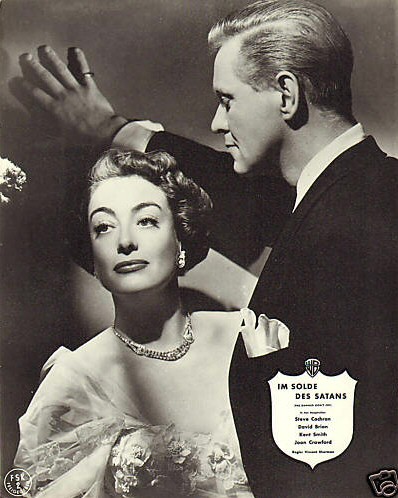
Reflections on ... The Damned Don't Cry (1950)


For the first Lobotomy Room film club of 2020, let’s bask in some old-school pagan diva worship! As is tradition, the first film club of the New Year stars eternal Lobotomy Room favourite - Golden Age Hollywood’s bitch goddess extraordinaire Joan Crawford! (In January 2018 we screened Strait-Jacket. In January 2019, Sudden Fear).

If you enjoy watching the reliably intense Crawford suffering in mink, irresistibly tawdry noir melodrama The Damned Don’t Cry (1950) is the movie for you! Thursday 16 January! Hear her snarl hard-boiled dialogue like “Don’t talk to me about self-respect! That’s something you tell yourself you’ve got when you’ve got nothing else!” No spoilers, but it begins with Crawford as downtrodden housewife from the wrong side of the tracks Edith Whitehead, who climbs to the top of high society … one man at a time! (Edith’s mantra: “I want something more than what I’ve had out of life. And I’m going to get it!”). Unfortunately – she soon finds herself embroiled in the murky realm of organized crime (and sexy gangster Steve Cochran!).

Lobotomy Room Goes to the Movies is the FREE monthly film club downstairs at Fontaine’s bar (Dalston’s most unique nite spot!) devoted to Bad Movies We Love (our motto: Bad Movies for Bad People), specializing in the kitsch, the cult and the camp! Third Thursday night of the month. Doors to the basement Bamboo Lounge open at 8 pm. Film starts at 8:30 pm prompt! We can accommodate 30 people maximum on film nights. Remember: the film is FREE so you can buy more cocktails! (One drink minimum).


/ "She’s as tempting as a cupcake - and as tough as a 75-cent steak!” / 

It was never intentional, but in recent years it’s become a Lobotomy Room film club ritual to screen a Joan Crawford film to usher in the new year. Maybe it’s a subconscious act of pagan goddess worship? Anyway, we showed Strait-Jacket in January 2018, Sudden Fear in January 2019 and now The Damned Don’t Cry in January 2020. When I introduced Damned onstage, I quoted Crawford’s line of dialogue from the film, “I want something more than what I’ve had out of life - and I’m going to get it!” and urged the audience to embrace this mission statement as their new year’s resolution for 2020.


/ “Call me CHEAP?” Nothing’s cheap when you pay the price she's paying! /

After Crawford’s Oscar-winning, career-reviving comeback victory with Mildred Pierce (1945), her studio Warner Bros clearly decided: don’t mess with the formula. Subsequent films like Flamingo Road (1949), The Damned Don’t Cry (1950) and This Woman is Dangerous (1952) are all increasingly threadbare and repetitive variations of the Mildred Pierce template, cleaving to the same essential noir crime melodrama style and theme. As The Chiseler concisely summarizes, the narratives of these Crawford pictures all “follow a woman as she claws her way out of dreary poverty, attains a pinnacle of penthouse luxury, and plunges from there into the abyss”. So yes, it’s a formula - but hell, it’s a juicy, lurid and insanely enjoyable formula, and these films are understandably embraced today as both exemplars of mid-century “women’s pictures” and camp classics.  Think of it this way: imagine there was an all-night Joan Crawford film marathon on TV. If you started watching The Damned Don’t Cry, fell asleep mid-way through, woke up in middle of This Woman is Dangerous and continued watching, you probably wouldn’t notice any discrepancy. (It helps that Crawford co-stars with silver fox David Brian Flamingo Road, Damned and This Woman is Dangerous!).


/ Joan Crawford with David Brian in The Damned Don't Cry /

As a Joan Crawford star vehicle par excellence, Damned certainly delivers on showcasing the diva’s considerable mid-period strengths. It ticks all the boxes: Crawford gets beautifully lit and flattering close-ups, copious costume changes (charting her trajectory from drab housewife to upper-crust socialite), gets to have big emotional confrontations, snarl hard-boiled dialogue and slap men’s faces. (Just to shake things up, in Damned, Crawford herself also gets slapped around and roughed-up a lot). Characteristically of this period, Crawford’s leading men are mostly secondary considerations, with minimal threat of challenging her dominance. (The exception: smoldering noir tough guy Steve Cochran. More of him later).


/ Suffering in mink: Joan Crawford in The Damned Don't Cry /


/ Check out those gams! Yes! Scary diva Joan Crawford at full voltage in torrid melodrama The Damned Don’t Cry (1950) /

Vincent Sherman directs Damned with verve and economy, ensuring the story unfolds in broad strokes and dramatic flourishes. Boiling with ambition and hunger, Crawford swaps identities with remarkable ease, swiftly re-inventing herself from frumpy small town hausfrau Edith Whitehead to elegant heiress Lorna Hansen Forbes (“the darling of café society”) under the tutelage of her new friend, shifty posh-voiced grifter Patricia Longworth (exquisitely performed with the perfect amount of patrician anxiety by scene-stealing Selena Royle). Sherman neatly contrasts the visual signifiers of Crawford’s new realm (cocktails (vermouth and cassis!), gold cigarette cases, mink coats, orchids, swimming pools) and her discarded working-class origins (derricks pumping in the Texas oil fields belching sooty plumes of pollution, blue collar men in hardhats and overalls, a wardrobe of cloth coats and aprons, no make-up, scraped-back hair).


Initially Damned positions Crawford in a conventional romantic triangle. Edith / Lorna must choose between impoverished, honest (and dull) accountant Marty Blackford (Kent Smith) or sociopathic but rich and suave organized crime kingpin George Castleman (David Brian). But then mid-way through the film Castleman’s dangerously volatile mobster associate Nick Prenta (Steve Cochran) arrives and explodes the movie apart. If you’re unfamiliar with hirsute and broodingly handsome Cochran (1917 - 1965), he’ll be a revelation. Probably best-remembered for the film White Heat (1949), Cochran is worthy of comparison to peer Robert Mitchum: both invested unexpected complexity and humanity to their portrayals of sexy noir thugs. 


/ “A woman who crossed the paths of many men … and double-crossed every one of them!” Steve Cochran and Joan Crawford in The Damned Don't Cry /


Great as Crawford is – she is never less than majestic and mesmerizing to watch here – she is also sticking with what she already knows in Damned. (By 1950 Crawford could play a role like Edith / Lorna with her eyes closed). I’d argue Damned really belongs to Cochran, whose performance feels modern, nuanced and surprising. For a macho gangster, Nick (as Cochran plays him) reveals intriguing fissures of sensitivity and insecurity seething below the surface. At times, Cochran almost suggests Nick is a little boy playing at being a mobster. For example, even while Nick strives to maintain his taciturn demeanor, it’s also clear he’s astounded a classy high falutin' dame like Lorna could be romantically interested in him (watch the way Nick proudly escorts her through his swanky Palm Springs nightclub, hoping to impress her), and he’s quick to bristle with offense when he suspects she’s belittling him. Cochran does nothing to solicit the audience’s sympathy – and yet Nick is easily Damned’s most compelling character. He’s also sex on legs: watch for the poolside scenes of Cochran in clingy swimming trunks or a terry cloth robe, with his impressive chest pelt on full display. The cruel and sensual face, lush dark brows and mane of oiled, combed-back black hair also anticipates Elvis Presley. Read more about essential noir icon Cochran in this lyrical, perceptive essay.


Speaking of male pulchritude, Cochran is rivaled here by Richard Egan (1921 – 1987) as Roy Whitehead, the laborer husband who Edith abandons. Egan's appearance is fleeting but – phew! – memorable. With his brawny physique, stubbled face, leather jacket, pomaded hair and visible chest hair, Egan suggests a hunky escapee from a Bob Mizer / Athletic Model Guild beefcake photo shoot. Interestingly, there is reason to believe that various points, the cougar-ish Crawford was romantically involved with virtually every man involved in The Damned Don’t Cry. She’s been "linked" to director Vincent Sherman and leading men David Brian, Steve Cochran and Egan.


/ Above: Egan with Crawford in The Damned Don't Cry (1950) and below in a candid social shot from what appears to be the early sixties /


 / Above: as a bonus for reading this far, some beefcake pin-ups of the wondrous Richard Egan. You're welcome! Read more about him here /


/ Two things: apparently at some point Crawford had off-screen "intimate knowledge" of each of her leading men in this shot (and director Sherman). And I love how this smiling publicity photo wildly misrepresents The Damned Don't Cry as a romantic comedy / 


/ Portrait of a bitch goddess extraordinaire: Joan Crawford in The Damned Don't Cry /

To the surprise of no one, now that London is on lock-down with the dreaded Coronavirus, the monthly film club is on indefinite hiatus. (We were meant to screen Desert Fury in March). But as god as my witness, Lobotomy Room (and Fontaine's bar) will be back! Watch this space.

Further Reading

Read my analysis of the Joan Crawford films Sudden Fear (1952) and Autumn Leaves (1956). 


Saturday, 23 November 2019

Reflections On ... Hush ... Hush, Sweet Charlotte (1964)


Attention, Scream Queens! In honour of Halloween, for the October Lobotomy Room film club presentation we’ve scheduled the apogee of the “hagsploitation” genre Hush ... Hush, Sweet Charlotte (1964) starring Bette Davis at her most frenzied! Wednesday 16 October! Come and settle-in for an evening of spine-tingling Southern Gothic horror in the Tiki splendour of Fontaine's Bamboo Lounge!

Lobotomy Room Goes to the Movies is the FREE monthly film club downstairs at Fontaine’s bar (Dalston’s most unique nite spot!) devoted to Bad Movies We Love, specializing in the kitsch, the cult and the camp! (Our motto: Bad Movies for Bad People!). Remember: admission is FREE so that you can buy more cocktails! (One drink minimum).


“Millionaire and southern belle Charlotte Hollis guards a deep, dark secret. When cousin Miriam comes to stay with Charlotte, mystifying events begin to occur, driving the latter closer to insanity.”

/ IMDb’s synopsis for Hush … Hush, Sweet Charlotte (1964) /


/ "Suspense that starts with a whisper … and mounts to a shattering unpredictable climax!” /

Here at Lobotomy Room we love hagsploitation. For anyone unfamiliar, it’s the disreputable and campy subgenre (sometimes also referred to as Pyscho-Biddy or Grande Dame Guignol) whereby aging,  hungry-for-work leading ladies of Hollywood’s Golden Age swallowed their pride, lowered their standards and slummed it in gruesome horror movies in the 1960s and 70s. What Ever Happened to Baby Jane? (1962) – which revived the flagging careers of arch-rivals Bette Davis and Joan Crawford - is universally credited as inaugurating the whole cycle, but you could argue that Gloria Swanson as homicidal silent movie diva Norma Desmond in Sunset Boulevard (1950) was the original hagsploitation anti-heroine. And surely Norman Bates' toxic mother in Psycho (1960) merits a mention?


/ Bette Davis as Charlotte Hollis /

In any case, these horror flicks offered a temporary fillip to the flatlining careers of actresses as disparate as Tallulah Bankhead (Die, Die My Darling, 1965), Veronica Lake (Flesh Feast, 1970), Miriam Hopkins (Savage Intruder, 1970) and Shelley Winters (in multiple Curtis Harrington-directed thrillers like Who Slew Auntie Roo? and What’s the Matter with Helen? both 1971).

With some justification, the genre has been denounced as both misogynist and ageist. It essentially positions the aged woman as inherently horrific, after all. These are horror films about the ravages of time! But on the plus side, these films also offered juicy, demanding lead roles to veteran actresses who’d been otherwise sidelined by their industry for the crime of growing older. It's complicated!


Hagsploitation movies mostly tapered-off by the late 1970s, but it never entirely vanished from popular culture. Note how sixty-something Oscar winner Jessica Lange (whose film career had long been in the doldrums) triumphantly re-invented herself playing homicidal harridans in Ryan Murphy’s American Horror Story on television. I’d argue the campy psychological thriller Greta (2018) starring Isabelle Huppert is a prime example of modern hagsploitation.


/ Crawford and Davis promoting Hush at the beginning of filming, before it all went tits up /

Hush, Hush … Sweet Charlotte is the follow-up to the unexpected box office victory of What Ever Happened to Baby Jane? It was meant to jubilantly reunify director Robert Aldrich with his Baby Jane leading ladies Davis and Crawford – but as you probably already know (especially if you watched Ryan Murphy’s wildly entertaining 2017 TV mini-series Feud: Bette and Joan) that went catastrophically wrong. Penny Stalling pithily recaps what happened in her 1978 book Flesh and Fantasy:

“Despite the fact that Bette Davis and Joan Crawford had been bitter rivals for years, Jack Warner managed to get them to agree to co-star in his upcoming thriller What Ever Happened to Baby Jane? The press predicted that all hell would break loose when the girls got together, but director Robert Aldrich, keenly aware that his budget couldn’t afford costly delays, kept the girls apart as much as possible when they weren’t working. When the two screen queens were reunited for Hush, Hush … Sweet Charlotte, however, the predicted fireworks became a reality. Riding high as a result of the earlier film’s success, Bette and Joan apparently felt they could afford to engage in some impromptu histrionics for Charlotte’s cast and crew. The hostilities ceased when Crawford became ill. After doctors told her that she would have to bow out, Crawford cried for three days in her hospital bed. When she read that Olivia de Havilland was to replace her, Crawford announced that she was happy for Olivia since she “needed the work.” A victorious Davis posed for on-the-set candids sipping a Coca-Cola.”  


Interestingly, de Havilland was not the first choice for Crawford’s substitution. The character of Miriam was also reportedly offered to Katharine Hepburn, Loretta Young, Barbara Stanwyck and Vivien Leigh first. (Some accounts claim Stanwyck was proffered the role of Jewel Mayhew – the part played by Mary Astor – rather than Miriam). Leigh – de Havilland’s co-star in Gone with the Wind - rejected the opportunity, bitchily explaining, “I could just about look at Joan Crawford’s face on a Southern plantation at 6:00 in the morning; I couldn’t possibly look at Bette Davis’.”

(In fact, Hush was the second film in a row in which de Havilland stepped into a role originally intended for Crawford. Prior to this she played the lead in ultra-lurid shocker Lady in a Cage (1964) when Crawford bowed-out. (This also means Hush wasn’t de Havilland’s first foray into hagsploitation)).


Understandably, a lot of people are preoccupied with what Hush would have been like with Crawford as Miriam. As a great cinematic “What If?” it ranks up there with Judy Garland as Helen Lawson instead of Susan Hayward in Valley of the Dolls (1967). But hell, I love raspy-voiced bitch goddess Hayward hamming it up and growling her way through Valley, and I love de Havilland in Hush. To fixate on Crawford does de Havilland a grave disservice. Why not appreciate de Havilland’s performance on its own considerable merits? In the 1930s and 40s she specialized in exuding sweetness as exemplars of virtuous femininity, most famously as the demure Maid Marion opposite Errol Flynn in The Adventures of Robin Hood (1938) and as Melanie Wilkes in Gone with the Wind (1939). Cast against type, de Havilland is spellbinding in an evil role (sorry – spoiler!), portraying Miriam with purring subtlety. It’s genuinely unsettling when Miriam suddenly betrays her true nature and turns nasty or violent, her usual honeyed ladylike voice abruptly shuttling to a snarl.


(I’m trying to think of other examples of de Havilland exploring her inner bitch onscreen. She’s mesmerizing in the underrated The Dark Mirror (1946) playing identical twin sisters, one good and one bad. The sociopathic one is inevitably far more compelling). It’s also worth noting that de Havilland - now 103 years old – is the sole cast member of Hush still alive and in fact is now one of the very few surviving Golden Age Hollywood-era stars. At this point her only peer is Kirk Douglas (102).


/ Can you say fierce? Joan Crawford as Miriam / 

All the footage shot with Crawford as Miriam has seemingly vanished and to this day remains unseen.  Presumably it was destroyed at the time: if it still existed, it would surely have cropped-up as a DVD extra or in a documentary by now? But watch for the scene where Miriam’s cab first pulls up to the driveway of Charlotte’s sprawling Southern mansion (approximately 28 minutes and thirty seconds into the film). De Havilland is wearing a hat and no sunglasses. In one fleeting shot we get the briefest, almost subliminal but unmistakable blink-and-you-miss-it glimpse of Crawford (wearing no hat and dark sunglasses) peering out of the cab’s passenger window. Presumably this was left-in in error. In all likelihood, this is the sole surviving fragment of Crawford as Miriam.


/ Olivia de Havilland as Miriam /

The film’s original title was to be What Ever Happened to Cousin Charlotte? (the title of the short story it’s based on). But it was decided this was too like What Ever Happened to Baby Jane? and it was re-titled (reportedly at Bette Davis’ own insistence).


The painting of young Charlotte displayed on the wall is recycled from Bette Davis’ role as petulant southern belle Julie in the 1938 film Jezebel.


/ See Bette Davis scream and scream again (and again. And again. And then some more. Seriously, she screams a lot in this film!) / 

Hush doesn’t just reassemble Davis and director Aldrich from Baby Jane: the cast of Hush also includes Victor Buono (1938 - 1982), seen in a flashback as Charlotte’s father. (In reality, Buono was young enough to be Davis’ son). Speaking of age: as someone who certainly ain't getting any younger, it’s very enjoyable watching a film in which all the lead characters are on the wrong side of fifty!


The basic premise of Hush (people are conspiring to make Charlotte have a nervous breakdown and pin a murder on her) is essentially the same plot-line as Strait-Jacket starring Joan Crawford (1964).

Think of Hush as the Mercedes Benz or Rolls Royce of hagsploitation. It was made with a luxe high budget, featured a distinguished all-star cast (not just Davis and de Havilland, but Joseph Cotton, Mary Astor and Agnes Moorehead) and was filmed on location on an actual Southern mansion (the Houmas House Plantation and Gardens in Baton Rouge, Louisiana). The sultry Southern Gothic atmosphere simmering with resentments, family tragedies and secrets almost hints at Tennessee Williams terrain. The black and white cinematography is exceptionally beautiful and velvet-y (watch for a haunting shot of de Havilland peering out of a misty window).


In fact, Hush is almost too plush for its own good: hagsploitation is better when it’s starker, nastier and more hardboiled. Baby Jane, for example, was made on a significantly lower budget. I’d argue William Castle’s primal, trashy low-budget b-movie Strait-Jacket starring Joan Crawford is superior, more urgent hagsploitation than Hush, which feels overextended and bogged-down with flashbacks, art-y dream sequences and way too many cliched shots of characters prowling around darkened hallways.  And Hush shamelessly plagiarizes one climactic moment from the French film Les Diaboliques (1955)!


As Paul Roen argues in volume one of his essential High Camp: A Gay Guide to Camp and Cult Films (1994), Hush is pioneering in one regard, though: “the historical significance of Hush … is that it brought graphic gore into the mainstream. There had of course been other gory films before this one, but they didn’t have stars and weren’t nominated for Oscars. (Contrary to popular perception, Psycho contains no gore). Before we even get to the opening titles, Hush … shows us Bruce Dern’s hand being severed with a meat cleaver, blood splashing on a cupid and Dern waving the gruesome stump of his arm at the camera.”


Hush is also one of the shrillest, loudest films you’ll ever watch, comparable to John Waters’ Desperate Living (1977) where everyone screams their lines at full volume. It certainly captures volatile monstre sacree Davis at full screech and at her most abrasive. Look, of course I love Bette Davis. Everybody loves Bette Davis. But in Hush Davis is borderline insufferable at points! Charlotte Hollis is not nearly as nuanced a characterization as her earlier Baby Jane Hudson. Davis seemingly assumed the success of Baby Jane meant she should crank up the histrionics even more. Was Aldrich too intimidated by the volcanic Davis to reign her in? And she’s matched by character actress par excellence Agnes Moorehead as loyal housekeeper Lydia: both ham it up shamelessly. (Odd to think the usually excellent Moorehead – overacting here as if her life depends on it – was nominated for Best Supporting Actress Oscar for this performance). The acting honours in Hush truly belong to the actors who dial-down the hysteria: de Havilland, Cotton and notably Mary Astor. In her last-ever film, Astor makes a haunting impression in a fleeting guest star appearance as Charlotte’s old rival Jewel Mayhew, lamenting “the ruined finery” of her genteelly impoverished old age. Davis’ eye-bulging, jibbering nervous breakdown towards the end reminded me of Divine’s as Francine Fishpaw in John Waters’ Polyester.


Further reading:

Read my analysis of Feud: Bette and Joan here.

Read Ken Anderson's essay on Hush here.