“The look is Jane Russell crossed with Morticia Addams, the
sound is pure Billie Holiday ...” Time Out
In the 1950s Sarah Vaughan's admirers nicknamed her “The Divine One”.
But she’s been dead for years – it’s surely overdue that the sublime Joey Arias
inherit that title. A group of friends and I saw him perform at London’s Soho
Theatre on 5 October. Arias is old school bohemian Mondo New York royalty, an ageless
enigma, an alien, an apparition (he’s rumoured to be 64 in human years, not
that you’d guess). He’s been performing and honing his night club act for over three
decades, whipping together jazz and cabaret torch songs, performance art, drag
and comedy (of the blue variety - Arias has the toilet mouth of a truck stop whore)
into a purring consistency. Mainly he evokes
the essence of doomed jazz chanteuse Billie Holiday in a manner that’s simultaneously
eerie, haunting, filthy and hilarious ...
while chewing gum and doing deep stripper squats, frequently stripped-down to nothing
but fetish-y Bettie Page black lingerie.
I hadn't seen La Arias perform since 1996 – the memory of
that was spine-tingling. It was at the tiny Freedom Theatre space in the
basement of the Freedom bar on Wardour Street. In those days they regularly hosted
outré avant garde performance stuff by the likes of Leigh Bowery (I also saw
The Lady Bunny there). I was there with a female friend called Wendy. We were
awe-struck by Arias. He opened with a wrenching version of Holiday’s “You've
Changed.” His face was like a Kabuki mask; his sleek black patent leather hair
was twisted into a Joan Crawford-in-Mildred Pierce 1940s pompadour. His stark monochromatic
make-up made Arias look like an escapee from some 1940s black and white film
noir B-movie. Later, Arias was prowling through the crowd singing, spotted Wendy,
dramatically stopped and stared as if transfixed by her - and leaned down and
kissed her on the lips (you know that scene in Morocco where Marlene Dietrich
in full butch top-hat-and-tuxedo-male drag kisses a woman in the audience on
the mouth? It was an exact re-enactment of that!). Post-kiss Wendy was
blushing, flushed and dazzled – with a perfect jet black lip imprint smack on
the side of her mouth!
Flash forward to present-day Soho Theatre: taking the stage
in a sensational nude-look, tightly-corseted Thierry Mugler gown and backed by
piano virtuoso Jeremy Brennan, Arias mixed jazz standards (“I Hear Music”, “All
of Me”, “Them There Eyes”, “Why Don’t You Do Right?”) with a wild mix of rock
and pop songs (imagine Billie Holiday tackling The Beatles’ “A Hard Day’s
Night”, Led Zepplin, Cream and “Be My Baby” by The Ronettes). Cavorting in lingerie
and stockings, a down-and-dirty Arias reveled in rancid behavior. Beckoning a
boy from the front row onstage, Arias unbuttoned his jeans, shoved his microphone
down the front of his boxers and proceeded to serenade his crotch. Then, for
his encore Arias transformed into a tragedienne, singing two of Holiday’s most exquisite heartbreak ballads (“Don’t
Explain” and “You've Changed”) back-to-back in a heart-tugging smoky-voiced
rasp so beautifully awash with sadness and anguish it made my friend Alison cry
– which then made me cry.
/ Two shots of Arias channeling Billie Holiday and casting a spell onstage, snatched by my friend Alison /
Onstage Arias suggests not just Lady Day, but a whole lost tradition
of fierce, commanding divas of a certain vintage: think boozy Tallulah Bankhead or scary late-period, taut-faced
Marlene Dietrich. I've seen the likes of Eartha Kitt and Juliette Greco perform
– maybe it sounds perverse, but Arias is their post-punk equal in artistry and charisma. When I got home I immediately put on Billie
Holiday's 1958 masterpiece Lady in Satin and swooned.
/ My favourite shot of the night. I call it "Two Fierce Bitches": after the concert, I glanced up to see my friend Alison and Joey deep in conversation, hugging. I rummaged through Alison's handbag, found her digital camera and caught this historic encounter for posterity. I treasure this photo! /
/ Stunning portrait of Joey Arias backstage at The Soho Theatre on the final night of his residency by the ultra-talented photographer Adrian Lourie /
/ From the same session: another intimate backstage shot of Arias in his dressing room at The Soho Theatre, this time by the very talented Fannar Gudmundsson. The form-fitting black gown he’s slithering into was astonishing: you catch a glimpse of the architectural corsetry going on inside it here /
Cast your mind back to Season 1, episode 8 of Mad Men (for me, the only TV show that matters. Here in the UK, evil tycoon Rupert "Montgomery Burns" Murdoch has poached Mad Men from the BBC for his Sky Atlantic cable station. Which I don’t subscribe to – so how the hell I’ll ever see the much-yearned for Season 5 I’ll never know. But I digress).
Anyway, in this episode outwardly suave but inwardly tormented Brylcreemed ad exec Don Draper swings by a party thrown by his volatile beatnik mistress Midge, where the bohemian East Village guests lounge around listening to 1950s Cool Jazz (Kind of Blue by Miles Davis, to be precise) and smoke reefer. When Don arrives at the Beat party, the door to Midge’s apartment is opened by ... me?
OK, so this actor (I've done a cursory Google search and can't find a screen credit for him) is considerably more handsome than me (and inevitably taller. At 5'6", I'm jockey sized). And I wouldn't touch that earth-toned paisley shirt with a barge pole. But the scruffy ginger facial hair. The vintage horn-rimmed glasses. The pasty complexion. It’s not even like I’m averse to donning a fez on occasion ...
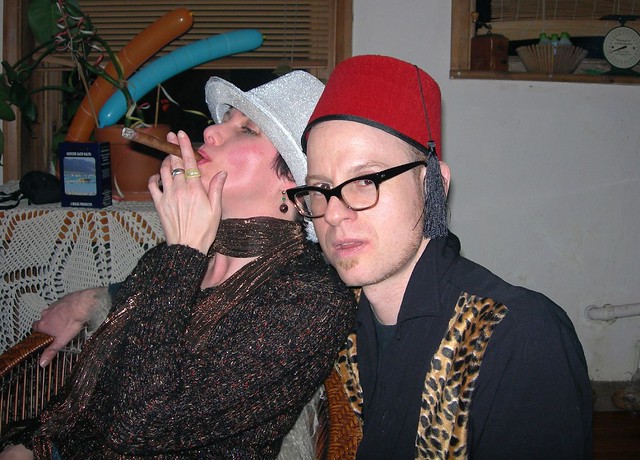
(New Year's Eve 2009: International sex kitten Magda and I. Dig those phallic balloons in the background!)
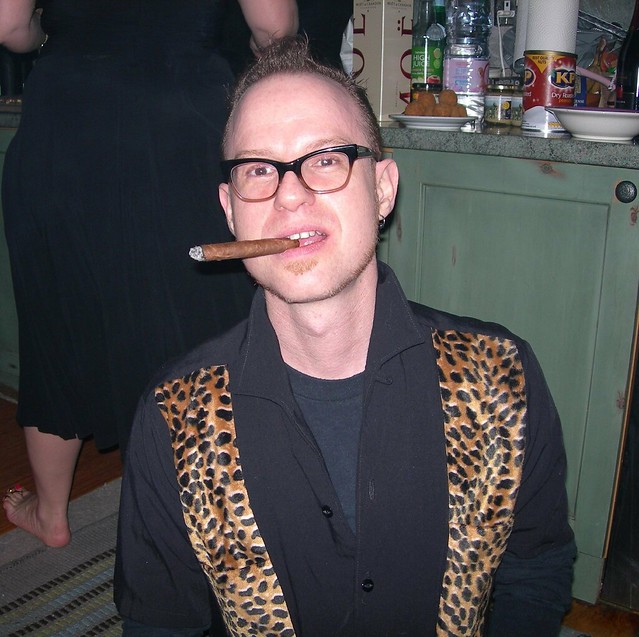
(Another shot from New Year's Eve 2009)
Before this, the closest I’ve had to a doppelganger in real life was the first time I ever went to the Viva Las Vegas rockabilly weekender in 2003. That weekend a female friend told me that she’d seen me coming down the escalator, went to say Hi and when she got closer she gasped – it looked exactly like me, but wasn’t me. Turns out my lookalike was French, and his name was Jean-Paul. Before the end of the weekend, my friend managed to introduce us. I don’t think he was flattered by the comparison! That was nine years ago – I think I look more like Jean-Paul now than I did then. On that weekend (my dream holiday I’d been looking forward to and saving for, my first time in Vegas) I was stricken with shingles! When the rash erupted it was like a Biblical curse, disgusting and painful. Luckily it happened towards the end of the weekend rather than the beginning. After returning from the doctor’s office, I collapsed in bed tripping on a cocktail of ultra powerful antiviral medication and prescription pain killers. The TV was on in the hotel room, tuned into CNN. While I lay there delirious, hair drenched in sweat, I heard a newscaster’s voice solemnly announce, “Jazz and blues legend Nina Simone has died aged 70 ...” So that’s how I always know exactly what I was doing on 21 April 2003.
And so was she! (My escort for the evening was Swedish Therese. I took this photo of her at The Virginia Creepers club a few years back).
Cockabilly is London’s only gay rockabilly club night. It was its organisers Mal Nicholson and Paul Dragoni that really gave me the confidence to pursue DJ’ing when they first launched their monthly Cockabilly night in 2008 and graciously let me make some tentative guest appearances. (So now you know who to blame for unleashing me on the world).
/ The Early Days: Leee Black Childers and I at Cockabilly in 2008 when it was still at The Moustache Bar in Dalston /
Mal and Paul themselves describe Cockabilly as "a rockabilly disco with homosexual tendencies, aimed at juvenile delinquents, homo reprobates, high school drop-outs and everything in between." Over the years Cockabilly has alternated between various venues (like the Moustache Bar and Dalston Superstore in Dalston and The Haggerston in Hackney). In summer 2011 it was re-launched at Shoreditch’s louche George & Dragon: the epicentre of East End bohemia and surely Cockabilly’s natural habitat and spiritual home. (Cockabilly’s patron saint is John Waters. Part of the George & Dragon’s shabby chic/kitsch decor is a gilt-framed poster of Divine in Pink Flamingos, garlanded with twinkling Christmas lights. ‘Nuff said).
It’s been ages since I guest DJ’d at Cockabilly, so I jumped at the chance when Mal and Paul invited me to at the July Cockabilly (plus it was dreamy to make my George & Dragon debut). The whole night was a blast and I really regret not having brought my camera to document it (I came so close to bringing my camera, but at the last minute I decided humping my DJ bag was enough – doh!). The crowd was really buzzing and it turned out to be quite star-studded: George & Dragon regular Princess Julia was there, and The Gossip’s Beth Ditto turned up and danced her ass off. In the flesh, she's much tinier and more beautiful than you might expect, with an incredible alabaster complexion. With her teased black beehive hairdo, Ditto looked like someone out of a John Waters film – which is meant as a compliment.
/ Grainy shot of me on the night taken by Mal with his phone. I don't know what I would have done without my DJ'ing assistant /
My modus operandi at Dr Sketchy is to create a sleazy cabaret / burlesque / titty shakin' vibe. It was a nice change to go for something a bit more abrasive and punkier and to play some full-throttle rockabilly, too. Anyway, this was my quick, tight, lager-fuelled 45-minute Cockabilly set:
Heartbreakin' Special - Duke Larson
Muleskinner Blues - The Fendermen
Khrushchev Twist - Melvin Gayle
All You Gotta Do - Tracy Pendarvis
I Love the Life I Live - Esquerita
Ain't That Lovin' You Baby - The Earls of Suave
Breathless - X
Salamander - Mamie van Doren
Little Lil - Mel Dorsey
Juvenile Delinquent - Ronnie Allen
Cooler Weather (Is A-Comin') - Eddie Weldon
Skull and Crossbones - Sparkle Moore
Tornado - Dale Hawkins
C'mon Everybody - Sid Vicious
Save It - Mel Robbins
Beat Party - Ritchie & The Squires
One Hand Loose - Charlie Feathers
Comin' Home, Baby - The Delmonas
I Walk Like Jayne Mansfield - The 5,6,7,8s
Little Things Mean a Lot - Jayne Mansfield
The Fire of Love - Jody Reynolds
In honour of Cockabilly, Kenneth Anger's sublime 1965 film Kustom Kar Kommandos. The Paris Sisters cooing "Dream Lover" will give you instant erect nipples.
/ Juliette Greco in the 1960s: trademark black dress and black eyeliner /
“When I was a young girl, Juliette Greco was my absolute idol ... If I want to be anybody, I want to be Juliette Greco.” Marianne Faithfull
I last saw Juliette Greco perform in June 2000 at The Barbican – one of the most mesmerising concerts I’ve ever seen. After a decade-long gap, she returned to London to cast another spell, this time at The Royal Festival Hall on 21 November 2010 to conclude the 2010 London Jazz Festival. My initial impression at seeing the now 83-year old grand dame of French chanson take the stage was to note that she looks regal but frail– until she opened her mouth. Greco’s impossibly deep and sensual voice, saturated in a lifetime of Gauloises (or Gitanes?) smoke and vin rouge, is still lacerating. (Someone once described Marlene Dietrich’s voice as sounding like autumn leaves being crunched under leather boots. It equally applies to Greco’s expressive throaty rasp). Then, that she is reassuringly still beautiful and her incredible charisma and sense of drama more potent than ever. Onstage, chanson’s great living exponent remains a torrent of seething emotion and volcanic intensity.
A quick summary for any newcomers to the magic of Juliette Greco: She emerged from the smoky cellar dives of post-war Left Bank Paris like Le Tabou and La Rose Rouge to achieve international stardom as both a chanteuse and an actress. Greco and her family had been active in the French Resistance, and her music and image are steeped in the rebellious, politicised bohemian French intellectual life centred around Saint-Germain-des-Prés. From early on she was encouraged to sing by the likes of by Jean-Paul Sartre and Boris Vian, and besotted leading French poets and philosophers wrote lyrics specially tailored for her (wonderful songs like “"Si tu t'imagines”, her first hit), establishing Greco as the black-clad high priestess of existentialism and a strong, enduring female presence in French popular culture. In the late 1940s she began an interracial affair with visiting American jazz star Miles Davis. Author Lewis MacAdams argues “the offspring of their three-year, long-distance liaison – of the marriage of bebop and existentialism – was the birth of cool.”
/ Beatnik icon: a very young Greco at the beginning of her career in the early fifties /
/ The birth of cool: Miles Davis and Juliette Greco in the fifties /
But hey I’m superficial, so it doesn’t hurt that in the 1950s Greco was lusciously, wantonly beautiful and nailed a timeless, striking almost Morticia Addams-esque look: tousled mane of dark hair, all-black wardrobe, kohl-blackened eyes under a Bettie Page fringe. The liner notes to one of her 1950s albums swoons about “the fascinating child-woman with the wild black hair and the deep-set burning eyes ...” Greco’s magnetic image set the template for female beatniks worldwide, who ironed their hair and donned winged black Cleopatra eyeliner and black polo neck sweaters in emulation. (As a fashion icon Greco belongs up there with countrywoman Brigitte Bardot and Edie Sedgwick. These days, fashion stylists and photographers probably reference the Greco style without realising where it originated).
/ Juliette Greco eyeliner technique /
/ Juliette Greco paper doll: weirdly, there's no black dress in the wardrobe selection! /
/ Various Greco faces over the years (during her fifties Hollywood stint, she had two nose jobs, which dramatically changed her appearance) /
/ Greco in Hollywood: co-starring with Richard Todd in the 1958 film The Naked Earth /
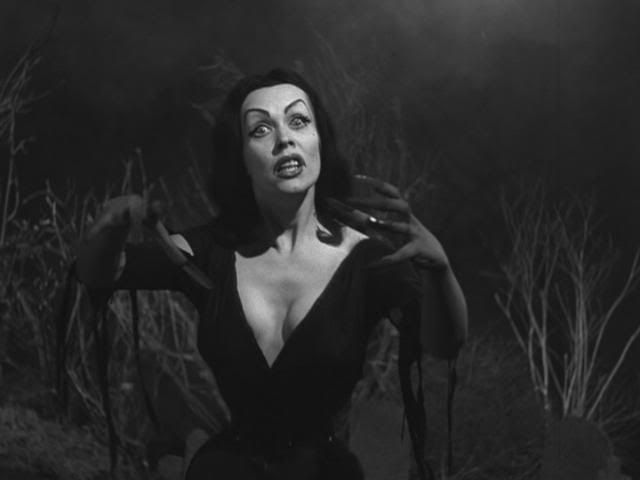
Anyway, it could have been a nostalgic trawl through Greco’s greatest hits, written for her by the likes of Jacques Brel and Serge Gainsbourg – which would still have been spellbinding. Instead it was an evening of stark minimalism: a black stage, Greco in her signature severe black dress (a floor-length bat wing-sleeved velvet shroud worthy of Vampira), and the formidable Greco songbook stripped down to just accordion (accordionist Jean-Louis Matinier) and piano (her husband and long-time accompanist Gérard Jouannest, who composed the music for many of Jacques Brel’s classics).
And while Greco has over 60 years of songs to chose from (she made her singing debut in 1949), she obviously chose the songs that have the greatest personal meaning for her, drawing largely from her majestic late-period work (like 1998’s Un jour d’ete et quelques nuits... and 2006’s Le temps d’une chanson) rather than solely 1950s and 60s crowd-pleasing material (for example, no “Sous les ciels de Paris”, and instead of "Les feuilles mortes", she sang Gainsbourg’s song about “Les feuilles mortes”,” La Chanson de Prevert”), although the set was certainly generously studded with Greco’s classics.
With her commanding theatrical gestures, Greco is as much an actress as she is a singer. Certainly she acts as much as she “sings”: melody definitely isn’t one of her priorities. Over the years Greco’s voice has coarsened and darkened, and is noticeably harsher and more guttural than on her old recordings. But it’s something she works to her advantage: Greco belongs to that elite group of female song stylists whose husky ravaged tones were powerful rather than pretty, and ideal for conveying romantic suffering and world weariness: think late-period Billie Holiday, Nina Simone, Hildegard Knef, Lotte Lenya, Dietrich, and younger singers like Nico and Marianne Faithfull, who very much followed in Greco’s tradition.
Greco hurled herself into every song, transforming each one into performance art. Her songs evoke a variety of moods: she tore into Brel’s "Bruxelles" with an almost angry glee, whereas Gainsbourg’s “La Javanaise” was spine-tingling, slowed-down and delicate. One thing she demonstrated is that at 83 she still retains her sensuality. Introducing “Deshabillez Moi” (Undress Me) she joked she really shouldn’t be singing it at her age, but it’s such a great song she will anyway – and then became the consummate self-mocking sex kitten, which she maintained for the rousing “Jolie Mome” and “L'Accordeon” (during which she played her own body with her fingertips as if it were an accordeon). Greco still has the erotic confidence of a great beauty (whose admirers included Miles Davis, Marlon Brando, Prince Aly Khan, Serge Gainsbourg, Sacha Distel and the film mogul Darryl F Zanuck, who tried to launch her as a Hollywood star in the 1950s), and clearly doesn’t doubt her allure. (In this regard, she reminded me of another slinky octogenarian chanteuse of the same vintage,Eartha Kitt, who we saw perform in 2007).
Ultimately, though, Greco is the consummate tragedienne and the most affecting songs were the bleak dirges. The old Edith Piaf standard “Les Amants d’un Jour” told the eerie story of the suicide pact between two doomed lovers. In her intro to “C’Etait un Train de Nuit” she explained that torture, war and death are all encompassed in the song, and then sang it with her eyes squeezed shut as if in horror. In it, she repeatedly gasps, “Je me souviens” (“I remember ...”) and describes scenes of prisoners on a train en route to a concentration camp. Brel’s tender “La chanson des vieux amants” ended with her covering her face in her hands as if in agony. Greco originally recorded another Brel masterpiece, “J’Arrive” in 1970, but the song – in which she confronts death, imploring, “Pourquoi moi? Pourquoi déjà?”(Why me? Why now?) -- obviously has added poignancy and greater intimations of mortality now that she’s singing it towards the end of her own life.
/ Greco performing "La chanson de vieux amants" in 2004 at The Olympia in Paris /
/ Autumn Leaves: Greco photographed by Pierre et Gilles in the eighties /
After seeing one of Marlene Dietrich’s last concerts in the 1970s, the film critic Kevin Thomas reflected, “she regarded her talent as a rare and precious wine that she would pour out drop by drop, and until it was gone it would be the most perfect, most refined of all.” Before Greco’s 2000 Barbican concert, she hadn’t performed in London since 1989 and then she waited a decade before returning. It was bittersweet knowing it was unlikely we’d ever see Greco again. For her Royal Festival Hall finale she sang a devastating “Ne Me Quitte Pas”. Greco’s is the angriest version you’ll ever hear of this Brel standard, shredding the elegant melody until it’s a savage plea (she virtually stamps her foot and shakes her fist when she sings it). Afterwards, drinking at the bar and reflecting on Greco’s artistry, commitment and urgency, we appreciated that we may have been born in the wrong era to have seen Edith Piaf, Billie Holiday or Dietrich perform, but we got to see Juliette Greco – every bit their equal. If this is the defiant but vulnerable Juliette Greco’s last performance in London, it was one none of us who saw it will ever forget.
/ Greco singing "Ne me quitte pas" on Italian TV /
/ Obviously photography was strictly forbidden, but at the very end of the night when La Greco came back out to take her curtain calls (and got a standing ovation), I managed to snatch this shot./
/ And Christian took this one: /
/ Someone shot this surprisingly good video of Greco performing "Avec le temps" at The Royal Festival Hall /
/ Strange, interesting litte clip of Greco filmed in 1966 in which she sings two of the songs she performed at The Royal Festival Hall: "Jolie Mome" and "Un Petit Poisson, Un Petit Oiseau." Most fascinating is the glimpses of her backstage in her dressing room, applying her thick black Cleopatra eyeliner /
A LOOK AT JULIETTE GRECO
The Royal Festival Hall concert didn't get much coverage in the press, but it got reviewed in The Telegraph. Not exactly the hippest publication (!), but you can read it here. To their credit they also interviewed her.
Excellent, very thorough overview of Greco's career here
I wrote this piece about Greco for the American punk website Razorcake way back in the early 2000s. I'd write it very differently now -- but here it is
On 20 March 2010 I went to a book signing at Foyle's bookstore at The Southbank in Waterloo: Patti Smith was in London autographing copies of her memoirs Just Kids about her relationship with photographer Robert Mapplethorpe and their early years together as struggling artists in NYC. I would say she's one of my punk heroes -- but Patti Smith is one of everyone's punk heroes!
Before the signing she sang a few songs accompanying herself on guitar and read a bit from the book. I couldn't actually see her performance as the queue was so long and she was just standing at the front of the store, not elevated on a stage but she was in lacerating voice. It felt incredible to meet Patti Smith even if only for a few fleeting moments -- she's so charismatic and such a legend. As you can see she graciously let me take her photo too.
Hollywood 90028 (1973)
-
*Hollywood 90028* was written, directed and produced by Christina
Hornisher. She seems to have worked on it intermittently in 1969 and 1970
but it was no...
THE GO-BETWEEN 1971
-
*"You flew too near the sun; you were scorched."*
Spoiler Alert. This is a critical essay, not a review, so plot points are
revealed for discussion
Gee, I...
The end is near
-
Cookie has, for some time now, thought about closing up shop on this blog.
I mean DHTiSH has had a good run, but after 15 years, it's time for a
diff...
Grace Jones
-
Artist: Grace Jones
LP: 7" single
Song: "I've Seen That Face Before (Liber Tango)"
[ listen ]
The incredible Grace Jones turned 76 one month ago today. ...
National Silent Movie Day: Manhandled (1924)
-
Wednesday, Sept. 29, 2021, is National Silent Movie Day. New York City's
beloved Film Forum is celebrating with a screening of Allan Dwan's 1924
silent...
SHABLAM:
-
While we are speaking in onomatopoeia,
"Girl, what did that girl just say, girl?" This queen is giving basic boot
camp for drag queens as she throws an a...
Who was Tamara Matul?
-
[image: Marlene Dietrich, Josef von Sternberg, Rudolf Sieber, Tamara Matul
at Olympic Auditorium, Los Angeles, 1934]
Rudolf Sieber, Tamara Matul, Marlene...
-
Welcome Refugees from tumblr!
[image: Christofascists.]
I'm busy exporting what's left of Drifting over the Ether & A Long Lunch. I
will be posting upda...
My Baking Supervisor
-
Meet Mr. Caspurr Burgers. He says:
"I helped you get up three hours earlier than usual this morning and this
is how you repay me? What is with this glass...
Béatrice Dalle Day
-
'Driving south on the A7 from Lyon to Marseille, I find my thoughts turning
to some of the scenes associated with the name of Béatrice Dalle. They
incl...
A BOGUS SPEECH BY A BOGUS PRESIDENT
-
Yesterday, Obama spoke in New Orleans at the 10 year anniversary of
Katrina. I'm not quite sure why we celebrate disasters' anniversaries, but
it was a ch...
DJ. Journalist. Greaser punk. Malcontent. Jack of all trades, master of none. Like the Shangri-Las song, I'm good-bad, but not evil. I revel in trashiness