Sunday, 28 August 2022

Reflections on ... The Sex Symbol (1974)


 Sure, excitement is buzzing over Blonde (Netflix’s adaptation of Joyce Carol Oates’ speculative 1999 Marilyn Monroe biography drops on 23 September). But I doubt Blonde will be anywhere near as much fun as The Sex Symbol (1974)! 

Not streaming on any legit platform and never issued on DVD, this thinly veiled made-for-TV roman à clef / Monroe biopic starring kitschy sex kitten Connie Stevens surely qualifies as a “lost film”. But a serviceable bootleg print of The Sex Symbol is currently viewable onYouTube - and I’m ecstatic to confirm it’s every bit as gloriously tasteless, exploitative and deranged as I could have dreamed! 

/ Connie Stevens is Marilyn Monroe. I mean, Kelly Williams / 

“Agatha Murphy from golden Hollywood with the biggest scoop 1957 has yet brought us!” jeers a vicious show business television presenter (played by shameless hambone Shelley Winters as a hybrid of Old Hollywood gossip columnists Hedda Hopper and Louella Parsons). “Kelly Williams, one of the most sex-sational movie stars of our time, is through! She has been reporting late for work or not all on the Phoenix production of Will You Be Mine? claiming to be ill …” Williams, Murphy announces, has been fired by Nick Fortis (Nehemiah Persoff), head of Phoenix studios. “She fled to her Bel Air home and is reported to be secluded there near hysteria!” 

“Hysteria” is an understatement! Incognito in headscarf, dark sunglasses and white pantsuit, our ersatz Monroe Kelly Williams pushes past the mob of press and fans gathered outside her front door. Once safely installed inside her sumptuous purple boudoir, she sloshes vodka (or is it gin?) into a tumbler and watches Murphy’s broadcast. When Murphy crows, “It is such a shame that in less than ten years, a young fresh once-great beauty has disintegrated into a neurotic alcoholic mess!” it represents the last straw. Kelly hurls the liquor bottle at the TV screen. It shatters. “I finally found a way to shut that Aggie’s fat ugly mouth!” Kelly screams to Joy Hudson (Madlyn Rhue), her infinitely patient confidante and personal assistant. (Some viewers have discerned a Sapphic aspect to the women’s relationship.  Later we see Joy giving a nude Kelly a rubdown on massage table – just what’s in her job description? – and Joy always seems vaguely disapproving of Kelly’s gentleman callers). 

Even worse, just then Agatha Murphy’s people phone requesting an exclusive interview. “Why don’t you tell her I have sclerosis of the liver!” Kelly screeches to Joy. “Or I’m a dope fiend! That oughta give her a story for tomorrow!” 

“You can’t keep wallowing in self-pity!” long-suffering Joy explodes. “A dozen doctors have told you there’s nothing wrong with you physically except you keep stuffing yourself with barbiturates and booze!” Predictably, Kelly doesn’t respond well to Joy’s truth bomb. “Get out of here! Don’t you tell me how to run my life! You’re nothing but a vulture, like the rest of Hollywood! You leech!” 

Cut to the delayed opening credits. Over the Henry Mancini theme song, we see a procession of garish faux Warhol Pop Art portraits of various doomed Hollywood Babylon-type female stars: Marilyn Monroe. Jayne Mansfield. Veronica Lake. Carole Lombard. Betty Grable. Ann Sheridan. Jean Harlow. Maria Montez … and finally Kelly herself. 

By now it’s evident The Sex Symbol has been made “on the cheap”. Minimal effort is taken to conjure the forties or fifties time periods. As Kelly, Stevens always resembles what she was at the time: an early seventies Las Vegas headliner with a shaggy frosted blonde coiffure, frosted blue eye shadow, frosted pink lipstick and costumes (and wigs and hairpieces) straight out of a Frederick’s of Hollywood catalogue. 
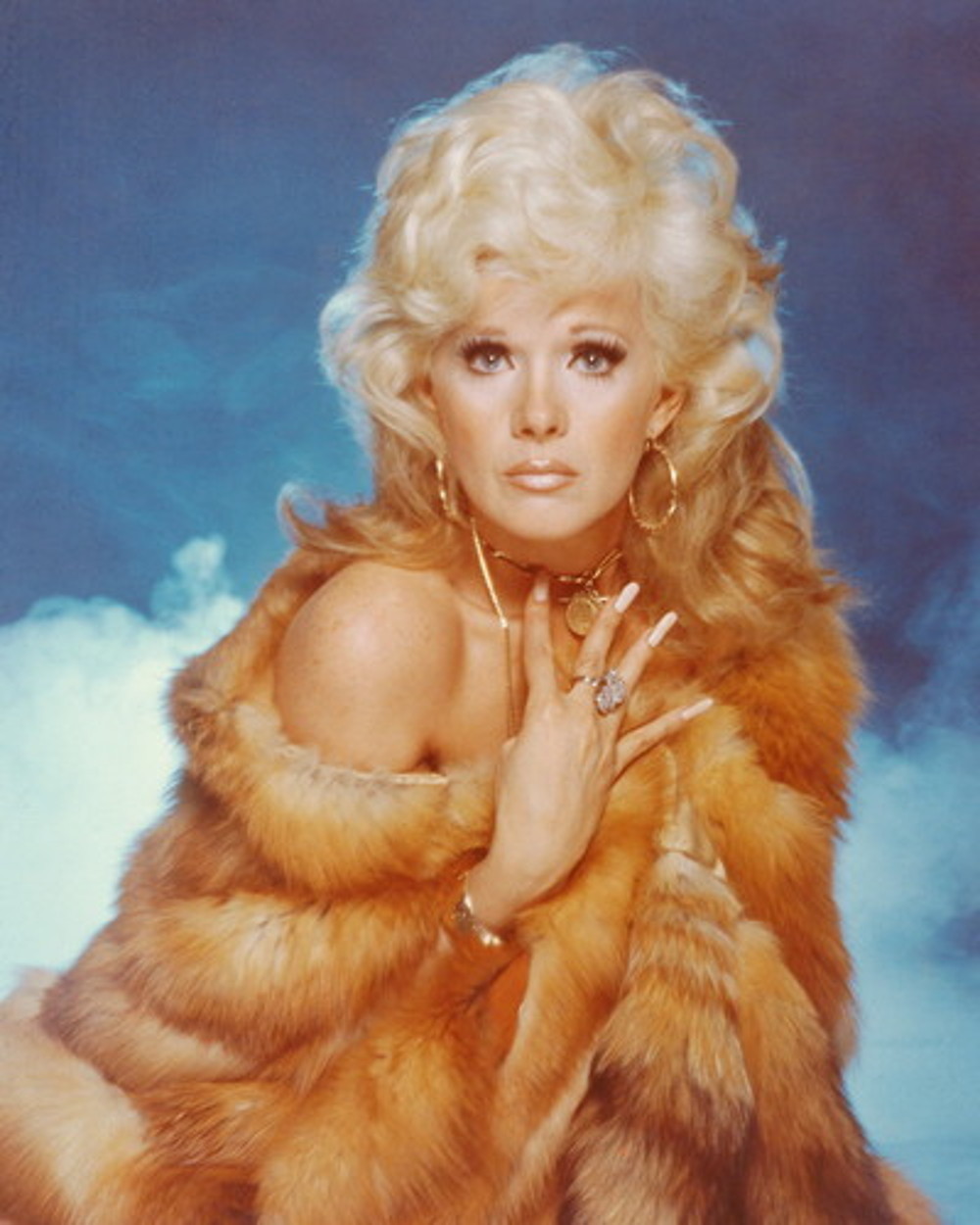

/ At one point, we see a flurry of "glamour shot" pin-ups of Kelly Williams, including these. Weirdly and confusingly, these exact photos would be recycled two years later to promote Stevens' subsequent film Scorchy (1976) / 

The Sex Symbol’s premise is that we’re witnessing Kelly’s dark night of the soul. In fact, the final night of her life. We’re presumably meant to find Kelly a tragic figure, but she’s insufferable. Her breathless baby doll voice quickly grates. Kelly rages, “Canned from one stinkin’ movie! Anyone would think I was dead!”, swills booze, pops fistfuls of pills, goes on crying jags and lashes out at her Spanish-speaking maid (“No! I’m not hungry!”). Much of the time she’s in bed shrieking into a pink telephone, like the worst-possible adaptation of Jean Cocteau’s La Voix Humaine. In terms of acting, Stevens’ guiding principle seems to be: “Patty Duke didn’t go nearly far enough as Neely O’Hara in Valley of the Dolls.” (Speaking of Dolls, Kelly is pitched as Neely and Jennifer North rolled into one).  And as my friend Kevin spotted, Stevens in full rampage in her bedroom anticipates Mink Stole’s tantrums as Peggy Gravel in John Waters’ Desperate Living (1977). 

In the present, Kelly frantically phones (harasses? Terrorizes?) the men in her life, which prompts flashbacks. The main victim is her psychiatrist. “I don’t mean to be rude calling you at home,” she begins. “I’m just beside myself. The studio has fired me. And that television witch says I’m finished! You heard me complaining often enough that my first husband claimed that I wasn’t very good in bed. Now I’m just a lush who’ll go with any man who asks!” Kelly then becomes gripped by paranoia the doctor might commit her into a mental institution – like what happened to her mother. “I’m not a nobody!” she bellows. “I’m a star! I made myself a star so no one could tell me what to do!” 

Our first flashback rewinds to World War II when pre-fame Kelly (still known as Emmaline Kelly) is toiling at an airplane factory. This may be unchivalrous to note, but at 36 (the age Monroe died) Stevens fails to convince in these scenes as a dewy wannabe starlet in her early twenties. Kelly’s photo has appeared in the newspaper captioned “Miss Blowtorch 1945” and Kelly vows to her soldier boyfriend Tommy that she’ll send the pic to modelling agencies and pursue her show biz dreams: “I got this thing burning in me. I just gotta be someone!” Unimpressed, Tommy implies she’ll wind up “auditioning in hotel rooms”. “I’m gonna be a star, Tom!” Kelly insists. “And I’ll do it standing up!” 

Kelly rapidly abandons this principle, because next time we see her she’s the protegee and mistress of hot shot agent Phil Bamberger (Milton Selzer).  Clearly modeled on Johnny Hyde (the talent agent who initially discovered and molded Monroe), kindly and significantly older Phil is a father figure, mentor, champion and lover. “There’s something pure about you,” Phil gushes. “It can’t be changed or violated.” Kelly (who describes herself as “an orphan kicked around from foster home to foster home”) confesses that one of her foster fathers did indeed violate her, then insists, “Cuddle me!” “Go slow, kitten!” Phil chuckles. “I’m an old man!” Worryingly, he also has a “bum ticker” – and promptly dies of a heart attack. Before that, Phil connects Kelly with cigar-chomping producer Jack P Harper (exploitation / horror director William Castle, who delivers one of the better performances). “Aggie Murphy started the rumour he died in bed with me!” Kelly wails to him. 

Harper dispatches Kelly on a cross country personal appearance publicity tour (“We’re selling a product here. A very lovely product, I must say!” In this sequence, Stevens wears a bouffant wig very similar to Monroe’s look in the unfinished Something’s Got to Give or the 1962 Bert Stern photo shoot - the sole time she’s styled to resemble Monroe). Kelly is a star-in-the-making! (The titles of her films - Midnight Madness. Will You Be Mine? Sex Bomb. Deep Purple. That Lady from Cincinnati – are hilariously generic). 
Back in the present-day, the doctor hangs up on Kelly. Affronted, she calls him right back. “Kelly, it’s after midnight!” “I pay you to be there to help me!” Kelly updates him that she’s she tracked down the phone number of her long-lost biological father via the county orphanage. Ignoring that bombshell, he counsels her, “As I’ve told you before, you shouldn’t ever take barbiturates if you’ve been drinking!” 

We watch Kelly’s first encounter with Agatha, when the gossip maven invites the newcomer over for tea. “This industry lives on gossip and scandal,” Agatha clucks. “You can expect to be called a promiscuous tramp. A nympho. And even worse!” Speaking of “promiscuous tramp”, Kelly is juggling two men: married Senator Grant O’Neal (Don Murray impersonating John F Kennedy) and retired football star Buck Wischnewski (William Smith), a Joe DiMaggio substitute. It’s Buck she marries, swayed perhaps when he says he does charity work for orphanages (the news makes Kelly tremulous: “I was an orphan!”). Their honeymoon, though, is a bust. Kelly is frigid. “Don’t you enjoy making love with me?” Buck inquires hesitantly. “Not very much, Buck. It isn’t your fault. It’s me. I just never … I mean, I’ll try harder next time. I’m sorry”. Kelly inexplicably consoles Buck by serenading him with the lullaby “Hush, Little Baby” in a little girl voice. Within minutes of announcing their marriage, Agatha proclaims their divorce. (It lasted 10 months). 

In the present, Kelly phones her manager Manny Fox (Jack Carter), waking him up. “Jeez, do you do know what time it is?” “What the hell do you mean do I know what time it is? I pay you ten percent to answer the phone any time!” Afterwards, Kelly mutters to herself, “Everybody in this whole stinkin’ town needs love. Nobody even knows the meaning of the word”  while smearing cold cream onto her face. 

At Agatha’s Christmas cocktail party, Fortis introduces Kelly to “America’s greatest living artist” Calvin Bernard (James Olson, the intellectual Arthur Miller equivalent). “You possess deep spiritual beauty,” Calvin rhapsodizes. “You’re a great beauty. A brilliant mind. A tremendous strength. All waiting for you to learn how to use them – and I intend to be your teacher!” He urges her to go to New York with him: “It’s the only civilized place to live in this country! Hollywood, California is a vulgar mirage, but New York … you’ll see!” Cut to the newspaper headline: “Sex Symbol to Wed Art Great.” In New York, Calvin pressures Kelly to abandon movies to study acting and perform Chekhov and Ibsen onstage. Emboldened, Kelly dares to complain about the quality of her latest script to Fortis. “She can’t act her way out of a paper bag!” Fortis thunders. “Pretty face. Good rear. Great chest. Period! She’s a piece of meat that I buy and sell just like the rest of them!” 

/ Shelley Winters, Connie Stevens and Nehemiah Persoff in The Sex Symbol (1974) /

Back in Hollywood, Kelly is invited to add her autograph and hand prints to the Hollywood Walk of Fame outside Grauman’s Chinese Theatre. To Calvin’s horror, in front of the assembled press she “goes rogue” and also presses her boobs into the wet cement as observers whistle and cheer lasciviously! (“Oh, my goodness!” Agatha swoons. “What is she doing?”). 

This stunt spells the dissolution of their marriage. Watching Kelly wash down pills at bedtime with alcohol, Calvin asks, “When did you get on the tequila kick?” “In Mexico. On our honeymoon.” “That must’ve been your first husband. We’ve never been to Mexico together.” “That’s right. (Laughs). That’s funny!” Glugging it back, Kelly toasts (and mispronounces) “Salut!” “Your ear for foreign languages is as lacking as your sense of good taste!” Calvin mocks. 

The action is catching up to Kelly getting fired from Will You Be Mine? “What happened? Booze or an orgy?” the queen-y disapproving director snaps as Joy guides a late and hungover Kelly onto the set. In the make-up chair, a dazed Kelly starts applying cold cream to her face while staring at her reflection – and then smears it all over the mirror, obliterating herself. 

That night, Kelly reaches her father by phone – at 2 am! It’s not the reunion she hoped for. “You must have the wrong number, lady!” “Daddy? Daddy? Daaaaad?” she howls when he hangs up. When she calls him back later, he shouts, “Listen, you! It’s almost five in the morning!” Abandoned by every man in her life, the end is neigh for Kelly Williams … 

Perversely, some of the participants (like Winters and Murray) in this debacle knew the real Marilyn. Stevens’ shrill “I’m-a-victim” portrayal never evokes Marilyn (and she’s inept in the drunk scenes). The sequence where Kelly beguiles reporters with her ditzy blonde comedy schtick feels like a chapter from the Jayne Mansfield story rather than Monroe’s. Stevens does, though, recall Pia Zadora, Liz Renay, Carroll Baker in Harlow (1965), Joey Heatherton, Catherine O’Hara parodying Joey Heatherton as Lola Heatherton – and Connie Stevens herself! Startlingly, there’s a totally gratuitous tits-and-ass nude scene towards the end. (The Sex Symbol received a European cinematic release padded with bonus material, which is the version on YouTube. The original ABC cut was one hour and 14-minutes. This one is one hour and 47-minutes). In conclusion: The Sex Symbol is required viewing!

Monday, 18 July 2022

The Next Lobotomy Room Film Club: Passport to Shame (1958) on 28 July 2022

This month the Lobotomy Room film club (our motto: Bad Movies for Bad People) presents for your delectation tense, irresistibly trashy black-and-white British b-movie Passport to Shame (1958)! See the film described by Radio Times as “a cheap, tawdry and utterly fascinating piece of vintage sexploitation” that aims to expose the shame of London’s prostitution rings! As a bonus: Passport co-stars 26-year-old Diana Dors - British cinema’s reigning bad girl - at her pouting sex goddess zenith!  Thursday 28 July 2022 downstairs at the fabulous Fontaine’s bar in Dalston! (Note: the film club is normally third Thursday of every month - but this month it got bumped to the following Thursday! Don't get it twisted!). 

Lobotomy Room Goes to the Movies is the free monthly film club devoted to the cult, the kitsch and the queer! Third Thursday night of every month downstairs at Fontaine’s bar (Dalston's most unique nite spot)! Two drink minimum. Inquire about the special offer £5 cocktail menu! Numbers are limited, so reserving in advance via Fontaine’s website is essential.  Alternatively, phone 07718000546 or email bookings@fontaines.bar to avoid disappointment! (Any difficulties reserving, contact me on garusell1969@gmail.com). The film starts at 8:30 pm. Doors to the basement Bamboo Lounge open at 8:00 pm. To ensure everyone is seated and cocktails are ordered in time, please arrive by 8:15 pm at the latest.

Facebook event page. 


/ Diana Dors in Passport to Shame (1958) /


/ Passport to Shame was released in North American markets as Room 43

Read more here. 

Friday, 24 June 2022

Reflections on ... Summer Storm (1944)


Recently watched: Summer Storm (1944). Tagline: “The Most Beautiful Woman God Ever Forgot to Put a Soul Into!” 

“George Sanders and Linda Darnell drifting to their destruction in the best Hollywood adaptation of a Chekhov story.” 

/ Andrew Sarris in his groundbreaking essay “Those Wild and Crazy Cult Movies” published in The Village Voice in 1978 / 

“Before this adaptation of Chekhov’s 1884 novel The Shooting Party, Linda Darnell was valued for her beauty rather than her acting ability, but her role here as Olga, a peasant girl who ruins the lives of three men in her quest for wealth and social standing, relaunched her career. She’s brilliant, particularly in her wedding scene, where she is aware of the patronising scorn of the aristocrats around her, adding fuel to her plan to improve her station. George Sanders gives one of the best male performances in Sirk’s canon, as the weak judge who falls in love with Olga. The critique of the limited options available to women is pure Sirk, while there is a moment of suspense that recalls Hitchcock, when a maid sees something disturbing from her changing room. The ending, where the judge has a life-changing decision to make, shows Sirk’s eye for human fallibility at its keenest.” 

/ From Douglas Sirk: 10 Essential Films by Alex Davidson, 2016 /


I’ve always wanted to see this early Douglas Sirk curiosity, which seems to be entirely out of circulation. (Summer Storm isn’t streaming anywhere. The DVD that Cinema Paradiso sent me dates to 2009 and is probably long out of print). In the Andrew Sarris article cited above, he lists Summer Storm as a film that should be embraced by cult movie aficionados. Obviously, that never happened. It’s minor Sirk, but hell, minor Sirk is more fascinating than most filmmakers on their best day!


Friday, 17 June 2022

Reflections on ... Swan Song (2021)


Recently watched: Swan Song (2021). 

In the sleepy town of Sandusky, Ohio, geriatric former hairdresser Pat Pitsenbarger (Udo Kier) has sunk into terminal ennui. Following a stroke and the death of his long-term boyfriend, this previously flaming creature is now languishing in a dreary care home. The monotony of his existence is broken when Pat receives an unexpected request: local socialite and Sandusky’s richest woman Rita Parker Sloan (Linda Evans aka Crystal Carrington from Dynasty) has died and her will stipulates only he can style her hair for her open casket funeral. In fact, he will receive $25,000 to complete the job. But Pat is torn. He and Rita had been estranged ever since Pat’s scheming erstwhile protegee Dee Dee (Jennifer Coolidge) opened her own salon - and poached Rita as a client. 

If this premise suggests a fun black comedy – it ain’t! The tone of Swan Song is predominantly solemn and melancholy. And writer / director Todd Stephens makes frequent misjudgments, relying on all the standard "sensitive" American indie film conventions (like employing what looks like a muted vintage-style Instagram filter over everything). 

Swan Song may be underwhelming and inconsequential, but it’s undeniably a great showcase for 77-year-old German actor Udo Kier. In his long distinguished international career Kier has collaborated with cinematic heavyweights like R W Fassbinder, Paul Morrissey (Flesh for Frankenstein, Blood for Dracula), Dario Argento (Suspiria), Werner Herzog, Lars Von Trier and Gus Van Sant (plus Madonna’s “Deeper and Deeper” video!). It’s glorious to see late-period Kier imbue this meaty lead role with battered dignity and eloquent suffering. And he visibly loves playing the flamboyant, unrepentantly “nellie” Pat. 

Linda Evans is perfectly adequate in what’s essentially a fleeting guest star appearance. But afterwards I thought it would have been great to see a real actress like present-day Ann-Margret playing Rita. Or - gasp! - Faye Dunaway. Still, Evans’ presence provides one fun in-joke when Pat and Rita’s gay grandson leaf through old snapshots - including one of Rita with one of her three husbands. And it's Evans with John Forsyth! The soundtrack is old-school gay as fuck: Shirley Bassey, Judy Garland - and a triumphant use of Melissa Manchester's "Don't Cry Out Loud!" What irritated me: Pat chain-smokes campy cigarillos (the brand is Mores) indoors throughout and no one ever says, "You can't smoke in here!"


Sunday, 12 June 2022

Reflections on ... Nunsexmonkrock (1982)


“Hagen recorded Nunsexmonkrock in New York with a band that included Paul Shaffer and Chris Spedding. To describe it as wild hardly suffices – the drugs-sex-religion-politics-mystical imagery that spills out is nearly incomprehensible in its bag-lady solipsism, but the music and singing combine into an aural bed of nails that carries stunning impact. It almost doesn’t matter that Hagen sticks to English; what counts is the phenomenal vocal drama. Her range seems limitless, and the countless characters she plays makes this fascinating.” 

/ The Trouser Press Record Guide (1991) review of Nina Hagen’s 1982 album Nunsexmonkrock /

“Nina Hagen’s 1982 album NunSexMonkRock is one of the single most ground-breaking and far-out things ever recorded and it deserves to be considered a great - perhaps the very greatest - unsung masterpiece of the post-punk era. I’ll take it even further: To my mind, it’s on the same level as PiL’s Metal Box, Captain Beefheart’s Trout Mask Replica or Brian Eno and David Byrne’s My Life in the Bush of Ghosts. Or The Dreaming by Kate Bush. There I’ve said it … Nunsexmonkrock could have been recorded 40 years ago, yesterday, or a thousand years from now and it just wouldn’t matter.” 

/ From Dangerous Minds website / 

Unleashed on this day forty years ago (12 June 1982): berserk German punk diva Nina Hagen’s debut solo album and definitive artistic achievement, futuristic 1982 post-punk masterpiece Nunsexmonkrock – hailed by a Rolling Stone reviewer as the "most unlistenable" record ever made. Au contraire! Hagen’s confrontational Exorcist-style vocals and crackpot flights of fancy are (mostly) grounded in experimental but tough and danceable New Wave rock. Opener “AntiWorld” invents an operatic / Biblical / gypsy punk hybrid. “Smack Jack” - her spooky anti-heroin diatribe - nails a sense of junkie panic. "Iki Maska" is anchored to the same Henry Mancini / Peter Gunn guitar riff as “Planet Claire” by the B-52’s. The irresistible “Born in Xixax” bristles with paranoid conspiracy theories predicting World War III but vows, “One day we will be free!” Best of all, the extraterrestrial “Cosma Shiva” marries blaxploitation funk bass with samples of the gurgles and squeals of Hagen’s baby daughter, and concludes with Hagen declaring, “And my little baby, I tell you - God is your father.”

Hagen would go on to make two more fun, interesting records (Fearless (1983) - her foray into disco - and the heavy metal-leaning In Ekstasy (1985)), then seemingly run out of inspiration (which unfortunately didn’t stop her from continuing to record). Four decades later, Nunsexmonkrock still sounds like bleeding-edge science fiction. If any of this tempts you, the album is on Spotify. 

Saturday, 11 June 2022

The Next Lobotomy Room Film Club: Mahogany (1975) on Thursday 16 June 2022


“There’s only one word to describe rich, dark, beautiful and rare. I’m going to call you … Mahogany!”

Yass, Queen! In honour of Pride Month, the Lobotomy Room film club (our motto: Bad Movies for Bad People), presents Mahogany (1975) starring fierce pop diva Diana Ross! Thursday 16 June downstairs at the fabulous Fontaine’s bar in Dalston! 

Seize this opportunity to celebrate Ross as an unassailable gay icon while she’s actually gracing our shores with her glittering presence this summer (she's performing at the Platinum Jubilee concert, a sold-out stint at the O2 Arena AND the “legends slot” at Glastonbury) with this berserk so-bad-it’s-GREAT camp classic in the tradition of Valley of the Dolls, Mommie Dearest and Showgirls! (Critic Roger Ebert dismissed Mahogany as a “big, lush, messy soap opera” - as if that’s ever a bad thing!). 

In this lurid rags-to-riches melodrama, Ross portrays Tracy Chambers, a poor but determined aspiring fashion designer from the gritty slums of Chicago. Instead, she’s “discovered” by a photographer (played by Tony Psycho Perkins) and winds up transformed into international supermodel Mahogany. But is success - and her decadent Euro-trash existence in La Dolce Vita Rome - all it’s cracked up to be? See the film that inspired everything from Beyonce to RuPaul and generations of drag queens to Paris is Burning! Throw on a chiffon cape, drip candle wax all over yourself and embrace the sequined lunacy of Mahogany on 16 June! 

Lobotomy Room Goes to the Movies is the FREE monthly film club devoted to the cult, the kitsch and the queer! Third Thursday night of every month downstairs at Fontaine’s bar in Dalston! Two drink minimum. Inquire about the special offer £5 cocktail menu! Numbers are limited, so reserving in advance via Fontaine’s website is essential. Alternatively, phone 07718000546 or email bookings@fontaines.bar to avoid disappointment! The film starts at 8:30 pm. Doors to the basement Bamboo Lounge open at 8:00 pm. To ensure everyone is seated and cocktails are ordered in time, please arrive by 8:15 pm at the latest. Facebook event page.


Saturday, 19 March 2022

Reflections on ... The Wild World of Batwoman (1966)


Recently watched: The Wild World of Batwoman (1966). Tagline: “A Thrill-cade of Excitement! Roaring through the city streets into Wildville!” 

Look, I have a high (possibly masochistic) tolerance for terrible films. In fact, I have a twisted affection for them. Give me a The Brain That Wouldn’t Die (1962) or I Eat Your Skin (1971), and I’m transfixed. But The Wild World of Batwoman defeated even me. Its duration is a mere one hour and six minutes, and yet somehow it felt like three numbing hours long. IMDb gives up on even attempting a synopsis: “The pointlessly named Batwoman and her bevy of Batmaidens fight evil and dance.” (Rotten Tomatoes makes more of an effort: “A busty vampire needs a scientist's atomic bomb, made from a hearing aid, to save a comrade”).  Opportunistic hack director Jerry Warren clearly aimed to exploit the popularity of the campy Batman TV series. When they legally threatened him over copyright infringement, Warren simply re-titled it She Was a Hippy Vampire. 

Anyway, the titular Batwoman (ineptly played by Katherine Victor) is a tired looking middle-aged woman in an exploding punk fright wig, Halloween mask and dominatrix outfit. She’s also a crime-fighting vampire ruling over a bevy of groovy “Bat Chicks” who are forever breaking into frantic go-go dancing. (Are they doing the Frug? The Watusi? The Jerk? I couldn’t tell you).  The ensuing wacky hi-jinks are utterly incomprehensible. To add to the confusion, Warren also pads-out the action by splicing in footage from The Mole People (1956), an entirely different film.  

The naïve kitschy tone has its appeal. There’s some decent twang-y garage rock music. The Wild World of Batwoman would inevitably be more tolerable broken into chunks on something like Elvira’s Movie Macabre or Mystery Science Theatre 3000. Anyway, I stuck it out to the bitter end. I defy you to the do the same! The Wild World of Batwoman (viewable on YouTube) is routinely described as one of the worst films ever made – find out why!