Showing posts with label Pauline Kael. Show all posts

Saturday, 2 March 2024

The Next Lobotomy Room Film Club ... Butterfield 8 (1960) on 21 March 2024

“The John O'Hara novel that seemed perfect for the movies, plus the role that seemed perfect for Elizabeth Taylor - and this is the garish mess it became,” is how the reliably terse Pauline Kael dismissed Butterfield 8. “Daniel Mann's direction is maybe even worse than the Charles Schnee-John Michael Hayes script. With Laurence Harvey; Dina Merrill, doing a noble wife to end all noble wives; and a vacuum on the screen that is said to be Eddie Fisher.” 
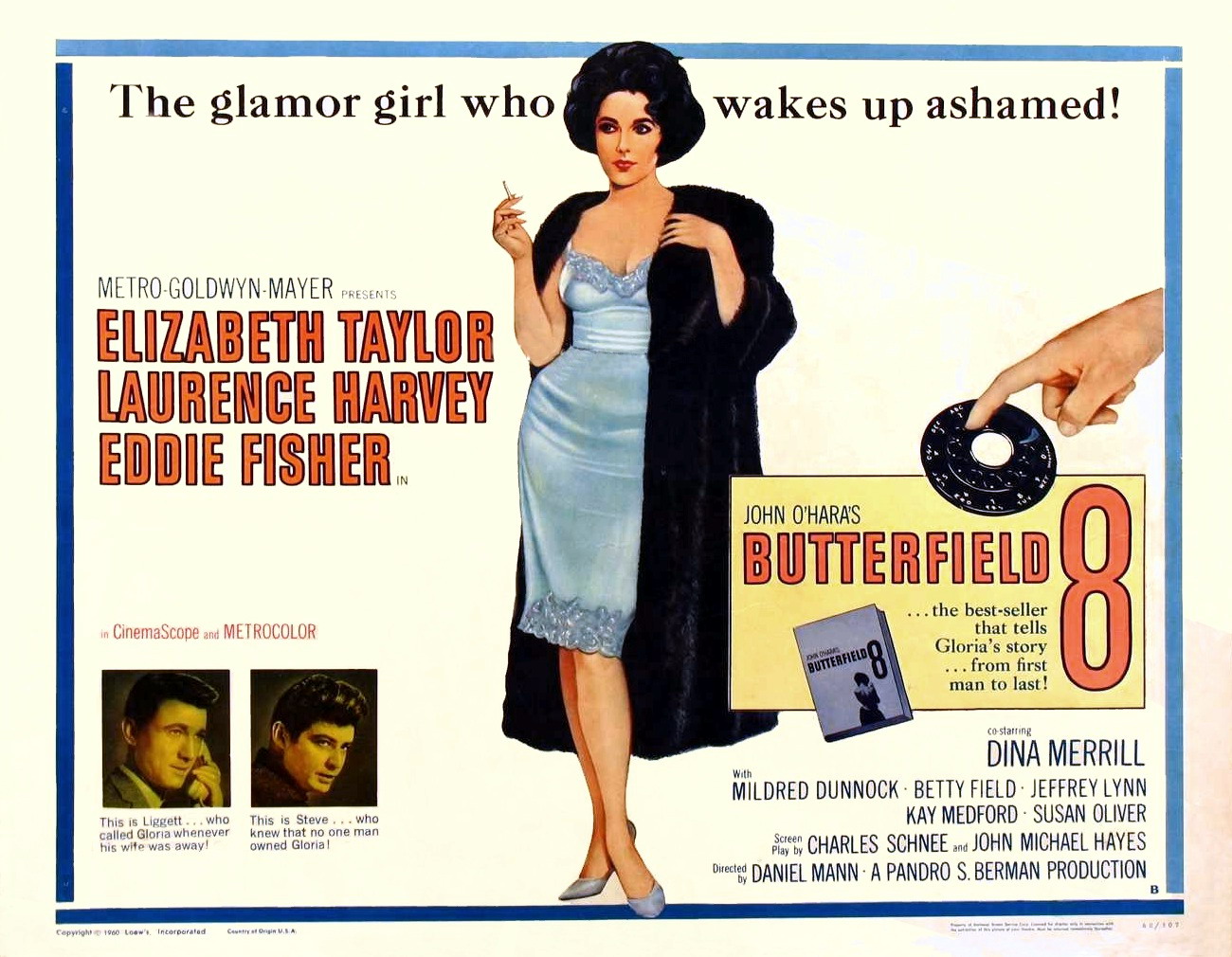
Almost no one has a good word to say about this lurid, wildly entertaining 1960 melodrama (including leading lady Taylor herself) – so of course Butterfield 8 is absolute catnip for me and it’s the March 2024 selection for the Lobotomy Room cinema club devoted to Bad Movies for Bad People! 


To its advantage: Taylor is sublime as wanton high-priced, high-class New York call girl Gloria Wandrous (tagline: “Gloria is the glamour girl who always wakes up ashamed!”). And the script co-authored by John Michael Hayes (the genius behind camp classicks (sic) Torch Song, Peyton Place, The Carpetbaggers, Where Love Has Gone and Harlow) features dialogue like “Face it, mama! I was the slut of all time!” and “I’ve had more fun in the back of a ’39 Ford than I could ever have in the vault of the Chase National Bank!” 


The opening moments alone are spellbinding: as Edward Margulies and Stephen Rebello recount in their 1993 book Bad Movies We Love, “Taylor awakens alone in her married lover’s bed, wraps herself in only a sheet, lights a cigar, drains a glass of whiskey, discovers her torn dress on the floor, brushes her teeth with booze, finds an envelope with $250 cash, scrawls “No Sale” in red lipstick across a mirror, leaves the money and instead steals the absent wife’s mink coat, calls her answering service and hails a cab to the apartment of … Eddie Fisher (by then, he was the real life Mr. Taylor).”  


So, join us on 21 March 2024 to watch Butterfield 8 over cocktails at Fontaine’s in Dalston! In my intro, I’ll provide context on Eddie Fisher leaving his then-wife Debbie Reynolds for Taylor in 1958 (the red-hot showbiz scandal of its time) and how Taylor almost dying of pneumonia helped win her a “sympathy Oscar” for her performance in Butterfield 8 in 1961! 

Lobotomy Room is the FREE monthly film club devoted to cinematic perversity! Third Thursday night of every month downstairs at Fontaine’s cocktail lounge in Dalston. Numbers are limited, so reserve your seat via Fontaine’s website. Alternatively, phone 07718000546 or email bookings@fontaines.bar. The film starts at 8:30 pm. Doors to the basement Bamboo Lounge open at 8:00 pm. To ensure everyone is seated and cocktails are ordered on time, please arrive by 8:15 pm at the latest.


“By the odds, it should be a bomb. But a bomb it is not, let us tell you. At least, it is not the sort of thing to set you to yawning and squirming, unless Elizabeth Taylor leaves you cold. In the first place, it has Miss Taylor, playing the florid role of the lady of easy virtue, and that's about a million dollars right there. "I was the slut of all times," she tells her mother in one of those searing scenes wherein the subdued, repentant playgirl, thinking she has found happiness, bares her soul. But you can take it from us, at no point does she look like one of those things. She looks like a million dollars, in mink or in negligée. When she sits at a bar with Laurence Harvey, who is not just any Joe but a millionaire with a ten-room Fifth Avenue apartment and "caves all over town," and she lets her eyes travel up and down him, measuring not the bulge of his pocketbook but the bulge of his heart - well, all we can say is that Miss Taylor lends a certain fascination to the film. Then, too, it offers admission to such an assortment of apartments, high-class bars, Fifth Avenue shops and speedy sports cars, all in colour and CinemaScope, that it should make the most moral status seeker feel a little disposed toward a life of sin. Brandy, martinis and brittle dialogue flow like water all over the place.”  

/ Bosley Crowther reviewing Butterfield 8 in The New York Times, 17 November 1960 /


“In both Cat on a Hot Tin Roof and Butterfield 8, Taylor appears in a tight white slip that looks as if it were sewn onto her body. What a gorgeous object she is! Feminists are currently adither over woman’s status as sex object but let them rave on in their little mental cells. For me, sexual objectification is a supreme human talent that is indistinguishable from the art impulse. Elizabeth Taylor, voluptuous in her sleek slip, stands like an ivory goddess, triumphantly alone. Her smooth shoulders and round curves, echoing those of mother earth, are gifts of nature, beyond the reach of female impersonators. Butterfield 8, with its call-girl heroine working her way down the alphabet of men from Amherst to Yale, appeared at a very formative moment in my adolescence and impressed me forever with the persona of the prostitute, whom I continue to revere.” 

/ From "Elizabeth Taylor: Hollywood’s Pagan Queen" by Camille Paglia, Penthouse magazine, March 1992 /


Sunday, 18 November 2012

Reflections on Anouk Aimée (and her sunglasses) in La Dolce Vita


/ Marcello Mastroianni, Anouk Aimée and Federico Fellini on the set of La Dolce Vita /
Federico Fellini’s carnival-esque and hallucinatory epic masterpiece La Dolce Vita (1960) takes a state of the nation overview of Rome’s post-war upheaval. The themes of alienation and collapse of conventional morality are personified by the existential angst of Marcello Mastroianni, torn between art (writing the Great Novel; the world of poetry, philosophy and spirituality espoused by his intellectual friends) and commerce (his job as a sensational tabloid journalist writing about debauched cafe society and shallow show business, materialism and decadence). In other words, it’s what Pauline Kael jokingly dismissed as one of “the sick soul of Europe movies”, although for me La Dolce Vita remains a vital and profound film and has lost none of its capacity to thrill.  

But hey, I’m also very superficial, and enjoy La Dolce Vita primarily as an exercise in high style. That’s not meant as a diss: what style! La Dolce Vita captures the acme of Italian glamour and design: the glistening cars (and the Lambretta scooters the paparazzi zoom around on), the elegant clothes, the nightclubs (no one films decadent nightclub, party and orgy scenes like Fellini in his 1960s pomp). And the sunglasses.


/ Marcello Mastroianni in La Dolce Vita: Was any man ever more handsome?! /

In particular, the severe black cat’s eye sunglasses as sported by French actress Anouk Aimée. La Dolce Vita is episodic, loosely structured around the series of beautiful women Marcello encounters on his nocturnal travels around Rome in the space of a week, including his anguished and neurotic fiancée Yvonne Furneaux; visiting buxom Hollywood starlet Anita Ekberg; and statuesque Nordic fashion model Nico (a dazzling and very funny young pre-Velvet Underground Nico essentially playing herself).

The most complex and elusive of Marcello’s women is Aimée as wealthy, jaded nymphomaniac heiress Maddelena. When we first see her, Maddelena is lounging moodily against the bar of a nightclub, her insolent and inscrutable sunglasses clamped-on. Later we will see her wearing them even while driving her Cadillac at night.


“Everything is wrong tonight,” she kvetches, petulant and unsmiling, to Marcello. Socialite Maddelena is clearly in the grips of an existential crisis. “I’d like to hide, but never manage it ... Rome is such a bore ... I need an entirely new life.”


Aimée as Maddelena is the epitome of early 1960s chic: stark black cocktail dress, upswept bouffant hair, those killer shades. She drifts through La Dolce Vita with the hauteur of a catwalk fashion model, or a fashion illustration come to life (angular, willowy and wasp-waisted, Aimée is certainly emaciated enough to be a model; Tom Wolfe would describe her as “starved to perfection”).

The opacity of her black glasses renders Maddelena totally expressionless, emphasising how seemingly dead (or blank or “pretty vacant”) she is inside. Her tangible depression is like a fashion statement.

The rich playgirl gets a perverse erotic charge from slumming it amongst Rome’s demimonde: Maddelena and Marcello impulsively pick up a prostitute on the street and go back with her to the whore’s decrepit flood-damaged basement apartment for a sexual assignation. Maddelena is clearly excited to do it in a prostitute’s bed. For the first time, she looks genuinely relaxed and smiling.


(In her brief screen time, Adriana Moneta imbues the role of the middle-aged prostitute with a gritty, Anna Magnani-ish earth mother warmth. She’d play a similar role the following year for Pier Paolo Pasolini in his debut film, Accattone).


/ Mastroianni, Adriana Moneta and Aimee in La Dolce Vita /

In another kinky and unexpected touch, while in the prostitute’s bedroom Maddelena finally removes her signature sunglasses ... to reveal she’s been hiding a black eye behind them all along. The moment is devastating, revealing a whole other side to Maddelena’s haughty demeanour: a secret troubled and seedy life of depravity and sadomasochism. The viewer can only suspect Maddelena craves violence to snap her out of her terminal ennui.


Punk poetess Patti Smith has always been voluble about the influence of 1950s and 60s nouvelle vague and European art cinema on her artistic worldview.  Interviewed for Circus magazine in 1976, Smith described the seismic impact of seeing Aimée in La Dolce Vita as a teenager:

“Besides me wanting to be an artist, I wanted to be a movie star. I don't mean like an American movie star. I mean like Jeanne Moreau or Anouk Aimée in La Dolce Vita. I couldn't believe her in those dark glasses and that black dress and that sports car. I thought that was the heaviest thing I ever saw. Anouk Aimée with that black eye. It made me always want to have a black eye forever. It made me want to get a guy to knock me around. I'd always look great. I got great sunglasses.”


Anouk Aimée (born 1932 as Francoise Sorya Dreyfus. The surname “Aimée” translates as “Beloved”) has been described as “the French Audrey Hepburn”, which only hints at her allure.  While Aimée is every bit as gamine-like and ethereal as Hepburn, she’s far darker and more interesting than that implies. To me, she’s always been one of the great beauties and most haunting actresses of French cinema. By La Dolce Vita, Aimée was already a veteran (she made her debut as a teenager in the 1947 film La Maison sous la Mer). Fellini must have liked her; he cast Aimée again in his film 8 ½ (1963) three years later. With her Modigliani face, feline and inscrutable bearing and whisper-soft voice (her voice in La Dolce Vita was dubbed by an Italian actress), Aimée invests every performance with a remote Garbo-like mystery and capacity for tragedy.  Her melancholic dark eyes evoke graceful, stoical suffering. Certainly her Maddelena is complex, lonely, and even tragic. Fellini implies Marcello and Maddelena would be ideal for each other, if only they were capable of change. “I would like to be your faithful wife,” Maddelena laments to Marcello towards the end of La Dolce Vita, “and have fun like a whore.”

In a long and distinguished international career, the character of Maddelena is one of Anouk Aimée’s greatest accomplishments.


Anouk Aimée in La Dolce Vita


A few years ago fashion designer Tom Ford launched his retro-looking cat's eye sunglasses which he called "Anouk": clearly a tribute to Anouk Aimée and the sunglasses she wears in La Dolce Vita. They come in a choice of black or tortoise shell.