Showing posts with label bad movies rule. Show all posts

Wednesday, 8 January 2025

Next Lobotomy Room film club: Dead Ringer (1964) on Thursday 16 January 2025


For the first film club presentation of the New Year, Lobotomy Room comes screaming back (out of the gutter and into your arms!) with ultra-campy 1964 psychological thriller Dead Ringer (aka Who Is Buried in My Grave?)! Thursday 16 January at Fontaine’s! Starring volcanic grande dame of golden age Hollywood Miss Bette “Mother Goddamn” Davis in dual roles! (As Eric Henderson of Slant magazine puts it, “It features the compelling spectacle of Bette Davis competing for screen space with the only actress capable of upstaging her: Bette Davis”). 

Made between What Ever Happened to Baby Jane? and Hush … Hush, Sweet Charlotte, it sees Davis portraying long-estranged identical twin sisters (Margaret is now an affluent socialite, while Edith is impoverished, seething with resentment - and vengeful). Veteran Davis’ career was so long at this point she’d already made a variation of this film in the 1940s with A Stolen Life (1946)! Packed with juicy suspenseful twists and turns, Dead Ringer is a blast! And Davis in full blowtorch abrasive, gloriously self-parodic Medusa-like mode is simply magnificent. (This is precisely the incarnation of Davis that nightclub female impersonators like Charles Pierce and Craig Russell would seize on). 

Lobotomy Room is the FREE monthly film club devoted to Bad Movies for Bad People! Third Thursday night of every month downstairs at Fontaine’s cocktail lounge in Dalston. Numbers are limited, so reserve your seat via Fontaine’s website. Alternatively, phone 07718000546 or email bookings@fontaines.bar. (Fontaine’s is closed until 10 January so don’t be surprised if you don’t hear back until later in month). The film starts at 8:30 pm. Doors to the basement Bamboo Lounge open at 8:00 pm. To ensure everyone is seated and cocktails are ordered on time, please arrive by 8:15 pm at the latest. Facebook event page. 


And remember -- the only thing more fun than a movie starring Bette Davis – is a movie starring TWO Bette Davises!

Watch the trailer below:

Saturday, 21 December 2024

Reflections on ... Scorchy (1976)


Recently watched: low-brow 1976 grindhouse crime thriller Scorchy. IMDb’s ultra-concise plot summary: “Connie Stevens is Jackie "Scorchy" Parker, the hottest undercover agent the Feds have ever known. She makes fast friends - and deadly enemies.” 

I’d always yearned to see this one, but found Scorchy somehow not quite as juicy or fun as I hoped, especially considering its outrageous tagline (“She's Killed a Man, Been Shot at And Made Love Twice Already This Evening... And The Evening Isn't Over Yet!”). The storyline sees spunky fun-loving narcotics agent Jackie (Stevens) orchestrating an elaborate undercover operation to nab heroin-smuggling drug baron Philip Bianco (Cesare Danova). There are shoot-outs and car chases - AND helicopter and speedboat chases! (Considering Scorchy’s director Howard Avedis mainly focused on sexploitation fare like The Teacher (1974) and Dr Minx (1975), he shows a real flair for action sequences). 


/ Representative glimpse of the ultra-seventies hair, clothes and decor in Scorchy /

Scorchy frequently suggests a 1970s Blaxploitation flick, but with honkies in the central roles. Like, it feels like it should be Pam Grier playing Jackie, but it’s Connie Stevens. (And Grier’s superior 1975 film Friday Foster hits some of the same trashy sweet spots as Scorchy). Anyway, the then 38-year-old Stevens seizes the opportunity to distance herself from her ingenue days as Cricket Blake in TV’s Hawaiian Eye. There are glimpses of her bare breasts, a gratuitous skinny-dipping scene and raunchy dialogue aplenty delivered in Stevens’ trademark whispery babydoll voice (in the context of Scorchy, 1970s women’s liberation equals Jackie exclaiming about getting laid. In one exchange, she teases her boss Chief Frank O’Brien (Norman Burton) with “You look tense. You need a blowjob!” Perhaps understandably, he responds, “You’re a fruitcake, you bitch!”). I know the character is based on Stevens’ sex kitten contemporary Joey Heatherton, but with her frosted pale lipstick and feathered blow-dried hair, in her close-ups Stevens frequently resembles Catherine O’Hara as Lola Heatherton in SCTV. Anyway, you also get the backdrop of Seattle in the 1970s AND hunky young male starlet Greg Evigan before B J and The Bear. Weirdly, in theory “Scorchy” is meant to be Jackie’s nickname but I don’t recall any of the characters addressing her by that in the entire film?


/ Above: Catherine O'Hara as Lola Heatherton in SCTV. Below: publicity shot of Connie Stevens for Scorchy (clearly, the movie's poster was adapted from this pic) /

Watch Scorchy on YouTube. (Because of the sex and violence on offer, you will need to log-in!).

Friday, 13 December 2024

Reflections on ... The Unholy Wife (1957)


/ Illustration by Olivier Coulon /

Recently watched: The Unholy Wife (1957). Tagline: “Half-angel. Half-devil. She made him half-a-man!” 

This pedestrian but enjoyably sordid film noir is unique for being made in scorching colour. Even in the faded print circulating on YouTube, British sex bomb leading lady Diana Dors’ gleaming platinum hair and skin-tight costumes in royal blue, fuchsia and ice pink are eye-popping. (Director John Farrow was no hack: he made some of Robert Mitchum’s greatest films (Where Danger Lives (1950), His Kind of Woman (1951). He clearly had an “off day” here). 

The Unholy Wife offers a portrait of a dysfunctional marriage in the verdant sun-dappled vineyards of Napa Valley. Or as the publicity blurb promises “This is the wine cellar of the most respectable house in the Valley. This is where she met them, made love to them, laughed with them at her husband … at the man who gave her a name, a home and a heritage – the man she wanted to destroy!” The action unfolds in flashback, with present-day Phyllis (whose name evokes the Barbara Stanwyck character Phyllis Dietrichson in Double Indemnity (1944)) in jail, recounting the events that led to her imprisonment. (In these scenes, jailbird Dors is seen scrubbed of make-up and sporting brown hair, which can’t help but recall her earlier British film Yield to the Night (1956)). In a role originally intended for Shelley Winters, Dors is a seething, manipulative married woman scheming with her lantern-jawed, broad-shouldered lover San (hunky Tom Tryon) to murder her cuckolded husband, vineyard owner Paul (played by Rod Steiger – in a role originally intended for Ernest Borgnine - in the then-fashionable mumbling Actor’s Studio tradition). Wringing her hands in the background is mother-in-law Emma, played by Beulah Bondi (a part intended for Ethel Barrymore). 

/ Tom Tryon and Diana Dors in The Unholy Wife /

Watch for one truly glorious sequence of Phyllis and her pal Gwen (hard-boiled, nicotine-saturated noir icon Marie Windsor) toiling as “hostesses” at a low-down gin joint. While the blowzy resident nightclub singer (Maxine Gates) wails “One for My Baby (and One More for the Road”), Phyllis – sheathed in sensational silver lamé - kvetches, “Not much action around here tonight.” Windsor’s appearance is fleeting and makes you wish The Unholy Wife was mainly 90-minutes of just her and Dors hanging out. The commercial and critical failure of The Unholy Wife ultimately cut short Dors’ brief and unhappy sojourn in Hollywood, and she returned to the United Kingdom. (For gossip-hungry sensationalism freaks, Dors and Steiger - both married to other people - had a fling during production).


/ Frustratingly, I couldn't source a good colour image of Marie Windsor and Diana Dors online in this nightclub sequence. (Windsor's dress is bright red). /

Watch The Unholy Wife here.

Wednesday, 4 December 2024

Reflections on ... Death at Love House (1976)


Recently watched: 1976 ABC Movie of the Week Death at Love House. Joel and Donna Gregory (Robert Wagner and Kate Jackson) are a husband-and-wife writing duo collaborating on a biography of the doomed Hollywood star Lorna Love, who died tragically young in 1935. (Coincidentally, Joel’s artist father had an impassioned affair with Lorna and painted a portrait of her). And for reasons never fully explained, the couple move into Love’s totally intact Hollywood mansion to research their book (Love House was shot on location at the former estate of silent movie star Harold Lloyd). 

Creepily, Lorna’s perfectly preserved, eternally youthful corpse is on permanent display – Snow White-style - in a shrine on the premises. Strange occurrences immediately start happening. Who is the ethereal “woman-in-white” Donna glimpses in the garden? Why are there macabre occult symbols everywhere? Who was Father Eternal Fire, Lorna’s satanic looking “spiritual advisor”? And who tried to kill Donna in the locked bathroom by carbon monoxide poisoning? 

Obviously, almost anything produced by Aaron Spelling is bound to be campy fun. Raspy-voiced, gorgeous young Jackson is always an engaging screen presence. With its emphasis on occultism, golden age Hollywood and lurid showbiz tragedies (Lorna is clearly inspired by Jean Harlow), Love House suggests a page torn from Kenneth Anger’s Hollywood Babylon. It will also remind you of other, infinitely superior movies: Sunset Boulevard (1950), The Legend of Lylah Clare (1968), Fedora (1978). And like 1944 film noir Laura, characters spend a lot of time staring, mesmerized, by an oil painting of a dead woman. For verisimilitude, supporting parts are played by actual classic Hollywood veterans like Sylvia Sidney, Joan Blondell, Dorothy Lamour and John Carradine. (The Gregorys’ literary agent is played by Bill Macy - Walter from Maude!). 

Less happily, zero effort is taken to make Lorna 1930s “period appropriate”. (She’s seen in flashbacks portrayed by Marianna Hill - cult movie fans will recognize her from Messiah of Evil (1973) and The Baby (1973) - with a feathered blow-dried 70s Farrah Fawcett coiffure). And the ending is worthy of an old episode of Scooby-Doo! Smudged, murky prints of Love House are easy to find on YouTube.

Friday, 22 November 2024

Reflections on ... Rent-A-Cop (1987)

Recently watched: Rent-A-Cop (1987). When Burt Reynolds and Liza Minnelli were originally teamed for the 1975 film Lucky Lady, the result was a notorious and expensive mega-flop. So, I could kiss on the lips whoever approved reuniting the duo for crime thriller / romantic comedy hybrid Rent-A-Cop, the acme of gleefully enjoyable 1980s schlock. 

When a police sting operation goes horrifically wrong, gruff tough-as-nails Detective Tony Church (Reynolds) joins forces with kooky free-spirited escort girl Della Roberts (Minnelli). Della, you see, witnessed the carnage and is the sole person who can identify masked gunman Adam "Dancer" Booth (played by James Remar. Sex and the City fans will recognise him as Samantha Jones’ on-off boyfriend Richard Wright. Remar also made his share of good movies, like The Warriors, Cruising (both 1979) and Drugstore Cowboy (1989)). But not if Dancer kills her first! Or, as Rent-A-Cop's tagline exclaims “There’s a killer on the loose and the lady is the target.” 


Inevitably – after some wacky hi-jinks - the sparring odd couple of Tony and Della gradually fall in love. Aside from a cameo appearance in The Muppets Take Manhattan, this represents Minnelli’s first screen role after a gap of five years following her highly publicized stint at the Betty Ford Clinic (her previous major part was Arthur in 1981). Awash in sequins and mugging furiously, this is certainly Minnelli at her most “Minnelli”. Della’s sex work is depicted as a wholesome TV sitcom-friendly lark (she offers her johns the gamut of “his mommy, Little Bo-Peep, or Helga the Bitch Goddess”. It should be noted that the same year, Minnelli’s peer Barbra Streisand also unconvincingly played a high-price prostitute in Nuts). 

Anyway, Rent-A-Cop abounds with “what-the-fuck?” moments: Dancer inexplicably performs a sweaty homoerotic Flashdance-style number in front of a mirror. A bewigged drag queen at a nightclub accosts Della with “I love your muff!” Guest star Dionne Warwick portrays Della’s madam. Weirdly, Rent-A-Cop is set in Chicago and exteriors were shot there but the interiors were filmed in Rome’s Cinecittà Studios. And the screenplay was written by Michael Blodgett – best-remembered by cult cinema fans as hunky Lance Rock in the 1970 Russ Meyer sexploitation classic Beyond the Valley of the Dolls! Reynolds and Minnelli were both nominated for the 1988 Golden Raspberry Awards for Worst Actor and Worst Actress (Minnelli won). 

Further reading: the Cranky Lesbian blog’s shrewdand in-depth analysis. She quotes Reynolds' not very chivalrous but frank recollection on acting opposite Minnelli: “She’s not the easiest person in the world to act with. She’s never quite with you. It’s like she’s reading something somewhere off-camera. Yet she’s amazing as a live performer.”

Tuesday, 3 September 2024

Reflections on ... The Deliverance (2024)


Recently watched: Netflix’s The Deliverance (2024). Tagline: “Every family has its demons.” 

Directed by the reliably juicy and lurid Lee Daniels (the filmmaker best known for Precious (2009) and The Paperboy (2012)), it begins as a gritty urban drama (complete with Lil’ Kim on the soundtrack) about poverty, abuse, alcoholism, and racism as we watch the troubled African American Jackson family (mother, three kids and grandmother) hoping for a fresh start by moving into a new home in blue collar Pittsburgh. But within no time, it becomes apparent the house is cursed, and The Deliverance shifts tone into berserk, traumatic down-and-dirty horror in the tradition of The Exorcist (1973) or Amityville Horror (1979). (Or more accurately, The Deliverance is like an update or variation of Abby, the 1974 Blaxploitation version of The Exorcist). All the demonic possession horror movie tropes are present and correct: possessed children scuttle up the walls. Characters suddenly adopt growling, guttural voices or speak in tongues or develop stigmata on their hands. A cross on the wall bursts into flame. When someone is sprinkled with holy water, they scream “It burns!” 

Is The Deliverance silly and cliched? Sure, and the reviews have been savage, but if you keep your expectations low it’s also a blast. And the acting is exceptional: Andra Day is ferocious as tough, beleaguered single mom Ebony Jackson, as is Mo’Nique as a no-nonsense social worker. But it’s Glenn Close - gamely sporting wig and make-up choices pitched somewhere between Tammy Faye Bakker and Rachel Dolezal - as flamboyant born again grandmother Alberta (her wildest role since playing J D Vance’s Mamaw in Hillbilly Elegy) who steals the whole thing. Alberta is the kind of part Shelley Winters or Susan Tyrrell once might have played and the way Close attacks it is pure, gleeful hagsploitation. My favourite scene: the three generations of Jackson women (grandmother, mother and granddaughter) braiding each other’s hair while watching 1967 camp classic Valley of the Dolls on TV and reciting the “Broadway doesn't go for booze and dope” dialogue off by heart. But weirdly, for such a cine-literate family, none of them seems to have watched The Exorcist!


Saturday, 2 March 2024

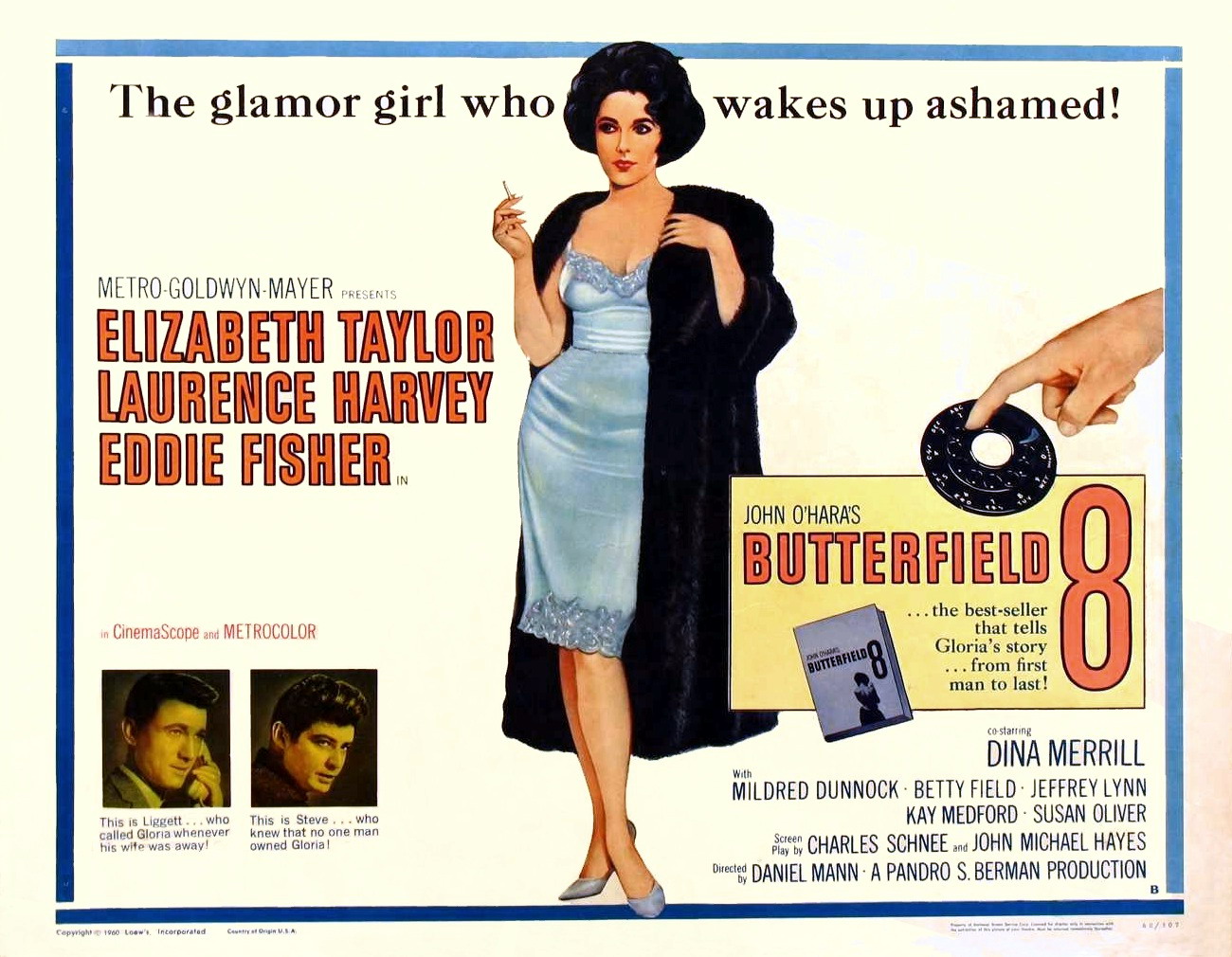
The Next Lobotomy Room Film Club ... Butterfield 8 (1960) on 21 March 2024

“The John O'Hara novel that seemed perfect for the movies, plus the role that seemed perfect for Elizabeth Taylor - and this is the garish mess it became,” is how the reliably terse Pauline Kael dismissed Butterfield 8. “Daniel Mann's direction is maybe even worse than the Charles Schnee-John Michael Hayes script. With Laurence Harvey; Dina Merrill, doing a noble wife to end all noble wives; and a vacuum on the screen that is said to be Eddie Fisher.” 

Almost no one has a good word to say about this lurid, wildly entertaining 1960 melodrama (including leading lady Taylor herself) – so of course Butterfield 8 is absolute catnip for me and it’s the March 2024 selection for the Lobotomy Room cinema club devoted to Bad Movies for Bad People! 


To its advantage: Taylor is sublime as wanton high-priced, high-class New York call girl Gloria Wandrous (tagline: “Gloria is the glamour girl who always wakes up ashamed!”). And the script co-authored by John Michael Hayes (the genius behind camp classicks (sic) Torch Song, Peyton Place, The Carpetbaggers, Where Love Has Gone and Harlow) features dialogue like “Face it, mama! I was the slut of all time!” and “I’ve had more fun in the back of a ’39 Ford than I could ever have in the vault of the Chase National Bank!” 


The opening moments alone are spellbinding: as Edward Margulies and Stephen Rebello recount in their 1993 book Bad Movies We Love, “Taylor awakens alone in her married lover’s bed, wraps herself in only a sheet, lights a cigar, drains a glass of whiskey, discovers her torn dress on the floor, brushes her teeth with booze, finds an envelope with $250 cash, scrawls “No Sale” in red lipstick across a mirror, leaves the money and instead steals the absent wife’s mink coat, calls her answering service and hails a cab to the apartment of … Eddie Fisher (by then, he was the real life Mr. Taylor).”  


So, join us on 21 March 2024 to watch Butterfield 8 over cocktails at Fontaine’s in Dalston! In my intro, I’ll provide context on Eddie Fisher leaving his then-wife Debbie Reynolds for Taylor in 1958 (the red-hot showbiz scandal of its time) and how Taylor almost dying of pneumonia helped win her a “sympathy Oscar” for her performance in Butterfield 8 in 1961! 

Lobotomy Room is the FREE monthly film club devoted to cinematic perversity! Third Thursday night of every month downstairs at Fontaine’s cocktail lounge in Dalston. Numbers are limited, so reserve your seat via Fontaine’s website. Alternatively, phone 07718000546 or email bookings@fontaines.bar. The film starts at 8:30 pm. Doors to the basement Bamboo Lounge open at 8:00 pm. To ensure everyone is seated and cocktails are ordered on time, please arrive by 8:15 pm at the latest.


“By the odds, it should be a bomb. But a bomb it is not, let us tell you. At least, it is not the sort of thing to set you to yawning and squirming, unless Elizabeth Taylor leaves you cold. In the first place, it has Miss Taylor, playing the florid role of the lady of easy virtue, and that's about a million dollars right there. "I was the slut of all times," she tells her mother in one of those searing scenes wherein the subdued, repentant playgirl, thinking she has found happiness, bares her soul. But you can take it from us, at no point does she look like one of those things. She looks like a million dollars, in mink or in negligée. When she sits at a bar with Laurence Harvey, who is not just any Joe but a millionaire with a ten-room Fifth Avenue apartment and "caves all over town," and she lets her eyes travel up and down him, measuring not the bulge of his pocketbook but the bulge of his heart - well, all we can say is that Miss Taylor lends a certain fascination to the film. Then, too, it offers admission to such an assortment of apartments, high-class bars, Fifth Avenue shops and speedy sports cars, all in colour and CinemaScope, that it should make the most moral status seeker feel a little disposed toward a life of sin. Brandy, martinis and brittle dialogue flow like water all over the place.”  

/ Bosley Crowther reviewing Butterfield 8 in The New York Times, 17 November 1960 /


“In both Cat on a Hot Tin Roof and Butterfield 8, Taylor appears in a tight white slip that looks as if it were sewn onto her body. What a gorgeous object she is! Feminists are currently adither over woman’s status as sex object but let them rave on in their little mental cells. For me, sexual objectification is a supreme human talent that is indistinguishable from the art impulse. Elizabeth Taylor, voluptuous in her sleek slip, stands like an ivory goddess, triumphantly alone. Her smooth shoulders and round curves, echoing those of mother earth, are gifts of nature, beyond the reach of female impersonators. Butterfield 8, with its call-girl heroine working her way down the alphabet of men from Amherst to Yale, appeared at a very formative moment in my adolescence and impressed me forever with the persona of the prostitute, whom I continue to revere.” 

/ From "Elizabeth Taylor: Hollywood’s Pagan Queen" by Camille Paglia, Penthouse magazine, March 1992 /


Saturday, 10 February 2024

Reflections on ... The Children (1980)


Recently watched: gleefully cheap, nasty and enjoyable exploitation flick The Children (1980). Tagline: “Something terrifying has happened to … The Children.” 

It was free to stream on Amazon Prime (as well it should be) and their synopsis is more succinct than anything I could come up with: “A nuclear-plant leak turns a busload of children into murderous atomic zombies with black fingernails.” 

Yes, the contemporary reviews were scathing (The Orlando Sentinel termed the cast “the ugliest bunch of folks we've seen assembled on any screen at any one time” and The Pittsburgh Post-Gazette accurately but cruelly noted that the children’s charred victims resemble “leftover pepperoni pizza, complete with black olives and anchovies”). 

But seen today, The Children looks like a prime example of irresistible low-brow drive-in fare complete with gore, violence, bad special effects and the occasional glimpse of bare breasts. And there is artistry here: as the It Came from Beyond Pulp blog perceptively argues, “once night falls, [director Max Kalmanowicz’s] true gifts come into play. Under cover of near-darkness, he exhibits an almost supernatural mastery of simple, evocative, and scary-as-hell shot framing, shock reveals, and pacing. He doesn’t make the mistake, common in the slasher genre, of overlighting his shots: the lighting here is the familiar blindness-inducing pitch black of a moonless night, in which headlights, flashlights, and candles illuminate just enough to remind you of how cavern-dark everything else is. It’s here, in the dark, where he uses his scary kids brilliantly. Smiling, arms outstretched, calling “mommy, mommy” in their piping voices, they loom out of the blackness like pretty little angels of death: this is the single scariest image I can remember from any horror film.” 

Unsurprisingly, The Children’s cast is mainly unknowns, but one woman felt vaguely familiar: Gale Garnett (who delivers a very broad, soap opera-style performance). She was the singer of 1964 hit "We'll Sing in the Sunshine", which I remember being ubiquitous on the radio when I was a kid.

Sunday, 31 December 2023

Reflections on ... New Year's Evil (1980)


Staying in tonight? Want some thematically appropriate festive viewing? I recommend grisly low-budget slasher flick New Year’s Evil (1980). Tagline: “Don’t dare make new year’s resolutions … unless you plan to live!” In Los Angeles, glamorous hard-boiled celebrity DJ and television’s first lady of rock’n’roll Blaze Sullivan (Roz Kelly) is hosting “Hollywood Hotline”, a live televised coast-to-coast New Year’s Eve countdown. Viewers are encouraged to phone in to vote for their favourite New Wave song of the year - but one of the callers is a misogynistic serial killer calling himself “Evil”, who threatens to murder a “naughty girl” as each time zone hits midnight – culminating with Blaze herself!


What distinguishes New Year’s Evil is its focus on the punk subculture. Considering it was filmed in LA in 1980, the mind boggles at the actual bands the filmmakers could have feasibly utilized for the musical sequences: X, The Screamers, the Germs, the Zeros, The Weirdos! The presence of any of these would make New Year’s Evil a valuable time capsule. But no – we see only two appalling ersatz punk bands (nonentities Shadow and Made in Japan), and at tedious length. The film’s received wisdom about how punk rockers behave (they are troublemakers with piercings and Mohawks who mosh and stick their tongues out a lot) is unintentionally hilarious. New Year’s Evil also fails to clarify why hardened young hardcore punk fans are so rabidly enthusiastic about sequin-clad middle-aged Blaze. Is it because she exhorts things like “It’s time to spin out and boil your hair!” while wielding a feather boa?


Which brings us to Roz Kelly. In her brief heyday, she was best known for portraying Pinky Tuscadero, Fonzie’s tough cookie girlfriend in seventies sitcom Happy Days. Her screen presence was certainly … um … distinctive. Whether playing Pinky, Anthony Franciosa’s brassy secretary Flaps (yes – Flaps!) in Curse of the Black Widow (1977), cavorting in Paul Lynde’s infamous 1976 Halloween special or indeed here as Blaze, Kelly is consistently abrasive, brittle and borderline hostile. Her bizarre acting choices are perhaps the scariest aspect of New Year’s Evil! 


Watch it for free on YouTube.

Saturday, 26 August 2023

The Next Lobotomy Room Film Club: The Leech Woman (1960) on 21 September 2023


Are you anxious about the specter of old age? Do you dread the inevitable ravages of time? Honey, we all do! Let’s watch a movie that exacerbates those fears! (To clarify, I mean aging of the female variety! A man ageing is entirely fine, obviously!). 

Yes! Join us at Fontaine’s cocktail bar in Dalston on Thursday 21 September when the FREE monthly Lobotomy Room cinema club (devoted to Bad Movies for Bad People) presents ultra-trashy 1960 exploitation movie The Leech Woman! (Tagline: “Her evil jungle-born secret of eternal youth … drained the love and life from every man she trapped!”). 

The Leech Woman opens with suave endocrinologist Dr Paul Talbot (hunky Phillip Terry – an ex-husband of Joan Crawford!) bickering with his embittered, haggard and alcoholic older wife June (Coleen Gray, best remembered for co-starring opposite Tyrone Power in disturbing 1947 noir Nightmare Alley). We know June is evil because she’s wearing one of those Cruella de Vil-style fox fur stoles with the heads still attached). 

/ Out of what terrifying jungle rites had come her awesome secret – for prolonging life – and regaining youth and beauty? Estelle Helmsley as Malla /

They are interrupted by the arrival of Dr Talbot’s mysterious new patient – a shriveled ancient-looking woman called Malla (Estelle Helmsley) who claims to be 150 years old and to know the secret of restoring lost youth – but first they must accompany her back to her ancestral village in Africa. And ominously, Malla hisses to June, “You are the one in my dreams of blood!”  What could possibly go wrong? 


/ Every victim makes her young … beautiful … and more dangerous than before! Coleen Gray as June Talbot /

There are voodoo rituals. Human sacrifice. Stock footage of screeching monkeys and hissing snakes. Quicksand. But weirdly, no leeches! Spaces are limited, so reserve your seat now! 

Lobotomy Room Goes to the Movies is the FREE monthly film club devoted to cinematic perversity! Third Thursday night of every month downstairs at Fontaine’s cocktail lounge in Dalston! Numbers are limited, so reserving in advance via Fontaine’s website is essential. Alternatively, phone 07718000546 or email bookings@fontaines.bar. The film starts at 8:30 pm. Doors to the basement Bamboo Lounge open at 8:00 pm. To ensure everyone is seated and cocktails are ordered on time, please arrive by 8:15 pm at the latest.

Full details on event page. 


Monday, 3 July 2023

The Next Lobotomy Room Film Club: Lady in a Cage (1964) on 20 July 2023


“Help! I am trapped in a small private elevator!” Seriously - don’t you just hate it when that happens? That’s the dilemma that befalls genteel, affluent widowed poetess Cornelia Hilyard (Olivia de Havilland). She’s recuperating from a broken hip; her son is away for the weekend – and the small private elevator in question malfunctions, leaving her trapped between floors. And just then, when Cornelia is at her most vulnerable, a gang of feral delinquents break into her home …

Berserk 1964 thriller Lady in a Cage is firmly in the post-Whatever Happened to Baby Jane? hagsploitation tradition (interestingly, the lead role was originally offered to Joan Crawford.  And the same year de Havilland co-starred opposite Bette Davis in that other hagsploitation classic, Hush … Hush, Sweet Charlotte (1964)). Won’t you join us on Thursday 20 July when the free monthly Lobotomy Room cinema club (devoted to Bad Movies for Bad People) presents Lady in a Cage? But take note of the leading lady’s warning: “Do Not See Lady in a Cage Alone! It is a shocking picture with a terrifying theme! No holds are barred in Lady in a Cage. So, take somebody along and hold onto them – for dear life!” There will be safety in numbers downstairs at Fontaine’s cocktail lounge – and stiff cocktails to steady your nerves!


Lobotomy Room Goes to the Movies is the FREE monthly film club devoted to cinematic perversity! Third Thursday night of every month downstairs at Fontaine’s cocktail lounge in Dalston! Numbers are limited, so reserving in advance via Fontaine’s website is essential. Alternatively, phone 07718000546 or email bookings@fontaines.bar to avoid disappointment! The film starts at 8:30 pm. Doors to the basement Bamboo Lounge open at 8:00 pm. To ensure everyone is seated and cocktails are ordered on time, please arrive by 8:15 pm at the latest.

Facebook event page.


/ Below: the truly nutty original trailer for Lady in a Cage /