/ The sublime Danish actress Anna Karina in Jean-Luc Godard's Vivre sa vie (1962) /
Anna Karina – the elfin Bambi-eyed star of French New Wave
1960s cinema - graced The British Film Institute in person on Saturday 16
January 2016 last night as part of its Jean-Luc Godard season. (Godard and
Karina were married between 1961-1967. She was Godard’s muse and the leading
lady of his definitive early films). First was a screening of Godard’s sublime
1962 nouvelle vague masterpiece Vivre sa vie (in which Karina plays a wannabe
actress who drifts into prostitution with tragic consequences. She is wrenching in the film). Then Karina was
invited onstage for an interview (by film critic Jason Solomons) followed by a Q&A
session with the audience.
Pal and I were in the back row, but I can confirm the
75-year old Karina is still svelte and her heart-shaped cheekbones still intact,
although her voice is now a raspy croak – Karina has evidently smoked a lot of
Gauloises (or Gitaines?) over the decades. She was endearingly dotty and
eccentric – clearly still a mischievous free spirit and bohemian. It’s hard to
believe Karina isn’t French (she’s Danish, born in 1940 in Copenhagen): her
accent sounds impeccably French, her demeanour is so old-school Parisian and
she’s the absolute mistress of the dismissive Gallic shrug.
And Karina did a lot of Gallic shrugging! There was
definitely a language barrier. Karina’s answers would drift, dither and meander,
sometimes missing the point. After an audience
member would ask a question, Karina would turn to the onstage interviewer with
a quizzical expression. After a while Solomon exclaimed, “Don’t look at me – I didn’t ask the question!” When
someone asked what her strangest experience was working on a film, she snapped
“Strange? What’s strange?” When people probed too deeply about Godard’s
motivations and thought processes, she replied, exasperated, “I didn’t direct
the film!” Asked whether it was provocative or scandalous to play a prostitute
in 1962, she demurred, “Because I played a prostitute didn’t mean I was a
prostitute!” (But Karina added the Parisian “working girls” she encountered on
the street afterward would approach her and say they approved of her
portrayal and found it truthful).
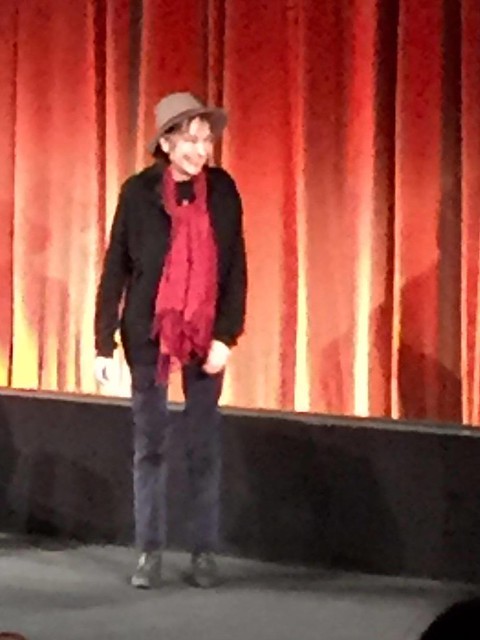
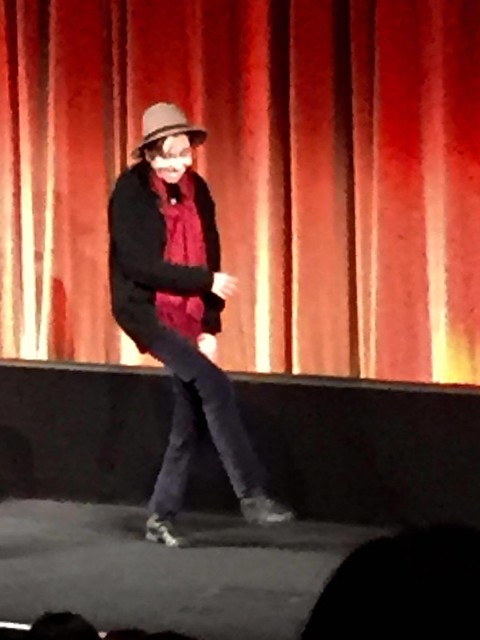
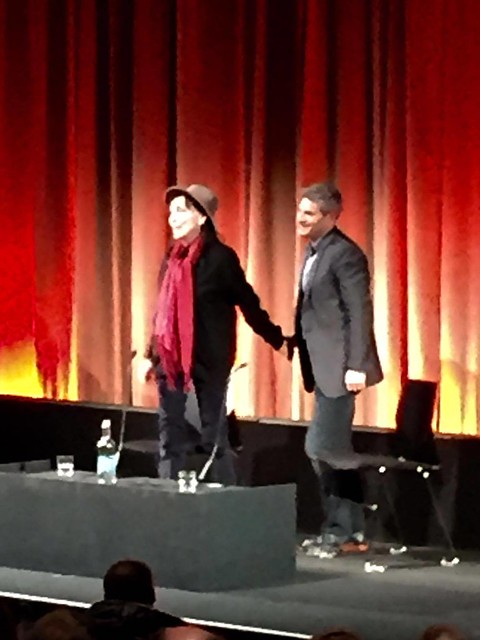
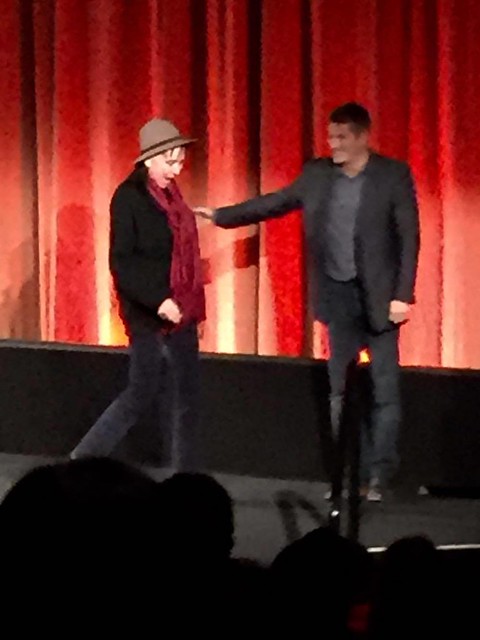
/ Above: some pretty grainy and pixellated shots of Karina onstage at The BFI with journalist Jason Solomons (Pal took them on his iPhone from the back row!) /
The questioners seemed fixated on Karina’s hairstyle and
wardrobe in Vivre sa vie, which she accepted with good grace. Was the black bob
inspired by Louise Brooks? Karina
revealed her hair in the film was actually a wig. It began as a very long wig
and the stylist kept cutting it shorter and shorter. She didn’t know – maybe!
People compared it to Louise Brooks afterwards. As for the clothes: they look astonishingly
cool to modern eyes - that late fifties / early sixties period was the acme of
style for both men and women (same era as the early seasons of TV's Mad Men). The 22-year old Karina certainly looks
sensational in her simple pencil skirts, ruffled blouses and cardigans –
although she would have looked chic in a potato sack.

One annoying question actually led to an interesting
response. Weirdly, one woman asked Karina what young modern actresses she
admired. (Did the questioner honestly think Karina was going to reply, “Jennifer
Lawrence!”?) Karina seemed nonplussed, asked her to repeat the question and
then confessed she has a hard time keeping track of new actors, there are so
many. They don’t usually make an impression on her unless they’ve been around
a few years and become established. Then somehow the subject changed to what
actresses Karina admired when she was growing up and the answer was more
illuminating: Judy Garland, Ava Gardner and Edith Piaf. In terms of warmth,
radiance and the capacity for expressing both hurt and happiness, you can
clearly see the influence of Garland and Piaf on Karina’s acting.
I learned afterwards of one fascinating movie factoid from
one of Karina’s other onstage interview sessions for a different film at The
BFI. (Karina was interviewed about three times at The BFI while she was in London). She was asked about Godard’s Le Mepris (1963), in which Karina herself does not appear. Instead, Brigitte Bardot gives one
of her best performances in the role of Camille. Bardot was always Godard’s first
choice – but according to Karina, the producers pressured Godard to consider
another great European art cinema leading lady of the period – Italy’s tousle-haired blonde lioness and Michelangelo Antonioni's muse, Monica
Vitti. I revere the gorgeous Vitti and she would have been great – but very different – as Camille.
Godard met with her in Rome to discuss Le Mepris. Vitti arrived an hour late
and reportedly stared out the window the whole time, indifferent. So the role
went to Bardot instead and the rest is history. Interestingly, for segments of
Le Mepris Bardot dons a short jet-black wig that recalls ... Anna Karina in Vivre
sa vie!


/ Brigitte Bardot in
Le Mepris (1963) /
My highlights: Karina described how, when she first arrived
in Paris as a 17-year old runaway, she was “discovered” in the cafe Les Deux Magots and
snapped-up to be a fashion model. One day on a photo shoot she was telling the
hair stylist or make-up artist she wanted to be an actress; an older woman with
a big hat smoking a cigar overhead and inquired what Karina’s name was. When Karina
replied “Hanne Karin Blarke Bayer”, the woman announced, “You should call
yourself Anna Karina!” Afterwards Karina learned the mysterious older woman
was – Coco Chanel! The final question of the night was: what was Karina’s
mindset as a teenager, hitchhiking to Paris on her own, not speaking a word of
French? Karina recalled how poor she was on arrival (she owned one pair of high
heels and one black dress) and expressed astonishment at how brave and gutsy she’d
been. (Karina admitted her motivation was to escape her unhappy home life with
her mother and abusive stepfather). How lucky for generations of cinema goers Anna
Karina that
did flee to Paris when she did!
Further reading:
Anna Karina: Two or Three Things We Know About Her: You can watch videos of Karina's Q&A sessions at The BFI here
A sweet and very revealing
interview with Karina in
The Guardian