Showing posts with label Italian cinema. Show all posts

Thursday, 20 August 2026

Reflections on ... Teresa la ladra / Teresa the Thief (1973)

I’m always moaning about how difficult it is to see Monica Vitti’s Italian comedies in the UK – and now the British Film Institute here has devoted an entire season (Monica Vitti: Creative Force) to her films! Buying tickets for the BFI is pricey as hell, so I could only pick one (and I’d already seen 1968’s La ragazza con la pistola (The Girl with the Pistol)), so I opted for Teresa la ladra (Teresa the Thief) (1973) on Tuesday night. It was an evening of diva worship – Italian style!

A prime example of commedia all'italiana, it’s an earthy, raffish slice of life picaresque following the titular thief and jailbird Teresa (Vitti) from her impoverished rural girlhood to the hardships and deprivation of Italy during and after WWII to old age. (Of her father, Teresa recalls almost admiringly, “When he hit you, he REALLY hit you!”). Living by her wits, the cheerful, resilient and amoral Teresa survives as a petty criminal (burglar, pickpocket, seller of contraband cigarettes). 


Unexpectedly, there are parallels with John Waters’ Female Trouble (1974). Teresa is for Vitti what Dawn Davenport was for Divine: a charismatic, bad girl criminal anti-heroine. When Teresa burgles apartments, she even has two female accomplices, just like Dawn’s sidekicks Chiclet and Concetta. 

There’s a nice running gag where Teresa and her female cohort lure men to the cinema and steal their wallets while they’re distracted. The movie is always Waterloo Bridge (1940): Teresa is entranced by it but never gets to see how it ends. The tone is mostly larky, except towards the end when Teresa is sectioned in a mental institution and it turns harrowing. “I was livid with hunger and passion!” Teresa exclaims at one point, and Vitti makes you believe it. (The penniless Teresa is famished much of the time and wolfs down food as opportunity arises). Picking up where her forebear Anna Magnani left off, Vitti is magnetic throughout: she narrates in her inimitable husky voice and gets multiple dreamy close-ups (those green eyes!). 

Director Carlo Di Palma’s storytelling is shaggy and episodic in a good-natured way. And he sure knows how to artfully compose a shot: watch for the gorgeous sequence at a party where Teresa is surrounded by drunk revelers and completely oblivious as we watch her feckless husband and his mistress sneak out and abandon her in the background. By the end, I’d convinced myself not only could I speak fluent Italian but that I WAS Italian!


Sunday, 28 November 2021

Reflections on ... Story of a Love Affair (1950) aka Cronaca di un amore.

Recently watched: Story of a Love Affair (1950) aka Cronaca di un amore. Trust me - never was a title more bitterly ironic! A bleak Italian neo-realist interpretation of American film noir very loosely inspired by The Postman Always Rings Twice, Love Affair represents the feature film debut of art cinema virtuoso Michelangelo Antonioni (1912 - 2007). His icily detached perspective, ambivalence towards his characters (he certainly never invites sympathy for them) and emphasis on desolate cityscapes are already present and correct. If Love Affair initially feels a bit inconsequential and unengaging, persevere – the tension really builds as it proceeds, and the ending is devastating. And remember: Antonioni wants you to feel alienated! 

Love Affair is a meditation on guilt, consequences, human weakness and fatalism. Smouldering nineteen-year-old Lucia Bosè (whose sultry dark looks anticipate Isabella Rossellini and Natassja Kinski) is swathed in furs, veils and spectacular haute couture ensembles as Paola, the petulant and spoiled young trophy wife of millionaire Milanese industrialist Enrico (Ferdinando Sarm). (Antonioni ensures we repeatedly observe Paola snap abrupt orders to her staff: “Get me cigarettes!” “Get me a martini!”). When she’s reunited with Guido (ruggedly handsome dreamboat Massimo Girotti), a lost love she hasn’t seen in years, Paola begins scheming for them to run away together. But Guido is penniless, and she can’t countenance the thought of abandoning the fabulously lavish lifestyle she’s become accustomed to. Soon Paola starts hinting the solution is for Guido to murder Enrico …   


To complicate things: the jealous Enrico has hired a private detective to investigate Paola’s past. And Guido and Paola share a painful dark secret from years earlier: they may have killed before! At the very least, their amoral self-absorption contributed to a tragic accident. The camera swoons over the combined beauty of Girotti and Bosè. They are perhaps the most exquisite couple in Italian cinema history right up until Antonioni teamed Monica Vitti with Alain Delon in L'Eclisse in 1962. (Antonioni and Bosè would reunite in 1953 for the even better The Lady Without Camelias). Bosè died of coronavirus complications aged 89 in 2020. 


Saturday, 13 November 2021

Reflections on ... The Grim Reaper (1962) aka La commare secca.

Recently watched: The Grim Reaper (1962). Original title: La commare secca. 

“You’ll die covered in lice!” Seriously – Italians have the best insults! A vivid slice of life in the gutter adapted from a short story by highly politicized low life poet/provocateur Pier Paolo Pasolini, The Grim Reaper (21-year-old Bernardo Bertolucci’s directorial debut) opens with the discovery of a murdered prostitute in the park alongside The Tiber. The ensuing film unfolds in flashbacks, as the potential culprits recount their versions of what happened that night while being interrogated by the cops. Meanwhile, Bertolucci repeatedly cuts back to the doomed sex worker (starkly unglamorous and middle-aged with a careworn face) getting ready for work in her flat, drinking espresso, pinning-up her hair, oblivious that she has a date with death. 

Out of all the mid-twentieth century Italian art cinema directors, Bertolucci is the one I’m least au fait with. The Grim Reaper is firmly in the gritty tradition of Pasolini’s early masterworks Accattone (1961) and Mamma Roma (1962), Fellini’s Nights of Cabiria (1957) and Visconti’s Rocco and His Brothers (1960). In fact, it offers an irresistible cornucopia of all my favorite Italian neo-realist leitmotifs! Raw egg-sucking. Prostitution (everyone is seemingly either a pimp or on the game themselves. The tough hetero-flexible Italian boys depicted here are seemingly open to turning tricks, if only to rob the johns of their gold watches). Petty crime. Rough trade in tight pants. Italian men sexually harassing girls on the street. Women with ratted hair and heavy black liquid eyeliner. Nuns. The Colosseum. Women wearing Anna Magnani-style black slips. Grubby urchins playing in the street. Hungry characters speaking wistfully of potatoes in meat sauce and gnocchi. Ads for Campari and Cinzano everywhere. 

This isn’t a spoiler, but the conclusion offers a bleakly pessimistic assessment of mankind. “She was only a whore!” the killer shouts in protest when he’s finally apprehended.

Note! Don't confuse this film with this one! 


Sunday, 14 March 2021

Reflections on ... Rocco and His Brothers (1960)


/ Alain Delon and Annie Girardot in Rocco and His Brothers (1960) /

Recently watched: Italian art cinema virtuoso Luchino Visconti’s ambitious epic (177-minute!) tragedy Rocco and His Brothers (1960). In his review, critic Roger Ebert summarizes Rocco and His Brothers as “operatic” and “homoerotic” – both descriptions are apt! What greater recommendation is there? 

Led by widowed matriarch Rosaria, the Parondi family relocates from grinding poverty in the rural south to urban industrialized north (in this case, Milano) in search of better prospects. Instead, all they find is relentless catastrophe. And the options for the brothers seem limited to boxing or crime. 

Like his contemporary Pier Paolo Pasolini, Visconti had a superior “queer eye” when it came to casting handsome male actors. All five Parondi brothers are stone cold stunners – particularly beauteous young Alain Delon as Rocco. (We get ample opportunity to ogle the brothers wearing the de rigueur Italian neo-realism white “wife beater” vests, sparring in the boxing ring and showering). In terms of homoeroticism: also note the corrupt boxing promoter and how he is coded as vaguely sexually predatory (especially the scene where he walks into the gym’s changing room and stares frankly at Simone and Rocco as they shower. Although I can’t say I blame him). 


/ The memorable shower sequence in Rocco and His Brothers /

But arguably, the film is dominated by Annie Girardot as local prostitute Nadia, the Parondis’ new neighbour. Encountering the glamorous, sensual and insouciant Nadia throws a hand grenade into the family’s life, with both deeply flawed Simone (Renato Salvatori – magnificent in this complex and demanding anti-hero role) and Rocco falling hopelessly in love with her. Inevitably, heartbreak and death ensue. (As someone laments towards the end, “Christ will regret the suffering visited upon us!”). 


 / Annie Girardot and Renato Salvatori as the doomed couple in Rocco and His Brothers /

Perhaps understandably, Rosaria is prone to glancing skyward despairingly and calling Nadia a “putana.” (This archetypal black-clad Italian peasant mamma is actually played by volatile Greek actress Katina Paxinou. And Delon and Girardot are, of course, French actors playing Italian characters – and dubbed by Italian voices. Watch also for gorgeous young starlet Claudia Cardinale in a supporting role). I’m embarrassed to admit I wasn’t very au fait with Annie Girardot (1931 - 2011) beforehand but judging by her heart-wrenching performance here she was every bit the equal of other iconic European art cinema actresses like Jeanne Moreau, Anna Magnani and Monica Vitti. Time hasn’t blunted the impact of Rocco and His Brothers.


Friday, 2 September 2016

Reflections on ... La Dolce Vita (1960)


/ The glorious Anita Ekberg (1931 - 2015) as Sylvia in La Dolce Vita (1960) /

From the Facebook events page for the Lobotomy Room Goes to the Movies film club on 28 August 2016 at Fontaine's:

Attention, jaded Continental sophisticates! Embrace the spirit of Eurotrash hedonism (and pretend we’re still in the EU) when Lobotomy Room presents a FREE special decadent Bank Holiday Sunday [28 August] screening of Federico Fellini’s carnival-esque and hallucinatory epic masterpiece La Dolce Vita (1960)! You know that iconic image of voluptuous Swedish sex bomb Anita Ekberg frolicking in Rome’s Trevi Fountain? That’s from La Dolce Vita – one of the most stylish movies ever made! It captures the acme of Italian glamour: the cars, the clothes, the nightlife (no one films debauched nightclub, party and orgy scenes like Fellini in his 1960s pomp) and most of all – the sunglasses! While you watch the film, take the edge off your hangover with negronis or glasses of Prosecco! Needless to say it’s illegal to smoke in the Bamboo Lounge, but feel free to keep your shades on!


Because of the film’s running time (three hours!), the film starts earlier than usual at 6 pm. Arrive circa 5:30 to order your drinks and grab the best seats downstairs in the Bamboo Lounge. (I’ll be down there playing music and screening vintage “nudie cutie” blue movies before the main feature). The film is FREE and seating is limited. If you’re feeling proactive, contact Fontaine’s to reserve a seat in advance: email ruby@fontaines.bar or call 07718 000546.


/ The love-hungry, pleasure-chasing international sin set is coming – to Lobotomy Room’s FREE screening of Federico Fellini’s La Dolce Vita THIS Sunday! In the basement Bamboo Lounge of Fontaine’s! It promises to be an orgiastic Bacchanal! See the film condemned by the Catholic Church as blasphemous and banned in Spain until 1975! (By the way: in 2016 Photobucket.com keeps deleting this photo saying it violates their standards! La Dolce Vita is still freaking out the squares all these decades later!) /

This represented the first time Lobotomy Room ever presented a serious art film with subtitles! In fact, I warned the attendees: "Do you realise you’ve signed-up for a three-hour black-and-white foreign-language film with subtitles? The doors are now locked – you aren’t going anywhere!" When I first proposed La Dolce Vita to Ruby (Fontaine’s glamorous boss lady), she expressed doubts whether anyone would actually want to sit through it. In fact we pulled-in a more than decent house and everyone sat rapt and intoxicated by Fellini’s vision. His filmmaking is so fluid, swirling and seductive, the three hours flew by.

As usual, before the film I stood up and blurted-out a garbled, half-assed introduction. (My public speaking style can definitely best be described as “blurted”). I definitely mentioned that in the spirit of La Dolce Vita, I had a thunderous hangover that Sunday. Anyway, here is a summary of the points and fun facts I spewed (obviously I've expanded considerably here):


/ See the world's most handsome man (Marcello Mastroianni in La Dolce Vita) suffer a profound existential crisis! /

Federico Fellini (1920 – 1993) had already made a few great films by this point (I particularly love 1957’s Nights of Cabiria), but the international success of La Dolce Vita really catapulted him to worldwide fame.

The film was sizzling and scandalous for its time. Perhaps inevitably the Catholic Church hated La Dolce Vita, considering it blasphemous (it was banned in Franco's Spain until 1975!). The film lets Fellini have his cake and eat it too: it’s a critique or exposé of the moral bankruptcy and hollowness of “the sweet life” (fame, wealth, celebrity and hedonism) – but we still get to enjoy watching the lengthy lurid scenes of orgies, nightlife and the beautiful people cavorting at length. (Dolce Vita is an “art film” but that’s the template for pretty much all “cautionary” sexploitation films since too!).


La Dolce Vita takes a state-of-the nation overview of Rome’s post-war upheaval. The themes of alienation and the collapse of conventional morality are personified by the existential angst of its anti-hero Marcello (played by Marcello Mastroianni), torn between art (writing the Great Novel; the world of poetry, philosophy and spirituality espoused by his intellectual friends) and commerce (his job as a sensational tabloid journalist writing about the superficial realms of cafe society and show business).


To contrast against the tawdry Roman nightlife centred around Via Veneto, mid-way through the film we see Marcello and his fiancée Emma attend his friend Steiner’s intellectual high-toned salon full of poets, artists and the literary set (complete with a sari-clad Asian woman seated on the floor strumming the guitar and singing folk songs and guests reciting poetry aloud).  No doubt I’m missing the point entirely, but the final climactic orgiastic party (where the divorcee does a striptease writhing on the floor) looks far more fun! (Bear in mind this film was made in 1959, so these are orgy scenes where everyone remains fully clothed! See also: Michelangelo Antonioni’s The Red Desert).


/ One of my favourite party scenes in La Dolce Vita, set in the crumbling ruins of a castle (the gorgeous blonde in the centre of the dissolute aristocrats is Nico!) /

An interesting side note is the presence of clearly-identified gay and cross-dressing characters in several of these nightclub and party scenes.  Fascinating as it is to see frank and overt LGBT representation in a film made in 1959, what’s problematic today is that Fellini seemingly employs them to depict how low Marcello has sunk! (If you’re at a party surrounded by pretty chorus boys frolicking in drag, you’ve basically reached Dante's inner circle of hell).

Seen today, La Dolce Vita is incredibly prescient in its anticipation of the relentless celebrity and gossip culture we are now saturated in and - for better or for worse - take for granted as a constant backdrop to our daily lives.  (This is, famously, the film where the expression “paparazzi” for celebrity photographers came from: Marcello’s sidekick and photographer friend is called Paparazzo).

The film also works as a time capsule of the late fifties period when international film productions started flooding Rome's Cinecittà Studios (leading to it being nicknamed "Hollywood on the Tiber").  A lot of terrible gladiator, sword-and-sandal and Biblical epics were made at Cinecittà during these years, but so too were parts of the mega-budget 1962 Liz Taylor version of Cleopatra. Weirdly, almost all of La Dolce Vita itself was shot within the confines of Cinecittà as opposed to “on location.” (For example, Fellini painstakingly recreated Via Veneto  in the studio). Sadly, the particular studio of Cinecittà  where most of La Dolce Vita was made was destroyed in a fire in 2012


La Dolce Vita is loosely structured around Marcello’s fleeting encounters with a series of beautiful women. The most fondly-remembered and iconic of these is probably the truly statuesque Anita Ekberg as visiting Hollywood starlet Sylvia, in town to make a film at Cinecittà. (I love it when - during Sylvia’s sensational publicity stunt arrival at the airport - one of the reporters turns to Marcello and admiringly declares her a “magnificent chunk of woman!”). Ekberg is probably essentially playing a cartoonish version of herself, but it’s nice to think Sylvia’s characterisation (especially the campy, cooing little girl delivery) is a bit influenced by Jayne Mansfield.  Like Sylvia and her insecure boozy actor husband (played by Lex Barker), certainly sex kitten-gone-berserk Mansfield and her muscle-bound former Mr Universe husband Mickey Hargitay spent a lot of time stirring up trouble and making terrible movies in Rome in the early sixties. One bit does feel like an explicit tribute to Mansfield: the party scene where Frankie (one of the visiting Hollywood actors working in Rome) hoists Ekberg over his head and twirls her around  – that was one of Mansfield and Hargitay’s favourite attention-seeking party tricks.


/ Mickey and Jayne in action /

(By the way: the famous Trevi fountain scene was shot in the middle of winter.  Mastroianni wore a wet-suit under his clothes and slugged vodka to keep warm. Fellini recalled that Ekberg didn’t complain about the cold at all).


/ Who’s that girl? The mystery blonde with Marcello Mastroianni is – Nico! Yes, that Nico – long before the eternally enigmatic singer was discovered by Andy Warhol and joined the Velvet Underground as husky-voiced chanteuse, German fashion model Nico memorably appeared in La Dolce Vita as one of the series of beautiful women Marcello encounters on his nocturnal jaunts through Roman nightlife. And the role was a real stretch for her – she’s playing a fashion model called Nico!/


/ Fellini and Nico during the filming of La Dolce Vita /

Still in her early twenties, Nico was then what we now would call an in-demand, international “supermodel." I’m probably not very objective (the gloomy German diva is my all-time favourite singer), but I think her performance in La Dolce Vita is adorable, natural and – perhaps surprisingly considering Nico’s later icily-serious, gravely-composed, heroin-ravaged tortured artist image – very funny.  If you’ve read Richard Witt’s 1993 biography Nico: The Life and Lies of an Icon or seen the 1996 documentary Nico: Icon, you’ll know La Dolce Vita really captures what Nico was like at that period in her life: still un-corrupted, insouciant and childlike, jet-setting around the world on modelling assignments. 


/ See Anouk Aimee as the most elegant wealthy nymphomaniac in film history! /


/ The fabulous Anouk Aimee in La Dolce Vita /

The most complex and inscrutable of Marcello’s women is Anouk Aimee as the bored, haughty heiress Maddalena. I’ve already written at length about Modigliani-faced French actress Anouk Aimee’s performance as Maddalena, but seeing La Dolce Vita again I was struck by two things:  1) her voice is dubbed throughout by an Italian actress (having another actor dub someone’s voice was routine in Italian cinema at the time but feels weird today. Aimee’s own distinctive whisper-soft voice is notably different), for most of her screen-time she keeps black sunglasses clamped-on and I suspect the bouffant hairstyle she sports is a wig. So Anouk Aimee is essentially in disguise! But Maddalena’s alluring sense of remote, Garbo-like inscrutability and melancholy is entirely Aimee’s own.  2) Aimee is so thin in La Dolce Vita, she’s almost wraith-like (her waist is worthy of comparison to Vampira’s). Also: virtually all of La Dolce Vita’s main players are dead now.  Aimee is still alive (she’s a very stylish 84-year old).  So is Yvonne Furneaux (now 88), the French actress who plays Marcello’s neurotic and suicidal fiancée Emma.  Furneaux appeared in some pretty distinguished European art films in addition to La Dolce Vita, like the early Antonioni film Le Amiche (1955) and as Catherine Deneuve’s sister in Repulsion (1965). Furneaux really excelled at playing mentally unstable women! 


If you’ve never watched La Dolce Vita before, anticipate being taken aback by just how troubling the film is. (Afterwards I spoke to one of the attendees who’d never seen the film before. She was surprised by how dark La Dolce Vita was: she was expecting something sweeter and more Audrey Hepburn-esque. ) The film is fondly-remembered as a sentimental classic of mid-century European cinema, but Fellini’s vision is deeply un-consoling, unexpectedly incorporating suicide and infanticide.  (Even religion is depicted as just another cynical form of show business. No wonder the Catholic Church hated it!). La Dolce Vita begins as Marcello’s existential crisis and concludes with his permanent journey into darkness. Bravely, Fellini makes Marcello become progressively more unsympathetic and misogynistic as the film proceeds. (Women get casually slapped around and roughed-up a lot in La Dolce Vita). An enduring masterpiece of style and substance, La Dolce Vita deserves its status as one of the most chic films ever made (the nightclub scenes! The cha cha music!), but it’s the uncompromisingly bleak ending that lingers in your memory.


/ I love this candid shot. Lunch break on the set of La Dolce Vita! The people assembled here are like European art cinema royalty of the fifties and sixties: Marcello Mastroianni, Anouk Aimee, Federico Fellini and Pier Paolo Pasolini (the controversial queer filmmaker and poet collaborated on La Dolce Vita’s script). Note that they are being serenaded by an accordion player while they dine – the sweet life indeed! /

Sunday, 17 March 2013

Reflections on Mamma Roma (1962)


/ Tight skirt, tight sweater: the sensational Anna Magnani in Mamma Roma (1962) by Pier Paolo Pasolini /
Volcanic. Tempestuous. Explosive. Volatile. Ok, these are all clichéd adjectives to use in the description of Italy’s greatest actress Anna Magnani – but hell, they’re accurate. The woman (revered as La Lupa by her Italian fans) was a tigress, a seething torrent of raw emotion. Magnani was dead by 1973 (Italy was plunged into mourning) and made relatively few films, but she left behind a gallery of screen-scorching performances. I’ve loved her in Rome: Open City (dir: Roberto Rossellini, 1945), L’Amore (dir: Rossellini, 1948), Bellissima (dir: Luchino Visconti, 1951) and The Golden Coach (Jean Renoir, 1953).


/ My favourite portrait of La Magnani, taken in the early 1970s (so towards the end of her life). If you have to age, it may as well be like this! She was clearly a powerful and sensual presence right up until the end /

By the mid-50s, Magnani was so acclaimed in Europe that Hollywood inevitably beckoned. Weirdly, her American films seem well and truly inaccessible these days: I’ve never seen either The Rose Tattoo (1955) – for which she won the Best Actress Oscar -- or Wild is the Wind (1957). They’re seemingly unavailable on DVD in the UK and never crop up on TV.  For me Magnani steals Tennessee Williams adaptation The Fugitive Kind (1959) from under the noses of co-stars Marlon Brando and Joanne Woodward, even with the handicap of unfamiliar English (she apparently never properly learned English and had to painstakingly learn her lines phonetically).


/ Magnani in Mamma Roma (1962). The surrounding urban decay (dotted with ancient ruins) feels desolate, almost lunar /

Magnani’s crowning achievement, though, is Mamma Roma (1962), the film she made after returning to Italy after her stint in Hollywood. (Accounts vary about whether Magnani was born in 1905 or 1908.  Depending who you believe, she was her either 54 or 57 in Mamma Roma). The film is the highly politicised poet/provocateur Pier Paolo Pasolini's follow-up to his sensational debut Accattone (1961). (I’ve already sang the praises of Accattone. I’ve seen Mamma Roma – one of my all-time favourite films -- many times over the years; this time it was on the big screen at The British Film Institute as part of their comprehensive two-month Pasolini retrospective).


/ A light-hearted moment on the set of a mostly tragic film: (left to right) Franco Citti, Ettore Garofolo, Anna Magnani and Pier Paolo Pasolini /

All of the essential components of Magnani’s persona are represented in Mamma Roma: Earth mother. Feral she-wolf. Mother Courage. Mary Magdalene. Noble whore. Fallen woman. Monstre Sacrée. Gritty but kind-hearted ageing prostitute. Vital life force. Every Italian woman who ever wore a black slip and shouted at someone from her tenement balcony. Magnani portrays title character Mamma Roma (sometimes referred to as “Signora Roma; we hear her actual surname -- Garofalo – just once). The name implies she’s meant to personify the earthy, sensual, battered but resilient essence or spirit of Rome itself.


/ Pasolini and Magnani during the filming of Mamma Roma /

(Pasolini reportedly later expressed ambivalence about casting the internationally famous actress in the lead role: in the Italian neo-realist tradition, he preferred using unknowns. His hesitation is impossible to believe watching Mamma Roma today: Magnani’s fierce, vital and magnetic performance anchors the film).


Magnani was a genuinely funny and ribald screen comedienne, but I like her best suffering heavy emotional torment. Her entry into show business in the 1930s was as a night club chanteuse – apparently she was like an Italian Edith Piaf. Onscreen she pitches her performances the way the great French chanson tragediennes Piaf and Juliette Greco sing their most tortured songs. Certainly Magnani’s ravaged, careworn face, with its expressive dark eyes and soulful under-eye bags, was ideal for evoking anguish.


Mamma Roma is a middle-aged prostitute who’s been walking the streets for decades. (Italian neo-realist whores have great fashion sense; Magnani mainly sports a tight pencil skirt and tight sweater-over-bullet bra combo, with a patent leather handbag and killer stiletto heels). Along the way she was forced to abandon her son Ettore (presumably he was raised by relatives; Pasolini never clarifies). Finally liberated from the bondage of her pimp and ex-lover Carmine, Mamma Roma is reunited with Ettore (now a teenager) and strives to eke out a new, more respectable life for them together in dog-eat-dog post-war / economic miracle-era Rome.


/ Mamma Roma and Ettore attend mass / 

This theme of re-location from rural poverty to urban slum (and the traditions and roots that get lost in the promise of modernity and progress) particularly interested Pasolini. Like Accattone, Mamma Roma is set around the Roman neighbourhoods Pigneto and Trastevere – then decrepit, now hip and gentrified. I did some serious bar-hopping in Pigneto when I was in Rome in October 2010. To channel the ghosts of Pasolini, Magnani, Luchino Visconti, Michelangelo Antonioni and Federico Fellini I would have happily licked the cobbled pavement. (In reality I stuck to drinking Campari and Prosecco).
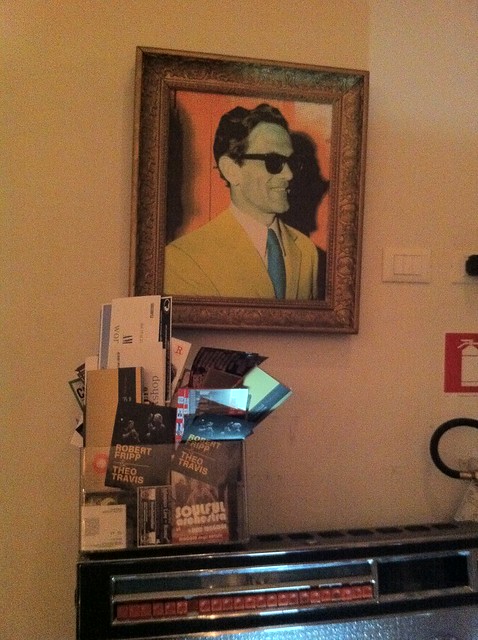
Bar Necci in Pigneto

/ My photo of framed portrait of Pasolini above a vintage jukebox at Bar Necci in Pigneto, taken when I was there in 2010. It was in this neighbourhood Pasolini filmed his early masterpieces Accattone and Mamma Roma. See the rest of my Roman holiday pics on my flickr page /

Pasolini strove to transcend the conventions of Italian neo-realism into his own idiosyncratic Cinema of Poetry. As with Accattone, Pasolini tenderly ennobles the hardscrabble struggles of the impoverished social underclass with a lyrical, painterly eye (framing characters like they’re in a Renaissance painting) and employing classical music (in Accattone Pasolini used Bach as an aural backdrop; in Mamma Roma, Vivaldi soars on the soundtrack). This is a milieu of bare subsistence, in which hunger is a genuine possibility. When people argue, someone inevitably pulls a knife; the confrontation is probably observed by urchin children and a mangy third world stray dog. The war-scarred landscapes are so decimated they look lunar. In the background, a baby always seems to be crying. Mamma Roma and Ettore are cafoni, the Italian equivalent of North American hillbillies. In the subtitles, there are frequent disparaging references to “hicks”. Mamma Roma admonishes Ettore to not speak like a hick (presumably in a rough, rural peasant dialect) but to talk like she has learned to – like an urban Roman.


Almost immediately, there are ominous premonitions things won’t go well. The window to Ettore’s new bedroom offers a view of the local cemetery. Worse, Mamma Roma is tracked down by Carmine, who blackmails her into working the streets again.  Carmine is played by the swarthy, smouldering Franco Citti from Accattone (again playing a pimp). This time around Citti sports a (deliberately?) unflattering sleazy little moustache; it certainly makes him look like a seedy pimp. Magnani and Citti’s confrontations crackle with violence – emotional, with the potential for physical (you wouldn’t want to see Magnani lunging at you with a kitchen knife and wild-eyed expression). I’m a total sucker for Franco Citti; he’s unforgettable reminding Mamma Roma when he first met her, she was “covered in lice” and “didn’t know what panties were.” “You knew it would end badly for one of us ...” he snarls.


/ Franco Citti as Carmine /


For swathes of Mamma Roma, Magnani vanishes and the action centres on Ettore.  As Magnani’s wayward son, non-professional actor Ettore Garofolo (yes, the character is named after the actor who plays him) makes a haunting impression and suggests a complex and troubled inner life. Pasolini’s camera tenderly explores his elfin face (melancholic in repose), button nose and sorrowful dark puppy eyes, captivated. A simultaneously tough and vulnerable man-child, he struts in the perfect sailor roll (or in this context, pimp roll) even in the too-big suit his mother insists he wear. As has already been pointed out, Garofolo can look like the pretty teenaged street thug from a Caravaggio painting come to life. (Pasolini and Caravaggio probably shared similar taste in rough trade).


/ Heartbreaker: Ettore Garofolo /

Ettore is amoral, alienated. He rejects Mamma Roma’s attempts to make him go to school or work, drifting instead towards petty crime with the local juvenile delinquents. (Ettore’s gang are very much Pasolini’s type and his camera caresses them in loving close-ups. In a nicely rakish touch, one of  Ettore’s cutest buddies is missing a front tooth). It’s interesting to speculate Ettore has the makings already of being the next Carmine. In her urgent mission to advance her illiterate provincial son, Mamma Roma never stops to ask him what he actually wants. When someone asks Mamma Roma, "You’d hang on the cross for him, wouldn’t you?” she unhesitatingly replies, “What else is there?” Her maternal love is savage, primeval -- but Pasolini hints she’s also motivated by assuaging her own guilt for having abandoned him and asks if maybe Ettore would have been more content to stay in the countryside and be a labourer. Is what awaits him in Rome an “improvement”?


Pasolini’s most daringly audacious and avant-garde scenes depict Magnani turning tricks at night on a grim stretch of road (recalling the scrubby wasteland on the outskirts where Maddalena is beaten up in Accattone). These are opportunities for Mamma Roma to relate her own history. It starts with her fellow tarts (like loyal friend Biancofiore) and her “johns” asking Mamma Roma to tell them her story, but as Magnani walks and speaks they gradually drift away until it’s mainly Mamma Roma delivering heart-rending monologues about her travails directly to the viewer, effectively breaking the fourth wall. She speaks of brutal, grinding rural poverty and enforced marriage at age 14 to a relatively wealthier, much older man.


/ Mamma Roma's friend and fellow prostitute Biancofiore (Luisa Loiano). With her beehive hairdo and heavy 1960s dark eye make-up, she looks like a J H Lynch painting come to life /


/ Silvana Corsini as the town tramp, young single mother Bruna, who ensnares Ettore with her feminine wiles (and fuzzy arm pits). Corsini played the dim-witted whore Maddalena in Accattone: she was exceptionally good at playing not very bright child-like women /

Pasolini keeps key details of Mamma Roma’s life vague and – confusingly – her accounts often contradict themselves. She married the corrupt older man, but also refers to having “married” Ettore’s criminal father – who was promptly hauled off to prison by waiting police men as soon as the ceremony ended. They’re clearly not the same man. How many husbands has Mamma Roma had? There’s a tantalising possibility that Carmine could be Ettore’s father. (Ettore himself expresses no curiosity about his father’s identity. A more conventional director would have explored this plot angle; Pasolini has different priorities).  Mamma Roma’s stories meld the personal and the political: she rails against hypocrisy, Mussolini’s Fascism, injustice. In one soliloquy she describes the family of Ettore’s father as wretched scum, the lowest of the low (a police snitch, a beggar, a brothel madam) but points out “if they’d had money, they would have been good people” – perhaps the most powerful message of the whole film. In a moment of religious doubt, Mamma Roma looks skyward and angrily implores God, “Explain to me why I’m a nobody, and you’re the king of kings.”
As it progresses, Mamma Roma is increasingly characterised by an overwhelming sense of dread. Outside maybe film noirs, it’s difficult to find films more fatalistic than Mamma Roma or Accattone. It’s not a spoiler to reveal that Mamma Roma (like Accattone) builds toward a tragedy that feels ancient, epic, primal and operatic; Pasolini foreshadows this from almost the beginning. It climaxes in a startling shot of a character filmed from above in a crucifixion position so beautifully-composed, so suffused with Christ-like suffering it makes you gasp.
Earlier there’s a wrenching moment when Mamma Roma abruptly clamps her hand over her face and bursts into tears of sheer relief, believing that things finally seem to be going in her favour -- all the degradation and turmoil she’s suffered is seemingly justified. Of course she is wrong. The odds (or the system) are stacked against her and Ettore before she even began. Mamma Roma’s daring to improve her lot seems to enrage the gods. Fate punishes her. It’s impossible to escape the past. Pasolini persuasively demonstrates that mother and son are foredoomed by their environment and socioeconomic status. In Accattone, Franco Citti seals his fate by defiantly declaring, “Either this world kills me or I’ll kill it!” In Mamma Roma, Anna Magnani similarly swears, “I’ve paid my dues in this life, and the next.” She lives to regret those words.