KLAXON!
Boy, am I excited to make my debut at London’s red-hot new grindhouse cinema, The Nickel [117-119 Clerkenwell Road EC1R 5BY]! I’m squealing like a hungry, grasping
starlet! Join me on Tuesday 7 October when I introduce 1977 Canadian cult
classic Outrageous!
Set in snowy Toronto, Outrageous! is a wistful
slice-of-life character study about the friendship between Liza Connors (Hollis
McLaren), a schizophrenic woman fresh out of a mental institution and Robin
Turner (Craig Russell), a gay hairdresser with showbiz aspirations. Seen today,
Outrageous! is a gritty and invaluable social document of LGBTQ life in the
seventies, capturing the period of gay liberation between the Stonewall riots
in 1969 and the advent of AIDS. The gay bars are frumpy, cluttered and populated
mostly by leather daddies and mustached clones – and look like a blast! And rest
assured, the drag scene depicted here is rough and ready, done on a tight
budget and bears little resemblance to RuPaul’s Drag Race. Outrageous!
also preserves the late Craig Russell’s nightclub act: in a tsunami of
old-school diva worship, he impersonates the likes of Mae West, Judy Garland,
Marlene Dietrich, Bette Davis, Barbra Streisand and Bette Midler. (Pictured above:
Russell as Tallulah Bankhead). And its messages about embracing nonconformity,
celebrating small victories and taking a compassionate tone towards societal
outsiders feel more relevant than ever. Buy your ticket here NOW!
Hagsploitation truly is the horror sub-genre
that keeps on giving. Sparked by the unexpected success of 1962’s What Ever
Happened to Baby Jane? in the 1960s and 70s, maturing female stars of golden
age Hollywood extended their careers by swallowing their pride, embracing their
inner scream queen and plunging into exploitation shockers: think of Joan Crawford,
Bette Davis, Tallulah Bankhead, Olivia de Havilland, Agnes Moorehead and
Shelley Winters starring in the likes of Strait-Jacket, Hush … Hush … Sweet
Charlotte, Berserk, Lady in a Cage, Die! Die! My Darling, Dear Dead Delilah and especially
the “question movies” Whoever Slew Auntie Roo?,What’s the Matter with Helen? and
What Ever Happened to Aunt Alice?
Roaring back from career doldrums (I last remember
her playing Miley Cyrus’ mother in 2012), 61-year-old Demi Moore finds herself in a similar
position in director Coralie Fargeat’s grisly and stylish satire The Substance.
In a gutsy, exposed (in every sense) performance, Moore plays Elisabeth Sparkle,
a middle-aged television celebrity abruptly fired by ageist and sexist network
executive (Dennis Quaid, really chomping the scenery). Despondent, Elisabeth takes
desperate measures to rejuvenate her “best self” with a mysterious unregulated black
market scientific procedure called The Substance … and things swiftly unravel.
Characterized
by stunning art direction and a visceral sound design that emphasizes every repulsive
squelching noise, The Substance ratchets up maximum dread and offers a goldmine
of knowing movie references: Basket Case. Carrie. Death Becomes Her. The Elephant Man.The Shining. Every single
David Cronenberg “body horror” flick but particularly The Fly. Thematically, it
reminded me of two specific b-movies from the late 1950s: The Wasp Woman and The Leech
Woman, in which the anti-heroine experiments with science (or voodoo) to
restore youth and beauty with monstrous consequences (and – it must be noted - these
films make their point with a fraction of The Substance’s budget and two hour-and
40-minute running time).
The Substance is bound to be divisive. There was multiple
“walk outs” when I saw it yesterday. Does it critique society's youth fixation or wind up reaffirming it? And has Fargeat lost control of the material by the
ultra-gory splatter fest finale? However you cut it, it’s a wild ride and
destined for cult status.
Reader, I was one of the mixed-up
generation of misfits warped by the Scala at an impressionable age. (I moved to
London just in time to experience its final year or so; I remember feeling
bereft when it closed). The first double bill I ever saw there was within a
month or two of arriving: Girl on a Motorcycle (1968) / The Wild Angels (1966) (in other
words, Marianne Faithfull and Nancy Sinatra as black leather-clad biker mamas).
This was when Kings Cross was still a genuinely dangerous grungy red-light district
/ junkie central (just walking from the tube station to the cinema felt like
risking your life).
From there, I plunged into essential underground
classicks by the likes of John Waters, Russ Meyer, Kenneth Anger, Andy Warhol,
Richard Kern and Bruce LaBruce. But for me, the film synonymous with the Scala will
always be Thundercrack! (1975). It was a blast to revisit it on Sunday afternoon
with friends. In this triple X sensual and depraved oddity written by George Kuchar
and directed by Curt McDowell, a motley crew of freaky outsiders seek shelter at
an isolated old dark house one rain-lashed night. The house in question is
called Prairie Blossom and its chatelaine is the eccentric, drunk, reclusive and
deeply horny Mrs. Gert Hammond, a Blanche DuBois-type wearing Anna Magnani’s
black slip.
/ Marion Eaton as Gert Hammond /
If you’ve never experienced Thundercrack!, anticipate hardcore sex
scenes interspersed with verbose faux Tennessee Williams dialogue (“Take me
away from all this! I’ve got money, a car and a body – and they’re all yours!”).
You get a measure of Thundercrack! immediately when Gert vomits into a toilet,
her wig falls into the bowl, and she simply slaps it back onto her head to
answer the front door. (“Who’s there that speaks to me in the voice of a woman?
It’s been years since those doors felt the touch of a human knuckle!”). As
Gert, the remarkable Marion Eaton’s gutsy and committed performance deserves to
be proclaimed alongside Divine’s in Pink Flamingos or Female Trouble in the gutter
movie pantheon.
/ Ken Scudder's deeply memorable jockstrapped crotch in Thundercrack! Read his story here /
Scala!!! is in cinemas now and will be available for streaming soon. Thundercrack! is apparently available on Blu-ray, but really, you wanted to watch it in a cinema full of rowdy drunk people - ideally at midnight!
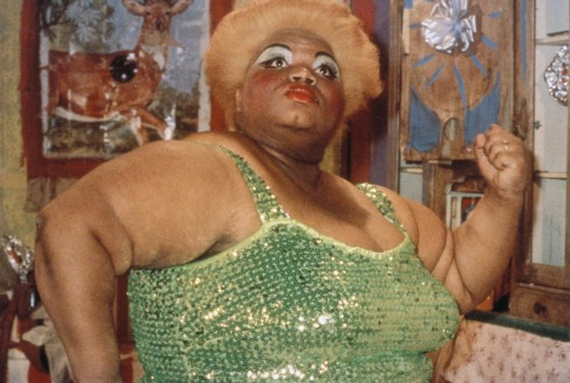
“The doorbell rang, I opened the door and
there she was – my dream-come-true, four-hundred pounds of raw talent. I
carefully invited Jean in, and the first thing she did was goose me to totally
unnerve me. She asked for a drink and got it. She laughed and said she had no
objections to nudity (“I’ve got a lot to show, honey”), would certainly dye her
hair blonde (“Big deal. I’ve had blonde hair twice before”) and asked for a
special chair that wouldn’t break when she sat on it. After listening to her
give a hilarious reading from the script, we went over the contract, I gave her
an advance on her salary, and it was settled.”
/ John Waters recalling his first encounter
with Jean Hill when she auditioned for Desperate Living in the book Shock Value
(1981) /
“Could the mighty Jean Hill in her very heart have been a deeply
sincere, vulnerable and perhaps even a (gasp!) shy person? Actually, I think
she was, and her outrageous persona was a way to compensate for this and
connect with people and get them to drop the bullshit, prejudice and
affectation and deal with her person-to-person. She refused to be labelled. She
was fat, she was black, and her health problems forced her to become a kind of
permanent “patient,” and she was sometimes on welfare, so she was also filed as
a “charity case,” but she refused to be put in any of these boxes or to be
looked down upon. She was forged in defiance. There is nothing unique about
that — the ghetto is full of defiant people, but it becomes special when that
defiance is coupled with intelligence, wit, humour, compassion and a flair for
the absurd, and that’s what made Jean stand out in any crowd.”
Died on this day ten years ago: John Waters’ majestic “soul diva” Jean
Hill (15 November 1946 – 21 August 2013), unforgettable as Grizelda in his 1977
bad taste punk classick Desperate Living. (She also makes a fleeting but vivid cameo appearance in Waters' 1981 film Polyester).
Recently re-visited: The Legend of Lylah
Clare (1968). Tagline: “Overnight she became a star. Over many nights she
became a legend.”
Klaxon!! A pristine version of this widely
reviled misbegotten camp oddity is currently viewable on YouTube – and it’s compulsory
viewing for devotees of “bad movies we love”. I hadn’t seen this one since I
was a teenager - and in fact even then I’m not sure I made it to the end.
Sultry Kim Novak stars as decadent German
screen diva Lylah Clare (think Marlene Dietrich or Greta Garbo), who died in
her prime in murky circumstances – and urban myth has it she was initially
discovered working in a “brothel that catered to some pretty peculiar
fantasies.” Now, twenty years after her death agent Bart Langner (Milton
Selzer) has terminal cancer and his final wish is to produce a tell-all Lylah
Clare biopic. But when Langner pitches the idea to Lylah’s temperamental husband
and directorLewis Zarkan (Peter
Finch), he’s dismissive anyone could do Lylah justice (“Dreary little pussycats
come mincing in here like bitches in heat doing their dirty little business!” Zarkan
fumes). But then Langner introduces his discovery and proposed leading lady - a
mousey unknown wannabe actress called Elsa Brinkmann (Novak again wearing
glasses and a brown wig). “Shoulders. Hips. Cheekbones. Just like Lylah. It’s
uncanny!” he raves.
When she arrives at the mansion Zarkan
shared with Lylah, the meek Elsa seems oddly mesmerized by a huge oil portrait
of Lylah – and the sweeping dramatic staircase where she plunged to her death.
(To be fair, it is a total death trap!). And when the tyrannical Zarkan
manhandles her, the angered Elsa suddenly exclaims, “Keep your feeelthy hands
off me!” in Lylah’s guttural Germanic voice - and in fact, seems to be possessed
by her! (Note that Lylah’s “baritone babe” voice is dubbed by the great German
actress and singer Hildegard Knef). Uh oh! From here, things just get weirder
and messier …
Director Robert Aldrich sure loved
recycling the show biz-is-hell theme: The Big Knife (1955). Whatever Happened
to Baby Jane? (1962). The Killing of Sister George (1968). For good measure,
Aldrich also throws in references to other peoples’ movies like Sunset
Boulevard (1950), Vertigo (1958) and Valley of the Dolls (1967). (More
recently, Lylah Clare belongs in the same lineage as David Lynch’s Mulholland
Drive (2001) and Inland Empire (2006) and the ultra-divisiveBlonde (2022)).
Downsides: characters endlessly pontificating
at length about the dog-eat-dog cruelty of Hollywood. The furiously hammy spittle-flecked
performances of Finch and Ernest Borgnine are insufferable. There’s zero
attempt to capture period verisimilitude in the flashbacks to the 1930s (or is
it the 1940s? It’s impossible to tell!). Coral Browne plays a malicious dragon
lady gossip columnist loosely based on Hedda Hopper and Louella Parsons. The cruel
humour poked at the fact she’s disabled and wears a leg brace has aged like an
avocado.
But Novak is always compelling to watch.
This is her equivalent of Boom!or Secret Ceremony, the freaky “failed art
movies” her peer Elizabeth Taylor made in the same period. Interestingly, Aldrich’s
first choice for Lylah was French actress Jeanne Moreau (her presence would
have made it feel more cerebral and European art cinema) – which feels inconceivable
today considering Lylah Clare (with its themes of shifting female identities and
men obsessively making-over women) seemingly makes deliberate allusions to Novak’s
earlier film Vertigo.(Novak had been
absent from the screen for three years and Lylah Clare would be her final major
starring role).
Critics were mostly hostile, but some were
prophetic. "Not merely awful; it is grandly, toweringly, amazingly so,” Richard
Schickel wrote in Life magazine. “I laughed myself silly at Lylah Clare,
and if you're in just the right mood, you may too”, while Roger Ebert
concluded, “Like the Burton-Taylor Boom, it provides its own grisly
satisfaction: You can have fun watching it be so bad.”
“Before this adaptation of
Chekhov’s 1884 novel The Shooting Party, Linda Darnell was valued for
her beauty rather than her acting ability, but her role here as Olga, a peasant
girl who ruins the lives of three men in her quest for wealth and social
standing, relaunched her career. She’s brilliant, particularly in her wedding
scene, where she is aware of the patronising scorn of the aristocrats around
her, adding fuel to her plan to improve her station. George Sanders gives one
of the best male performances in Sirk’s canon, as the weak judge who falls in
love with Olga. The critique of the limited options available to women is
pure Sirk, while there is a moment of suspense that recalls Hitchcock, when a
maid sees something disturbing from her changing room. The ending, where the
judge has a life-changing decision to make, shows Sirk’s eye for human
fallibility at its keenest.”
I’ve always wanted to see this early
Douglas Sirk curiosity, which seems to be entirely out of circulation. (Summer
Storm isn’t streaming anywhere. The DVD that Cinema Paradiso sent me dates to
2009 and is probably long out of print). In the Andrew Sarris article cited
above, he lists Summer Storm as a film that should be embraced by cult movie aficionados. Obviously, that never happened. It’s minor Sirk, but hell, minor Sirk is more
fascinating than most filmmakers on their best day!
“There’s only one word to describe rich,
dark, beautiful and rare. I’m going to call you … Mahogany!”
Yass, Queen! In honour of Pride Month, the
Lobotomy Room film club (our motto: Bad Movies for Bad People), presents Mahogany
(1975) starring fierce pop diva Diana Ross! Thursday 16 June downstairs at the
fabulous Fontaine’s bar in Dalston!
Seize this opportunity to celebrate Ross as
an unassailable gay icon while she’s actually gracing our shores with her
glittering presence this summer (she's performing at the Platinum Jubilee
concert, a sold-out stint at the O2 Arena AND the “legends slot” at Glastonbury)
with this berserk so-bad-it’s-GREAT camp classic in the tradition of Valley of
the Dolls, Mommie Dearest and Showgirls! (Critic Roger Ebert dismissed Mahogany
as a “big, lush, messy soap opera” - as if that’s ever a bad thing!).
In this lurid rags-to-riches melodrama,
Ross portrays Tracy Chambers, a poor but determined aspiring fashion designer
from the gritty slums of Chicago. Instead, she’s “discovered” by a photographer
(played by Tony Psycho Perkins) and winds up transformed into international
supermodel Mahogany. But is success - and her decadent Euro-trash existence in
La Dolce Vita Rome - all it’s cracked up to be? See the film that inspired
everything from Beyonce to RuPaul and generations of drag queens to Paris is
Burning! Throw on a chiffon cape, drip candle wax all over yourself and embrace
the sequined lunacy of Mahogany on 16 June!
Lobotomy Room Goes to the Movies is the
FREE monthly film club devoted to the cult, the kitsch and the queer! Third
Thursday night of every month downstairs at Fontaine’s bar in Dalston! Two
drink minimum. Inquire about the special offer £5 cocktail menu! Numbers are
limited, so reserving in advance via Fontaine’s website is essential. Alternatively, phone
07718000546 or email bookings@fontaines.bar to avoid disappointment! The film
starts at 8:30 pm. Doors to the basement Bamboo Lounge open at 8:00 pm. To
ensure everyone is seated and cocktails are ordered in time, please arrive by
8:15 pm at the latest. Facebook event page.
[I reviewed Criterion's new Blu-ray release of John Waters Multiple Maniacsfor gay arts and culture website HISKINDin March 2017. Read it here. Disappointingly, they edited the hell out of it, deleting all my efforts to put the film into context – so I’m posting it here in its uncut / uncensored original version!]
It’s looking increasingly unlikely cinema’s
high potentate of trash John Waters will ever make another movie following
2004’s commercial flop A Dirty Shame.
(In recent years, the 70-year old “peoples’ pervert” has successfully diversified,
spreading his joyous message of filth via books and spoken word tours instead of
films).
But happily for Waters’ legions of fanatics
ravenous for a lurid sensationalism fix, they get to rediscover one of his
freshly-exhumed obscure classicks (sic). For decades, Multiple Maniacs (1970) - which Waters himself calls his “celluloid
atrocity” - has been virtually impossible to see. A grainy, scuzzy VHS was issued in the
eighties, then it occasionally surfaced as a poor-quality pixelated bootleg (Waters’
legal team promptly deletes it every time it crops up on YouTube) - but until
now it’s never officially been available on DVD or Blu-ray. And now Criterion
has handled Multiple Maniacs like
it’s a prestigious art movie, giving it a loving deluxe digital remaster
treatment. Watching this crystalline deep velvety black-and-white revival of Multiple Maniacs is like experiencing a
whole new film.
/ Divine as Lady Divine in Multiple Maniacs /
Forty-seven years later, the restored,
reviled and revolting Multiple Maniacs
hasn’t lost its capacity to startle. It still feels insanely raw, nasty, punk
and queer. And it’s essential to understanding Waters’ subsequent films (Multiple Maniacs suggests a preliminary
sketch for his next film, 1972’s more famous Pink Flamingos). In her first starring role, Waters’ 300-pound hog
princess drag queen leading lady and muse Divine portrays Lady Divine, the
cruel and amoral proprietoress of traveling freak show “The Cavalcade of
Perversions” of assorted sluts, fags, dykes and pimps. (The sensational revue incorporates
vomit eaters, bicycle seat lickers, a junkie writhing in withdrawal and “two
queers actually kissing on the lips like lovers”). When we first encounter Lady
Divine, she’s lounging stark naked on a bed and barking orders at her minions –
think Liz Taylor as Cleopatra. Upon learning her carnival barker boyfriend and
criminal accomplice Mr David is leaving her for another woman, a homicidal Lady
Divine embarks on a berserk rampage. The
film concludes with a cannibalistic blood orgy (Multiple Maniacs – made in ’69 – was Waters’ response to the
Charles Manson Family murders in same way Beyond
the Valley of the Dolls was for Russ Meyer). Oh and – spoiler alert – a
giant lobster is involved.
/ David Lochary as Mr David in Multiple Maniacs /
Sure, in technical terms neophyte Waters’
filmmaking is frankly amateurish (which makes Multiple Maniacs feel like a lunatic home movie) and the actors
sometimes stumble over the verbose script. But there is much here to make a
Waters devotee swoon in frenzied ecstasy. The cast features Waters’ familiar stable
of regular actors at their most heartbreakingly youthful and fresh-faced, like
David Lochary and Mink Stole (Raymond and Connie Marble, the villains of Pink Flamingos), Mary Vivian Pearce, Cookie
Mueller as Divine’s hard-boiled lisping (frequently topless) juvenile delinquent
daughter and – in her film debut - the beloved snaggle-toothed outsider actress
and punk granny Edith Massey. The
vicious dialogue is predictably quotable (“I love you so fucking much that I
could shit!” “And all at once she inserted her rosary into one of my most
private parts …”) while the soundtrack encompasses ominous rumbling surf
instrumentals and twangy rockabilly. Thematically, Multiple Maniacs sees Waters lashing out at his Catholic
upbringing: the “rosary job” Divine
receives from perverted religious whore Mink Stole and the blasphemous
re-enactment of the Stations of the Cross still feel taboo and sacrilegious.
/ Edith Massey as The Virgin Mary in Multiple Maniacs /
Best of all, Multiple Maniacs captures iconic freak diva Divine-in-embryo, still
a fleshy young starlet or ingénue on
the ascent. Mincing around like Jayne
Mansfield in a skin-tight leopard print pencil skirt and brunette wig, snarling
her lines and sometimes actually foaming at the mouth in excitement, this represents
early Divine at the height of her monstrous beauty.
The promotional tagline for Multiple Maniacs screams, “Better than
amyl nitrate! Better than Carbona! Better than heroin!” What other film could
live up to those claims? It’s like an intravenous jolt of bad taste. For
long-term Waters aficionados, the Blu-ray release of Multiple Maniacs is the equivalent of Christmas day. For newcomers
to Waters’ oeuvre, it offers an
excellent introduction. Get corrupted!
MULTIPLE
MANIACS - available to buy on Blu-ray from 20th March 2017 from the Criterion
Collection Further reading: Read my epic 2010 interview with John Waters here
Now that 2016 is circling the drain, won’t
you indulge me in reminiscing a bit about Lobotomy Room Goes to the Movies? My free
monthly film club (focusing on the cult, the kitsch and the queer!) in the
basement Bamboo Lounge of Dalston’s Art Deco fleshpot Fontaine’s is just over
one year old. Let’s get all retrospective and wistfully re-visit the titles we’ve
presented over the past year.
Let the countdown commence!
Seven Sinners (1940) – 24 November 2015
The seven films director Josef von
Sternberg and his muse and leading lady Marlene Dietrich made together between
1930 and 1935 were dark, erotic, witty and sublime works of art. Together they
honed Dietrich’s complex, sultry and feline persona and brought a whiff of
genuine Weimar decadence to mainstream Hollywood. By comparison Seven
Sinners (made after Dietrich and von Sternberg’s personal and professional
relationship imploded) is pure trash - but kitschy, enjoyable fun trash of the
highest order! It’s a romantic comedy starring Dietrich as good time girl
nightclub chanteuse Bijou Blanche, set adrift and stirring up trouble
in a South Seas port, while pursuing a hunky naval officer (played by a young
and still relatively unknown John Wayne). Event page.
Pee Wee’s Christmas Playhouse Special (1988)
- 15 December 2015
In honour of the holiday season, let’s get
festive and combine some Christmas cocktail capers with the most kitschy and
campy of all TV specials – Pee-Wee’s Playhouse Christmas Special from
1988! In which that bow-tied perverse brat Pee-Wee Herman welcomes a
mind-boggling selection of special guests to his playhouse - including Grace
Jones, Little Richard, Cher, Joan Rivers, Charo, Zsa Zsa Gabor, Oprah Winfrey
and kd lang! [Note: the TV special is actually just under an hour long, so
before and after I will play my most abrasive atomic-era Christmas tunes to pad
things out!]. So … won’t you join me for a snowball, glass of prosecco or
mulled wine and learn about the true meaning of Christmas with Pee-Wee Herman?
See you there!
The featured presentation this month will
be the ultra-lurid 1964 juvenile delinquent exploitation
psychodrama Kitten with a Whip – starring quintessential atomic-era
sex kitten-gone-berserk Ann-Margret. This sleazy little black and white B-movie
urgently poses the question: why do the sweetest kittens have the sharpest
claws? Fresh from cavorting with Elvis in Viva Las Vegas, red-headed vixen
Ann-Margret plays a vicious teenage sociopath escaped from her high-security
juvenile detention centre – who then takes hostage and torments straight-laced
local politician John Forsythe in his palatial suburban dream house. (Yes – a
cardigan-wearing and still dark-haired John Forsythe as in Dynasty’s
silver fox Blake Carrington!). From there, Ann-Margret’s gang of thug friends
turn up – and things just get wilder!
Morocco (1931) - 24 February 2016.
Considering Valentine’s Day falls this
month, February’s selection is a love story. But bear in mind this is, after
all, Lobotomy Room Goes to the Movies – so the love story is a twisted, high
camp tale of amour fou. In Morocco (1930) – directed by
visionary maestro of kinky exotica Josef von Sternberg – dissolute
nightclub chanteuse and woman of mystery Amy Jolly (German screen
diva Marlene
Dietrich in her sensational Hollywood debut) finds herself adrift in
North Africa and caught in a love triangle, torn between a handsome amoral
Foreign Légionnaire (lanky young Gary Cooper at the height of his beauty) and a
wealthy playboy (Adolphe Menjou. Perversely, Menjou is meant to represent von Sternberg himself – who in his complex off-screen relationship with the
bisexual Dietrich stoically stood by and watched her seduce legions of men and
women both). Depending on your sensibility, Morocco culminates in an
ending which you’ll either find irresistibly romantic or totally absurd. Either
way, the film is a blast!
Desperate Living (1977) - 23 March 2016
The featured presentation this month will
be John Water’s ultra-twisted punk-y black comedy Desperate
Living (1977). It’s one of his relatively lesser known gems (probably
because his usual muse and leading lady - three hundred pound drag queen Divine
- isn’t in it). The genuinely nasty Desperate Living has something to
offend everyone! See the film that Variety lambasted as “amateur
night on the psycho ward” and that Waters himself has called “the worst of all
my films. And it’s the grimmest!”
The Wild, Wild World of Jayne Mansfield
(1968) - 27 April 2016
Rated “X” upon its release in 1968, the
ultra-trashy faux documentary chronicles the kinky globe-trotting
misadventures of Hollywood sex kitten-gone-berserk Jayne Mansfield. Watch agog as kitsch icon Mansfield - the punk Marilyn Monroe, revered by John
Waters and Divine (and “the face” of Lobotomy Room) - visits the
hedonistic “sin spots” of the world, encompassing topless go-go clubs, gay
bars, drag queen beauty contests and nudist colonies, usually accompanied by
her pet Chihuahua! The low-budget Wild, Wild World was in production 1964 - 1968. Bear in mind Mansfield died in 1967. Part of the fun is spotting how the
producers cobbled things together after Mansfield’s death in order to complete
the film. Watch for the (many) shots of a body double filmed from behind
wearing Mansfield’s dishevelled blonde wig. And the sound-alike who delivered
the voice-over narration (nailing Jayne’s breathless babydoll coo) deserved an
Oscar!
Valley of The Dolls (1967) – 25 May 2016
“You have to climb Mount Everest … to get
to the Valley of The Dolls.” Before Mommie Dearest …
before Showgirls … the original “What the hell were they thinking?”
Bad Movie We Love was Valley of the Dolls. A perennial favourite of
drag queens and a cult classic for connoisseurs of kitsch, the unintentionally
hilarious and wildly entertaining 1967 film adaptation of Jacqueline Susann’s
lurid 1966 bestseller took the already trashy source material – and went even
tawdrier with it! (At the film’s premiere, an outraged Susann reportedly called
the film “a piece of shit!”). A cautionary tale about the perils of show
business, it follows the travails of three ambitious casualties of the glamour
jungle: friends Anne, Neely and Jennifer. (The “dolls” of the title refer to
the fistfuls of uppers and downers the characters pop like Tic Tacs throughout
– usually washed down with booze). Valley of The Dolls packs
everything discriminating thrill-seekers demand in its lunatic two hours: hammy
performances, pill-popping, bouffant wigs, cat-fights, slurring drunken scenes,
rehab, drug-fuelled meltdowns and crap-tastic musical numbers.
“Ladies and gentlemen, welcome to violence,
the word and the act. While violence cloaks itself in a plethora of disguises,
its favourite mantle still remains: sex. Violence devours all it touches, its
voracious appetite rarely fulfilled. Yet violence doesn’t only destroy – it
creates and moulds as well! Let’s examine closely, then, this dangerously evil
creation, this new breed, encased and contained within the supple skin of
woman… the softness is there, the unmistakable smell of female. The surface
shiny and silken. The body yielding yet wanton. But a word of caution – handles
with care and don’t drop your guard! This rapacious new breed prowls both alone
and in packs, operating at any level! Any time! Anywhere! And with anybody! Who
are they? One might be your secretary! Your doctor’s receptionist! Or a dancer
in a go-go club!” Yes! The Lobotomy Room Goes to the Movies film selection
this month in the Bamboo Lounge of Fontaine’s is
ultimate sexploitation B-movie Faster, Pussycat! Kill! Kill! (1966).
Perhaps cleavage-fixated director Russ Meyer’s defining masterpiece, it follows
a trio of vicious thrill-hungry go-go dancers going on a homicidal rampage in
the desert. As cinema’s sleaze maestro John Waters argues, “Faster Pussycat!
Kill! Kill! is beyond a doubt the best movie ever made. It is possibly better
than any film that will be made in the future!” [Pussycat! was our biggest hit to date - the first time we had to post a warning on Facebook that if you hadn't already reserved a seat in advance, don't turn up on the night!]
Attention, jaded Continental sophisticates!
Embrace the spirit of Eurotrash hedonism (and pretend we’re still in the EU)
when Lobotomy Room presents a FREE special decadent Bank Holiday Sunday
screening of Federico Fellini’s carnival-esque and hallucinatory epic
masterpiece La Dolce Vita (1960)! You know that iconic image of
voluptuous Swedish sex bomb Anita Ekberg frolicking in Rome’s Trevi
Fountain? That’s from La Dolce Vita – one of the most
stylish movies ever made! It captures the acme of Italian glamour: the cars,
the clothes, the nightlife (no one films debauched nightclub, party and orgy
scenes like Fellini in his 1960s pomp) and most of all – the sunglasses! While
you watch the film, take the edge off your hangover with negronis or glasses of
Prosecco! Needless to say, it’s illegal to smoke in the Bamboo Lounge, but feel
free to keep your shades on!
Of the seven sublime films director Josef
von Sternberg and leading lady / muse Marlene Dietrich made together, surely
the wildest and weirdest is Blonde Venus (1932). It stars sultry
German glamour puss Dietrich as a hausfrau and mother forced to
resume her career as a nightclub chanteuse due to circumstances too
complicated to go into here – and then finders herself entangled in a romantic
triangle between her sick scientist husband and a suave millionaire (played by
a very young Cary Grant). But none of that is important! It’s mainly an excuse
to luxuriate in Dietrich’s shimmering close-ups, multiple extravagant costume
changes and sensational musical numbers. Most notorious of the latter is the
riotously kitsch and freaky “Hot Voodoo” sequence. If you’ve never seen it
before I won’t spoil it for you, but 1) “Hot Voodoo” is the campiest thing
you’ve ever seen, 2) watching it might turn you gay and 3) over eight decades
later, the likes of Grace Jones, Madonna and Kate Moss are still referencing it
in videos, concerts and photo shoots.
[This was the third Dietrich film I’ve
screened. The previous two – Seven Sinners and Morocco – both bombed big-time
and just didn’t lure any punters in – which was really demoralising, as
Dietrich is possibly my all-time favourite actresses and I'd hoped to make her films Lobotomy Room staples. In retrospect, the main
reason the two earlier two screenings belly-flopped was because I hadn’t yet mastered
the dark art of promoting them properly online – which is, to shell-out loads of money to
Facebook every month to reach more people! Happily, Blonde Venus was a maximum-capacity,
red-hot triumph! It restored my faith in the allure of Marlene Dietrich!]
Elvira: Mistress of the Dark (1988) – 28
October 2016
Embracing the spirit of Halloween, the
October presentation is … Elvira: Mistress of the Dark (1988)! A
gleefully low-brow, raunchy broad comedy starring buxom, beehive-haired horror
movie hostess Elvira, the beloved cult figure for generations of punks, psychobillies,
Goths and misfits of all description. In the film, Elvira inherits a haunted
house en route to making her Las Vegas debut – but really, it’s all mainly an
excuse for endless boob jokes. If you’re a fan of trashy eighties cinema or the
humour of Pee-Wee Herman and John Waters, this is the Halloween movie of your
(wet) dreams!
This month we’re really scraping
the barrel with perhaps the WORST film we’ve screened to date – Mae
West’s infamous final film Sextette (1978)! Think of it as
an unintended camp classick – or a freaky Diane Arbus photograph come to life!
Bewigged, carefully shot in ultra-soft-focus, virtually immobile and never
making eye contact with any of her co-stars, West frequently looks like she has
been mummified or taxidermied. Just how nuts was West? When West and [Timothy]Dalton
duet on the Captain and Tennille soft rock hit “Love Will Keep Us Together”
(did I mention Sextette is a musical?), West insisted the original
lyric “young and beautiful / someday your looks will be gone” be changed to
“young and beautiful / your looks will never be gone!” Gasp in
astonishment at the mind-boggling Sextette – one of the most wildly
misjudged films ever made! See the movie that made The New York
Times declare, “Granny should have her mouth washed out with soap, along
with her teeth!"
Christen Christmas party season 2016 on a
sweaty, desperate note – at Lobotomy Room! When we transform the
Polynesian-style basement Bamboo Lounge of Dalston’s premiere Art Deco vice den Fontaine’s into
Santa’s grotto! Friday 2 December! For the final festive and boozy Lobotomy
Room of 2016, we’re combining the film club and the dance
party! COME for the FREE screening of the most kitschy and
campy of all seasonal TV specials – Pee-Wee Herman’s 1988 Playhouse
Christmas Special! Watch agog as bow-tied perverse brat Pee-Wee welcomes a
mind-boggling cavalcade of super star special guests to his playhouse -
including queer favourites Grace Jones, Little Richard, Cher, Joan Rivers, Charo,
Zsa Zsa Gabor, Oprah Winfrey and kd lang!
And so we conclude by coming full circle
with Pee-Wee Herman. (His Christmas special is an annual festive tradition!
Sadly, I’ve deduced from bitter experience that both Pee-Wee and Elvira – for me,
beloved cult idols – just aren’t that well-known or appreciated in London
judging by the tepid responses to the Halloween and Christmas screenings. And I
blew a lot of money promoting these! For the most part, Brits – especially the
millennials – just don’t know who they are!).
So - who knows what 2017 holds for Lobotomy
Room Goes the Movies? The first film club of the New Year will be Wednesday 25
January and the title is yet to be determined. (An announcement will follow
soon!). Some potential clues for upcoming selections: John Waters – the Peoples’
Pervert, revered Filth Elder and a holy religious figure for Lobotomy Room –
celebrates his birthday in April. And June 2017 represents the fiftieth
anniversary of the death of Lobotomy Room’s patron saint, definitive doomed
Hollywood Babylon starlet Jayne Mansfield (19 April 1933 - 29 June 1967). You’d better believe we’re going to
commemorate that! Suffice to say, I’ll be endeavouring to excavate more cinematic
curios and oddities to titillate and corrupt! Follow me on Facebook here and/or here to
keep informed. Read more about Lobotomy Room Goes to the Movies in Loverboy magazine Follow me on tumblr
/ Tony Lo Bianco and Shirley Stoler as Raymond Fernandez and Martha Beck in The Honeymoon Killers (1969) /
I was buggin’ out with excitement to re-visit The Honeymoon Killers (on Thursday 12 February 2015 to be precise) when The Barbican screened
it as part of their My Twisted Valentine mini-season. It’s been well over
twenty years since I've watched this vicious 1969 black comedy cult movie. I
know because I last saw it at London’s much-missed grindhouse repertory cinema
The Scala in then-derelict Kings Cross which was defunct by 1993. It
absolutely blew me away then. Happily, I can report The Honeymoon Killers is un-mellowed
by time. It still packs a nasty jolt!
A true tale of amour fou, The Honeymoon Killers is based on
the lurid true story of serial killer couple Martha Beck and Ray Fernandez.
Dubbed “the Lonely Hearts killers” by the tabloids (they lured their female victims
to their deaths using personal ads), their homicidal rampage between 1947 and
1949 and subsequent trial gripped the public’s imagination. Both were ultimately
executed in the electric chair at Sing Sing prison in 1951, still declaring
their devotion to each other.
Director Leonard Kastle’s film (the only one he ever made)
recreates their story in grainy, atmospheric black and white. The Honeymoon
Killers looks and feels harsh, stark and immediate - like a gritty documentary
or a Diane Arbus photograph come to life. The murder scenes, captured by tense and
jittery handheld camera in long real-time takes, suggest a gruesome
and nightmarish home movie. They force you to contemplate how long it takes and
how unpleasant it is to actually kill someone. Forty-five years later, these
sequences still disturb.
The Honeymoon Killers explores the banality of everyday
suburban evil: this is a realm of
stifled and compromised lives, disappointments, Catholic kitsch, comfort-eating
and lace doilies. Perhaps because of
budgetary constraints (the film was made on $150,000), The Honeymoon Killers
makes no attempt to recreate the 1940s in costumes or decor – it’s firmly set
in the late sixties (thus presumably unintentionally, it evokes the spectre of
the Charles Manson murders). Like the 1967 film Bonnie and Clyde, it is
inspired by the story of the real-life murder spree couple rather than
slavishly faithful to the facts. The details are pared-down, simplified to just
the austere essentials. For example, the actual killers reportedly murdered
twenty women; in the film, they are only shown killing a handful. It also omits
the fact that Martha had children by a previous relationship, which she
abandoned to be with Ray.
Sold to contemporary audiences as a straight exploitation horror
movie (see the misleading trailer), The Honeymoon Killers is stranger and more
original than that. The tone is unsettling:
it frequently feels like broad black comedy with deliberately overripe acting, predicting
the cinema of John Waters. There are arty avant garde moments (the climactic underwater
bit where Martha tries to drown herself in a jealous rage; soaring classical music
on the soundtrack). The film bristles with paranoia and thwarted lust.
The casting of the murderous lovers is inspired. Tony Lo
Bianco’s gigolo Ray is a swarthy and manipulative charmer with a thick Spanish
accent, a toupee and Latin rhythm in his hips. (As an added bonus, the fleeting glimpse of Lo Bianco’s pert
naked cafe con leche butt certainly makes an impression).With her freckles, mane of
teased hair, 1960s eyeliner and steely demeanour Shirley Stoler is riveting as
the imperious and petulant Martha. Stoler (1929-1999) went on to have a distinguished career as a character
actress, specializing in sinister villainesses in both film (Klute, Desperately
Seeking Susan) and TV (soap operas The Edge of Night and One Life to Live, Charlie’s
Angels, Pee-Wee’s Playhouse). Her towering performance here anticipates
Divine. Is there any higher compliment?
Hard Target (1993)
-
*Hard Target* is a 1993 action movie directed by John Woo and starring
Jean-Claude Van Damme. This is obviously yet another adaptation of the
classic 1924...
NEGATIVES 1968
-
Spoiler Alert. This is a critical essay, not a review, so plot points are
revealed for discussion
*Vivien: “Something is going on, and I want to know what...
The end is near
-
Cookie has, for some time now, thought about closing up shop on this blog.
I mean DHTiSH has had a good run, but after 15 years, it's time for a
diff...
Grace Jones
-
Artist: Grace Jones
LP: 7" single
Song: "I've Seen That Face Before (Liber Tango)"
[ listen ]
The incredible Grace Jones turned 76 one month ago today. ...
National Silent Movie Day: Manhandled (1924)
-
Wednesday, Sept. 29, 2021, is National Silent Movie Day. New York City's
beloved Film Forum is celebrating with a screening of Allan Dwan's 1924
silent...
SHABLAM:
-
While we are speaking in onomatopoeia,
"Girl, what did that girl just say, girl?" This queen is giving basic boot
camp for drag queens as she throws an a...
Who was Tamara Matul?
-
[image: Marlene Dietrich, Josef von Sternberg, Rudolf Sieber, Tamara Matul
at Olympic Auditorium, Los Angeles, 1934]
Rudolf Sieber, Tamara Matul, Marlene...
-
Welcome Refugees from tumblr!
[image: Christofascists.]
I'm busy exporting what's left of Drifting over the Ether & A Long Lunch. I
will be posting upda...
My Baking Supervisor
-
Meet Mr. Caspurr Burgers. He says:
"I helped you get up three hours earlier than usual this morning and this
is how you repay me? What is with this glass...
Béatrice Dalle Day
-
'Driving south on the A7 from Lyon to Marseille, I find my thoughts turning
to some of the scenes associated with the name of Béatrice Dalle. They
incl...
A BOGUS SPEECH BY A BOGUS PRESIDENT
-
Yesterday, Obama spoke in New Orleans at the 10 year anniversary of
Katrina. I'm not quite sure why we celebrate disasters' anniversaries, but
it was a ch...
DJ. Journalist. Greaser punk. Malcontent. Jack of all trades, master of none. Like the Shangri-Las song, I'm good-bad, but not evil. I revel in trashiness


.jpg)


.jpg)