Showing posts with label Royal Festival Hall. Show all posts

Sunday, 16 November 2014

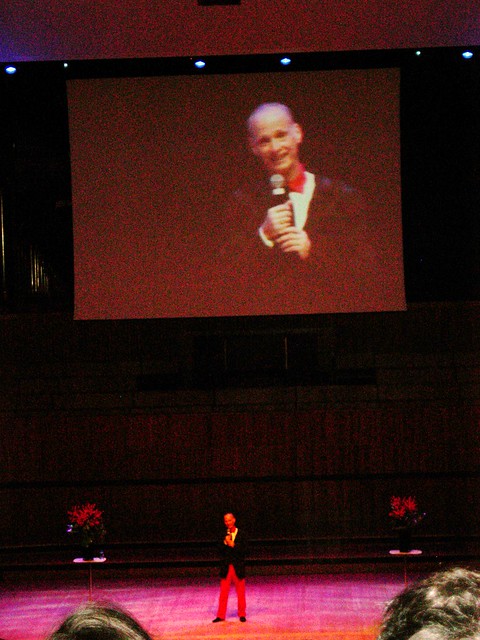
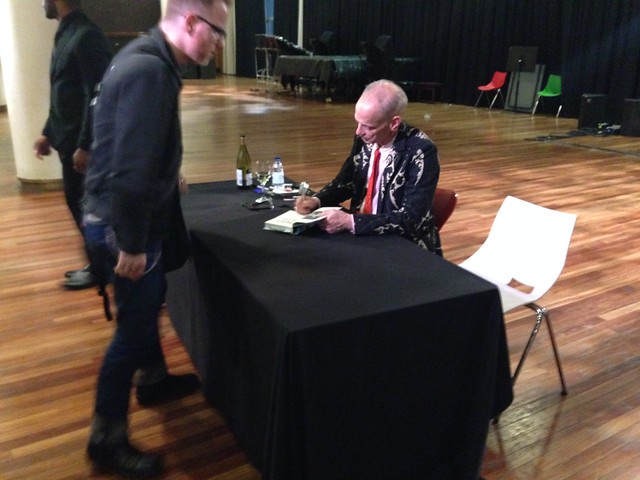
Reunion with the Prince of Puke: John Waters at Southbank Centre 11 November 2014

1401291_10152335785576901_5159777179204286564_o (1)

[John Waters - the "filth elder" of us all  - made a triumphant return visit to London on Tuesday 11 November 2014 when he brought his This Filthy World: Filthier and Dirtier show to The Royal Festival Hall. I've been regularly contributing to Beige magazine lately and they asked me to do a scene report. You can also read this on their website]

Trust John Waters to lure the freakiest, queerest crowd assembled at The Royal Festival Hall since punk diva Siouxsie’s 2013 Meltdown comeback gig. Or the last time Diamanda Galas performed there. Or in fact since the last time Waters brought his acclaimed one man stand-up comedy show This Filthy World to town.

In his tight, rapid-fire ninety minute set, the veteran cult filmmaker turned raconteur regaled us with dirty stories like a joyous bad influence toilet-mouthed uncle (albeit an exceptionally elegant uncle clad in Comme des Garcons). [Note: I've since been corrected that Waters' ultra soigné suit was by Belgian designer Dries Van Noten!]

Outing himself as a Lana Del Rey fan, the trash auteur admitted contemplating coming onstage and serenading us with her entire Ultraviolence album while maintaining direct eye contact in an act of creepy performance art - but chickened out. Waters suggested David Lynch should produce the dysfunctional ice maiden’s next album and argued Lynch would be missing a trick if he doesn’t invite her to appear on the 2016 Twin Peaks reboot.

Perversely, Waters loves tarnished pop idol Justin Bieber even more now that he’s on the descent, admitting he’d love to cut an album of duets with him like Tony Bennett’s and Lady Ga Ga’s.

Recalling his childhood, Waters described how in kindergarten he’d tell his mother stories about the peculiar little boy in his class who never spoke to his classmates and only coloured with black crayons. When Mrs Waters enquired about this kid to his teacher at a PTA meeting, the teacher exclaimed, “But that’s your son!”

Anecdotes about the making of his notorious midnight movies were inevitable. Waters called outrageous late maverick actress Susan Tyrrell - who loved freaking out the squares by loudly announcing she possessed “the pussy of a 12-year old girl”- one of the most terrifying women he ever met.

[Tyrrell, of course, played Ramona Rickettes in Waters' 1990 film Cry-baby. He mentioned the cast also included the notorious, troubled and frequently violent sex kitten Joey Heatherton. He talked about Heatherton being arrested in 1985 for physically assaulting a clerk at the passport agency office – and then just recently attacking a neighbour whose noisy juicer machine was disturbing her. “Don’t fuck with Joey Heatherton!”]

When his elderly mother asked about the subject matter of 2004’s A Dirty Shame (Water’s last film to date) and he replied, “Sex addiction”, she wearily sighed, “Maybe we’ll be dead before it comes out.” His father shrugged “It was funny but I hope I never see it again.”

Waters cited viewing putrid 1945 “sexual hygiene film” Mom and Dad at an impressionable age as a key influence on his own sensibility. An embryonic example of sexploitation cinema, it played in Baltimore’s grindhouse theatres for eight years. Starved for a glimpse of female nudity, the men in the audience actually masturbated to close-ups of childbirth. Waters said seeing this set him on his path as a filmmaker.  

The tone sweetened when he fondly reminisced about his two much-missed leading ladies, Divine and Edith Massey. Explaining Divine’s persona as hybrid of Jayne Mansfield and Godzilla conceived to scare hippies, Waters described filming his 300-pound drag starlet crawling through mud on a pig farm in 1969’s Mondo Trasho. Once the cameras started rolling two of the pigs spontaneously started fucking. It wasn’t in the script, but it added to the magic. “Divine turned the pigs on!” he marvelled.

Admitting he still wakes up surprised that Divine is dead, he revealed that actress Mink Stole, his casting director Pat Moran and himself have bought burial plots together adjoining Divine’s and dubbed the area Disgraceland. Waters urged everyone to come and fuck on their graves when they’re dead: “We’d love it!” His is actually a double burial plot and Waters suggested if any rabid fan wanted to dig-up the remains of either Pier Paolo Pasolini or Jean Genet and re-bury them next to him, he’d appreciate the tribute.

But let’s face it, we come to John Waters for filth and he didn't disappoint. Most middle-aged straight men “are bears without even knowing it,” he argued. Waters is an unrepentant connoisseur of poppers. When he throws “popper parties” uncomprehending straight guests unsure about the mechanics of taking amyl nitrate have drunk it or stuck it in their asses. “We need popper education!” He skewered what he sees as the dysfunctional S&M relationship between humans and their pets: dogs are “doomed to suffer human caresses ...your cat hates you!” And he taught us kinky new sexual slang. A “blouse” is an effeminate top. [Note: he also lamented no one uses the expression "basket" anymore!]. As for “blossoms” (also known as “rosebuds”), do a Google image search if you’re feeling brave but perhaps not from your office PC.

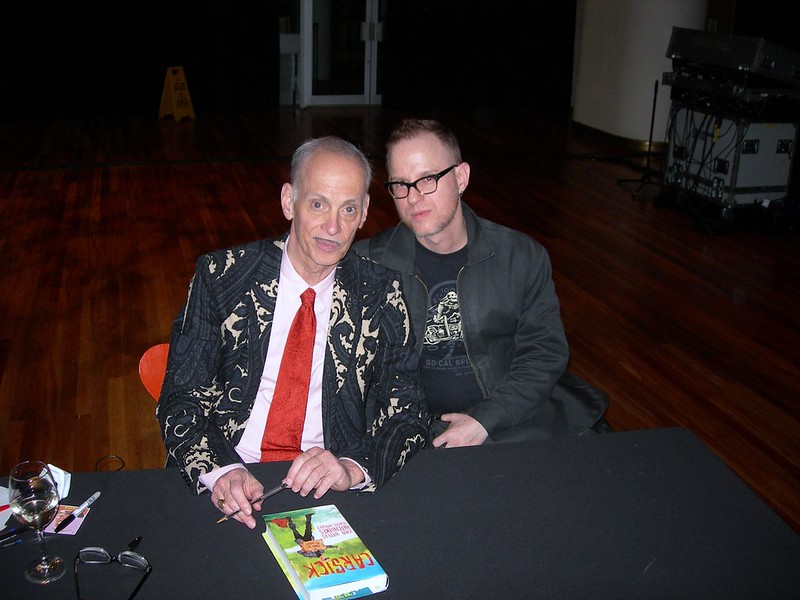
/ The photos below were taken by Mia of Amy Grimehouse /
IMG_7229 (1)


Further reading:

My 2010 interview with John Waters for Nude magazine

My 2011 reunion with the Prince of Puke

When John Waters brought his Christmas Show to Royal Festival Hall in 2011

Full scene report from the Amy Grimehouse 12-hour John Waters Filth Fest on 29 March 2014

Saturday, 17 December 2011

John Waters's Christmas Show at The Royal Festival Hall on 5 December 2011


Seeing John Waters at Christmas time is becoming something of an annual tradition. In December 2010 the Sultan of Sleaze was in London promoting the hardback edition of his latest book Role Models (that was when I interviewed him for the Nude website). While in London the irrepressible provocateur / raconteur did an onstage interview followed by a question and answer session at The Royal Festival Hall, which I attended with my friends Mari, Alison and Damon. It was a blast.

On 5 December 2011 Waters returned to the same venue, this time touring his long-running Christmas-themed spoken word show. Waters has long been garrulous about his rabid enthusiasm for the kitschy and campy aspects of Christmas: his 1987 book Crackpot: The Obsessions of John Waters includes the essay "Why I Love Christmas" (read an excerpt here). In 2005 he collated a compilation of his favourite twisted Christmas tunes (mainly obscure 1950s and 60s Rhythm and Blues) entitled A John Waters Christmas (which is one of my DJ'ing staples during the Christmas party season). Fruitcake, the jinxed film project he’s been trying to get off the ground in recent years (his last film to date remains 2004's A Dirty Shame) was meant to be a seasonal children’s film about a criminal family who steals meat to order for Christmas dinner. And we can never, ever forget the single greatest Christmas scene ever committed to celluloid: Christmas morning with hair-hopping juvenile delinquent Dawn Davenport and her family in Female Trouble (1974).


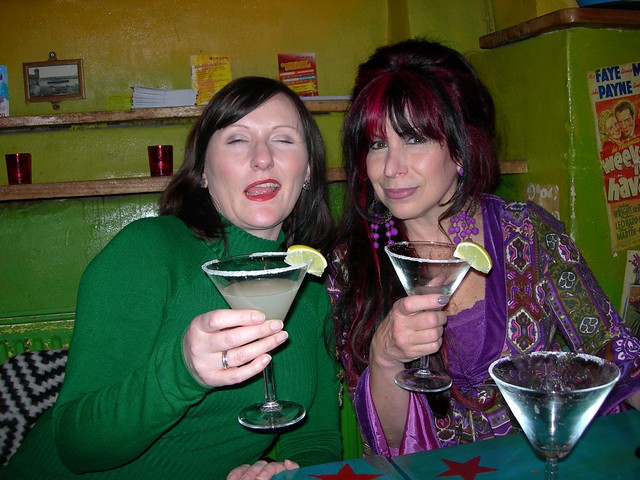
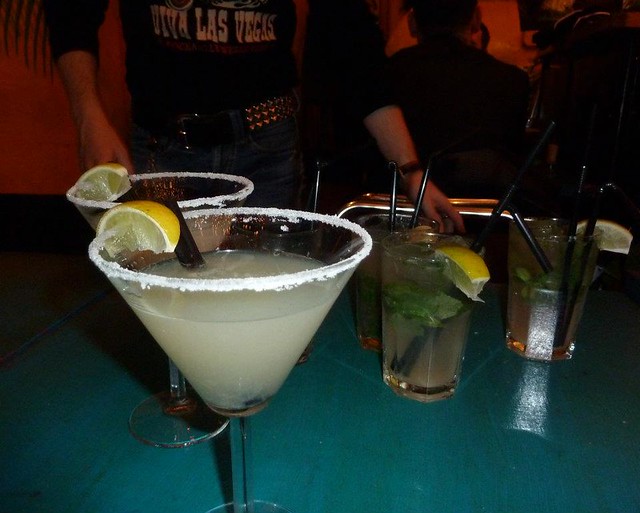
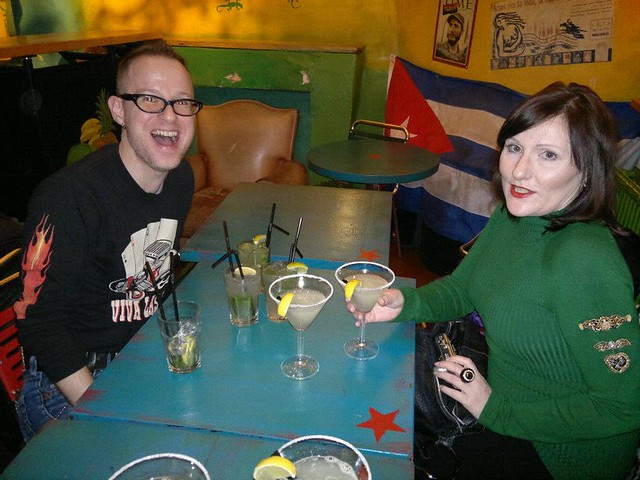
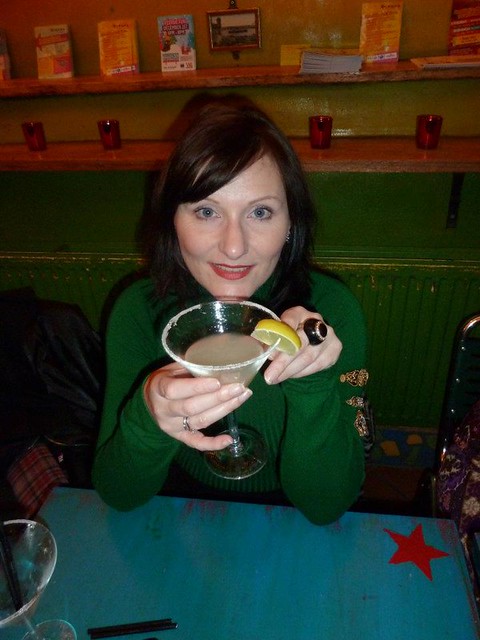
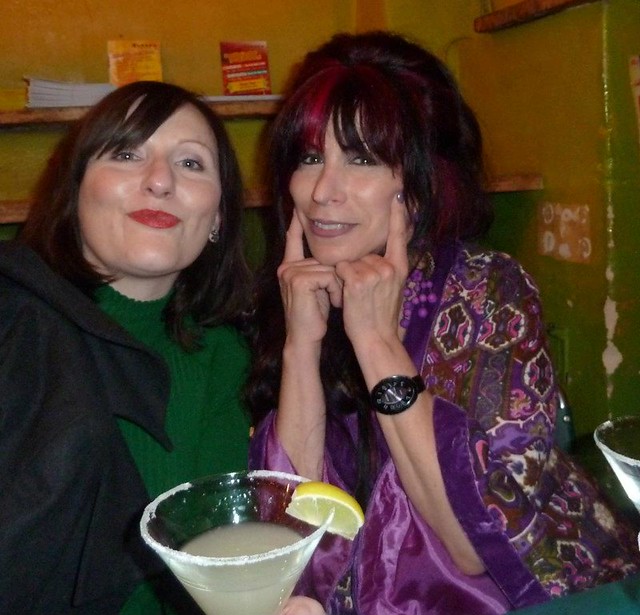
Beforehand, I met up with my glamorous friends Alison Leary and Laurie Vanian (Mari was meant to come, but was ill on the night. Luckily she recovered in time for my Christmas cocktail party on 10 December) for happy hour cocktails at one of my all-time favourite bars, Cubana in Waterloo. Even just walking towards Cubana cheers me up and gets my mouth watering at the thought of their Mojitos: as soon as you turn the corner and approach the bar, you see their giant painted mural of Carmen Miranda with her arms outstretched triumphantly (why a Cuban bar features gigantic tribute to Carmen Miranda – who was born in Portugal and raised in Brazil – is a whole other question). (I used to work in that neighbourhood, at a fetish / sex shop on Lower Marsh almost directly opposite Cubana. Let’s not open that whole can of worms. That was a lifetime ago!). Needless to say, talking trash with these two vixens (think of Alison and Laurie as my Chicklet and Concetta -- Dawn Davenport's bad-girl friends from Female Trouble) over two-for-one drinks was the perfect warm-up to seeing cinema’s Prince of Puke.


/ Chicklet (Susan Walsh) and Concetta (Cookie Mueller) in Female Trouble (1974). Photo Via /

Pre-John Waters Christmas Show Drinks at Cubana

/ Alison (channelling Tallulah Bankhead) and Laurie at Cubana /

Pre-John Waters Christmas Show Drinks at Cubana

/ Margaritas and Mojitos at Cubana ... and a crotch shot of me /

Pre-John Waters Christmas Show Drinks at Cubana

/ Alison and I /

Pre-John Waters Christmas Show Drinks at Cubana

/ Devastating glamour shot of Alison. Her sweater matches the radiator beautifully. She thinks of everything /

Pre-John Waters Christmas Show Drinks at Cubana

/ Alison and Laurie /

Pre-John Waters Christmas Show Drinks at Cubana

/ The great man himself: King of Sleaze John Waters onstage at the Royal Festival Hall. We were in row P: not bad at all, but not good enough to take any decent shots. His outfit is almost certainly by Comme des Garcons /

I was quite drunk by the time John Waters came onstage (four Mojitos followed by some pre-show pints of lager on an empty stomach will do that), but I can confirm the show was a scream and far raunchier and "bluer" than the description “Christmas show” suggests. The anecdotes flowed effortlessly and Waters was on great form. Here are some of the highlights I can recall from my Mojito and lager fog:

Waters revealed that the only time Divine would drag up and try to actually convince or “pass” as a real woman was every Christmas Eve – when she’d go to Mass! (She probably just liked look a very zaftig Elizabeth Taylor wannabe).

One particulary great line: Waters was saying that unlike many of his friends, he really does believe some people are genuinely heterosexual. Most of his friends are apt to snarl, “Oh, so you’re straight? So is spaghetti until it gets hot!”

He lamented that all young people now shave their pubic hair off, recalling how in his youth he and his friends loved it and call it “pelt.” People used to actually say, “I want to get me some pelt tonight!” (This brought back a nice memory of the much-missed Edith Massey as Queen Carlotta in Waters’ 1977 cinematic atrocity Desperate Living exclaiming, “Look at that pelt!” as one of her evil henchmen stripped naked in front of her).

He said he loves learning new sexual slang. One of his friends recently told him he’s a “blouse.” When Waters asked, “What’s a blouse?” his friend explained, “An effeminate top!”

At the end, he wished us all a “filthy, bisexual, biracial Christmas!” It was a heart-warming end to the night, and rest assured I’m doing my damnedest to live up to John Waters’ Christmas wish. Which reminds me: I've got to get me some pelt!

Saturday, 1 January 2011

Juliette Greco at The Royal Festival Hall


/ Juliette Greco in the 1960s: trademark black dress and black eyeliner /

“When I was a young girl, Juliette Greco was my absolute idol ... If I want to be anybody, I want to be Juliette Greco.” Marianne Faithfull

I last saw Juliette Greco perform in June 2000 at The Barbican – one of the most mesmerising concerts I’ve ever seen. After a decade-long gap, she returned to London to cast another spell, this time at The Royal Festival Hall on 21 November 2010 to conclude the 2010 London Jazz Festival. My initial impression at seeing the now 83-year old grand dame of French chanson take the stage was to note that she looks regal but frail– until she opened her mouth. Greco’s impossibly deep and sensual voice, saturated in a lifetime of Gauloises (or Gitanes?) smoke and vin rouge, is still lacerating. (Someone once described Marlene Dietrich’s voice as sounding like autumn leaves being crunched under leather boots. It equally applies to Greco’s expressive throaty rasp). Then, that she is reassuringly still beautiful and her incredible charisma and sense of drama more potent than ever. Onstage, chanson’s great living exponent remains a torrent of seething emotion and volcanic intensity.

A quick summary for any newcomers to the magic of Juliette Greco: She emerged from the smoky cellar dives of post-war Left Bank Paris like Le Tabou and La Rose Rouge to achieve international stardom as both a chanteuse and an actress. Greco and her family had been active in the French Resistance, and her music and image are steeped in the rebellious, politicised bohemian French intellectual life centred around Saint-Germain-des-Prés. From early on she was encouraged to sing by the likes of by Jean-Paul Sartre and Boris Vian, and besotted leading French poets and philosophers wrote lyrics specially tailored for her (wonderful songs like “"Si tu t'imagines”, her first hit), establishing Greco as the black-clad high priestess of existentialism and a strong, enduring female presence in French popular culture. In the late 1940s she began an interracial affair with visiting American jazz star Miles Davis. Author Lewis MacAdams argues “the offspring of their three-year, long-distance liaison – of the marriage of bebop and existentialism – was the birth of cool.”

/ Beatnik icon: a very young Greco at the beginning of her career in the early fifties /


/ The birth of cool: Miles Davis and Juliette Greco in the fifties /


But hey I’m superficial, so it doesn’t hurt that in the 1950s Greco was lusciously, wantonly beautiful and nailed a timeless, striking almost Morticia Addams-esque look: tousled mane of dark hair, all-black wardrobe, kohl-blackened eyes under a Bettie Page fringe. The liner notes to one of her 1950s albums swoons about “the fascinating child-woman with the wild black hair and the deep-set burning eyes ...” Greco’s magnetic image set the template for female beatniks worldwide, who ironed their hair and donned winged black Cleopatra eyeliner and black polo neck sweaters in emulation. (As a fashion icon Greco belongs up there with countrywoman Brigitte Bardot and Edie Sedgwick. These days, fashion stylists and photographers probably reference the Greco style without realising where it originated).

/ Juliette Greco eyeliner technique /


/ Juliette Greco paper doll: weirdly, there's no black dress in the wardrobe selection! /


/ Various Greco faces over the years (during her fifties Hollywood stint, she had two nose jobs, which dramatically changed her appearance) /


/ Greco in Hollywood: co-starring with Richard Todd in the 1958 film The Naked Earth /


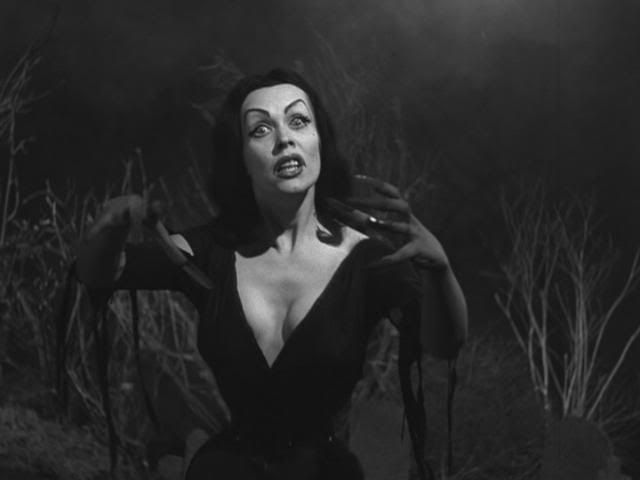
Anyway, it could have been a nostalgic trawl through Greco’s greatest hits, written for her by the likes of Jacques Brel and Serge Gainsbourg – which would still have been spellbinding. Instead it was an evening of stark minimalism: a black stage, Greco in her signature severe black dress (a floor-length bat wing-sleeved velvet shroud worthy of Vampira), and the formidable Greco songbook stripped down to just accordion (accordionist Jean-Louis Matinier) and piano (her husband and long-time accompanist Gérard Jouannest, who composed the music for many of Jacques Brel’s classics).

And while Greco has over 60 years of songs to chose from (she made her singing debut in 1949), she obviously chose the songs that have the greatest personal meaning for her, drawing largely from her majestic late-period work (like 1998’s Un jour d’ete et quelques nuits... and 2006’s Le temps d’une chanson) rather than solely 1950s and 60s crowd-pleasing material (for example, no “Sous les ciels de Paris”, and instead of "Les feuilles mortes", she sang Gainsbourg’s song about “Les feuilles mortes”,” La Chanson de Prevert”), although the set was certainly generously studded with Greco’s classics.

With her commanding theatrical gestures, Greco is as much an actress as she is a singer. Certainly she acts as much as she “sings”: melody definitely isn’t one of her priorities. Over the years Greco’s voice has coarsened and darkened, and is noticeably harsher and more guttural than on her old recordings. But it’s something she works to her advantage: Greco belongs to that elite group of female song stylists whose husky ravaged tones were powerful rather than pretty, and ideal for conveying romantic suffering and world weariness: think late-period Billie Holiday, Nina Simone, Hildegard Knef, Lotte Lenya, Dietrich, and younger singers like Nico and Marianne Faithfull, who very much followed in Greco’s tradition.

Greco hurled herself into every song, transforming each one into performance art. Her songs evoke a variety of moods: she tore into Brel’s "Bruxelles" with an almost angry glee, whereas Gainsbourg’s “La Javanaise” was spine-tingling, slowed-down and delicate. One thing she demonstrated is that at 83 she still retains her sensuality. Introducing “Deshabillez Moi” (Undress Me) she joked she really shouldn’t be singing it at her age, but it’s such a great song she will anyway – and then became the consummate self-mocking sex kitten, which she maintained for the rousing “Jolie Mome” and “L'Accordeon” (during which she played her own body with her fingertips as if it were an accordeon). Greco still has the erotic confidence of a great beauty (whose admirers included Miles Davis, Marlon Brando, Prince Aly Khan, Serge Gainsbourg, Sacha Distel and the film mogul Darryl F Zanuck, who tried to launch her as a Hollywood star in the 1950s), and clearly doesn’t doubt her allure. (In this regard, she reminded me of another slinky octogenarian chanteuse of the same vintage,Eartha Kitt, who we saw perform in 2007).


JULIETTE GRECO - Déshabillez-moi
Uploaded by currerbell. - Watch more music videos, in HD!


"Jolie Môme" Juliette Greco
Uploaded by lemondedeyanis. - Explore more music videos.

Ultimately, though, Greco is the consummate tragedienne and the most affecting songs were the bleak dirges. The old Edith Piaf standard “Les Amants d’un Jour” told the eerie story of the suicide pact between two doomed lovers. In her intro to “C’Etait un Train de Nuit” she explained that torture, war and death are all encompassed in the song, and then sang it with her eyes squeezed shut as if in horror. In it, she repeatedly gasps, “Je me souviens” (“I remember ...”) and describes scenes of prisoners on a train en route to a concentration camp. Brel’s tender “La chanson des vieux amants” ended with her covering her face in her hands as if in agony. Greco originally recorded another Brel masterpiece, “J’Arrive” in 1970, but the song – in which she confronts death, imploring, “Pourquoi moi? Pourquoi déjà?”(Why me? Why now?) -- obviously has added poignancy and greater intimations of mortality now that she’s singing it towards the end of her own life.

/ Greco performing "La chanson de vieux amants" in 2004 at The Olympia in Paris /


/ Autumn Leaves: Greco photographed by Pierre et Gilles in the eighties /

After seeing one of Marlene Dietrich’s last concerts in the 1970s, the film critic Kevin Thomas reflected, “she regarded her talent as a rare and precious wine that she would pour out drop by drop, and until it was gone it would be the most perfect, most refined of all.” Before Greco’s 2000 Barbican concert, she hadn’t performed in London since 1989 and then she waited a decade before returning. It was bittersweet knowing it was unlikely we’d ever see Greco again. For her Royal Festival Hall finale she sang a devastating “Ne Me Quitte Pas”. Greco’s is the angriest version you’ll ever hear of this Brel standard, shredding the elegant melody until it’s a savage plea (she virtually stamps her foot and shakes her fist when she sings it). Afterwards, drinking at the bar and reflecting on Greco’s artistry, commitment and urgency, we appreciated that we may have been born in the wrong era to have seen Edith Piaf, Billie Holiday or Dietrich perform, but we got to see Juliette Greco – every bit their equal. If this is the defiant but vulnerable Juliette Greco’s last performance in London, it was one none of us who saw it will ever forget.

/ Greco singing "Ne me quitte pas" on Italian TV /


/ Obviously photography was strictly forbidden, but at the very end of the night when La Greco came back out to take her curtain calls (and got a standing ovation), I managed to snatch this shot./


/ And Christian took this one: /


/ Someone shot this surprisingly good video of Greco performing "Avec le temps" at The Royal Festival Hall /


/ Strange, interesting litte clip of Greco filmed in 1966 in which she sings two of the songs she performed at The Royal Festival Hall: "Jolie Mome" and "Un Petit Poisson, Un Petit Oiseau." Most fascinating is the glimpses of her backstage in her dressing room, applying her thick black Cleopatra eyeliner /

A LOOK AT JULIETTE GRECO


The Royal Festival Hall concert didn't get much coverage in the press, but it got reviewed in The Telegraph. Not exactly the hippest publication (!), but you can read it here. To their credit they also interviewed her.

Excellent, very thorough overview of Greco's career here

I wrote this piece about Greco for the American punk website Razorcake way back in the early 2000s. I'd write it very differently now -- but here it is