Sunday, 17 March 2013

Reflections on Mamma Roma (1962)


/ Tight skirt, tight sweater: the sensational Anna Magnani in Mamma Roma (1962) by Pier Paolo Pasolini /
Volcanic. Tempestuous. Explosive. Volatile. Ok, these are all clichéd adjectives to use in the description of Italy’s greatest actress Anna Magnani – but hell, they’re accurate. The woman (revered as La Lupa by her Italian fans) was a tigress, a seething torrent of raw emotion. Magnani was dead by 1973 (Italy was plunged into mourning) and made relatively few films, but she left behind a gallery of screen-scorching performances. I’ve loved her in Rome: Open City (dir: Roberto Rossellini, 1945), L’Amore (dir: Rossellini, 1948), Bellissima (dir: Luchino Visconti, 1951) and The Golden Coach (Jean Renoir, 1953).


/ My favourite portrait of La Magnani, taken in the early 1970s (so towards the end of her life). If you have to age, it may as well be like this! She was clearly a powerful and sensual presence right up until the end /

By the mid-50s, Magnani was so acclaimed in Europe that Hollywood inevitably beckoned. Weirdly, her American films seem well and truly inaccessible these days: I’ve never seen either The Rose Tattoo (1955) – for which she won the Best Actress Oscar -- or Wild is the Wind (1957). They’re seemingly unavailable on DVD in the UK and never crop up on TV.  For me Magnani steals Tennessee Williams adaptation The Fugitive Kind (1959) from under the noses of co-stars Marlon Brando and Joanne Woodward, even with the handicap of unfamiliar English (she apparently never properly learned English and had to painstakingly learn her lines phonetically).


/ Magnani in Mamma Roma (1962). The surrounding urban decay (dotted with ancient ruins) feels desolate, almost lunar /

Magnani’s crowning achievement, though, is Mamma Roma (1962), the film she made after returning to Italy after her stint in Hollywood. (Accounts vary about whether Magnani was born in 1905 or 1908.  Depending who you believe, she was her either 54 or 57 in Mamma Roma). The film is the highly politicised poet/provocateur Pier Paolo Pasolini's follow-up to his sensational debut Accattone (1961). (I’ve already sang the praises of Accattone. I’ve seen Mamma Roma – one of my all-time favourite films -- many times over the years; this time it was on the big screen at The British Film Institute as part of their comprehensive two-month Pasolini retrospective).


/ A light-hearted moment on the set of a mostly tragic film: (left to right) Franco Citti, Ettore Garofolo, Anna Magnani and Pier Paolo Pasolini /

All of the essential components of Magnani’s persona are represented in Mamma Roma: Earth mother. Feral she-wolf. Mother Courage. Mary Magdalene. Noble whore. Fallen woman. Monstre Sacrée. Gritty but kind-hearted ageing prostitute. Vital life force. Every Italian woman who ever wore a black slip and shouted at someone from her tenement balcony. Magnani portrays title character Mamma Roma (sometimes referred to as “Signora Roma; we hear her actual surname -- Garofalo – just once). The name implies she’s meant to personify the earthy, sensual, battered but resilient essence or spirit of Rome itself.


/ Pasolini and Magnani during the filming of Mamma Roma /

(Pasolini reportedly later expressed ambivalence about casting the internationally famous actress in the lead role: in the Italian neo-realist tradition, he preferred using unknowns. His hesitation is impossible to believe watching Mamma Roma today: Magnani’s fierce, vital and magnetic performance anchors the film).


Magnani was a genuinely funny and ribald screen comedienne, but I like her best suffering heavy emotional torment. Her entry into show business in the 1930s was as a night club chanteuse – apparently she was like an Italian Edith Piaf. Onscreen she pitches her performances the way the great French chanson tragediennes Piaf and Juliette Greco sing their most tortured songs. Certainly Magnani’s ravaged, careworn face, with its expressive dark eyes and soulful under-eye bags, was ideal for evoking anguish.


Mamma Roma is a middle-aged prostitute who’s been walking the streets for decades. (Italian neo-realist whores have great fashion sense; Magnani mainly sports a tight pencil skirt and tight sweater-over-bullet bra combo, with a patent leather handbag and killer stiletto heels). Along the way she was forced to abandon her son Ettore (presumably he was raised by relatives; Pasolini never clarifies). Finally liberated from the bondage of her pimp and ex-lover Carmine, Mamma Roma is reunited with Ettore (now a teenager) and strives to eke out a new, more respectable life for them together in dog-eat-dog post-war / economic miracle-era Rome.


/ Mamma Roma and Ettore attend mass / 

This theme of re-location from rural poverty to urban slum (and the traditions and roots that get lost in the promise of modernity and progress) particularly interested Pasolini. Like Accattone, Mamma Roma is set around the Roman neighbourhoods Pigneto and Trastevere – then decrepit, now hip and gentrified. I did some serious bar-hopping in Pigneto when I was in Rome in October 2010. To channel the ghosts of Pasolini, Magnani, Luchino Visconti, Michelangelo Antonioni and Federico Fellini I would have happily licked the cobbled pavement. (In reality I stuck to drinking Campari and Prosecco).
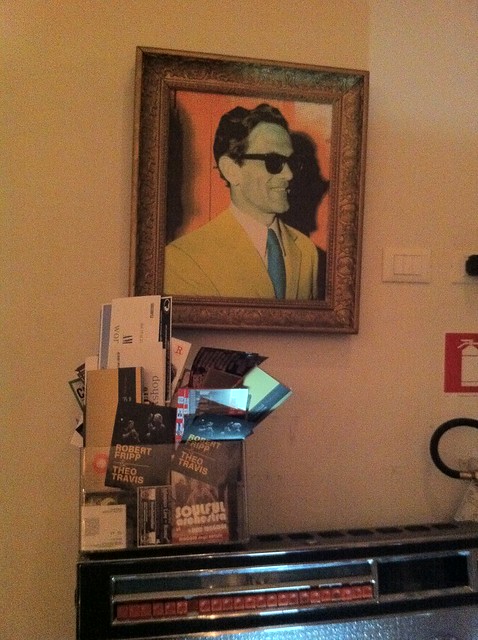
Bar Necci in Pigneto

/ My photo of framed portrait of Pasolini above a vintage jukebox at Bar Necci in Pigneto, taken when I was there in 2010. It was in this neighbourhood Pasolini filmed his early masterpieces Accattone and Mamma Roma. See the rest of my Roman holiday pics on my flickr page /

Pasolini strove to transcend the conventions of Italian neo-realism into his own idiosyncratic Cinema of Poetry. As with Accattone, Pasolini tenderly ennobles the hardscrabble struggles of the impoverished social underclass with a lyrical, painterly eye (framing characters like they’re in a Renaissance painting) and employing classical music (in Accattone Pasolini used Bach as an aural backdrop; in Mamma Roma, Vivaldi soars on the soundtrack). This is a milieu of bare subsistence, in which hunger is a genuine possibility. When people argue, someone inevitably pulls a knife; the confrontation is probably observed by urchin children and a mangy third world stray dog. The war-scarred landscapes are so decimated they look lunar. In the background, a baby always seems to be crying. Mamma Roma and Ettore are cafoni, the Italian equivalent of North American hillbillies. In the subtitles, there are frequent disparaging references to “hicks”. Mamma Roma admonishes Ettore to not speak like a hick (presumably in a rough, rural peasant dialect) but to talk like she has learned to – like an urban Roman.


Almost immediately, there are ominous premonitions things won’t go well. The window to Ettore’s new bedroom offers a view of the local cemetery. Worse, Mamma Roma is tracked down by Carmine, who blackmails her into working the streets again.  Carmine is played by the swarthy, smouldering Franco Citti from Accattone (again playing a pimp). This time around Citti sports a (deliberately?) unflattering sleazy little moustache; it certainly makes him look like a seedy pimp. Magnani and Citti’s confrontations crackle with violence – emotional, with the potential for physical (you wouldn’t want to see Magnani lunging at you with a kitchen knife and wild-eyed expression). I’m a total sucker for Franco Citti; he’s unforgettable reminding Mamma Roma when he first met her, she was “covered in lice” and “didn’t know what panties were.” “You knew it would end badly for one of us ...” he snarls.


/ Franco Citti as Carmine /


For swathes of Mamma Roma, Magnani vanishes and the action centres on Ettore.  As Magnani’s wayward son, non-professional actor Ettore Garofolo (yes, the character is named after the actor who plays him) makes a haunting impression and suggests a complex and troubled inner life. Pasolini’s camera tenderly explores his elfin face (melancholic in repose), button nose and sorrowful dark puppy eyes, captivated. A simultaneously tough and vulnerable man-child, he struts in the perfect sailor roll (or in this context, pimp roll) even in the too-big suit his mother insists he wear. As has already been pointed out, Garofolo can look like the pretty teenaged street thug from a Caravaggio painting come to life. (Pasolini and Caravaggio probably shared similar taste in rough trade).


/ Heartbreaker: Ettore Garofolo /

Ettore is amoral, alienated. He rejects Mamma Roma’s attempts to make him go to school or work, drifting instead towards petty crime with the local juvenile delinquents. (Ettore’s gang are very much Pasolini’s type and his camera caresses them in loving close-ups. In a nicely rakish touch, one of  Ettore’s cutest buddies is missing a front tooth). It’s interesting to speculate Ettore has the makings already of being the next Carmine. In her urgent mission to advance her illiterate provincial son, Mamma Roma never stops to ask him what he actually wants. When someone asks Mamma Roma, "You’d hang on the cross for him, wouldn’t you?” she unhesitatingly replies, “What else is there?” Her maternal love is savage, primeval -- but Pasolini hints she’s also motivated by assuaging her own guilt for having abandoned him and asks if maybe Ettore would have been more content to stay in the countryside and be a labourer. Is what awaits him in Rome an “improvement”?


Pasolini’s most daringly audacious and avant-garde scenes depict Magnani turning tricks at night on a grim stretch of road (recalling the scrubby wasteland on the outskirts where Maddalena is beaten up in Accattone). These are opportunities for Mamma Roma to relate her own history. It starts with her fellow tarts (like loyal friend Biancofiore) and her “johns” asking Mamma Roma to tell them her story, but as Magnani walks and speaks they gradually drift away until it’s mainly Mamma Roma delivering heart-rending monologues about her travails directly to the viewer, effectively breaking the fourth wall. She speaks of brutal, grinding rural poverty and enforced marriage at age 14 to a relatively wealthier, much older man.


/ Mamma Roma's friend and fellow prostitute Biancofiore (Luisa Loiano). With her beehive hairdo and heavy 1960s dark eye make-up, she looks like a J H Lynch painting come to life /


/ Silvana Corsini as the town tramp, young single mother Bruna, who ensnares Ettore with her feminine wiles (and fuzzy arm pits). Corsini played the dim-witted whore Maddalena in Accattone: she was exceptionally good at playing not very bright child-like women /

Pasolini keeps key details of Mamma Roma’s life vague and – confusingly – her accounts often contradict themselves. She married the corrupt older man, but also refers to having “married” Ettore’s criminal father – who was promptly hauled off to prison by waiting police men as soon as the ceremony ended. They’re clearly not the same man. How many husbands has Mamma Roma had? There’s a tantalising possibility that Carmine could be Ettore’s father. (Ettore himself expresses no curiosity about his father’s identity. A more conventional director would have explored this plot angle; Pasolini has different priorities).  Mamma Roma’s stories meld the personal and the political: she rails against hypocrisy, Mussolini’s Fascism, injustice. In one soliloquy she describes the family of Ettore’s father as wretched scum, the lowest of the low (a police snitch, a beggar, a brothel madam) but points out “if they’d had money, they would have been good people” – perhaps the most powerful message of the whole film. In a moment of religious doubt, Mamma Roma looks skyward and angrily implores God, “Explain to me why I’m a nobody, and you’re the king of kings.”
As it progresses, Mamma Roma is increasingly characterised by an overwhelming sense of dread. Outside maybe film noirs, it’s difficult to find films more fatalistic than Mamma Roma or Accattone. It’s not a spoiler to reveal that Mamma Roma (like Accattone) builds toward a tragedy that feels ancient, epic, primal and operatic; Pasolini foreshadows this from almost the beginning. It climaxes in a startling shot of a character filmed from above in a crucifixion position so beautifully-composed, so suffused with Christ-like suffering it makes you gasp.
Earlier there’s a wrenching moment when Mamma Roma abruptly clamps her hand over her face and bursts into tears of sheer relief, believing that things finally seem to be going in her favour -- all the degradation and turmoil she’s suffered is seemingly justified. Of course she is wrong. The odds (or the system) are stacked against her and Ettore before she even began. Mamma Roma’s daring to improve her lot seems to enrage the gods. Fate punishes her. It’s impossible to escape the past. Pasolini persuasively demonstrates that mother and son are foredoomed by their environment and socioeconomic status. In Accattone, Franco Citti seals his fate by defiantly declaring, “Either this world kills me or I’ll kill it!” In Mamma Roma, Anna Magnani similarly swears, “I’ve paid my dues in this life, and the next.” She lives to regret those words.


Sunday, 24 February 2013

Reflections on Shanghai Gesture (1941)


/ Gene Tierney and Ona Munson in Josef von Sternberg's Shanghai Gesture (1941) /

(Note: I wrote the review below for the DVD of Shanghai Gesture for the Nude magazine website several years ago now. I thought I'd dust it off, tweak it a bit and revive it here. The film is truly berserk, haunting and highly recommended -- especially with a stiff drink in your hand)


/ Ona Munson and Maria Ouspenskaya in Shanghai Gesture (1941) /

The seven films Josef von Sternberg and Marlene Dietrich made together are like intoxicating  fleurs du mal: erotic, dark, witty, sublime, and modern. Together they honed Dietrich's complex, sultry and feline persona and brought a whiff of genuine Weimar decadence to mainstream Hollywood. After their personal and professional relationship imploded with The Devil is a Woman in 1935 Dietrich went on to work with major directors like Billy Wilder, Fritz Lang and Alfred Hitchcock and tour her acclaimed one-woman cabaret show around the world well into her 70s. For von Sternberg - who'd antagonised a lot of people in his 1930s heyday with his volatile tyrannical temperament - his post-Dietrich career was one long, humiliating decline.


/ Almost ridiculously beautiful colour portrait of Gene Tierney on the set of Shanghai Gesture /

1941's Shanghai Gesture represents one of von Sternberg's last gasps before losing creative autonomy. (During the filming of 1952's Macao , he'd be sacked midway through production and replaced by Nicholas Ray). A torrid and baroque study in vengeance and corruption, the film sees Von Sternberg re-visiting the locale of Shanghai Express, his 1932 triumph with Dietrich. Sir Guy Charteris (Walter Huston), a rich white industrialist with a murky past, is seeking to gentrify Shanghai (he calls it "the cesspool of the Far East"). When gorgon-like dragon lady Mother Gin Sling (Ona Munson) learns he intends to close her gambling den she starts plotting her revenge. Meanwhile, slumming rich girl Poppy (the exquisite Gene Tierney) becomes ensnared by the toxic allure of the casino ("It smells so incredibly evil ..."), addicted both to gambling and the heavy-lidded charms of Dr Omar (a torpid Victor Mature in a burnoose and fez).


/ Gene Tierney, Victor Mature and Phyllis Brooks. It has to be said, Mature is insanely sexy as Dr Omar. No man ever looked better in a fez /


/ Kiss me, you fool. Who could resist? /

Von Sternberg was Hollywood's most seductive visual stylist. Here he evokes a sensual and depraved Shanghai of the imagination, an underworld of opium-scented exotica. Mother Gin Sling's vice palace is a glittering Art Deco inner circle of hell, where the beautiful and the damned drink cocktails of brandy and sulphur and gamble away their souls. A Chinese New Year parade is depicted as a macabre carnival; Mother Gin Sling's climactic New Year's Eve party culminates with the surreal sight of terrified female "white slaves" being hoisted skyward in cages.


/ This scene is genuinely surreal and will have you rubbing your eyes in amazement /

The overripe, purple dialogue occasionally threatens to tip the film into kitsch (Dr Omar calls Poppy "my plucked bird of paradise"; Mother Gin Sling snaps at someone, "Stop behaving like a disabled flamingo!"). But even in a scratchy, muffled DVD transfer, Shanghai Gesture is a hypnotic, shimmering spectacle and its treatment of miscegenation and colonialism is way ahead of its time. And as portrayed by Munson (best-remembered as bordello madam Belle Watling in Gone with the Wind ) with a purring voice, serene mask-like face and Medusa hairstyle, Mother Gin Sling is a mesmerising villainess.


/ Ona Munson: compelling and unforgettable as Mother Gin Sling in a role that feels like it could have been intended for Marlene Dietrich (or Anna May Wong). The whole persona of Mother Gin Sling also feels informed by Gale Sondergaard in The Letter (1940) from the year before /


/ Gale Sondergaard as the inscrutable and sinister Mrs Hammond in The Letter (1940) /

Munson obviously made an impression as the brassy but warm-hearted Belle in Gone with the Wind (interesting bit of trivia: the part of Belle was supposedly offered to both Mae West and Tallulah Bankhead beforehand), but in the larger role of Mother Gin Sling she truly seizes the moment. Munson’s life and career were both disappointing and ended in tragedy (she committed suicide at the age of 51 in 1955). This is the performance to remember Ona Munson for. Late in the film, Munson has an incredible monologue in which she divulges how she came to be Mother Gin Sling (“... they sewed pebbles into the soles of my feet so I couldn’t escape ...”). It’s an acting tour de force, which can be favourably compared to Elizabeth Taylor’s similarly lurid and climactic monologue in Suddenly Last Summer.


/ The sardonic and evil Mother Gin Sling smiles as Poppy comes unglued /

Shanghai Gesture 002

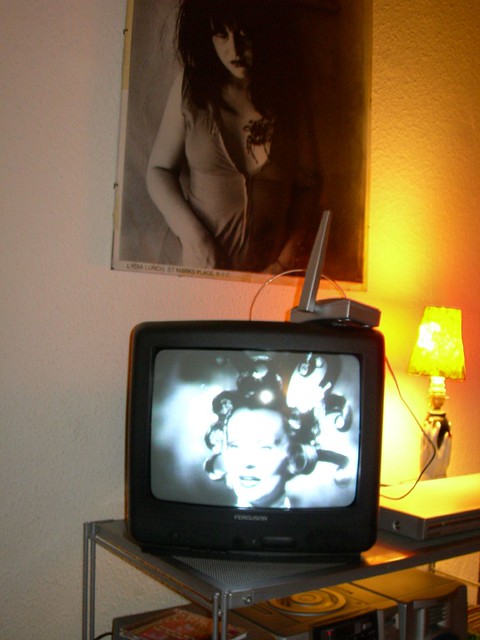
/ Watching Shanghai Gesture at home, while Lydia Lunch glares from above (as you can see, both my TV and CD player are 1990s relics) /

Sunday, 17 February 2013

Valentine's Day Dr Sketchy Set List 14 February 2013


/ Happy Valentine's Day, Freaks! /

The annual Anti-Valentine’s Day Dr Sketchies always rock – and this year’s was no exception. The Royal Vauxhall Tavern sold-out in advance and it felt really buzzing to play for such a rowdy and enthusiastic capacity crowd. (This was also the first Dr Sketchy since November 2012 – we didn’t do a Christmas one, sadly – so it also felt like a promising start to the New Year).

True to the anti-Valentine theme, the Scottish-accented emcee Ebenezer Valentine was in antagonistic and lairy mode throughout (think: aggressive character out of Trainspotting). The night boasted three models and performers:  the exquisite showgirl deluxe Annette Bette; Violet Strangelove performed two tableaux vivants that fit in with the anti-Valentine’s theme: angrily popping balloons in the first, then eating Häagen-Dazs ice cream straight from the tub and crying in the second; and finally male model Les (he goes by just one name, like Madonna, Prince or Cher, apparently). He posed as the anti-Cupid, armed with a toilet plunger (to pluck-out cupid’s arrows with).

Annette Bettè (a petite Ann-Margret-style redhead) has performed at a few Dr Sketchy’s before and is always good value. She certainly didn’t disappoint this time. In fact, she was wilder and more abandoned than ever! She emerged onstage wearing a sensational pink rubber dress with a heart print motif, moodily smoking a cigarette (the smoking ban be damned!). Her undulating dance climaxed with a big chunk of white cake somehow materialising. Annette crammed it hungrily into her mouth and then – in uncontrollable delight – began mashing the cake into her cleavage before flinging handfuls of cake and frosting into the startled audience, and then finally stripping down to just her g-string and heart-shaped red pasties. Brilliant! (Before the next act Dr Sketchy promoter Clare Marie had to sweep up the crumb-y debris off the stage floor).

At Home with Mamie Van Doren. Doesn't this photo have a Diane Arbus vibe? Every aspect is so pristine: her platinum blonde bouffant hair, her white dress and pumps, the all-white Atomic-era minimalist decor of her living room. But there's a subliminal bat squeak of alienation about the photo (maybe the way Mamie is isolated in the shot, emphasising her loneliness) that evokes Arbus. It reminds me a bit of this:


/ Blaze Starr at Home. Photographed by Diane Arbus in 1964 /

Anyway, anyone who follows this blog in even the most perfunctory way knows that the luscious Mamie Van Doren is essential to my aesthetic philosophy (my pantheon also includes the likes of Jayne Mansfield, Esquerita, Ann-Margret, Serge Gainsbourg, Eartha Kitt and Ike and Tina Turner). I play at least one track by her every time I DJ anywhere. I’ve already done a bit of a Valentine to La Mamie on this blog before, but while I was going through some ancient files on my PC I stumbled across this tribute I wrote in 2007. At the time a Gawker-style London website was due to launch and they were looking for potential writers. They were asking us to write a series of short blog entries on pretty much anything as sample pieces for their consideration. The website never got off the ground and the two guys behind it were prats (in other words, I didn't get shortlisted!). But I wrote this:

In the fifties Mamie Van Doren was the bullet bra’d, tight-sweatered reigning starlet of B movies. Her film titles alone tell their own story: Sex Kittens Go to College, The Las Vegas Hillbillies, Voyage to the Planet of Pre-Historic Women. Think women-in-prison flicks, lurid juvenile delinquent dramas (“desperate stabs from the jukebox jungle!”), low-budget sexploitation, the drive-in circuit.


Discovered by Howard Hughes, the platinum blonde starlet was groomed as a Marilyn Monroe successor. Don’t dismiss Van Doren as another Monroe manquée, though: she exuded her own sleazy, rock’n’roll appeal,  portraying tough pony- tailed teenaged bad girls well into her late 20s.

Now 77 (she's now actually 82) , Van Doren is more than the Jayne Mansfield who survived to old age. The woman who, in the 1960s, penned salacious kiss-and-tell memoirs like My Naughty, Naughty Life and I Swing now blogs about current events and politics. She’s a wise, witty and incisive writer, and maintains her own entertaining website herself.

Van Doren’s blogs are anti Iraq, anti Bush, impeccably left wing, but as a younger woman she considered herself a Republican. Her political awakening came when, her film career long snuffed out, she travelled to the frontlines of Vietnam in the early 70s to entertain American troops and witnessed horrors.

Today Van Doren seems blissfully unconcerned about acting her age. She continues to party at Hugh Hefner's Playboy mansion. On her website she sells autographed "nipple prints" (she applies lipstick to her nipple and blots it into paper) and posts her own home-made soft porn short films. The "dumb blonde" is having the last laugh.


/ No one comes off well being compared to Marilyn Monroe. Ideally the likes of Van Doren and her contemporary Jayne Mansfield would be appreciated as talents in their own right /
I’ve probably posted this clip before, but it captures Mamie in her fleshy, blowsier 1960s element so here it is again. I played “Take It Off” by The Genteels (one of the archetypal tittyshaking tunes) towards the end of the night while Les the male model posed. Here’s Mamie shaking it like a Poloroid to it in the 1964 film 3 Nuts in Search of a Bolt.


Another fun musical number (and another great acrylic wighat) from 3 Nuts in Search of a Bolt. Boy, this movie looks rancid.


Jungle Madness - Martin Denny
Là-bas C'est Naturel - Serge Gainsbourg
Vírgenes del Sol - Yma Sumac
Black and Tan Fantasy - Duke Ellington
Safari - The El Capris
I Can't Sleep - Tini Williams and The Skyliners
The Slouch - Ray Gee and His Orchestra
Kansas City - Ann-Margret
Spring, Sprang, Sprung - Jack Fascinato
Begin the Beguine - Sammy Davis Jr
Commanche - The Revels
You'd Better Stop - LaVerne Baker
Wiped Out - The Escorts
Baby Come Back - Esquerita
He's the One - Ike and Tina Turner
Torture Rock - Rockin' Belmarx
Torture - Kris Jensen
There'll Be No Goodbyes - Susan Lynne
Night Scene - The Rumblers
Bewildered - Shirley and Lee
Endless Sleep - Jody Reynolds
Strollin' - The Shades
That's A Pretty Good Love - Big Maybelle
Khrushchev Twist - Melvin Gayle
Rompin' - Jerry Warren
Cherry Pink - The Bill Black Combo
Shangri-la - Spike Jones New Band
Make Love to Me - June Christy
The Beast - Milt Buckner
You're My Thrill - Dolores Gray
Misirlou - Martin Denny
Kiss - Marilyn Monroe
Unchain My Heart - Florence Joelle
Madness - The Rhythm Rockers
Jaguar - The Jaguars
Bang Bang - Janis Martin
Drums A Go-Go - The Hollywood Persuaders
Dragon Walk - The Noblemen
Boss - The Rumblers
I Walk Like Jayne Mansfield - The 5,6,7,8s
Take It Off - The Genteels
Seperate the Men from the Boys - Mamie Van Doren
The Strip - The Upsetters
Ice Man - Filthy McNasty
A Guy Who Takes His Time - Mae West
Big Man - Carl Matthews
Pussycat Song - Connie Vannett
Sweet Little Pussycat - Andre Williams
My Pussy Belongs to Daddy - Faye Richmonde
Let's Go Sexin' - James Intveld
Little Girl - John and Jackie
Nosey Joe - Bull Moose Jackson
Beat Party - Ritchie and The Squires
Crawfish - Johnny Thunders and Patti Palladin
Pass the Hatchet - Roger and The Gypsies


Monday, 11 February 2013

Wild Thing DJ Set List 6 February 2013


/ 1960s beefcake model Rock Granger demonstrating How to Stuff a Mesh Posing Pouch: I also love his old school tattoos (check out the classic Sailor Jerry-style one of the hula girl on his forearm) /


Joe Pop (the main man behind weekly queer rock’n’roll club night Wild Thing, every Wednesday night at The Retro Bar in Charing Cross) is currently holidaying in San Francisco, so for this Wild Thing Phil Clark and I were drafted to fill in behind the decks.


/ The flyer the fabulously talented Joe Pop designed for this Wild Thing night /

I had been looking forward to DJ'ing at this Wild Thing for ages, but unfortunately it turned out to be a messy night bedeviled by some catastrophic technical glitches! Phil DJs at The Retro Bar regularly and as he put it, the geriatric PA is pretty much glued together by dirt! Thank Christ Phil has technical expertise about these things otherwise there might not have been any music at all (I’m not of much assistance in these circumstances. I'm more of a sensitive artiste who just turns up and hopes the decks work). I was playing CDs and he was using vinyl; Phil was getting no audio at all from one of the turntables and had to pry open the back of the decks to locate loose wires and attempt to reconnect them (I stood there holding a flash light and watching the sweat beads pop out on his head. It was like an action movie where someone has to defuse a bomb). Then, once he got that working, we realised the speakers were well and truly BLOWN on one side of the room: no matter how loud we cranked up the volume, people were comfortably talking over the music without even having to raise their voices (while we in the DJ booth could barely hear what we were playing). Meanwhile, on the other side of the room by the bar, the audio was blisteringly loud, muddy and fuzzy! I compensated by playing a mostly noisy punk set.  If The Retro Bar wants to hold club nights with DJs, the management should consider getting the basics right first and invest in a decent sound system.

Anyway, Phil and I soldiered on (the complimentary beers certainly helped) and perversely, it turned out to be a good night in spite of everything. My friends Paul and Dez were there (once I realised the sound wasn't working I texted another friend not to come!), and we had one garrulous eager beaver coming up with multiple song requests (I wouldn't normally play Vince Taylor's "Brand New Cadillac" unprompted), who at least danced around enthusiastically. (He also asked for The Cramps: I compromised by playing the original version of "Goo Goo Muck" by Ronnie Cook and The Gaylads, which he seemed to dig. I'm not a people pleaser!).
I’m actually really happy with my set (I wanted it to be confrontational, aggressive and punk-y, which I think it was), even if only punters on one side of the bar got to hear it! (The emphasis was on Los Angeles punk in particular, one of my favourite schools of punk: the mighty X, The Germs, The Alley Cats. I remember someone pointing out years ago, New York and London had hip, credible lineages to draw on: New York punks could reference the Velvet Underground and the Warhol scene, whereas London punks had the likes of Roxy Music and Bowie. In their recent past, Los Angeles punks had howlingly naff soft rockers Fleetwood Mac, The Eagles and Linda Ronstadt – no wonder they were so nihilistic and angry! They had a lot to rebel against. If you're interested in exploring the original Los Angeles punk subculture, I highly recommend the awesome CD Jon Savage Presents Black Hole: Californian Punk 1977-1980, compiled by the author of England's Dreaming).


/A tender love song via Turbonegro /


 / Did anyone ever have better hair than Billy Fury? /

From the book Rock’n’Roll Confidential by Penny Stallings:
“In the years that preceded the beat explosion of the sixties, the British rock scene consisted mostly of Elvis imitators – pretty boys like Adam Faith, Tommy Steele and Billy Fury, with vaselined pomps, pink socks and guitars they couldn't play ...”
What an unfair assessment of Billy Fury! Stallings’ book came out in 1984, and fortunately Fury (born Ronald Wycherley, 17 April 1940 – 28 January 1983) has been more generously reappraised since his premature death as perhaps the greatest British rockabilly singer. But hey, I am a lurid sensationalism freak so rather than argue about Fury’s musical merits, this time I’m going to ask: was Billy Fury gay? Let’s have a heated debate! To  paraphrase that great thinker Homer Simpson, “If celebrities didn’t want us picking through their garbage and spreading rumours that they’re gay, they shouldn’t have expressed themselves creatively.”


Fury has been dead for so long (and his heyday even longer ago), he’s remembered today primarily by rockabilly enthusiasts. The rockabilly contingent particularly reveres Fury for his vicious 1960 debut The Sound of Fury, widely regarded as the most authentic and unvarnished rock’n’roll album to emerge from the UK in that era (it still sounds brooding, frantic and sexy today). The combination of Fury’s snarling delivery and the cover image of the sullen blond Liverpudlian rocker in a sparkly lamé suit (deliberately referencing Elvis Presley’s famous Nudie gold lamé suit from the cover of his 50,000 Elvis Fans Can’t Be Wrong album) is timelessly irresistible and (much as I hate the word) iconic.  


The quality ain't great -- but explosive, grainy fragment of a raw Billy Fury tearing his way through "Don't Knock Upon My Door from The Sound of Fury on TV in 1958. 

The Sound of Fury peaked at number 18 -- apparently not a big enough hit to please the suits. Afterwards Fury was discouraged from recording his own original material, and steered towards a more commercial teen idol / romantic balladeer direction. While it’s an undeniable shame Fury wasn’t permitted to record more of his own rockabilly material and had to compromise his artistic ideals (and it did him no favours with tiresome rock purists), his subsequent lush pop ballads like “Last Night Was Made for Love” and “Halfway to Paradise”, packed with drama and yearning, are actually pretty great and were chart successes.


/ A far smoother, more show biz Billy Fury by the early 1960s in variety performer / crooner mode /


In 1962 Fury made his film debut in Play It Cool (directed by a very young Michael Winner, the notorious celluloid hack who died recently and was responsible for some of the worst films ever made). I haven’t seen Play it Cool since the 1990s, but I recall it as barely serviceable drive-in / B-movie schlock. (Imagine the worst Elvis vehicle, relocated to London and with a bargain basement budget). Fury was no actor, and looked tangibly uncomfortable onscreen – and yet still managed to exude heavy-lidded erotic magnetism even while lip-synching to his corniest songs.


You can watch the whole film above. Be warned: it's no great shakes!
Offstage, there certainly were romances with women, which were publicised in the press – but did Fury have a secret life? People who encountered Fury often described him as shy, remote, sensitive and depressed (and an enthusiastic pot smoker). With the game-changing arrival of fellow Scousers The Beatles and the ensuing turbulent youth quake as the 1960s progressed, popular tastes changed dramatically and Fury was suddenly yesterday’s man. It didn’t help that health problems forced Fury to stop touring. His heart had been weakened by a childhood bout with rheumatic fever: it left him with delicate health, and he apparently knew he was destined to die young. Like Brigitte Bardot and Doris Day, once he was out of the limelight Fury focused his attention on animal rights (he was particularly keen on horses and birds).  At a particularly low point in the late 1970s Fury was forced to declare bankruptcy. 

By the early 80s a broke and ailing Fury hit the comeback trail. Photos and Youtube clips depict him as still handsome, but with a deep orange fake tan (perhaps to make him look healthier than he really was) and unbecoming blow-dried  hairdo (he should have stuck with his impeccable quiff). Towards the end, Fury re-recorded his classic 1960s hits for the tacky K-tel label. I once bought this version by mistake (the CD cover misleadingly had a photo of the young Billy Fury). Late-period Fury’s voice was still beautiful, but weakened and drained of energy -- almost eerie, a ghost of his former self. Billy Fury died of a heart attack at the tragically early age of 42.


The gay theory could certainly be linked to Fury’s connection to manager Larry Parnes, one of the first great pop impresarios in British music -- who happened to be unapologetically gay. It was Parnes who discovered the teenaged Wycherley, re-christened him and groomed him for stardom. Famously, Parnes built his own star system of early British rock’n’roll idols, giving his cute protégées what now sound like outrageously campy and suggestive names (Tommy Steele, Marty Wilde, Vince Eager, Dickie Pride and Lance Fortune). Parnes also set the template for Brian Epstein with The Beatles and Kit Lambert with The Who later on, creating the enduringly popular theory that gay managers have an innate insight into what appeals to teenage girls.
Fury never managed to crack the international market. I only became aware of his existence once I moved to London in the early 1990s and was instantly attracted to Fury’s soaring voice and dreamy heartthrob looks. For kitsch reasons, I valued Fury as the British Elvis manqué , the male equivalent of pouting platinum blonde sex bomb Diana Dors (the British Marilyn Monroe or Jayne Mansfield).


/ Eddie Cochran and Billy Fury backstage in 1960 (I played tracks by both of them at this Wild Thing) /
In those pre-internet days I was able to earn extra money writing for music and men’s print magazines. The journalist John Gill and I were both contributors to the now-defunct Vox magazine. Gill kindly referenced and acknowledged my MAXIMUMROCKNROLL interview with maverick British queercore musician Tongueman (RIP, Spud Jones) in his 1995 book Queer Noises: Male and Female Homosexuality in Twentieth-Century Music. When I was sent a complimentary copy, I was surprised to read:

“Another pop figure from the 1960s who is now known to have been gay is Billy Fury, one of the many Elvis Presley clones that were factory farmed by the British music industry in the wake of rock’n’roll. Unlike many of his contemporaries, however, Fury did write a number of his remarkable nineteen chart hits. At this remove, however, Fury is probably more memorable for the fact that he was managed by queer entrepreneur Larry Parnes than for his impact on the history of rock’n’roll."

He’s “now known ...?” Is he? I would have loved for Gill to pursue this further, because Fury’s homosexuality (or bisexuality) is far from common knowledge and still feels un-documented. 


As well as rockabillies, Fury is also lovingly remembered by Morrissey fans. Always a connoisseur of homo-erotic images and firm male flesh, Morrissey’s infatuation with Billy Fury is perhaps inevitable. “He’s virtually the same as James Dean,” Morrissey told Sounds in June 1984. “He too was entirely doomed, which I find quite affectionate ....”

From the biography Morrissey: Scandal and Passion by David Bret:
“Liverpool-born Billy Fury was an ethereal-looking young man who had always wanted to be a rock star and enjoy the hedonistic lifestyle that went with it. Perhaps terrified of his sexuality becoming public knowledge, he had more or less taken over Johnnie Ray’s “tears on my pillow” mantle, and found fame with heartfelt ballads such as “Halfway to Paradise” and “I’d Never Find Another You.” Morrissey included Fury’s photograph on the sleeve of The Smiths’ “Last Night I Dreamt Somebody Loved Me” (but wisely refrained from etching “Eaten by Vince Eager” on the vinyl, a reference to one of Fury’s stable mates, when warned of the possible repercussions). He also championed Fury in “Paint A Vulgar Picture.” Both tracks were recorded in the spring of 1987 for Strangeways Here We Come.”

Ideally a thorough, warts-and-all biography will eventually emerge about Fury which sets the record straight. A true unsung pop hero, his life and career certainly warrant one. His surviving family seem to keep a tight grip on protecting Fury’s image, though, and this looks unlikely. Anything that deviates from the official line certainly would be unlikely to receive their authorisation.
Let’s give the last word to Jake Vegas. In December 2011 my friend Ms Mansfield and I went to Boz Boorer's Christmas party at a pub in West Hampstead. It’s not a neighbourhood I’m familiar with at all. As soon as we left the tube station and crossed the street, we were confronted with a huge and beautiful spray-painted mural of Billy Fury! I later learned the location was chosen because Fury recorded many of his biggest hits at the Decca studios, which used to be nearby. It prompted a quick photo session!


/ The glamorous Ms Mansfield in front of the Billy Fury mural in West Hampstead. Shame about the location of the black garbage bag. [Update as of 2017: I've passed the Billy Fury mural a few times this year and sad to report it's now hopelessly defaced by graffiti!] /
/ The original photo the mural is based on /


How to be timelessly cool: Ms Mansfield and Jake at the club night More Than Vegas circa 1995 ...


Ms Mansfield and Jake at Boz Boorer's Christmas party in December 2011


Afterwards at Boz’s party Ms Mansfield and I mentioned the Billy Fury mural to Soho habitué and sleazy blues shouter Jake Vegas. Without a trace of sentimentality he recalled, “I met Billy Fury once in the 1970s. He was as camp as Christmas.”


Perhaps unsurprisingly, Joe Pop has already used Billy Fury's image on a Wild Thing flyer
Further reading:

Nice, thorough documentary about Billy Fury on Youtube

Billy Fury's bio on Allmusic Guide

Little Girl - John and Jackie
Wiped-Out - The Escorts
Heartbreak Hotel - Buddy Love
Muleskinner Blues - The Fendermen
Little Queenie - The Bill Black Combo
You Give Me Worms - Turbonegro (for Eric)
Nothing Means Nothing Anymore - The Alley Cats
Pillowcase - The Voluptuous Horror of Karen Black
Johnny Hit and Run Pauline - X
Boss - The Rumblers
What Do You Think I Am? Ike and Tina Turner
Brand New Cadillac - Vince Taylor
Handclappin' Time - The Fabulous Raiders
Gonna Type a Letter - Billy Fury
C'mon Everybody - Sid Vicious
Mean Muthafucking Man - Wayne County and The Electric Chairs
Punks Get off the Grass - Edith Massey
Goo Goo Muck - Ronnie Cook and The Gaylads
I Don't Care - The Ramones
Contact - Brigitte Bardot
Margaya - The Fender Four
Batman - Link Wray and The Raymen
Breathless - Arlie Neaville
Treat Me Right - Mae West
Rockin' Out the Blues - The Musical Linn Twins
Woo Hoo - The Rock-A-Teens
Forming - The Germs
Someone to Love - Les Ritas Mitsouko (for Gibran)
Tongue-Tied Jill - Charlie Feathers
Can't Stop Thinking About It - The Dirtbombs
Suey - Jayne Mansfield
Sweetie Pie - Eddie Cochran