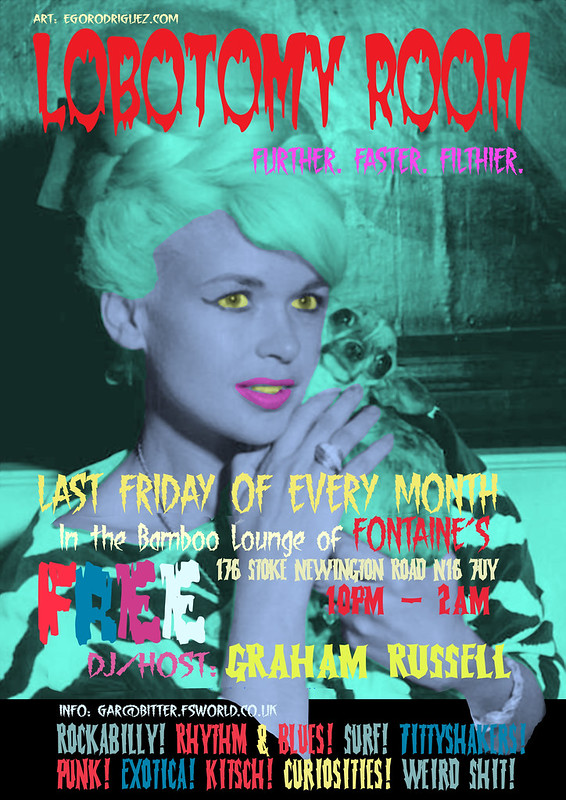
Lobotomy Room Goes to the Movies is the FREE monthly film
club with an emphasis on the cult, the kitsch and the queer. This month’s
presentation is … Blonde Venus! Wednesday 28 September in the Polynesian-style
basement Bamboo Lounge of Fontaine’s bar in Dalston!
Of the seven sublime films director Josef von Sternberg and leading lady / muse Marlene Dietrich made together, surely the wildest and weirdest is Blonde Venus (1932). It stars sultry German glamour puss Dietrich as a hausfrau and mother forced to resume her career as a nightclub chanteuse due to circumstances too complicated to go into here – and then finders herself entangled in a romantic triangle between her sick scientist husband and a suave millionaire (played by a very young Cary Grant). But none of that is important! It’s mainly an excuse to luxuriate in Dietrich’s shimmering close-ups, multiple extravagant costume changes and sensational musical numbers. Most notorious of the latter is the riotously kitsch and freaky “Hot Voodoo” sequence. If you’ve never seen it before I won’t spoil it for you, but 1) “Hot Voodoo” is the campiest thing you’ve ever seen, 2) watching it might turn you gay and 3) over eight decades later, the likes of Grace Jones, Madonna and Kate Moss are still referencing it in videos, concerts and photo shoots.

/ Kate Moss does Marlene Dietrich in "Hot Voodoo" in for W Magazine in October 2007 /
Not to divulge any plot spoilers, but midway through Blonde Venus Dietrich has to take her child and go on the run and she gradually sinks to ever more squalid and impoverished circumstances (at one point she seems to be living in a chicken coop!). The way Sternberg films it, the more sullied Dietrich becomes, the more radiantly beautiful she looks (and her outfits become more artfully dishevelled). Degradation never looked so good!
Anyway, Blonde Venus is the absolute summit of sinful 1930s Art Deco glamour and therefore the perfect film to watch in the decadent environs of Fontaine’s. Now – sing along with me: “Hot voodoo / dance of sin / Hot voodoo / worse than gin / I’d follow a caveman right into his cave …"
As usual: arrive circa 8 pm to order your drinks and grab the best seats. The film starts at 8:30 pm prompt. The film is FREE and seating is limited. If you’re feeling proactive, contact Fontaine’s to reserve a seat in advance: email ruby@fontaines.bar or call 07718 000546.
Of the seven sublime films director Josef von Sternberg and leading lady / muse Marlene Dietrich made together, surely the wildest and weirdest is Blonde Venus (1932). It stars sultry German glamour puss Dietrich as a hausfrau and mother forced to resume her career as a nightclub chanteuse due to circumstances too complicated to go into here – and then finders herself entangled in a romantic triangle between her sick scientist husband and a suave millionaire (played by a very young Cary Grant). But none of that is important! It’s mainly an excuse to luxuriate in Dietrich’s shimmering close-ups, multiple extravagant costume changes and sensational musical numbers. Most notorious of the latter is the riotously kitsch and freaky “Hot Voodoo” sequence. If you’ve never seen it before I won’t spoil it for you, but 1) “Hot Voodoo” is the campiest thing you’ve ever seen, 2) watching it might turn you gay and 3) over eight decades later, the likes of Grace Jones, Madonna and Kate Moss are still referencing it in videos, concerts and photo shoots.
/ Kate Moss does Marlene Dietrich in "Hot Voodoo" in for W Magazine in October 2007 /
Not to divulge any plot spoilers, but midway through Blonde Venus Dietrich has to take her child and go on the run and she gradually sinks to ever more squalid and impoverished circumstances (at one point she seems to be living in a chicken coop!). The way Sternberg films it, the more sullied Dietrich becomes, the more radiantly beautiful she looks (and her outfits become more artfully dishevelled). Degradation never looked so good!
Anyway, Blonde Venus is the absolute summit of sinful 1930s Art Deco glamour and therefore the perfect film to watch in the decadent environs of Fontaine’s. Now – sing along with me: “Hot voodoo / dance of sin / Hot voodoo / worse than gin / I’d follow a caveman right into his cave …"
As usual: arrive circa 8 pm to order your drinks and grab the best seats. The film starts at 8:30 pm prompt. The film is FREE and seating is limited. If you’re feeling proactive, contact Fontaine’s to reserve a seat in advance: email ruby@fontaines.bar or call 07718 000546.

Blonde Venus - the fifth of the seven intoxicating films
visionary director Josef von Sternberg (1894 – 1969) and actress Marlene Dietrich (1901 – 1992) made together between 1929 and 1935 - is considered a
minor work in their canon, chiefly remembered for the spectacular “Hot Voodoo”
musical sequence. It bombed at the box office in 1932 and received mostly
withering reviews. Blonde Venus has a reputation as a lurid, sentimental
potboiler (in his definitive 1992 biography Marlene Dietrich: Live and Legend,
Steven Bach positions it as belonging in the “mother-love sobber-weepers”
genre). In fact, it’s one of my
favourite of the Dietrich-Sternberg collaborations and - as I said in my
introduction to the sold-out Lobotomy Room audience - it’s their wildest and
weirdest film. Blonde Venus, I’d argue, is a strange and complex film roiling
with tensions and conflicts and ripe for queer and feminist appraisals.
Blonde Venus is a pre-Code film (made during the brief,
heady period roughly between 1929 – 1934 when actresses like Jean Harlow went bra-less and it was still like the Wild West
in terms of what films could show onscreen), so it’s ripe with an ambiance of
sleaze and some deliciously kinky moments. It opens, in fact, with a skinny-dipping
scene in the Black Forest when visiting American scientist Ned Farady (Herbert
Marshall) encounters German cabaret performer Helen (Dietrich) swimming nude in
a lake with her fellow showgirls. (He calls her “my little water nymph”). The action
then cuts abruptly several years forward to Helen – now married to Ned - as a dutiful
aproned hausfrau and mother (of a 5-year old son) in a tenement apartment in
New York. Their modest but idyllic family life is shattered when Ned is struck
down with “radium disease.” To pay for the experimental medical treatment in
Europe that might save Ned’s life, Helen is forced to resume her career as a nightclub
chanteuse.
Sternberg packs even these early wholesome domestic scenes with
macabre and perverse touches. As Ethan Mordden points out in his 1983 book
Movie Star, “Sternberg was the champ of weird. Stop the projector during a
medium shot in any of his films and you’ll see a crammed picture, every piece
in it doing something. Graffiti, toys, masks, light fixtures, bowls of things:
the sets are alive.” When we see housewife Helen demurely embroidering, she
actually seems to be cross-stitching black crows in a pattern worthy of Morticia
Addams. The doctor that Ned consults keeps a human skull displayed on his desk
(he even absent-mindedly picks it up and plays with it while speaking). Helen
and Ned’s cherubic little boy Johnny plays with eerie German Expressionist toys (watch
for the demonic grinning papier-mache mask Johnny wears at
one point – a jarring moment).
Of all the films Dietrich and Sternberg made together, only
Blonde Venus is set in contemporary Depression-era US. It has some genuinely hard-boiled
and gritty moments, with Helen motivated by the very real threat of
destitution. The cut-throat world of show business Helen returns to is shown to
be competitive, exploitative and sexist. “Let’s see your legs!” a
cigar-chomping manager commands. Helen obliges, lifting her skirt (“Is that
enough?”). “You certainly got me hopped-up, baby,” he growls in response.

/ The Blonde Venus backstage in her dressing room pre-show /
Re-christened with show biz name “Blonde Venus”, we finally
see Helen in action as a nightclub diva with the film’s show-stopping first
musical number – the truly freaky and berserk “Hot Voodoo”. It plays like a
pagan, taboo and primitive beauty and the beast-style ritual, with Dietrich as
an albino goddess or priestess shedding her gorilla fur disguise. All these decades later “Hot Voodoo” is still
deliriously weird, and perhaps the first incidence of deliberate, knowing camp
in popular culture. (It’s easy to imagine Sternberg and Dietrich looking at
each other across the camera and thinking, “Can you believe we’re getting away
with this?”). As Bach describes:
“The notorious Hot Voodoo is simply unforgettable, despite
or because of its absurdity. Marlene emerges from a gorilla suit to don her
silver-blonde Afro (suggesting Harpo Marx) against a Cotton Club background of
African “native” girls. There are tom-toms, palms, the black bartender with a
stutter… Helen’s – Dietrich’s – astonishing confidence in her allure is
near-dictatorial with star presence. She shifts her weight from one hip to
another as she sings. She need not do more; her voice insinuates the rest. The
absurd lyric – “Hot Voodoo gets me wild / Oh, fireman save this child!” – goes
on for five minutes in two long takes intercut with shots of Cary Grant paying
stunned attention. This is a witch casting her spell; that hip-to-hip sway is
the mesmerising come-on of a blonde cobra.”


/ I’ve always been curious about the above photo when it appears online or in books: it’s clearly an entirely different outfit to the black sequinned one Dietrich wears onscreen in “Hot Voodoo.” Is this shot a “wardrobe test” of a potential costume that got rejected? In his book, Bach provides a clue: production of Blonde Venus was a long rancorous ordeal with Sternberg (and Dietrich) feuding with studio heads. (At one point Paramount threatened to sack Sternberg and replace him with another director). There were so many script re-shuffles that “major sequences (including the “Hot Voodoo” number) were completely recostumed and reshot.” So, the famous version of “Hot Voodoo” we’re all familiar with is actually the second reshot version. This pic above was presumably what Dietrich wore in the original scrapped number that was resigned to the cutting room floor. Imagine – an alternate unseen version of “Hot Voodoo”! In an ideal world, that would resurface and be included as a DVD extra. Or even better – a “director’s cut” of Blonde Venus true to Sternberg and Dietrich’s original vision! /
Afterwards, suave young millionaire politician Nick Townsend
(Cary Grant) takes a keen interest in Helen and visits her backstage.
As soon as Ned departs to Europe for his cure, Helen embarks
on an affair with playboy Nick. Helen’s almost instant romance with Nick reportedly
caused executives at Paramount to panic. Considering Helen is meant to be a
sympathetic romantic heroine, she is weirdly unknowable and amoral. She’s never
shown, for example, having any serious qualms or pangs of guilt about her
infidelity. The script can’t contain or resolve this contradiction. This is
often described as one of the film’s flaws. I’d maintain it’s what makes it
fascinating. “Give me a little kiss,” Nick implores, after ushering Helen into
a luxe life as a kept woman. Helen hesitates then submits. The camera cuts away
tactfully as they embrace. He asks Helen directly: does she love Ned? She
replies, “He needs me.”

/ Best use of rear projection (and a wind machine) ever /
“I wish I was someone else,” Helen admits to Nick. “Then I could stay with you here forever.” Helen’s unfixed, constantly shifting identities are one of the most interesting aspects of Blonde Venus. Nude water nymph. Cabaret star. Housewife. Mother. Later, fallen woman. Prostitute. Androgynous pansexual in male drag. She even goes under multiple names: Helen Faraday. (Faraday is her married name; presumably before that Helen had a German maiden name). Helen Jones. Blonde Venus. Later, on the run, she checks into hotels with the pseudonym Helen Blake.
“I wish I was someone else,” Helen admits to Nick. “Then I could stay with you here forever.” Helen’s unfixed, constantly shifting identities are one of the most interesting aspects of Blonde Venus. Nude water nymph. Cabaret star. Housewife. Mother. Later, fallen woman. Prostitute. Androgynous pansexual in male drag. She even goes under multiple names: Helen Faraday. (Faraday is her married name; presumably before that Helen had a German maiden name). Helen Jones. Blonde Venus. Later, on the run, she checks into hotels with the pseudonym Helen Blake.
The jig is up when the cured Ned arrives back in New York
unexpectedly early. Discovering Helen has been unfaithful, he turns vindictive.
“You took up with the first man who could give you the things I couldn’t”. Calling
her “a rotten mother”, he threatens to take Johnny away. Helen responds by kidnapping Johnny and
fleeing. (Cut to screaming newspaper headline “Police Hunt Cabaret Girl” with
huge photo of Helen wearing her “Hot Voodoo” Afro wig).
On the lam from her husband (and - symbolically – patriarchy,
heterosexuality and the male establishment as a whole), Helen now takes a journey
into the underbelly of thirties America with Johnny in tow. At this point
Blonde Venus turns very noir, very
desperate against a sordid backdrop of seedy hotel rooms, dive bars and
flophouses depicted in deep atmospheric chiaroscuro. When it’s no longer safe
to perform in cabarets, Helen takes odd jobs where she can (I love the
thought of Continental exquisite Dietrich labouring as a farmhand in Galveston!
If only Sternberg had given us a glimpse of Helen milking a cow or plucking
poultry). At their lowest point, Helen and Johnny appear to be living in a
chicken coop!
On the run Helen finds support and sisterhood with other disenfranchised
“outsider” women on society’s margins, including African Americans (one of
them, Cora, is played by Hattie McDaniel years before her Academy Award-winning
role as Mammy in Gone with the Wind) and a lesbian. (The gruff-voiced, short-haired nightclub
proprietoress in masculine clothing warns Helen police have been enquiring
about her. “Don’t worry, I’ve got a kid of my own. Good luck.” I studied Blonde
Venus many years ago at university. My professor maintained thirties audiences
would have instantly recognised her as a lesbian character). For Helen at this
point men are predators to be wary of and out-smarted. “Are you going to wash my dishes?” a restaurant manager leers suggestively
when penniless Helen admits she can’t pay the cheque at his diner. Men keep
recognising Helen’s face from the “Wanted” signs and newspaper headlines (“that
dame looked like the Venus woman …”), eager to hand her in for the reward.


Perversely, the lower Helen sinks, the more radiant Sternberg
makes Dietrich look. As Bach jokes, “no one ever made squalor more decorative
than Sternberg”. Wreathed in cigarette smoke with artfully dishevelled hair and torn garments, the
low-down and dirty Helen drinking a schooner of beer (“I’ll have some beer.
Cold beer”), coquette-ishly fanning herself truly represents Dietrich at her most beauteous.


Finally tracked down by one of Ned’s detectives, Helen surrenders
and hands over Johnny, convinced it’s for his own good. Fed-up with male
disapproval, she snarls, “What does a man
know about motherly love?” (This same racist detective – a real piece of work -
repeatedly addresses Cora as “Annie” – as if “they’re all the same” to him. Cue the Nina Simone song "Four Women").
At this point it could be argued Helen is shown belatedly “paying”
for her unfaithfulness. Her heartbreak when she gives Johnny back to Ned,
watching their train depart with glistening eyes, is palpable. At this point
the film seemingly breaks down. It cuts from drunken, broken bag lady Helen
departing a flophouse for homeless women vowing to get herself back on her feet
(“just watch me!”), to the Atlantic Ocean viewed from a ship by night, to a
montage of neon Art Deco nightclub signs in Paris heralding the Blonde Venues
Revue. No explanation is offered; it feels like a few essential scenes are
missing. How much time has elapsed? How did Helen manage to afford this trans-Atlantic
journey? Prostitution? Rich sugar daddies? It’s left tantalisingly unclear.


/ The Blonde Venus re-surfaces in Paris /
In any case, as “the toast of Paris” the Blonde Venus persona is revived, but the updated version is dramatically different. The new Helen is tough, independent and androgynous, a butch drag king in ice-white top hat and tuxedo imperiously smoking a cigarette in a long holder. (The “I Couldn’t Be Annoyed” musical sequence deliberately references Dietrich’s famous earlier “lesbian number” in one of Sternberg and Dietrich’s earlier triumphs, Morocco (1930). Sternberg loved dropping hints of Dietrich’s real-life bisexuality in their films together). Nick and Helen are re-united in her dressing room. (“I seem to recall you came backstage before,” she purrs). “Nothing means much to me now. It’s better that way. I haven’t a care in the world,” Helen insists. Nick sees through her steely, world-weary facade, knows she’s yearning for Johnny. Once again Helen crosses the Atlantic Ocean, from Old World to New World.


Back in New York, Blonde Venus now hurtles toward its conclusion. For some reason Helen opts to dress like a glamorous angel of death for the family reconciliation scene in fur and black satin. The ending was a compromise forced by the studio. (According to Bach, Dietrich herself wanted the film to finish with Helen not having to pick between Ned and Nick, but having simultaneous ongoing relationships with both men – very much how she conducted her own non-monogamous open marriage with multiple lovers off-screen. Obviously that couldn’t fly in 1932). It’s a “happy” ending with nothing truly resolved. Helen is never shown breaking up with Nick - it’s merely implied. Why would she choose killjoy prig Ned over chivalrous, gallant and undemanding Nick? (Who’s not only a millionaire, but looks like Cary Grant!). Will Helen be absorbed back into family and domesticity and abandon show business for good? She’s most fully herself (or most fully Dietrich), liberated and vital when onstage performing. How can a woman capable of “Hot Voodoo” not be allowed back onstage?!

/ Above: Helen and Johnny reunited /

Blonde Venus is wildly entertaining. Sternberg’s storytelling is vivid, fluid and concise. Visually, he is an untouchable stylist. Watch Blonde Venus more than once and you begin to notice how Sternberg’s own personal preoccupations or fixations abound. There are two noteworthy recurring motifs. One is the Atlantic Ocean: characters cross it multiple times in the film. For the characters in Blonde Venus, criss-crossing the ocean from Europe to North America seems to represent opportunities for transformation and reinvention. (Continental types Sternberg and Dietrich had made that life-changing journey themselves many times). And the German lullaby that Helen croons to Johnny at pivotal points in the film seemingly signifies a yearning for pure unconditional love, innocence and nostalgia. But mainly Blonde Venus works as a sleek showcase for the heavy-lidded magnetism of Marlene Dietrich. Her coolly inscrutable, feline self-possession as Helen is simply magnificent. Like a female version of Robert Mitchum, she underplays everything. You never catch Dietrich “acting”: she’s far too cool to emote. In particular, check out Dietrich’s superb nonchalance in the musical segments, basking in adoration. She is mesmerising to watch throughout.

This was the second recent sold-out instalment of the Lobotomy Room film club.
(The previous one was Faster, Pussycat! Kill! Kill! in July). Maybe it was their
cocktail-induced stupor, but the hip, full-capacity Bamboo Lounge crowd at
Blonde Venus sure was enthusiastic for a night of old-school diva worship. In
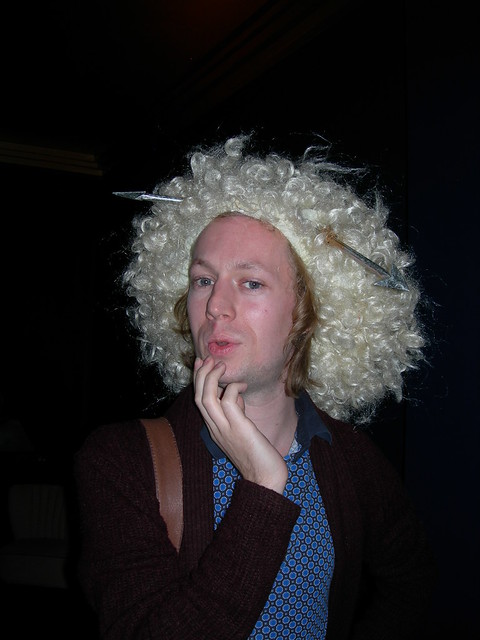
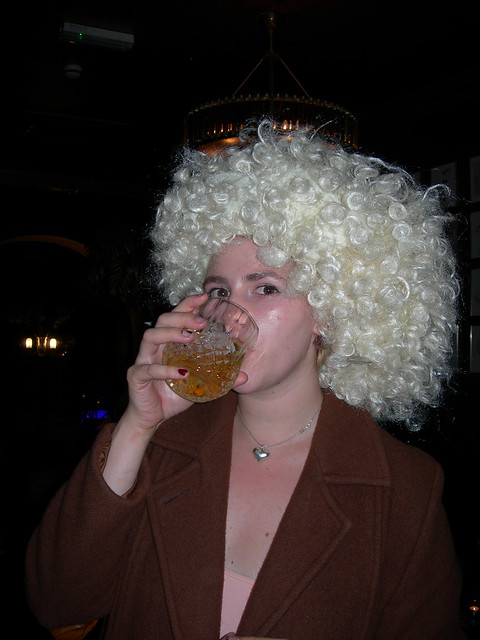
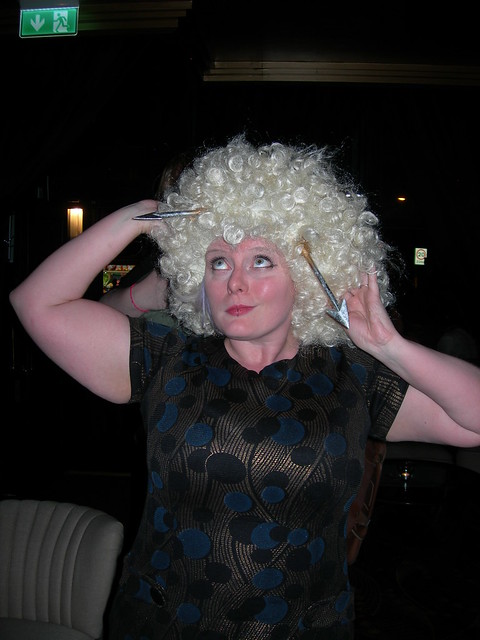
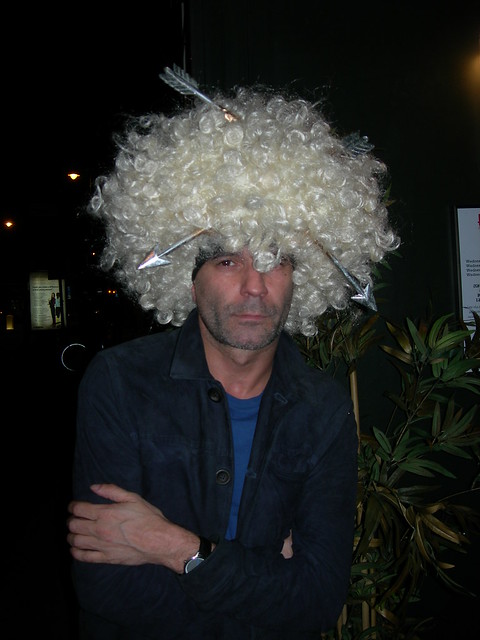
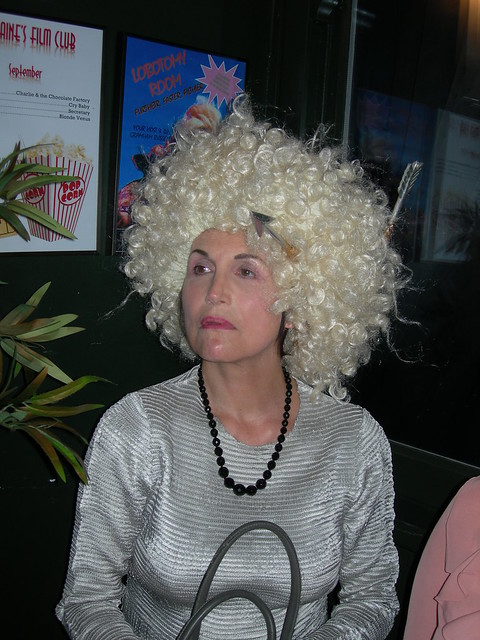
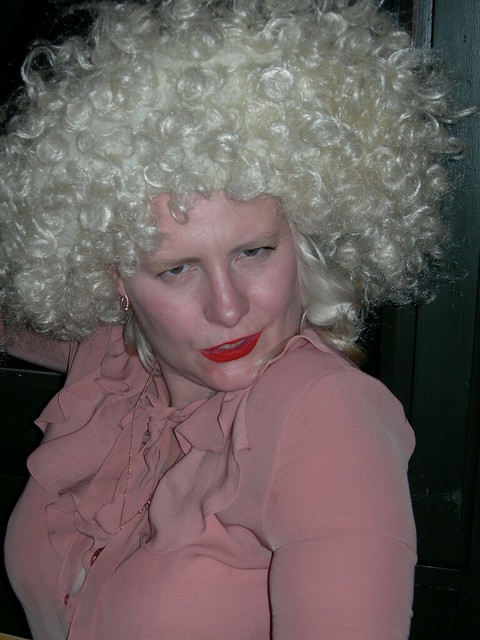
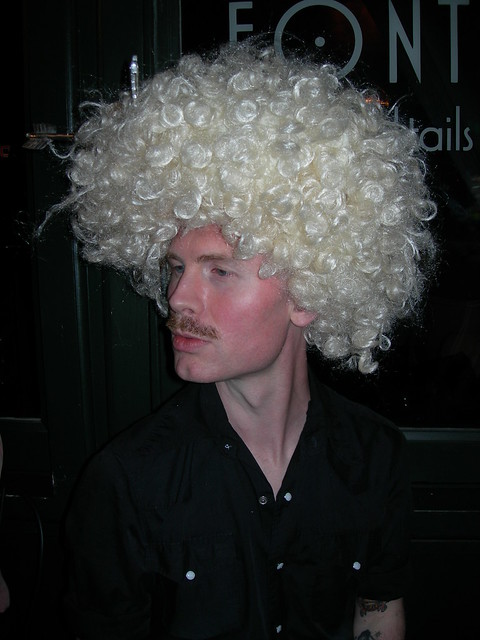
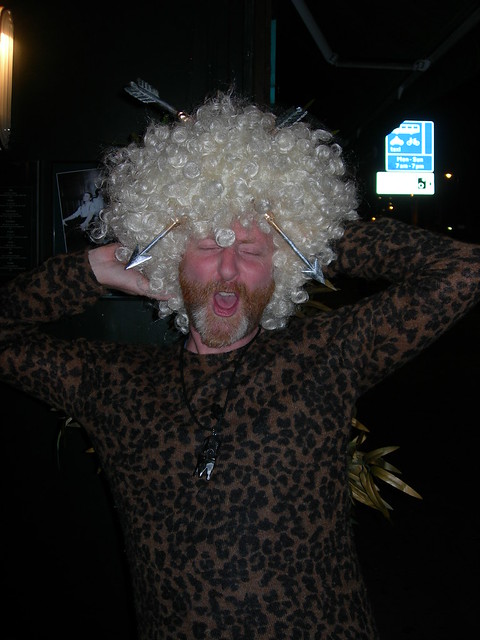
fact, after the film with minimal persuasion I got loads of ‘em to pay tribute
to Marlene Dietrich by donning a replica of the exploding platinum blonde Afro
wig she wears in the "Hot Voodoo" number (complete with glittery arrows!)
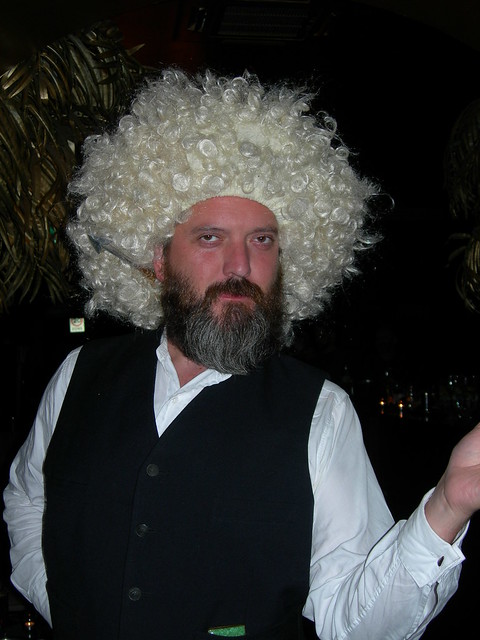
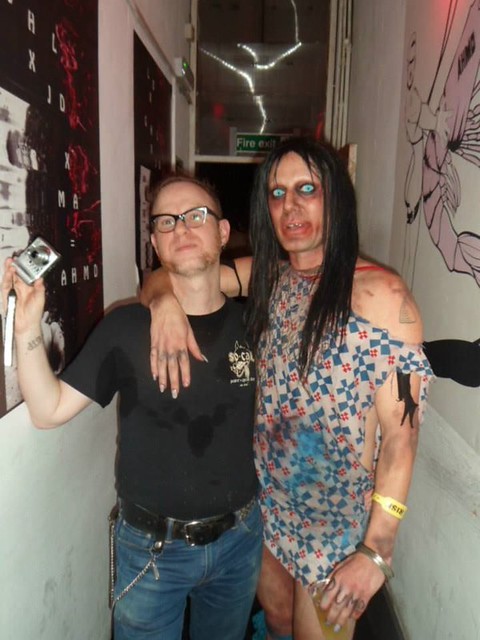
for a red-hot camera session. Here are the resulting glamour shots! What a diverse
variety of Marlenes of all genders! And funny how the wig can also evoke The
Simpson’s Sideshow Bob!