“Tennessee Williams wanted the lead in The Roman Spring of
Mrs Stone to go to Katherine Hepburn, after seeing her performance as the
scheming mother in Suddenly Last Summer. But Hepburn, who resented the way her
advancing years had been treated in that film, had no intention of inviting
comparison between herself and the lonely middle-aged actress who buys the
attentions of a male hustler. Although the public was intrigued by rumors of
an off-screen liaison between the film’s subsequent stars, Vivien Leigh and
Warren Beatty, Spring was a disappointment at the box office. It seems that
audiences were uncomfortable with the film’s depressing theme, and with the
painful similarities between the lives of Vivien Leigh and the mentally
unstable Mrs Stone.”
Penny Stalling. Flesh and Fantasy (1978)
If The Roman Spring of Mrs Stone (the 1961 film adaptation
of the Tennessee Williams novel) is remembered at all today, it’s as a dusty
and obscure minor footnote to the career of its leading lady Vivien Leigh (it would
be her penultimate film; Leigh died of tuberculosis aged 53 in 1967). It seemingly
never crops up on TV and is unavailable on DVD in the UK. As a fan of both
Leigh and Williams (and intrigued by Spring’s sordid subject matter!), I had
long been intrigued by this curiosity. When the British Film Institute in
London held a retrospective season commemorating the 100th
anniversary of Leigh’s birth in November 2013, I finally got to see it.
/ Make mine a Negroni: Vivien Leigh in The Roman Spring of Mrs Stone /
It certainly feels like a “lost” film. The BFI always
sources the best quality prints they can – and this one frequently looked
pretty scratchy and moth-eaten. In 1961 the film suffered by comparison with
Leigh and Williams’ earlier triumphant collaboration on A Streetcar Named
Desire (1951), for which she won her second Academy Award, and it was neither a
critical or commercial success. Seeing it in 2013 for the first time, I would
argue The Roman Spring of Mrs Stone is ripe for a more generous reappraisal. Williams
himself rated it highly, saying, “I think that film is a poem” in his 1972
memoirs (but then he also loved the catastrophic 1968 Liz Taylor-Richard Burton mega bomb Boom!). Call me perverse, but I find Spring infinitely more enjoyable
than the more highly regarded Streetcar.
/ Vivien Leigh and Warren Beatty in The Roman Spring of Mrs Stone /
The film is flawed but fascinating. It seethes with weird
hybrid tensions. With its woman-of-a-certain age in peril heroine, Spring
works as a lush old-fashioned conventional melodramatic “woman’s picture” awash
with romantic masochism, stoical suffering and deluxe production values (the
costumes, sets and Roman setting are pure eye candy). But it also plumbs the
depths of some spicy lurid subject matter: self-destruction, sexual humiliation
and glittering but empty hedonism in a milieu of pimps and prostitutes in
Rome’s La Dolce Vita international cafe society. (Some of Spring’s nightclub
and party scenes, with their grotesque celebrants, can be favorably compared
to the earlier Fellini film). Intriguingly for modern audiences, the film is shot
through with a definite queer sensibility (it’s surprisingly clear that those
seeking firm-bodied Roman hustlers on the Spanish Steps are just as likely to
be male as well as female; the role of Mrs Stone would probably make even more
sense as an older gay man pining for his younger thug lover). It’s also
convincingly permeated by a sense of real fatalistic despair almost from the
very start (onscreen Leigh’s depression is almost tangible). And in its tense, shocking
final moments, Spring packs the dread of a horror film.
/ The original theatrical trailer for The Roman Spring of Mrs Stone /
/ Leigh, draped in haute couture by Balmain /
Leigh portrays the titular Mrs Karen Stone – a
recently widowed and affluent middle-aged American actress adrift in Rome. Rich, lonely and vulnerable, Stone is easy
prey for heartless gigolo Paolo (Warren Beatty) and his malevolent female pimp The Contessa (Lotte Lenya). Leigh is only 47 here but it has to be said she
seems dramatically older. (And in the context of the story, the age of 47 seems
to represent something significantly older than it does in 2013). Draped in haute couture by Balmain (shame about the gruesomely unflattering blonde wigs), she
is still waveringly beautiful but careworn, ravaged and fragile. (Late-period Leigh’s
deep bass voice may come as a surprise; it was strikingly lower by the 1960s
after years of poor health and heavy smoking).
/ Ladylike and demure - but tortured /
Leigh is so perfect for the role, it's hard to believe it wasn't conceived with her in mind or that she wasn't the original choice. Her thin-skinned and delicate
performance is a portrait of someone deeply wounded but striving to maintain a
haughty dignity and detached froideur
(she boosts her confidence and self-soothes with vice, chain-smoking and
drinking Negroni cocktails). And yet Leigh had a tough core: she was a
profoundly unsentimental actress. Whether
as Scarlett O’Hara, Blanche Dubois or the complex and troubled Karen Stone, she
never solicits the audience’s sympathy. Considering Spring is her second last
film, Leigh ended her movie career on a high. My favorite moments of Leigh’s
performance here are probably the simplest: the segments of Stone drifting
aimlessly alone through Roman streets like a melancholy somnambulist, severely-etched and alienated in her ladylike suits, white gloves and cat’s eye sunglasses, are haunting. Thank God Katherine Hepburn didn't accept the role.
/ Like I said, the film has a genuinely queer sensibility: Warren Beatty wears very tight pants throughout and gets more than one lingering, admiring ass shot /
The film’s weakest link is callow young Warren Beatty, whose
thick comedy Italian accent is frankly awful (his acting would improve
considerably by Bonnie and Clyde in 1967). Why not cast an actual Italian actor
as Paolo? The dark, swarthy and sensual Franco Citti had already smoldered
playing sexy low-life pimps in two Pier Paolo Pasolini films, Accattone (1961)
andMamma Roma (1962). Or perhaps the French art
cinema heartthrob Alain Delon, who at least was Continental - and by all
accounts in real life every bit as predatory and amoral as Paolo! LuchinoVisconti’s bisexual protégé would have invested the part with some of the icy
sociopathic menace he brought to Plein Soleil (1960). (In fact Delon had been
considered for the role – but Leigh rejected him as “too pretty.” Perhaps she
didn't want to share close-ups with him. Who could blame her not wanting to be compared
to young Delon?).
/ Don't Smoke in Bed: Two ultra-sultry and homoerotic portraits of very young Delon by John S Barrington, a pioneer of gay beefcake / physique photography. Delon could have played the role of Paolo in his sleep. (Apparently Delon tried to suppress these photos later on. Read the biography Physique: The Life of John S Barrington by my friend, journalist and author Rupert Smith)
It could be argued the film is well and truly stolen from
both Leigh and Beatty by the frankly amazing Lotte Lenya, nominated
for a Best Supporting Actress Oscar for her performance as the toxic Contessa
(two years later she would play Rosa Klebb in the James Bond film From Russia
with Love – her most famous movie role). The 63-year old Austrian actress and chanteuse
(the definitive interpreter of her husband Kurt Weill’s songs, name-checked in
the English lyrics to “Mack the Knife”) is utterly compelling: she practically
purrs with smiling, serene evil. I literally gasped when she calls Stone a “chicken hawk”
(a very John Waters moment. I told you this was a queer film). And don’t even
get me started on how much I love The Contessa’s apartment. All the sets in
Spring are amazing, but her flat – shared with a menagerie of cats - is truly brothel-like,
a tart’s boudoir of crimson velvet furniture, flocked wallpaper and gilt.
/ Stirring up trouble: Lotte Lenya as the sinister Contessa. I love her blood-red and gold apartment /
As well as La Dolce Vita, for me Spring echoes Josef von
Sternberg’s The Blue Angel (1930) in its themes of sexual humiliation, cruelty and death,
and Bonjour Tristesse (1958) for the joyless European jet set debauchery and
luxurious settings. The story is full of Tennessee Williams’ essential recurring
preoccupations: loneliness, fear of aging,
compassion for human fragility, the need to live with illusions and occupations especially the concept of the
beautiful young gigolo doubling as an angel of death (See also: Boom!).
One of Spring’s other intriguing themes is American new
world naivety versus European old world decadence. During a heated argument,
Paolo spits at Stone, “Rome is 3000 years old. You’re what – fifty?” Later,
when someone describes Stone as “a great lady”, The Contessa is contemptuous,
arguing there is "no such thing as great American
lady" because great ladies do not occur in country less than two hundred
years old. Stone is out of her depth in Italy – against the corrupt and damaged
likes of Paolo and The Contessa, she doesn't stand a chance.
No spoilers, but Spring also raises the possibility Stone has
a death wish or unacknowledged suicidal impulse, subliminally motivating her. Aiming
to shock and offend her, Paolo taunts she’ll be discovered dead in bed with
her throat slit ear-to-ear by a gigolo three or four years from now. Stone
merely laughs “a cut throat three or four years from now would be a convenience”.
In a weird encounter on the street with some nosy American acquaintances Stone
lies to them that she’s been diagnosed with a fatal illness so that they won’t
bother her anymore. In the context of the film, this is fatalistic – she’s
sealing her own fate. Even more disturbingly, throughout the film Stone is literally
pursued by death – stalked by a completely silent, gauntly handsome angel of
death street urchin hustler who at first might even exist only in her
imagination. (He’s a very poetic Williams-ian touch: with his wraith-like cheekbones he
looks like a Giacometti sculpture come to life and is arguably more attractive
than Beatty). His recurring presence
foreshadows certain doom.
“A glamorous world – a strange romance!” the original
theatrical trailer to The Roman Spring of Mrs Stone tantalizingly promised. The
film offers a kinky glimpse of sex and dying in high society, viewed through a realm of genteel cocktail parties and gold cigarette cases.
/ Ominous: Karen Stone, stalked by death /
Further reading:
This great blog has some beautiful screen shots of The Roman Spring of Mrs Stone's lavish sets and costumes
My reflections on another Tennessee Williams adaptation, the notorious Boom! (1968)
The screenplay for The Roman Spring of Mrs Stone was adapted
by Gavin Lambert (1924-2005). During the
making of the film, Vivien Leigh was freshly divorced from Laurence Olivier and
struggling with mental illness - and yet was consistently elegant and professional
throughout. Read his sympathetic and insightful account of working Leigh here.
/ "Oh show me the me way to the next pretty boy ...": The incomparable Lotte Lenya (in 1962) singing us out with Kurt Weill's "Alabama Song"
/ Together they devour life! Or at least chew the scenery /
Baroque. Opulent. Decadent. Berserk! I celebrated my birthday on 12 May by attending a rare screening of the infamous 1968 Joseph Losey film Boom! at The Institute of Contemporary Art with my friend Alison. I’ve long been curious about the film for its reputation as one of the biggest bombs in Hollywood history and because Pope of Trash John Waters (one of my heroes) has championed it so enthusiastically and persuasively as his all-time favourite movie. "I show it to every person I think I'm falling in love with,” Waters claims. “If they hate it, I don't talk to them anymore." And finally, it seemed like a nice way to pay tribute to the film's leading lady, Elizabeth Taylor, who died in March. (When I interviewed Waters for Nude magazine in December 2010, he recalled how in the 90s he finally met Taylor at a party and was able to profess his love for Boom! She was horrified and screamed, “That movie is terrible!”). I can confirm Boom! still hasn't lost its capacity to alienate and annoy: the screening Alison and I attended was sparsely-attended. The couple in front of us walked out early on.
/ The wonderfully lurid trailer for Boom! /
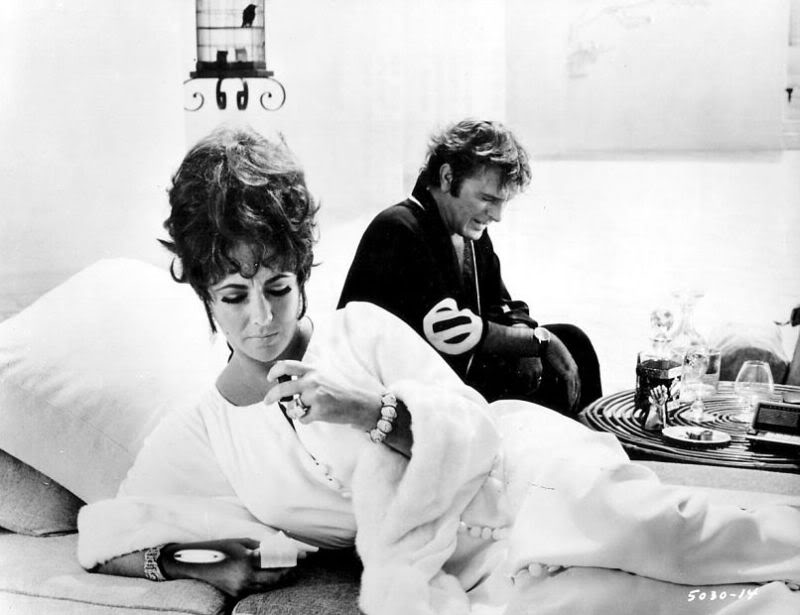
A true “film maudit”, Boom! is mainly remembered as a disastrous star vehicle / vanity project for tempestuous then-married duo Taylor and Richard Burton, at what author Lee Server has called “their jet-setting, conspicuously-consuming, bad-movie making height.” Tennessee Williams himself adapted the screenplay from his flop play The Milk Train Doesn’t Stop Here Anymore. Taylor plays ageing hedonist Flora “Sissy” Goforth, the much-married, drug addicted richest woman in the world (and it’s been argued, the most irritating woman in the world). From the windswept high solitude of her all-white villa on the edge of a cliff on a private island on the Amalfi Coast, the terminally ill Goforth is in denial about her imminent death, distracting herself by dictating her sensational Proustian memoirs into a tape recorder and directing her diva’s wrath at her long-suffering servants in fractured Italian (“Shit on your mother!” she screams at a maid who displeases her). "I need a lover," she growls to her secretary. Sure enough, she is visited by the enigmatic Christopher Flanders (played by Burton), a failed poet turned gigolo notorious on the international jet set as an ambiguous and parasitic Angel of Death who materialises whenever a wealthy woman is about to die.
In theory Boom! initially may have seemed promising. Taylor and Burton were show business royalty and the public was still entranced by their glitzy soap opera lifestyle. Taylor had triumphed in earlier film adaptations of Tennessee Williams plays like Cat on a Hot Tin Roof (1958) and Suddenly Last Summer (1959). Joseph Losey was a hip, art-y director of the moment, critically acclaimed for films like The Servant (1963). But considering the play Milk Train had failed on Broadway twice already in two different versions (in 1963 and 1964), it seems an odd choice as source material for a lavish big budget film adaptation. Tennessee Williams himself couldn’t be expected to be objective, but surely Losey, Taylor and Burton probably should have considered the play’s failure as an ominous premonition? The doomed 1964 Broadway production (which closed after only five performances) certainly sounds fascinating: it perversely partnered the odd couple of dissipated grand dame of the American stage Tallulah Bankhead as Goforth with wholesome 1950s teen heartthrob Tab Hunter as Flanders.
/ Tab Hunter as Christopher Flanders and Tallulah Bankhead as Sissy Goforth in the 1964 Broadway production of The Milk Train Doesn't Stop Here Anymore /
/ Gruesome twosome: Bankhead and Hunter /
The resulting film is overblown, irresistibly absurd, high camp run amok and unintentionally hilarious. Losey depicts the Goforth mansion as a grotesque freak show deluxe, complete with a sadistic dwarf bodyguard in jodhpurs and riding boots, a pet monkey on a chain, a talking mynah bird in a cage and sitar-playing Indian musicians. A cadaverous-looking Noel Coward pops up in a dinner jacket as a gossipy gay socialite nicknamed the Witch of Capri. When Flanders first trespasses onto Goforth’s island, her savage attack dogs are released – just like Mr Burns does with his hounds on The Simpsons.
/ Taylor as Sissy Goforth and Burton as Christopher Flanders /
Boom! feels drenched in a boozy / narcotic haze, which apparently extended both on and off screen. “They made this film drunk …” Waters has pointed out. The Burtons were famously hard-drinking, and Losey and the cast reportedly began each day’s filming with a round of Bloody Marys, and it shows. Drunken impaired judgement would certainly explain a lot. In any given shot it’s rare for a character not to have either a drink or a cigarette in their hand -- in Taylor's case, usually both (Taylor wields an outrageously long cigarette holder). The camera lingers over characters availing themselves of huge pitchers of Bloody Marys (which, it has to be said, look pretty tempting). There’s almost as much pill-popping as in The Valley of the Dolls. At one point Taylor washes down a fistful of pain killers with a gigantic snifter of brandy.
Then there’s the eternal problem of film translations of Tennessee Williams plays: his dialogue (heightened, poetic, high-falutin’) doesn’t translate easily to the screen. The atmosphere of decadence and impending tragedy is laid-on thick; everyone seems death-obsessed and is apt to suddenly start philosophising in long, meandering soliloquies about the meaning of life. Waters has shrewdly argued Boom! should be approached as a “failed art movie”: certainly Losey (out of his depth and reportedly intimidated by Liz and Dick) seems to be striving for high European art cinema seriousness, layering on heavy-handed symbolism a-go go, soundtracked by a doom-laden John Barry score and the constant sound of waves crashing onto the rocks. The moments of Taylor suffering panic attacks on her balcony, for example, recall Monica Vitti’s existential nervous breakdown in Michelangelo Antonioni’s 1964 Il Deserto Rosso. (Maybe if Boom! was made in a different language, if Taylor and Burton were dubbed in Italian, the film would have felt less risible?).
Considering Boom! was primarily conceived as a showcase for Taylor and Burton, they’re surprisingly miscast. For one thing, their ages are all wrong: Taylor is too young and Burton too old -- the play was about the relationship between an older, dying woman and a much younger man. Sissy Goforth is supposed to be dying: when Tallulah Bankhead played the role onstage she was in her 60s and genuinely wraith-like, prematurely ravaged by emphysema and the consequences of a suicidally debauched lifestyle (it would be her last major theatrical performance and she would die within five years). The 35-year old Taylor, on the other hand, looks sun-kissed, plump and in robust good health even when coughing up blood in a consumptive fit or writhing in agony screaming for an injection.
/ Another bourbon, darling? A desiccated Tallulah Bankhead towards the end of her life /
Similarly, as an elite high society gigolo Flanders surely should be a bronzed Adonis, or something like Terence Stamp in Pier Paolo Pasolini’s 1968 film Teorema. Clad throughout in a samurai warrior’s robe (complete with ceremonial sword), Burton looks haggard and faded. It's he who looks like he’s dying, instead of Taylor. (We get a few fleeting glimpses of Burton swimming naked – they’re deeply unappealing).
/ Taylor pouts through the pain. Burton as the angelo della morte looks moodily into the distance /
In any case, Boom! is overwhelmingly dominated by Taylor in full-throttle imperious, overripe, scenery-chewing diva mode. Camille Paglia has written of Taylor in another Joseph Losey film, Secret Ceremony (also 1968) as being “at the peak of her mature fleshy glamour.” That’s definitely true here, too. Shrouded mainly in floor-skimming caftans, with elaborate bouffant hairstyles augmented with hair pieces, Taylor is glamorous but prematurely matronly and slathered in thick make-up. Still channelling Martha in Who’s Afraid of Virginia Woolf? and shrieking like a harridan, Taylor’s Sissy Goforth is self-parodic, unhinged and drag queen-y: no wonder John Waters says Taylor’s appearance and abrasive performance in this film were a beloved source of inspiration for Divine. (Waters has said Divine was so influenced by Taylor that he smoked Salem cigarettes purely because they were Taylor's brand of choice).
/ So demanding ... /
Boom! is recognised today as a camp classic (it ticks all the right boxes as listed in Susan Sontag’s 1964 Notes on Camp essay, especially in terms of “failed seriousness”). It certainly seems to have a queer sensibility, and perhaps the role of Sissy Goforth is best approached as a coded drag queen. Interestingly, Rupert Everett played the role of Sissy in drag in a 1994 British stage production of Milk Train. And famously the role of the Witch of Capri was originally conceived as (and played onstage by) a woman and in Boom! it’s played by Noel Coward. (The part was originally offered to Katherine Hepburn – who was deeply offended). There’s a jaw-droppingly tasteless and misogynistic scene where the Witch of Capri describes a friend who refers to women as “poisson” and sniffs from a vial of ammonia to disguise the scent of any menstruating woman who might pass by him on the street. Seriously – what the hell were they thinking?!
While by no stretch a "good" film, Boom! is incredibly beautiful to look at, weirdly enjoyable and frequently mesmerising in a way only a truly trashy bad movie can be. There's a wonderful tension between the film's high-minded, literary aspirations and its actual lurid vulgarity. Essentially a filmed play, Boom! is extremely talk-y, but Losey’s prowling camera and elegantly composed shots ensure it’s never dull to watch. The production values were obviously high, and they're visible on the screen: the jewels Taylor wears, for example, are all genuine, on loan from Bulgari and worth an estimated $2,000,000. The art direction, sets, exteriors and Taylor’s garish wardrobe (especially her eye-popping Kabuki ensemble with the exploding headdress) are incredible. (Some of Taylor's costumes were apparently designed by Karl Lagerfeld). Captured in glorious Panavision, the sun-drenched Italian Riviera locale is exquisite (Boom! is usually described as having been filmed in Capri, but the closing credits say it was filmed on location in Sardinia). Boom! is immersive, a noble and ambitious failure, a real experience. Like Elizabeth Taylor’s interpretation of Sissy Goforth, it’s simultaneously seductive and repellent. Boom! is finally majestic in its misguided awfulness.
/ Taylor in Kabuki costume and Coward as The Witch of Capri /
The Key (La chiave, 1983)
-
*The Key* (*La chiave*) is a 1983 erotic/romantic drama written and
directed by Tinto Brass.
After his nightmarish experiences in the 70s with *Salon Kitt...
NEGATIVES 1968
-
Spoiler Alert. This is a critical essay, not a review, so plot points are
revealed for discussion
*Vivien: “Something is going on, and I want to know what...
The end is near
-
Cookie has, for some time now, thought about closing up shop on this blog.
I mean DHTiSH has had a good run, but after 15 years, it's time for a
diff...
Grace Jones
-
Artist: Grace Jones
LP: 7" single
Song: "I've Seen That Face Before (Liber Tango)"
[ listen ]
The incredible Grace Jones turned 76 one month ago today. ...
National Silent Movie Day: Manhandled (1924)
-
Wednesday, Sept. 29, 2021, is National Silent Movie Day. New York City's
beloved Film Forum is celebrating with a screening of Allan Dwan's 1924
silent...
SHABLAM:
-
While we are speaking in onomatopoeia,
"Girl, what did that girl just say, girl?" This queen is giving basic boot
camp for drag queens as she throws an a...
Who was Tamara Matul?
-
[image: Marlene Dietrich, Josef von Sternberg, Rudolf Sieber, Tamara Matul
at Olympic Auditorium, Los Angeles, 1934]
Rudolf Sieber, Tamara Matul, Marlene...
-
Welcome Refugees from tumblr!
[image: Christofascists.]
I'm busy exporting what's left of Drifting over the Ether & A Long Lunch. I
will be posting upda...
My Baking Supervisor
-
Meet Mr. Caspurr Burgers. He says:
"I helped you get up three hours earlier than usual this morning and this
is how you repay me? What is with this glass...
Béatrice Dalle Day
-
'Driving south on the A7 from Lyon to Marseille, I find my thoughts turning
to some of the scenes associated with the name of Béatrice Dalle. They
incl...
A BOGUS SPEECH BY A BOGUS PRESIDENT
-
Yesterday, Obama spoke in New Orleans at the 10 year anniversary of
Katrina. I'm not quite sure why we celebrate disasters' anniversaries, but
it was a ch...
DJ. Journalist. Greaser punk. Malcontent. Jack of all trades, master of none. Like the Shangri-Las song, I'm good-bad, but not evil. I revel in trashiness