Saturday, 14 September 2019

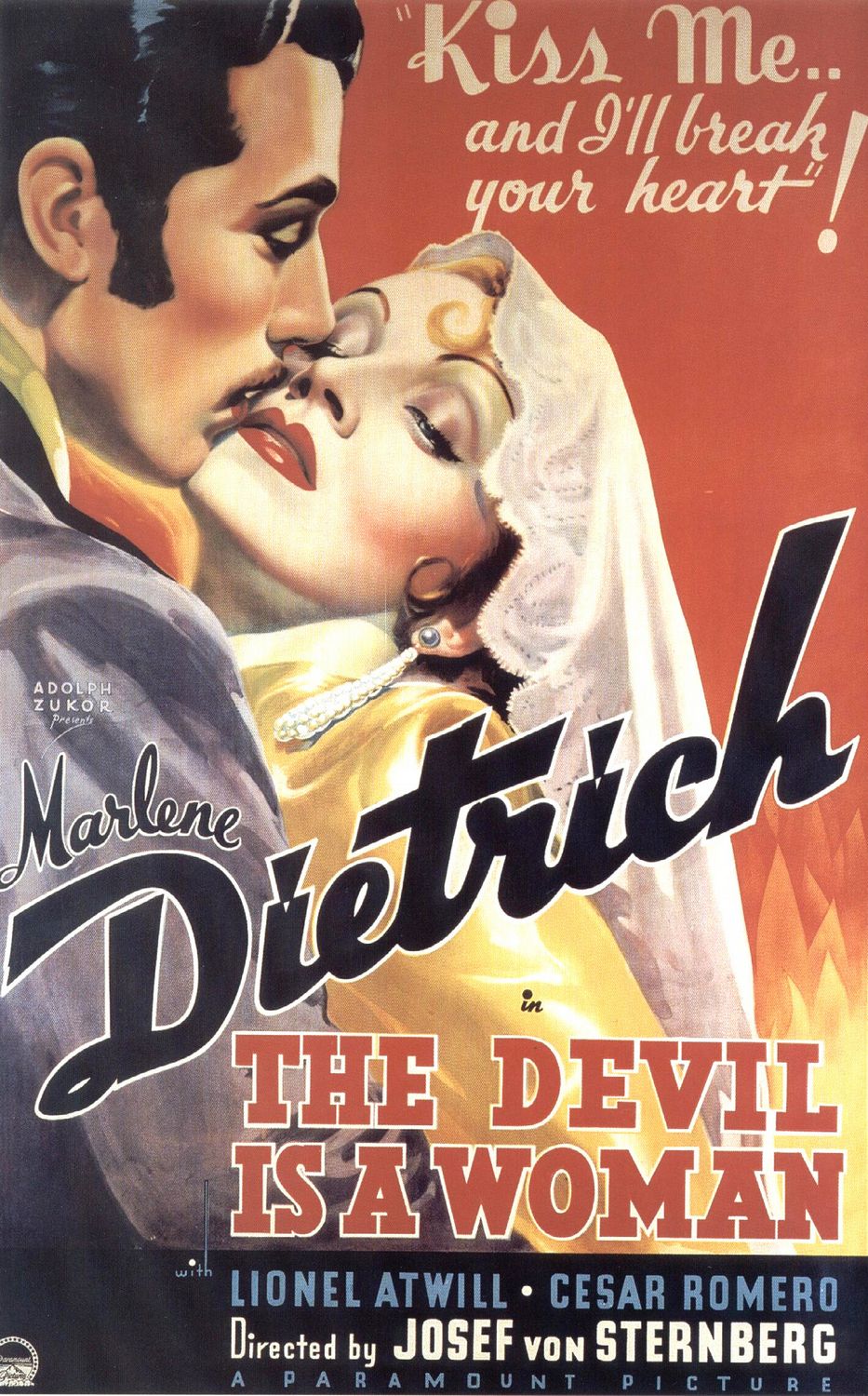
Reflections on ... The Devil is a Woman (1935)


If visionary director Josef von Sternberg was the Leonardo da Vinci of cinema, then German glamourpuss leading lady Marlene Dietrich was his Mona Lisa. The Devil is a Woman (1935) was the last of the seven exquisite films the duo collaborated on together. And boy, did they conclude in high style! Sumptuous and bizarre, it’s a kinky and cruel black comedy about sexual humiliation, tinged with sadomasochism, and offering one final swooning and ambivalent valentine from von Sternberg to his gorgeous muse.

Set in a dream-like, deliberately artificial turn-of-the-century Seville, it stars Dietrich (clad in a wild wardrobe of lace mantillas) as heartless gold-digging femme fatale Concha Perez (variously described as “the most dangerous woman you’ll ever meet!” and “the toast of Spain!”) cruelly pitting virile young Antonio Garvan (Cesar Romero at his most handsome) against the self-destructively besotted Captain Don Pasqual Costelar (Lionel Atwill – deliberately styled to resemble von Sternberg himself) for her own amusement.

The Devil is a Woman is a deliriously perverse, borderline-surreal spectacle! Come see the movie the Spanish government successfully banned and that Dietrich herself called her favourite (“because I was most beautiful in it”) on Wednesday 21 August!

Lobotomy Room Goes to the Movies is the FREE monthly film club downstairs at Fontaine’s bar (Dalston’s most unique nite spot!) devoted to Bad Movies We Love (our motto: Bad Movies for Bad People), specializing in the kitsch, the cult and the queer! Doors to the basement Bamboo Lounge open at 8 pm. Film starts at 8:30 pm prompt!


[The account below is cobbled together from my introductory notes plus some random reflections and musings on The Devil is a Woman]


The director Josef von Sternberg (1894 - 1969) and Marlene Dietrich (1901 - 1992) made seven films together in which he obsessed over lighting his muse’s face, trying to capture her mystique and crack her mystery. They had a volatile and complicated professional and personal relationship that had reached the end by 1935. The Devil is a Woman was the last movie they collaborated on and a lot has been read into it and how von Sternberg represents Dietrich onscreen this final time, looking for traces of bitterness, disillusionment or heartbreak.  What has certainly been noted is that the actor Lionel Atwill (1885 - 1946) who plays the masochistically-besotted Captain Don Pasqual – the man Dietrich cruelly torments in the film – seems to be deliberately styled to look just like von Sternberg. 

Also: in their previous films Dietrich tended to play “noble harlots” - essentially variations of a prostitute / fallen woman who actually operates with a far higher code of honour and more courage than the conventional society who judges her. In Devil, though, the man-eating, gold-digging character she plays (cigarette factory trollop turned nightclub chanteuse Concha Perez) is just plain bad!  


Interestingly, in Devil von Sternberg seems to deliberately reference The Blue Angel (1930), the first film he and Dietrich made together. Concha is a Spanish kissin’ cousin of the amoral Lola Lola, the German cabaret singer Dietrich plays in Blue Angel. And Atwill watching Concha sing in Devil’s musical number “Three Sweethearts Have I” echoes Emil Jannings watch Lola Lola sing "Falling in Love Again".  More perversely, von Sternberg also seems inspired by another Dietrich film he didn’t even direct himself: Song of Songs (1933), with Atwill and the great character actress Alison Skipworth (1863 – 1952) playing variations of the roles they enacted in that movie.


Asked late in life which was her favourite of the seven films she made with von Sternberg, Dietrich replied The Devil is a Woman. When pressed why, she snapped, “Because I was never more beautiful!” She may well have a point. Certainly Concha’s Spanish senorita costumes (heavy on the lace mantillas and giant tortoise shell combs) are among the most outrageous and elaborate Dietrich ever wore on-screen, and they’re created by Paramount Studio’s top designer, Travis Banton (1894 - 1958). But since then we’ve learned no one ever told Marlene Dietrich what to wear and in fact it was an active hands-on collaboration between Dietrich and Banton. Dietrich could easily get a co-designer credit on everything you see her wearing in the von Sternberg films.  It’s difficult to pick a favourite, but I do particularly love the macabre heavily veiled black widow / angel of death look Dietrich wears towards the end in the hospital scene.


And Dietrich is funny in this as well. She essays the coquettish and manipulative Concha in a haughty, petulant, foot-stomping and nostril-flaring register completely different from the aloof and inscrutable tone of her other performances in the von Sternberg oeuvre. Dietrich is seriously underappreciated as a fine comedic actress: see also Desire (1936), Seven Sinners (1940) and Stage Fright (1950) for further evidence of how funny she could be.


Someone who’s also very pretty in this film is Dietrich’s leading man, the Cuban-American actor Cesar Romero (1907 - 1994). Watch for the sensational bat-shaped mask Romero wears in the carnival scene. Swoon! About thirty years later Romero would memorably play The Joker in the campy 1960s Batman TV series. He refused to shave-off his signature pencil-line mustache for the role, so the make-up artist had to apply thick white foundation to conceal it. The suavely handsome Romero was a “confirmed bachelor” throughout his career and late in life when times were more enlightened, he openly admitted to being gay. He was also a long-term close friend of Joan Crawford (her nickname for him was “Butch”) and he regularly escorted her to nightclubs and film premieres when she was between husbands. 


The Devil is a Woman was a very unhappy and difficult production by all accounts, and then it was heavily censored. The original cut von Sternberg presented Paramount with was 93-minutes, but the final cut was only 76-minutes. We’ll never know what was in those lost 17 minutes (imagine if the footage was ever discovered in a vault somewhere! Oh, for a director’s cut!), but we do know a musical number was one of the casualties. Entitled “If It Isn’t Pain (Then It Isn’t Love)”, only the audio recording survives (you can hear it on YouTube).  It feels weird that – considering Concha is a nightclub singer – we only get to see Dietrich sing once (and the sole musical sequence “Three Sweethearts Have I” is relatively underwhelming in the von Sternberg - Dietrich canon). I’d love to know what the staging of “If It Isn’t Pain” was going to be!


To considerably complicate thing further, the Spanish government was so enraged by the depiction of the country in  The Devil is a Woman (the Spanish War Minister called the film “an insult to Spain and the Spaniards”) they demanded Paramount studios remove the film from circulation, otherwise all Paramount films would be banned from Spain. And Paramount consented! The “master print” was destroyed and the film was considered “lost” and went unseen for many years. Thankfully, both von Sternberg and Dietrich had kept their own personal copies of the film and it resurfaced in 1959 when von Sternberg began being honoured with career retrospectives.  


Devil was a critical and commercial flop in 1935 and von Sternberg’s career never recovered (he would never again enjoy full creative autonomy over his subsequent films. Of his post-Dietrich efforts, I highly recommend The Shanghai Gesture (1941) and Macao (1952)). All these decades later, The Devil is a Woman remains a deeply strange, deliberately artificial and disorienting art movie. Von Sternberg offers no “moral centre” or guidance on how you’re meant to feel about the characters or the action (and none of the characters are remotely “sympathetic” by conventional standards). What’s it all about – and what is the significance of that ending? Prepare to be dazzled and dumbfounded! 


Details on the September 2019 film club


Together the inspired trio of pop art visionary Andy Warhol, director Paul Morrissey and leading man / homoerotic beefcake icon Joe Dallesandro collaborated on three notorious underground films. Cinema’s Sultan of Sleaze John Waters has hailed Flesh (1968), Trash (1970) and Heat (1972) as “the trilogy that changed the rules of male nudity in modern-day cinema both underground and in Hollywood.” While all three movies are gritty, sordid classics of style and substance, I’d argue that Heat (the final and most polished of their efforts) is the most entertaining – and it’s this month’s Lobotomy Room film club selection! Wednesday 18 September!

A freaky and twisted black comedy, Heat is a loose remake of Sunset Boulevard (1950) set amidst the desperate low-rent fringes of Hollywood’s underbelly. Dallesandro stars as a coldly calculating wannabe actor and hustler who finds himself caught between an aging washed-up actress (the magnificent Sylvia Miles – who died this June aged 94) and her mentally unstable daughter (doomed Warhol Superstar Andrea Feldman). Trust me - you’ve never seen anything quite like Heat! If you enjoy the squalid early “gutter films” of John Waters, Heat is a must-see!

Lobotomy Room Goes to the Movies is the FREE monthly film club downstairs at Fontaine’s bar (Dalston’s most unique nite spot!) devoted to Bad Movies We Love, specializing in the kitsch, the cult and the queer! Doors to the basement Bamboo Lounge open at 8 pm. Film starts at 8:30 pm. We can accommodate thirty people maximum on film nights. Remember: the film is free so you can buy more cocktails! (One drink minimum). Event page.


Monday, 26 August 2019

Las Vegas Grind! Viva Las Vegas Rockabilly Weekender 2019


2019 was the year I learned that age is not just a number. I’ve been attending the Viva Las Vegas Rockabilly Weekender off and on since 2003 and now – aged 49 – it genuinely felt like a struggle to keep up. (Plus - as I’ve written elsewhere - I've been suffering with ongoing intermittent nerve pain).

It didn’t help that this year I had a punishing epic flight via AeroMexico. It was the cheapest option available (travelling over Easter equals ultra-expensive peak prices), but it meant flying from Heathrow to Mexico City – about 10 ½ hours – with a painfully long stop-over in Mexico, then a roughly four-hour flight from there to Las Vegas. I never fully recuperated from the flight, my body clock never quite switched to American time and trying to manage the late nights (when the red-hot action was!) was a battle. Frustratingly and bafflingly, the organizers of this year’s Viva Las Vegas scheduled some of the best bands – the ones I most wanted to see! – at crazy times like 2:30 am (including Los Straightjackets and The Rip ‘Em Ups). There was no way I could stay up that late. Speaking to fellow VLV veterans who’ve also hit middle-age, I wasn’t the only one finding it a challenge this time. What was it The Rolling Stones once sang? “What a drag it is getting old!”

So rather than attempting to cram everything in, the emphasis was on simply hanging out and catching up with friends. Anyway, here is my wild, wild Viva Las Vegas round-up / scene report. I took significantly less photos than usual this year (my geriatric digital camera has pretty much bit the dust) and the ones I did take are desultory. And really, it’s taken me so long to cobble-together this post, my memory has gone misty (I suspect I’ve forgotten loads of stuff). This will probably read like disjointed bullet points.  For better or for worse, here is my Viva Las Vegas scene report.


/ That's me (in the black sweatshirt) checking-in at The Orleans. Photo by Sean Law, the mogul behind Vancouver-based independent label Rockin' Records /

I arrived on Wednesday morning and promptly crashed-out in my room at The Orleans. I wish I’d seen Pachuco Jose y The Diamonds – but they were on at 1:30 am and I just couldn’t rouse myself from my jetlagged stupor!


/ Sheilah, Kevin and Ritch and The Hooch'n'Smooch /


/ Sharon, Patrick and Natelle at The Hooch'n'Smooch /

By Thursday my friend Kevin from New Orleans had arrived (as per tradition we were splitting a room). The first official day of Viva always means Sweet Pea’s ice-breaking Hooch’n’Smooch shindig: the ideal way to ease your way into the weekend and an opportunity to greet everyone. Later that night: the premiere LGBT meet-up in the Deluxe Club. Kudos to my friends Jr and Andre from Los Angeles for doing such a brilliant job organizing and suavely hosting this soiree. This was the first official LGBT club on the Viva Las Vegas schedule: I’m one of the elites who used to go to them when they were informal parties in Jr and Andre’s hotel room! Anyway, the event was a triumph and it was divine to hang out and have a few drinks with some some queer “fellow travelers” on the rockabilly scene.


/ No idea what day this shot (of Kevin, Sharon and I) was taken, so I'm sticking it here /

We made a point of catching The Desperados. I’ve raved about this ferociously rampaging sexy young quartet from Santa Ana, California before. To me The Desperados neatly exemplify what modern rockabilly should be – they attack their songs with the fervor of a punk band.


 / Kevin and I /

Friday: Visiting the sublime Frankie’s Tiki Room when in Las Vegas is always de rigueur. We wound up having a nice long afternoon drinking session there with Canadian friends Sean, Natelle and Sharon (who smuggled in a Canadian delicacy unavailable in the UK: ketchup-flavoured Pringles. One bite was Proust-ian, instantly conjuring-up my 1970s Canadian childhood). Of course, I sampled Frankie’s impeccable signature Mai Tais – and then tried my first Sea Hag. My head was swimming by the time I emerged from the gloom of Frankie’s blinking into the sunlight. (We didn’t make it to The Golden Tiki this trip).


/ Above: my Mai Tai and Kevin's Two Dots and a Dash /


/ Sharon - with a Canadian delicacy! /


/ Above: photo by Sean Law /


/ Above: my first-ever Sea Hag /


/ Above: Kevin /


/ Sean Law and I (I'm always chewing a wasp, in every damn photo) /

Then, back to The Orleans for the first slideshow presentation of the weekend by undisputed Ambassador of Mid-Century Americana Charles Phoenix. (He always does two). Damn, Phoenix knows how to work the room (as a raconteur he ranks up there alongside John Waters) and his lovingly assembled slideshows are pure catnip for aficionados of atomic-era kitsch.  


Speaking of John Waters … the people’s pervert and perennial filth elder was one of the emcees of the Burlesque Showcase later that night. He received the rapturous hero’s welcome you would anticipate from the attendees of Viva Las Vegas. I wish I could have recorded or taken notes during Waters’ introduction, because the Pope of Trash was on lacerating form. Clearly knowledgeable and passionate about the history of burlesque, he had loads of hilarious and insightful points to make. Waters was especially eloquent reminiscing about The Block in Baltimore – the notoriously tawdry neon-lit district of East Baltimore once synonymous with porn shops, peep shows and burlesque houses. He recounted how lax those establishments were with checking IDs and how in the 1960s he and Divine used to routinely sneak in as underage teenagers, illicitly ogling iconic striptease queens like Tempest Storm, Lili St Cyr, Irma the Body and Baltimore’s own Blaze Starr. Inspired by Viva Las Vegas, he free-associated a soliloquy about rockabilly luminaries moonlighting as male strippers, asking us to imagine being “tea-bagged” by Elvis, Gene Vincent or Eddie Cochran. And everyone roared in agreement when Waters declared, “The best strippers are old strippers!” Which made me think of that great Peaches video featuring the likes of Satan’s Angel (RIP) and Kitten Natividad. The ensuing burlesque performers themselves were the absolute crème de la crème and sensational to watch, but I was keeping track of the time on my watch because I knew that Messer Chups were playing in the Piano Bar …


Look, I know it’s still painful to accept, but voodoobilly royalty The Cramps are gone and they ain’t never coming back. Lux Interior, Bryan Gregory and Nick Knox from the definitive line-up are dead. Now 66-years old, surviving member Poison Ivy is as reclusive as Greta Garbo and hopefully enjoying a serene retirement. In that spirit – all hail Messer Chups, heirs to The Cramps! Seriously – the time is now to embrace the Russian surf trio as the 21st century Cramps. Messer Chups were by far the biggest musical revelation of Viva Las Vegas 2019. Suffice to say, Kevin and I were both awe-struck.  The name had always been on my radar and I’d given some of their tracks a cursory listen online but seeing them in person was mind-blowing.  


/ Above: Kevin and I watching Messer Chups. Photo by Sean Law /


/ Above: the only decent shot I took of Messer Chups /

A brief history: hailing from St Petersburg, Messer Chups have been around since the early 2000s and undergone multiple incarnations. Their early work is more experimental, featuring copious Theremin and snatches of sampled dialogue from horror movies – interesting, but markedly different from what they do now. Present-day Messer Chups specialize in minimalist deeply twang-y, menacing surf-noir played with real aggression and imbued with a profound and impressive comprehension of old horror and exploitation movies and low-brow trash culture.  (Viva Las Vegas always features surf bands at the pool parties, but both were underwhelming this year. Thank god for Messesr Chups).


Full credit to exemplary musicians Oleg Gitaracula (guitarist) and Rockin Eugene (drummer), but the undisputed focus and breakout star of the band is impossibly magnetic and inscrutable ice princess bassist Zombierella (real name: Svetlana Nagaeva). Call it sangfroid or froideur, Zombierella positively exudes it from beneath her Bettie Page bangs and no one could tear their eyes from her. She even got to sing a few times (although you wouldn’t describe what Zombierella does as “singing”. She delivered the song “They Call Me Zombie” with frosty aplomb, shuttling between a hiccough and a shriek). Kevin and I were exclaiming, why isn’t this woman a star? Why isn’t her pin-up on every available wall? Weirdly, just as Kevin queried, “When is David Lynch going to discover her?” Messer Chups lashed-into their surf version of the Twin Peaks theme! (Their interpretation is entitled “Twin Peaks Twist”).


Saturday at Viva Las Vegas means the car show. Top tip: the car show is the my favourite venue for shopping, and you find more interesting bargains than at the pricey indoor vendors.  But what do I know? I’m usually hunting for black t-shirts with skulls on them. 


/ My t-shirt haul: Vampira, Siouxsie and Elvira! /

Later, Kevin and I made a point of watching some of Aileen Quinn & the Leapin’ Lizards’ set. We’d first encountered Ms Quinn in 2015. Yes, she is that Aileen Quinn – the former moppet who starred in the 1982 film adaptation of the perky musical Annie directed by John Huston. So she has major kitsch appeal. Which compensates for a lot: I’m trying to pick my words diplomatically – she takes a kind of suburban soccer mom approach to rockabilly, and her stage school jazz hands are still very much in evidence. But she radiates genuine sweetness and enthusiasm (and plenty of people in the crowd clearly loved her). And once again, when we ambushed her for a quickie photo session Quinn was the epitome of graciousness. And later that night Kevin and I re-visited another camp icon …


When I attended the Viva Las Vegas Rockabilly Weekender in 2015 my friends Kevin, Mitch and I made a religious pilgrimage to see diminutive 1980s exploitation movie sex kitten-turned-credible and resilient jazz chanteuse Pia Zadora’s one-woman cabaret revue in an Italian restaurant called Piero's. It was a riot! Clad in hot pants, she belted jazz standards like “Come Rain or Come Shine” and “The Lady is a Tramp” in front of a Warhol portrait of herself. Zadora strode past our table several times that night pre-show, but never made eye contact and we never plucked up the courage to speak to her.


Flash forward four years later. When Kevin and I went to Viva Las Vegas again in April 2019, we made another trip to Piero’s, this time Pia did make eye contact – and the pictures speaks for themselves! She said hello, introduced herself, pulled up a chair, hung out with us – and was charm personified. The adorable Zadora happily consented to photos and even introduced us to her husband and son. I informed Zadora her old pal John Waters was in town and she gasped, “He is? He didn't tell me! I’m going to text him!” (Kevin pointed out it’s likely the Viva Las Vegas team flew him in and out just to emcee the burlesque showcase). She regaled us with anecdotes about the making of Hairspray (did you know Waters originally intended her for the part of Amber von Tussle?).


/ Below: Pia Zadora pouting through the pain in Lonely Lady (1983) /


Now a preternaturally youthful 66, Zadora has weathered the vagaries of fame (or should that be infamy?), the kind of bad press and horrendous reviews for her notorious flop films like Butterfly (1982), Lonely Lady (1983) and Voyage of the Rock Aliens (1984) that would devastate anyone else, shrugged it off and re-invented herself as a durable jazz diva. A truly wry, witty and self-deprecating tough cookie, whether joking between songs onstage or shooting the breeze with us, Zadora displayed impeccable deadpan comedic delivery. (Shame that quality was never properly exploited in a film). Anyway, meeting Pia Zadora was truly one of the highlights of the trip and I think I have a crush on her now!


/ "When I'm high, I am Odetta. Let's get naked and smoke!" Pia Zadora as Beatnik Chick in John Waters' Hairspray (1988) /


/ Liza Minnelli and Pia Zadora - together at last! Could it get more Las Vegas than this? Yes, Liza dropped by for a guest appearance the night we saw Pia. This is actually superstar female impersonator Sammy Gonzales, one of the featured performers in Frank Marino’s Divas Las Vegas revue. Don't you love how they coordinated their black sequined outfits? /

Sunday was, of course, the pool party. My expectations are always high for the Viva Las Vegas party – they’re usually a highlight. This one felt a bit tepid – maybe because the weather was overcast and the surf bands were disappointing. But I was just happy to stretch out on the Astroturf drinking Bloody Marys and talking to friends. 


/ Above: me at the pool party /


/ Above: Ejole and Chris /


/ Glamazons at the pool party on Sunday /

We split in time to see the second Charles Phoenix slideshow of the weekend (another killer set). The rest of the day was spent zig-zagging back and forth between the ballrooms watching bands. By Sunday night, I was ready to stop partying. After guzzling can after can of beer all weekend, it had become like aversion therapy and I literally couldn’t take another sip. It was time to go home!


/ Above: Charles Phoenix rocking the house /


/ Stylish couple /


/ Treasures at the vendors /


/ Last minute bargains at the vendors on Sunday! /

Monday: I flew back that morning – to do that agonizing AeroMexico journey in reverse!

Further reading:

Blogs from my previous Viva Las Vegas weekenders: 20102011201220132015 and 2017.


Monday, 29 July 2019

Reflections on ... Plan 9 from Outer Space


My friend, can your heart stand the shocking facts about grave robbers from outer space? Can you handle unspeakable horrors from outer space paralyzing the living and resurrecting the dead? If so, then do we have the film for you!

Gloriously inept and twisted b-movie visionary Ed Wood Jr unleashed Plan 9 from Outer Space – his much-ridiculed el cheapo sci fi horror thriller – on an unsuspecting world on 22 July 1959. Come celebrate the 60th anniversary of this notorious cinematic atrocity on Wednesday 17 July when the FREE monthly Lobotomy Room sinema club downstairs at Fontaine’s bar (Dalston’s most unique nite spot!) devoted to Bad Movies We Love presents Plan 9 from Outer Space!

Starring horror legend Bela Lugosi (in his final film appearance), hulking Swedish wrestler Tor Johnson and wraith-like glamour ghoul Vampira, the plot - incorporating flying saucers, zombies and nuclear war - offers a nightmare scenario about what happens when aliens administer long distance electrodes into the pineal and pituitary glands of the recent dead, bringing them back to life! A true cult classick, Plan 9 simply must be seen to be believed and will improve immeasurably by drinking Fontaine’s frosty cocktails!

Is Plan 9 from Outer Space one of the worst films ever made? YOU be the judge on 17 July! Doors to the basement Bamboo Lounge open at 8 pm. Film starts at 8:30 pm prompt! And remember: “We are all interested in the future, for that is where you and I are going to spend the rest of our lives! ..."


/ Art by Mitch O'Connell /

Plan 9 is my pride and joy … if you want to know me, see Glen or Glenda, that’s me. That’s my story. No question. But Plan 9 is my pride and joy.” Ed Wood quoted in Nightmare of Ecstasy: The Life and Art of Edward D Wood Jr (1992).


The following blog post is cobbled-together from my introductory speech on 17 July plus some random observations and fun facts about Plan 9 from Outer Space.


It was deeply gratifying to have such an enthusiastic crowd riveted to the screen to commemorate the 60th anniversary of Plan 9 from Outer Space. I feel like we did Ed Wood proud.


It’s been said that Wood directed Plan 9 “with brazen confidence but no taste, common sense or budget.” Wood himself would regard Plan 9 as his greatest artistic achievement for the rest of his tormented but productive, abbreviated and booze-sodden life. (He died in 1978 aged just 54 after years of chronic alcoholism and abject poverty). 


Plan 9 was little seen when it first emerged in 1959 and mostly languished in obscurity (aside from late-night TV screenings) until 1980 when Harry and Michael Medved published the book The Golden Turkey Awards, in which they nominated Plan 9 as the official worst film of all time. Thrust back into public attention, it’s been embraced by subsequent generations as an enjoyably terrible must-see cult film ever since. Certainly, you can’t call yourself an aficionado of cult or exploitation cinema without experiencing Plan 9 at least once.


Wood completed the film in 1956 but it took almost three years before he could find a distributor willing to touch it.


The original title was meant to be Grave Robbers from Outer Space.


The budget was an ultra-frugal $60,000 and those economic limitations are harshly visible onscreen. The tombstones in the graveyard are plywood and they wobble. Shadows of boom microphones are sometimes visible onscreen. When two pilot are shown in the cockpit of a plane, it appears to be a shower curtain behind them. It’s been widely reported that the flying saucers were hubcaps painted silver, but they were in fact made from a child’s model kit bought from a hobby shop. (Actually, there are multiple accounts of those flying saucers. I highly recommend you read the biography Nightmare of Ecstasy for more details about the making of Plan 9). For me, rather than detract, the cheap’n’cheerful aspect of Plan 9 – the fact that Woods’ ambitions vastly outstrip the financial restraints imposed on him and his own film-making expertise – considerably add to the film’s charms. This is genuine naïve outsider art.


/ Above: Bela Lugsoi. Below: Thomas Mason. I can't spot the difference, can you? /


Famously, Plan 9 represents horror icon – and definitive Dracula - Bela Lugosi’s final film appearance. In fact, you only get the most fleeting glimpses of Lugosi (looking gaunt and desiccated) at the film’s beginning. When he died of a heart attack on 16 August 1956 aged 73 with virtually no completed shots in the can, the resourceful Wood simply replaced Lugosi with a chiropractor named Thomas R Mason - who looked nothing remotely like him, was significantly younger and taller. Undeterred, Wood compensated by having Mason hunch and keep his face concealed with a cape. There’s something poignantly optimistic later when Wood intercuts footage of Lugosi and Mason assuming the audience won’t notice the difference.


The rest of the cast incorporate Wood’s colourful entourage of freaks from the lunatic underbelly of Hollywood Babylon: hammy psychic The Amazing Criswell (visibly reading his lines from cue cards), massive Swedish wrestler Tor Johnson and morbidly beautiful Finnish-born horror movie hostess Vampira (real name: Maila Nurmi).  Honourable mention must go to the exhausted-looking John “Bunny” Breckenridge (1903 - 1996) as the queen-y, disdainful leader of the aliens simply called The Ruler. I treasure his undisguised contempt, heavy eyeliner and lemon-sucking expression. (Bill Murray beautifully and accurately channeled Breckenridge’s hauteur in the 1995 biopic Ed Wood: the sole Tim Burton / Johnny Depp film I genuinely like). And those poor actors playing the aliens wear wildly unflattering tunics and leggings, unforgiving for their portly middle-aged frames.


I am unashamedly obsessed with cult icon Maila Nurmi (1922 - 2008), though, so for me Plan 9 feels like a paean to her macabre beauty and bizarre charisma. The woman is a sacred icon / touchstone for generations of punks, queers, goths, psychobillies and other assorted misfits. Re-visiting Plan 9, it’s always striking to see again just how freaky and extreme the cadaverous Nurmi’s look was. That emaciated waist! She was truly a pioneer in terms of body modification and fetishism.  The passage of time certainly hasn’t muted the shocking impact of coffin cutie Nurmi’s appearance.


Nurmi was the original TV horror movie hostess and a pop culture sensation between 1954 and 1955. But then The Vampira Show was abruptly cancelled in a dispute with ABC (they wanted to own the rights to her persona, she refused and was blacklisted), her career dramatically fizzled-out and never recovered. (Like Wood, Nurmi pretty much spent the rest of her life in poverty). She also alienated many by exploiting for publicity her friendship with James Dean following his death in 1955. By the time Nurmi appeared in Plan 9 she was widely considered washed-up and a show business pariah. All her scenes were filmed in one day, she was paid a grand total of $200 for her performance (the union minimum) and she was presumably glad to get it. Nurmi considered Plan 9 a humiliating nadir, but considering no footage of her TV series survives, it remains the definitive document of her onscreen allure. Enigmatic, mute and studiously indifferent, she is mesmerizing to watch in Plan 9.


Nurmi has claimed she was so horrified by the dialogue that Wood wrote for her that she demanded she play the role entirely in silence. But this oft-repeated theory feels apocryphal: remember - she and Tor Johnson both play zombies and he speaks no lines, either. And let’s pause here to ask: is Nurmi meant to be a zombie or a vampire in Plan 9? In many synopses, she’s called a vampire. But she’s raised from the dead by the aliens just like Johnson, and he is consistently referred to as a zombie. Which is it?


But seriously: how can such an entertaining, highly individual and compellingly weird work be considered “the worst film ever made”? The movie is Ed Wood’s labour of love and shouldn’t be dismissed. I prefer the more generous “so-bad-it’s-good” approach to Plan 9. At 80-minutes long, it zips along rapidly and never outstays its welcome (although when one of the aliens starts lengthily defining what a solaronite bomb it certainly threatens to).  


At its best, Plan 9 unfolds like a dream (or should that be nightmare?). Wood’s convoluted, jumbled story-telling - with reason, coherence and narrative jettisoned - only makes “sense” as nightmare logic. There are moments that almost anticipate David Lynch or Guy Maddin. Characters are almost always isolated, rarely sharing the same frame, which is disorienting and breaks movie-making conventions. And consider the repetition: Wood recycles the same footage over and over. We get glimpses of the long-dead Lugosi popping-up late in the film for no plausible reason, wandering through the woods in his Dracula cape.  The sequences of Tor Johnson and Nurmi shuffling silently and zombie-like through the bargain basement mist-enshrouded graveyard, past bleak gnarled trees, are hauntingly eerie – and are repeated over and over.


Adding to the strangeness, we’re never certain what time of day it is and seemingly neither is Wood. It changes shot-by-shot. For example, Wood will depict grave diggers in broad daylight – then cut to Vampira menacingly approaching them in night-time pitch darkness – and then cut to daylight again as they recoil in terror. The scene where Mason - doubling for Lugosi, face shrouded by his vampire’s cape - silently breaks into the sleeping woman’s bedroom and carries her off feels like primal silent cinema horror, a fragment from The Cabinet of Dr Caligari. It’s like watching a waking nightmare. Sixty years later, Plan 9 from Outer Space still casts an uncanny spell.


The next film club is Wednesday 21 August! Event page


If visionary director Josef von Sternberg was the Leonardo da Vinci of cinema, then German glamourpuss leading lady Marlene Dietrich was his Mona Lisa. The Devil is a Woman (1935) was the last of the seven exquisite films the duo collaborated on together. And boy, did they conclude in high style! Sumptuous and bizarre, it’s a kinky and cruel black comedy about sexual humiliation, tinged with sadomasochism, and offering one final swooning and ambivalent valentine from von Sternberg to his gorgeous muse.

Set in a dream-like, deliberately artificial turn-of-the-century Seville, it stars Dietrich (clad in a wild wardrobe of lace mantillas) as heartless gold-digging femme fatale Concha Perez (variously described as “the most dangerous woman you’ll ever meet!” and “the toast of Spain!”) cruelly pitting virile young Antonio Garvan (Cesar Romero at his most handsome) against the self-destructively besotted Captain Don Pasqual Costelar (Lionel Atwill – deliberately styled to resemble von Sternberg himself) for her own amusement.

The Devil is a Woman is a deliriously perverse, borderline-surreal spectacle! Come see the movie the Spanish government successfully banned and that Dietrich herself called her favourite (“because I was most beautiful in it”) on Wednesday 21 August!

Lobotomy Room Goes to the Movies is the FREE monthly film club downstairs at Fontaine’s bar (Dalston’s most unique nite spot!) devoted to Bad Movies We Love (our motto: Bad Movies for Bad People), specializing in the kitsch, the cult and the queer! Doors to the basement Bamboo Lounge open at 8 pm. Film starts at 8:30 pm prompt!