/ Twilight of a queen: Joan Crawford's last-ever photo session, 1976. Portrait by John Engstead /
Episode 8 of Feud: You Mean All This Time We Could Have Been Friends?
Episode 8 of Feud: You Mean All This Time We Could Have Been Friends?
Just some random thoughts, musings and
reflections on re-visiting the insanely enjoyable Feud: Bette and Joan (2017)
- Ryan Murphy’s deluxe eight-part TV mini-series covering the rivalry
between veteran screen queens Bette Davis and Joan Crawford during the making
of What Ever Happened to Baby Jane? (1962) - on BBC2. (I originally
watched Feud when it was first broadcast by FX in Spring 2017). You can read my earlier ramblings here and here.
Feud: Bette and Joan truly reaches its
zenith with episode eight. By this finale, even the most churlish contrarian
would have to admit both Jessica Lange and Susan Sarandon are completely
inhabiting Joan Crawford and Bette Davis. It’s never been just about the
physical resemblance, but at times the similarities (how Crawford’s and Davis’
coiffures and wardrobes are painstakingly simulated) are striking. The
conclusion is awash with sadness, depicting Crawford and Davis coping
with the travails of old age and exploring themes of abandonment, decline and
death. It’s also a supreme weepie on a par with, say, Douglas Sirk’s Imitation of
Life. Both times I’ve watched this episode, it’s been through a veil of tears (embarrassingly,
I wasn’t alone either time!).
It begins with Pauline (Robert Aldrich’s
personal assistant) reminiscing in 1978 about her unexpected chance reunion
with Crawford at LaGuardia airport, the final time she ever saw her. “She was
wearing a Pepto pink dress and a mask of chalk-white foundation being wheeled
through the airport with broken ankles, drunk …” seems a clear reference to the infamous 1968 clip of a frankly tipsy Joan giving an impromptu interview at an airport
in a wheelchair.
From there we cut to New York, 1969, with a
wrenchingly melancholic montage of a lonely, noticeably older and frailer Crawford
stoically adjusting to straitened circumstances and moving into a smaller and
more modest Manhattan high-rise apartment, sound-tracked to “Rain Drops Keep
Fallin’ on My Head.” (One caveat when I say “modest”: it’s a beautiful luxe apartment by any standards – but also an undeniable step down from Crawford’s previous
Hollywood movie star dream mansion with the grand staircase and swimming pool.
By this point, Pepsi had jettisoned Crawford from her lucrative spokeswoman
position and her film career never recovered from the Hush, Hush Sweet
Charlotte debacle).

/ Crawford with Princess Lotus Blossom /

/ Crawford with Princess Lotus Blossom /
As The New York Times’ Sheila O’Malley
notes, “the sequence goes on for some time, one evocative fragment after
another, a poignant portrait of a woman slowly turning into a ghost.” We observe
Crawford unpacking. Learning to heat quiche in the microwave. Answering fan
mail. Eating dinner alone on a tray in front of the TV. (The evening news coverage
of the Vietnam war depresses her). Wistfully looking at old photo albums while
self-medicating with a tumbler of vodka. Trying and failing to zip herself
into a green brocade dress, causing her to cancel lunch plans. Scrubbing the
kitchen floor on her hands and knees wearing yellow rubber Marigold gloves.
Taking possession of a new dog (the female Shiz Tzu Crawford would christen
Princess Lotus Blossom – her last pet). Brushing her teeth and spitting vivid
red blood into the avocado green sink (Crawford was indeed suffering from
periodontal disease at this point). The return of the brusque Mamacita (“I will
make myself available to you on a part-time basis”) amidst this relentless
solitude comes as a blessed relief. Crawford embraces her tearfully and
gratefully.


/ The return of Mamacita /

/ A portrait of Joan: 1959 photo by Eve Arnold /
/ A portrait of Joan: 1959 photo by Eve Arnold /
Lange here has finally adopted the bright auburn
hair colour that was mature, late-period Crawford’s trademark. Crawford’s pristine
final apartment is also lovingly recreated: the egg yolk yellow, white and
green décor (as described in Crawford’s book My Way of Life), with the
ultra-kitsch big-eyed and idealized Margaret Keane portrait displayed above the
plastic-covered couch.

/ Above: Feud's facsimile of Crawford's living room. Below: the genuine article. I am haunted by the Keane portrait! /

/ Above: Feud's facsimile of Crawford's living room. Below: the genuine article. I am haunted by the Keane portrait! /

The blood-spitting leads to a dentist scene. To the young dentist’s horror, Crawford explains that her dental problems are a result of having her six back molars removed years earlier to achieve her signature sunken cheekbones – a supposedly routine Hollywood procedure called “the Buccal”. She refuses his offer of dentures. When he cautions, “At your age you need to worry more about staying healthy than staying photogenic”, Crawford turns steely, snapping, “I’ll stop worrying about how I look when they dip me in formaldehyde.” As Nylon’s Dan Callahan notes, Crawford’s “highfalutin diction is at its frostiest” here.


(I’d long been familiar with the Buccal
theory. From Penny Stalling’s gossip-y 1978 book Flesh and Fantasy: “The
dramatic transformations that the stars underwent after arriving in Hollywood
weren’t always due to lighting or cosmetic tricks. Both Joan Crawford and
Marlene Dietrich had their backmost molars, top and bottom, extracted to create
their high-cheekboned beauty.” I remember reading that passage to my mother as
a kid and her dismissing it: people routinely get their top and bottom wisdom
teeth removed and don’t wind up with killer cheekbones! The painstakingly-researched
Concluding Chapter of Crawford blog definitively concludes Crawford never
underwent the process)
When Crawford’s agent approaches her with
the offer of a low-budget British independent horror film entitled The Missing
Link, she jumps at the chance to work again. She’ll be playing a scientist! (“I
had dreamed of playing Madame Curie”, Crawford purrs). Arriving on the set in London for the movie
(now re-titled Trog), she’s swiftly disenchanted with how just how threadbare
and micro-budgeted this schlocky production is. Her dressing room is a dingy Volkswagen
van too low for her stand up in. Her co-star is a wrestler wearing a furry ape
mask. Perhaps understandably, we see Crawford washing-down pills with a slug
from her vodka flask. It’s a degrading conclusion to Crawford’s distinguished
film career. Lange movingly demonstrates Crawford’s valiant attempts to
maintain her battered dignity and ladylike deportment.

/ Above: Crawford seeing her leading man in Trog for the first time /


I’m not sure about the veracity of the time
frame, but Feud conflates the filming of Trog with Crawford
dictating My Way of Life (her berserk 1971 volume of lifestyle,
hostessing and beauty tips) into a tape recorder. Feud’s musical
selections were frequently inspired: here the sense of doom is underlined with
Jim Morrison of The Doors crooning the dirge-like “The End” while Crawford intones
platitudes like “I mistrust people who don’t like animals” and “All the beauty
products in the world can’t disguise a disagreeable expression”, the upbeat
message painfully contrasted with her actual circumstances. In one spellbinding
sequence, we see Crawford alone on the deserted set of Trog at night,
pacing back and forth and seemingly in a trance. When she silently tries on
Trog’s gorilla mask, the effect is eerie and sad. This is Joan Crawford
unraveling.

/ Above: Crawford seeing her leading man in Trog for the first time /

/ “I love people. I’ve been asked if I ever
go around in disguise. Never! I think disguise is corny. If you’ve
earned a position, be proud of it. Don’t hide it. I want to be recognized. When
I hear people say, “There’s Joan Crawford!” I turn around and say, “Hi! How are
you?” From My Way of Life (1972), Crawford’s ultra-kitsch, wildly impractical lifestyle manual on how to be a
gracious, serene and enchanting wife, hostess and career bitch /


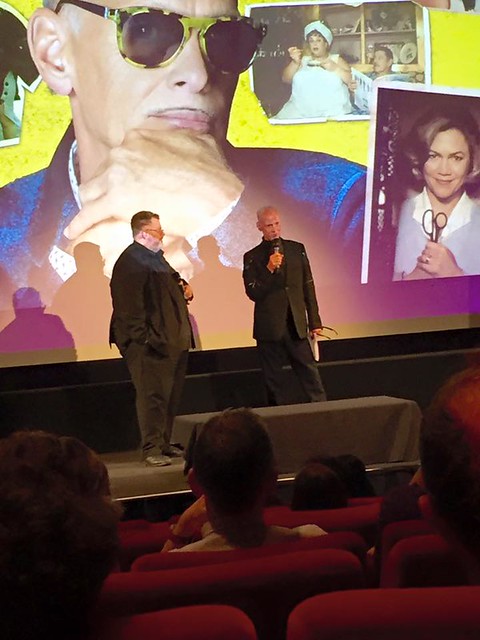
/ The loving recreations of scenes from Trog. I've only ever seen Trog once - but that was at a special screening introduced by John Waters himself at The British Film Institute in 2015! And he interviewed the wrestler Joe Cornelius (Trog himself! The man behind the gorilla mask!) onstage. Read about it here /
The mortification continues at a book signing
session to promote My Way of Life, when it becomes evident that a bratty and
irreverent new generation of younger fans (especially the queer ones) have
derisively embraced Crawford as a camp figure of fun. In an earlier episode of Feud,
Davis had told Victor Buono that she was flattered when drag queens
impersonated her in their nightclub acts. Crawford here sees that for an ageing
diva, being a gay icon is a decidedly mixed blessing (just ask Tallulah Bankhead). Always hyper-alert to any sign of ridicule,
Crawford hisses, “These people aren’t buying the book for my advice. They’re
buying it to mock me.” She’s haughtily affronted when a kittenish blond twink asks
her to autograph a Baby Jane photo. Why did it have to be that film, she
demands. He tries to backpedal by saying he loves What Ever Happened to Baby
Jane? because Blanche and Jane are “survivors.” Crawford abruptly stands up and storms
out, trailed by Mamacita: “What do you know about survival?”


Later, Crawford is crestfallen when she
sees an unflattering paparazzi pic of herself with Rosalind Russell in the newspaper:
“Is that really how I look? Then they’ve seen the last of me”. (This incident genuinely happened: Crawford
had hosted a party in honour of her friend Russell at New York’s Rainbow Room
in 1974. It was indeed her last public appearance). Over the phone she instructs
her manager to take her name off the books: no more film appearances. “I’m
done.” Crawford would withdraw from public life, remaining a recluse until her
1977 death.
Bette Davis, meanwhile is still acting, but
struggling and in inexorable decline. Having lowered her standards to keep employed,
Davis’ career is reduced to making mediocre, unsuccessful TV pilots that don’t
get picked-up. Sarandon is frankly magnificent as the abrasive, raspy-voiced,
chain-smoking and imperious monstre sacree Davis, complete with the 1970s tunics,
turtle-neck sweaters and big owlish smoked-brown spectacles. This dragon lady
incarnation of Davis is the one I remember from TV interviews growing up.

/ Roger Ebert recalling his interview with Davis just before her death: "In the grand style of a movie queen holding court, Miss Davis delivers pronouncements. She speaks in periods and exclamation points, punching out brief, emphatic statements. When she talks, she is always listening to herself talking, constantly monitoring and editing herself, like an actress directing her own performance." Sarandon absolutely captures this terse, theatrical quality. /

/ Bette Davis' 1973 celebrity roast (above) and Feud's recreation (below) /

Davis furiously rages to Victor Buono (Feud portrays him as Davis’ primary confidant) that Kate Hepburn is scoring all the choice roles for older actresses, while she’s left with the humiliating scraps. She then recounts a painful anecdote: Life magazine had recently invited Hepburn to pose with Davis for a special dual portrait – and Hepburn refused. Davis was stung by the rejection – and the realization that Hepburn felt superior to her (“Am I not every bit her equal?” she rails, blinking back tears). In an ideal world, the experience should have given Davis some insight into how she’d made Crawford feel in the past. There’s nothing to indicate Davis made that connection. (By the way: in real life the proposed Davis-Hepburn Life photo shoot was later than Feud implies. It happened in the eighties, not the seventies).

/ Roger Ebert recalling his interview with Davis just before her death: "In the grand style of a movie queen holding court, Miss Davis delivers pronouncements. She speaks in periods and exclamation points, punching out brief, emphatic statements. When she talks, she is always listening to herself talking, constantly monitoring and editing herself, like an actress directing her own performance." Sarandon absolutely captures this terse, theatrical quality. /

/ Bette Davis' 1973 celebrity roast (above) and Feud's recreation (below) /

Davis furiously rages to Victor Buono (Feud portrays him as Davis’ primary confidant) that Kate Hepburn is scoring all the choice roles for older actresses, while she’s left with the humiliating scraps. She then recounts a painful anecdote: Life magazine had recently invited Hepburn to pose with Davis for a special dual portrait – and Hepburn refused. Davis was stung by the rejection – and the realization that Hepburn felt superior to her (“Am I not every bit her equal?” she rails, blinking back tears). In an ideal world, the experience should have given Davis some insight into how she’d made Crawford feel in the past. There’s nothing to indicate Davis made that connection. (By the way: in real life the proposed Davis-Hepburn Life photo shoot was later than Feud implies. It happened in the eighties, not the seventies).

In a previous blog post, I erroneously
claimed that Feud repeatedly shows Crawford visiting elite Hollywood cocktail
bar and restaurant Perino’s but not Davis, even though in real life Davis was a
regular there. I stand corrected! Episode 8 shows a strained and miserable
reunion between Davis and her daughter BD in a booth at Perino’s. In a foreshadowing
of BD Hyman’s 1985 tell-all book My Mother's Keeper, the frankly-disapproving BD instructs Davis
she can longer see her grandchildren without “supervision” and that she needs
to address her “drinking problem.” Davis is aghast: “Since when do you think I'm a
drunk?” “You’re sitting right there with a margarita,” BD replies, “At 11 am!”

Further evidence of Davis’ dissipation is
provided next with a doctor’s appointment that echoes Crawford’s dentist scene.
Sarandon had earlier looked too glamorous as 1960s Davis: here she is properly
haggard, unflatteringly bewigged, complete with a hacking cough and wheezing asthmatic laugh. The
decades of heavy chain-smoking have caught up with her (Davis famously smoked
up to a hundred cigarettes a day). The
sympathetic female doctor implores her to quit, to go into rehab. “I’m off
booze. I can’t give up smoking. They’re my only friends.” (If cigarettes are
your “only friends”, you urgently need to reassess your life). Davis is smoking
openly in her doctor’s office during her check-up in this sequence, which is no
exaggeration. Vanity Fair has described how in real life Davis would even light up at the dentist’s – she was far too scary to be stopped. (Thank god she didn’t
live to see the smoking ban). Feud seemingly suggests Davis’ brand of choice was
Lucky Strikes. In fact, she smoked Vanguards. (Crawford smoked Alpines. I
assume both brands are now long-defunct?).

Davis has an awful experience making a made-for-TV
biopic about Depression-era evangelist Aimee Semple McPherson starring the
notoriously temperamental Faye Dunaway. (The Disappearance of Aimee, 1976). By
all accounts the two women clashed. Davis had long wished to portray “Sister
Aimee” herself. By the 1970s, she was reduced to playing McPherson’s mother in
a secondary role. By comparison, even Davis has to begrudgingly admit that Dunaway’s
chronic lateness and tantrums make Crawford seem like an easy-going paragon of
virtue.
When Buono tells Davis that Crawford is
dying of cancer, she tries to make light of it with a flippant joke: “Cancer
isn’t going to kill Joan. She’s a cockroach just like me.” The perceptive Buono
points out, “She may be the only person in the entire world who really knows
how you feel right now.” Later, we see Davis phone Crawford, but chicken-out
and hang up without speaking when Crawford answers. This incident is probably
Feud’s invention, but Sarandon’s darting, expressive eyes are genuinely
heartbreaking.

/ "This is Joan Crawford speaking ..." /

/ "This is Joan Crawford speaking ..." /

One of Crawford’s adopted twin daughters (Cathy) visits with her children. Crawford is relaxed about her grandchildren rough-housing in her immaculate apartment: in this regard at least, the control freak has finally mellowed in old age. Cathy cautiously refers to the rumoured book in the pipeline by Crawford’s estranged older adopted daughter, Christina. It’s fascinating to think Crawford already knew about the existence of Mommie Dearest prior to her death. Crawford acknowledges she already knows the book is “alleging the most vile things” and admits she was hard on Christina growing up: “I only wanted her to appreciate her advantages.” (This is one more thing Crawford and Davis shared: their daughters both wrote explosive “misery memoirs” about their mothers). Then comes one of Jessica Lange’s finest moments: in a hopeful tone, she hesitantly asks Cathy, “Do they think of me as their real grandmother?” When Cathy replies, “Of course”, Lange’s eyes brim with tears of gratitude and relief
For many viewers, the dream-like sequence that
follows – the dying Crawford’s hallucinatory “party scene” – represents Feud’s artistic
pinnacle. Sound-tracked to the The Flamingos’ doo-wop classic “I Only Have Eyes
for You”, Crawford stumbles from her bed late at night into the living room and
is suddenly reunited with the specters of her chief tormentors: Hedda Hopper, Jack
Warner and Bette Davis, looking exactly as they did in the early 1960s. They
are formally dressed and playing cards by candle light, wielding cigarettes and
martinis. Walking into the frame, Crawford herself is suddenly transformed from
grey-haired ailing crone in a nightie into a glamorous decades-younger manifestation
of herself sheathed in a satin gown. Davis – back in Margo Channing mode – is unexpectedly
sympathetic towards her. “Tell them what they did to you, Joan.” Crawford responds with a regretful, heartbreaking
soliloquy about the emotional cost of her devotion to movie stardom. “I suppose I felt like
I always had to be “on”. If someone caught a glimpse of the girl beneath the
movie star – poof! – I’d go back to the sad little wretch I’d been. I spent my
whole life being Joan Crawford. A woman I created for others. I don’t know who
I am when I’m by myself.”


Warner and Hopper vanish, leaving Davis and
Crawford alone. “Why am I so happy to see you?” Crawford marvels. “Nostalgia,”
Davis replies. In a bit of wish fulfillment, the duo finally manages to bond
and have the conversation they always should have had. They apologize to each
other, Davis telling Crawford, “I wish I’d been a friend to you.” Crawford’s
face (well, Lange’s face) glows with undisguised pleasure. “It’s not too late!”
Crawford exclaims. But it is. She calls for Mamacita to bring a celebratory
bottle of champagne for them to share. The arrival of the actual Mamacita snaps
Crawford out of her reverie. (“There’s no one else here – it’s just you and I”).
It had all been a dream; Crawford is a grey-haired wraith again. Crawford died one week
later. Mamacita tells the documentary filmmaker of her sadness that Crawford’s
funeral was full and star-studded, but when she’d been alive “when she needed
them most, no one was there.”


A journalist phones Davis for her comment
on Crawford’s death. Davis famously responds, “My mother always said don’t say
anything bad about the dead. Only say good. Joan Crawford is dead. Good.” It’s
a pithy – if heartless - quote which will look snappy in print, but once Davis
hangs up, Sarandon’s eyes are filled with remorse. (Davis herself would die in 1989).

We next see Davis visiting her disabled daughter Margo
in the institution. Combing the silent Margo’s hair, the hard-boiled Davis seems
able to let down her defenses and admit to loneliness and hurt. She describes the handsome young artist Don Bachardy drawing her portrait. Davis attempts to
flirt with him. Bachardy tells her he’s gay (in real life he was Christopher Isherwood’s long-term boyfriend). She’s further dejected to see how aged she looks in his unsparing
drawing. It’s a reminder: that’s not just what she looks like, that’s how he
sees her. “Yep. That’s the old bag,” Davis sighs.

/ Above: Don Bachardy's sketch of Davis. Interestingly, he also did Crawford's portrait too /

/ Above: Don Bachardy's sketch of Davis. Interestingly, he also did Crawford's portrait too /

Even worse, Davis has discovered a cache of her late mother’s old letters to a friend. The contents are deeply wounding, making Davis question her mother’s love. She’d written that “that I was a queen bee – that I was selfish and a pain and a chore. “
Finally, the action catches up to the present
day: the Oscars ceremony in 1978, where Olivia de Havilland and Joan Blondell
have been being interviewed by the documentary filmmakers. Backstage, Davis, de
Havilland and Blondell silently watch Crawford honoured as one of the Hollywood
luminaries who’d died that year. Sarandon’s face is a mask of mixed emotions.
When the documentarian asks Davis to speak for his film, she refuses.
Suddenly and unexpectedly, the action cuts from
1978 back to 1961 and the first day of What Ever Happened to Baby Jane?’s
production. It feels like an alternate universe where Crawford and Davis are
relaxed and at ease together, laughing on the set in their canvas director’s
chairs. Picking up her knitting, Crawford tells Davis, “Here’s what I really hope
from this picture when all is said and done. I hope I’ve made a new friend.” Smiling,
Davis replies, “Me too.” It’s a glimpse of what could have been.


Feud wasn’t perfect: it frequently laid-on its arguments about Davis and Crawford as casualties of Hollywood’s sexism and ageism with a trowel. The unconvincing 1978-set "present day" scenes with Oliva de Havilland and Joan Blondell being interviewed by a documentary crew existed purely to provide exposition. (Just think: if Murphy had skipped those, he wouldn’t now be facing Olivia de Havilland’s lawsuit!). And the central thesis that Crawford and Davis’ enmity was somehow manipulated by outside forces rings false. Both were fiercely competitive, temperamental and prickly and both had lengthy histories of clashing with directors and co-stars long before they worked together in the sixties. Think of Davis' skirmishes with Errol Flynn and especially Miriam Hopkins in the thirties and forties (not to mention Faye Dunaway in the seventies). Or Crawford with Norma Shearer in the thirties or Mercedes McCambridge during the making of Johnny Guitar. Of course, once they encountered each other, there would be an inevitable struggle for dominance. Feuding was in their DNA!
With all due regards to Bette Davis and Susan
Sarandon, perhaps Feud’s greatest legacy is the restoration of Joan Crawford’s
image. (Davis never required any rehabilitation in the first place). Without
ever sugar-coating her wrath, her neuroses or her messy alcoholism, the collaboration of Ryan
Murphy and Jessica Lange humanized Crawford, presenting her as a deeply flawed but
compelling anti-heroine, and hopefully banishing the shoulder-padded, wire hanger-wielding
Mommie Dearest caricature forever. In Feud, we see a Crawford who lived with
an unswerving commitment to glamour, almost militaristic in its discipline. That devotion to artifice and appearance can
make someone appear foolish, tragic, make you catnip to gays and ensure you
kitsch cult status. But there’s also something noble – even heroic - about it.
At its best, with its powerful and complex female
protagonists, conflicts, confrontations, torrents of emotional torment
and lush jewel-toned look, Feud invoked the same deeply
satisfying, cathartic vein of melodrama as Crawford’s and Davis’ own Golden Age
Hollywood “women’s pictures.” As Dan Callahan in Nylon concluded, “surely
on that honest tearjerker level, Feud: Bette and Joan is a series
that Bette and Joan themselves would have appreciated.”