Sunday, 22 May 2011

Reflections on Accattone


After French actor Pierre Clémenti died, cult author Dennis Cooper lovingly dedicated a blog to the androgynous and perverse poster boy of 1960s European art cinema. One of the motivations Cooper gave for his tribute was simply because the Bardot lipped, doe-eyed Clémenti is “what beauty looks like.” After recently seeing the Pier Paolo Pasolini film Accattone (1961) for the first time, for me the equivalent of “what beauty looks like” is closer to the Italian actor Franco Citti. (OK, Alain Delon figures in there somewhere too). Citti is of a similar vintage to Clémenti (who of course worked with Pasolini himself) but of an entirely different, butch-er and swarthier type.


Accattone represents the film debut of both the great uncompromising Italian auteur Pasolini (who wrote and directed it) and neophyte 26-year old leading man Citti. In the Italian Neo-Realist tradition, Pasolini cast his films with non-professional actors. Pasolini certainly struck gold with Citti, who he’d go on to use in several subsequent films. Accattone entirely centres on Citti’s astonishingly natural performance and charismatic physical presence. As writer Judy Bloch has pointed out, his “rough-hewn beauty is like a slap in the face.”

I actually saw Pasolini’s second film, Mamma Roma (1962) before Accattone. (I love Mamma Roma slightly more than Accattone simply because it features a lacerating performance from the volcanic Anna Magnani, the earth mother / she-wolf of Italian cinema. Citti pops up in Mamma Roma too – again playing a pimp as he does in Accattone, this time with a sleazy little moustache). Both Accattone and Mamma Roma firmly share the same sensibility as Luis Bunel’s Los Olvidados (1950): they’re devastating politicised studies of how grinding poverty defines peoples’ lives and their options.


Anna Magnani, the great tragedienne of Italian cinema, in Pasolini's Mamma Roma (1962)


Pasolini in conversation with Anna Magnani during the filming of Mamma Roma (1962)

Pasolini was fascinated and inspired by the uncorrupted and marginalised peasant culture of the cafone (the Italian equivalent of hillbillies; in English subtitles, when characters in Accattone and Mamma Roma argue their insult of choice is frequently translated as “hick”, which seems to be a scathing put-down). This is the milieu of Accattone, depicting the underclass of pimps, prostitutes and thieves struggling for survival in the post-war borgate (slum or shanty town) outside of central Rome. (Accattone, like Mamma Roma, was filmed in the Pigneto district – one of my favourite, most atmospheric neighbourhoods of Rome. At the time Pigneto would have been a slum. It’s been gentrified considerably since these films were made, but for me Pigneto is still haunted by Accattone and Mamma Roma and the ghost of Pasolini).

Citti plays the film’s anti-hero, a sullen young pimp. He’s named Vittorio but everyone calls him “Accattone” (Roman slang for beggar or scrounger). Accattone and his gang of lay-about friends reject work for a life of sponging, hustling and pimping -- and who can blame them, when the film implies the only alternative would be back-breaking hard physical labour at starvation wages anyhow? “Work?” Accattone howls, incredulous, at one point. “Animals work!”


At first you think how brave Pasolini is to base a film around such a callous, amoral and unsympathetic character, especially when you see how abusive Accattone is towards his dim-witted whore Maddalena and realise he has a wife and young child he’s abandoned. So Accattone is a prick, but as portrayed by Franco Citti he's a sexy and compelling prick. And as the film progresses we see chinks of despair, self-loathing and stoical suffering in Accattone -- revealed mostly wordlessly through Citti’s soulful expression and sorrowful hooded eyes. One of Citti’s best moments is after his brother in law kicks the snot out of him, while the entire extended family and neighbours cheer him on. With jeers of, “Pappone!” ("Pimp!") ringing in his ears, the battered Accattone makes his abject walk of shame home; we alone see the dejected expression on his face. It’s a heart-wrenching moment.


Pappone! Pappone!

Seen today, Accattone is still viciously hard-edged and unsentimental. Men beat whores for the sheer sport of it, and because they can. Cartagine (a rat-faced, feral teenaged psychopath and one of Accattone’s partners in crime) brags in a bar about how the night before he and his friends assaulted a prostitute. “What a beating! You should have seen us,” he laughs. “How she begged us!”

(An aside: one of the prostitutes (Margheritona) is played by actress Adriana Moneta, who's like someone out of Fellini's Le notti di Cabiria (1957). She’s instantly recognisable as Ninni, the prostitute who gets picked up by a slumming Marcello Mastroainni and Anouk Aimee in Fellini’s La Dolce Vita (1960). According to IMDb, these were her only two film credits – if true, her filmography may be modest but she can claim to have played the archetypal earthy, tough but good-natured Roman prostitute for two of Italian cinema’s great maestros).


Marcello Mastroianni, Adriana Moneta and Anouk Aimée in La Dolce Vita (1960)

Pasolini ennobles the struggles of his characters while never romanticising their poverty. (To his credit, he’s never guilty of poverty chic or poverty porn). These are people who are genuinely at risk of going hungry, who are reduced to stealing and selling their father’s false teeth in order to eat; it’s shown as virtually inevitable that a pretty girl will turn to prostitution. Accattone is simultaneously squalid and lyrically beautiful. What Pasolini does do is elevate the harsh, grinding suffering of the impoverished cafone to the level of operatic high tragedy in beautifully composed shots that evoke Renaissance paintings, with classical music swelling on the soundtrack. When Maddalena is driven to a deserted wasteland and savagely beaten by some vengeful Neapolitan henchmen of her previous pimp, Bach soars on the soundtrack as the camera observes her lying like a broken doll on the ground, swooping down on her abandoned handbag and a solitary shoe.

Maddalena is played by Silvana Corsini, presumably another non-professional actor. Pasolini obviously liked her, as she would later play Bruna, the town tramp with fuzzy arm pits who seduces Anna Magnani’s teenaged son in Mamma Roma. Information about Corsini is scarce: maybe she was simply a pretty local girl and Pasolini liked her face, but Corsini has an interesting screen presence and is exceptional at suggesting credulous, slightly uncomprehending not particularly bright child-women. After Maddalena’s assault, there is a memorable scene in the police station where the local thugs and pimps are brought in for her to try to identify her attackers. A true connoisseur of firm Mediterranean male flesh, Pasolini’s camera lingers over the handsome criminals’ tough insolent faces in loving close-ups. In retrospect, you can’t help but shudder and recall Pasolini was murdered by a psychotic teenaged rent boy in 1972 - if they represent his ideal type, Pasolini certainly paid the consequences.


The subtitles are in French for this clip, unfortunately

From the start, it’s hinted that Accattone painfully recognises the futility of his life and harbours a death wish. We see funeral processions, premonitions of death, and nightmares about impending death. “Either the world kills me, or I’ll kill it!” Accattone wails towards the end of the film. One guess who wins that challenge. Suffice to say, the film ends with a character exhaling, “Ah, now I’m fine ...” with cruel irony, while someone else stands over them making the sign of the cross with handcuffs on their wrists.


A drunk Accattone with tears running down his face

Saturday, 14 May 2011

Reflections on ... Boom! (1968)


/ Together they devour life! Or at least chew the scenery /

Baroque. Opulent. Decadent. Berserk! I celebrated my birthday on 12 May by attending a rare screening of the infamous 1968 Joseph Losey film Boom! at The Institute of Contemporary Art with my friend Alison. I’ve long been curious about the film for its reputation as one of the biggest bombs in Hollywood history and because Pope of Trash John Waters (one of my heroes) has championed it so enthusiastically and persuasively as his all-time favourite movie. "I show it to every person I think I'm falling in love with,” Waters claims. “If they hate it, I don't talk to them anymore." And finally, it seemed like a nice way to pay tribute to the film's leading lady, Elizabeth Taylor, who died in March. (When I interviewed Waters for Nude magazine in December 2010, he recalled how in the 90s he finally met Taylor at a party and was able to profess his love for Boom! She was horrified and screamed, “That movie is terrible!”). I can confirm Boom! still hasn't lost its capacity to alienate and annoy: the screening Alison and I attended was sparsely-attended. The couple in front of us walked out early on.


/ The wonderfully lurid trailer for Boom! /

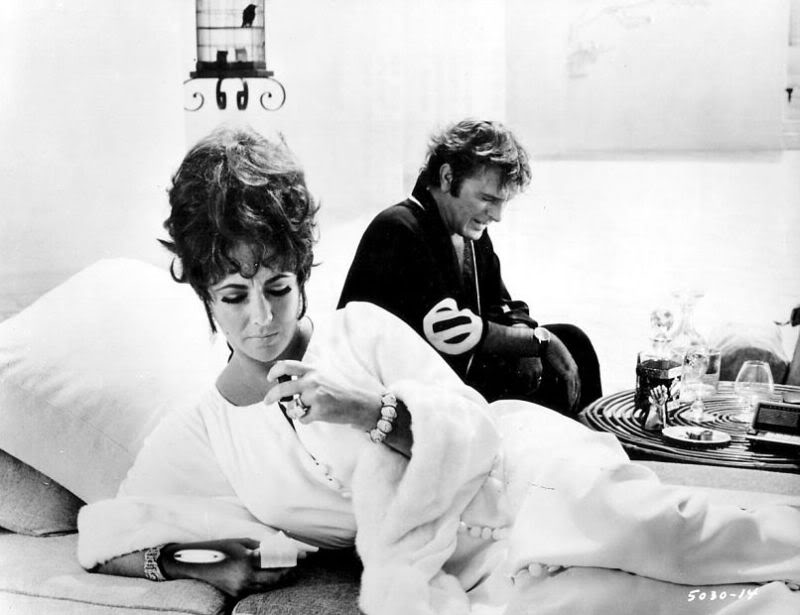
A true “film maudit”, Boom! is mainly remembered as a disastrous star vehicle / vanity project for tempestuous then-married duo Taylor and Richard Burton, at what author Lee Server has called “their jet-setting, conspicuously-consuming, bad-movie making height.” Tennessee Williams himself adapted the screenplay from his flop play The Milk Train Doesn’t Stop Here Anymore. Taylor plays ageing hedonist Flora “Sissy” Goforth, the much-married, drug addicted richest woman in the world (and it’s been argued, the most irritating woman in the world). From the windswept high solitude of her all-white villa on the edge of a cliff on a private island on the Amalfi Coast, the terminally ill Goforth is in denial about her imminent death, distracting herself by dictating her sensational Proustian memoirs into a tape recorder and directing her diva’s wrath at her long-suffering servants in fractured Italian (“Shit on your mother!” she screams at a maid who displeases her). "I need a lover," she growls to her secretary. Sure enough, she is visited by the enigmatic Christopher Flanders (played by Burton), a failed poet turned gigolo notorious on the international jet set as an ambiguous and parasitic Angel of Death who materialises whenever a wealthy woman is about to die.

In theory Boom! initially may have seemed promising. Taylor and Burton were show business royalty and the public was still entranced by their glitzy soap opera lifestyle. Taylor had triumphed in earlier film adaptations of Tennessee Williams plays like Cat on a Hot Tin Roof (1958) and Suddenly Last Summer (1959). Joseph Losey was a hip, art-y director of the moment, critically acclaimed for films like The Servant (1963). But considering the play Milk Train had failed on Broadway twice already in two different versions (in 1963 and 1964), it seems an odd choice as source material for a lavish big budget film adaptation. Tennessee Williams himself couldn’t be expected to be objective, but surely Losey, Taylor and Burton probably should have considered the play’s failure as an ominous premonition? The doomed 1964 Broadway production (which closed after only five performances) certainly sounds fascinating: it perversely partnered the odd couple of dissipated grand dame of the American stage Tallulah Bankhead as Goforth with wholesome 1950s teen heartthrob Tab Hunter as Flanders.


/ Tab Hunter as Christopher Flanders and Tallulah Bankhead as Sissy Goforth in the 1964 Broadway production of The Milk Train Doesn't Stop Here Anymore /


/ Gruesome twosome: Bankhead and Hunter /

The resulting film is overblown, irresistibly absurd, high camp run amok and unintentionally hilarious. Losey depicts the Goforth mansion as a grotesque freak show deluxe, complete with a sadistic dwarf bodyguard in jodhpurs and riding boots, a pet monkey on a chain, a talking mynah bird in a cage and sitar-playing Indian musicians. A cadaverous-looking Noel Coward pops up in a dinner jacket as a gossipy gay socialite nicknamed the Witch of Capri. When Flanders first trespasses onto Goforth’s island, her savage attack dogs are released – just like Mr Burns does with his hounds on The Simpsons.


/ Taylor as Sissy Goforth and Burton as Christopher Flanders /

Boom! feels drenched in a boozy / narcotic haze, which apparently extended both on and off screen. “They made this film drunk …” Waters has pointed out. The Burtons were famously hard-drinking, and Losey and the cast reportedly began each day’s filming with a round of Bloody Marys, and it shows. Drunken impaired judgement would certainly explain a lot. In any given shot it’s rare for a character not to have either a drink or a cigarette in their hand -- in Taylor's case, usually both (Taylor wields an outrageously long cigarette holder). The camera lingers over characters availing themselves of huge pitchers of Bloody Marys (which, it has to be said, look pretty tempting). There’s almost as much pill-popping as in The Valley of the Dolls. At one point Taylor washes down a fistful of pain killers with a gigantic snifter of brandy.

Then there’s the eternal problem of film translations of Tennessee Williams plays: his dialogue (heightened, poetic, high-falutin’) doesn’t translate easily to the screen. The atmosphere of decadence and impending tragedy is laid-on thick; everyone seems death-obsessed and is apt to suddenly start philosophising in long, meandering soliloquies about the meaning of life. Waters has shrewdly argued Boom! should be approached as a “failed art movie”: certainly Losey (out of his depth and reportedly intimidated by Liz and Dick) seems to be striving for high European art cinema seriousness, layering on heavy-handed symbolism a-go go, soundtracked by a doom-laden John Barry score and the constant sound of waves crashing onto the rocks. The moments of Taylor suffering panic attacks on her balcony, for example, recall Monica Vitti’s existential nervous breakdown in Michelangelo Antonioni’s 1964 Il Deserto Rosso. (Maybe if Boom! was made in a different language, if Taylor and Burton were dubbed in Italian, the film would have felt less risible?).

Considering Boom! was primarily conceived as a showcase for Taylor and Burton, they’re surprisingly miscast. For one thing, their ages are all wrong: Taylor is too young and Burton too old -- the play was about the relationship between an older, dying woman and a much younger man. Sissy Goforth is supposed to be dying: when Tallulah Bankhead played the role onstage she was in her 60s and genuinely wraith-like, prematurely ravaged by emphysema and the consequences of a suicidally debauched lifestyle (it would be her last major theatrical performance and she would die within five years). The 35-year old Taylor, on the other hand, looks sun-kissed, plump and in robust good health even when coughing up blood in a consumptive fit or writhing in agony screaming for an injection.


/ Another bourbon, darling? A desiccated Tallulah Bankhead towards the end of her life /

Similarly, as an elite high society gigolo Flanders surely should be a bronzed Adonis, or something like Terence Stamp in Pier Paolo Pasolini’s 1968 film Teorema. Clad throughout in a samurai warrior’s robe (complete with ceremonial sword), Burton looks haggard and faded. It's he who looks like he’s dying, instead of Taylor. (We get a few fleeting glimpses of Burton swimming naked – they’re deeply unappealing).


/ Taylor pouts through the pain. Burton as the angelo della morte looks moodily into the distance /

In any case, Boom! is overwhelmingly dominated by Taylor in full-throttle imperious, overripe, scenery-chewing diva mode. Camille Paglia has written of Taylor in another Joseph Losey film, Secret Ceremony (also 1968) as being “at the peak of her mature fleshy glamour.” That’s definitely true here, too. Shrouded mainly in floor-skimming caftans, with elaborate bouffant hairstyles augmented with hair pieces, Taylor is glamorous but prematurely matronly and slathered in thick make-up. Still channelling Martha in Who’s Afraid of Virginia Woolf? and shrieking like a harridan, Taylor’s Sissy Goforth is self-parodic, unhinged and drag queen-y: no wonder John Waters says Taylor’s appearance and abrasive performance in this film were a beloved source of inspiration for Divine. (Waters has said Divine was so influenced by Taylor that he smoked Salem cigarettes purely because they were Taylor's brand of choice).


/ So demanding ... /


Boom! is recognised today as a camp classic (it ticks all the right boxes as listed in Susan Sontag’s 1964 Notes on Camp essay, especially in terms of “failed seriousness”). It certainly seems to have a queer sensibility, and perhaps the role of Sissy Goforth is best approached as a coded drag queen. Interestingly, Rupert Everett played the role of Sissy in drag in a 1994 British stage production of Milk Train. And famously the role of the Witch of Capri was originally conceived as (and played onstage by) a woman and in Boom! it’s played by Noel Coward. (The part was originally offered to Katherine Hepburn – who was deeply offended). There’s a jaw-droppingly tasteless and misogynistic scene where the Witch of Capri describes a friend who refers to women as “poisson” and sniffs from a vial of ammonia to disguise the scent of any menstruating woman who might pass by him on the street. Seriously – what the hell were they thinking?!

While by no stretch a "good" film, Boom! is incredibly beautiful to look at, weirdly enjoyable and frequently mesmerising in a way only a truly trashy bad movie can be. There's a wonderful tension between the film's high-minded, literary aspirations and its actual lurid vulgarity. Essentially a filmed play, Boom! is extremely talk-y, but Losey’s prowling camera and elegantly composed shots ensure it’s never dull to watch. The production values were obviously high, and they're visible on the screen: the jewels Taylor wears, for example, are all genuine, on loan from Bulgari and worth an estimated $2,000,000. The art direction, sets, exteriors and Taylor’s garish wardrobe (especially her eye-popping Kabuki ensemble with the exploding headdress) are incredible. (Some of Taylor's costumes were apparently designed by Karl Lagerfeld). Captured in glorious Panavision, the sun-drenched Italian Riviera locale is exquisite (Boom! is usually described as having been filmed in Capri, but the closing credits say it was filmed on location in Sardinia). Boom! is immersive, a noble and ambitious failure, a real experience. Like Elizabeth Taylor’s interpretation of Sissy Goforth, it’s simultaneously seductive and repellent. Boom! is finally majestic in its misguided awfulness.


/ Taylor in Kabuki costume and Coward as The Witch of Capri /


/ John Waters discussing his love for Boom! /

Thursday, 5 May 2011

Las Vegas Grind! Viva Las Vegas 2011


Viva Las Vegas 2011 seemed to go by a blur! Maybe that’s the reason I took less good photos than usual. Less of my American friends went this year, which was a bit of a letdown. I caught brief glimpses of Satan's Angel and Dean Micetich of DiCE Magazine (aka the artist formerly known as Kid Rocker) but then never saw them again for rest of weekend. Missed Sweetpea’s Hootch and Smooch warm-up party on afternoon of Thursday. Didn’t make it into Double Down Saloon or Atomic Liquor and Cocktails (my two favourite Las Vegas dive bars. In fact Jim and I did make a special trek to go to the Double Down Saloon, but I neglected to bring my passport and the bouncer on the door wouldn’t let me in because I didn’t have ID to prove I was over 21! At my age!). Didn’t catch Big Elvis's lounge act this year (a sacrilege!). Didn’t catch either the burlesque showcase or the burlesque contest, even though my friend Sarah (aka Slinky Sparkles) was a contestant in the competition (the long queues to get in to both were extremely off-putting). Where the hell did the time go?!


/ After about a grand total of twelve and a half hours in an airplane, Sarah and Jim were gasping for a cigarette by the time we arrived in Vegas /


/ Sarah and I at The Orleans. Note her Vivienne Westwood handbag. It's genuine /

The highlights: Caught some great bands. Pachuco Josey y Los Diamantes. The Modern Don Juans. Los Straitjackets. Los Tiki Phantoms. (Yes, the future of rockabilly is Latino!). After Chuck Berry’s creaky and underwhelming performance in 2010 (Jim and I left after watching only three or four songs), I was wary of headliner Jerry Lee Lewis but the 75-year old rockabilly legend was in great voice and on stately / majestic form (even if he didn’t sing “Breathless”, my favourite song of his).


/ Closest thing I could get to a close-up of Jerry Lee Lewis performing at the car show /

Meeting Mistress of the Dark Elvira at the car show involved queuing in the baking sun for about 35 minutes and then buying wildly over-priced merchandise for the privilege of having my photo taken with her – but was well worth it to meet one of my teenaged idols. Elvira (aka Cassandra Peterson) was gracious and charming, and the woman is an ageless icon, revered by punks, rockabillies and Goths.


/ Elvira and I /


/ Close-up of Elvira: the photo is even better with me cropped-out! /


/ Present-day flame-haired veteran burlesque legend (and star of Teaserama) Tempest Storm at the car show /


/ Tempest Storm in the fifties /

Exploring the Charleston Antique Mall (a treasure trove of mid-century vintage kitsch) was fun. Was great seeing Jorge from Los Angeles (aka DJ Zorch) and his beautiful new girlfriend, albeit briefly. Finally meeting Sean Law! The pool parties with the surf band Aquasonics performing live every afternoon. For their sets they were joined onstage by Seattle burlesque starlet Miss Kitty Baby go-go dancing. Watching Kitty Baby (an escapee from a 1960s Russ Meyer film, with added tattoos) shake it like a Poloroid in the dreamy Vegas sunshine while drinking Pabst Blue Ribbon is a life-affirming experience: if the Viva Las Vegas weekender has a queen, it’s Miss Kitty Baby.


/ Me, Jim and Jorge (aka DJ Zorch from Los Angeles) /


/ Historic Meeting: Two Canadians Meet in Las Vegas! Sean Law and I /


/ Go, baby, go! Miss Kitty Baby in action, go-go dancing to the surf sounds of the Aquasonics /


/ Jim and Miss Kitty Baby: Note how the lurid colours of his Hawaiian shirt and her go-go dancer outfit coordinate beautifully /

Fittingly, one of the film selections on the flight back to London was the classic 1953 Marlon Brando juvenile delinquent / motorcycle gang film The Wild One. I hadn’t seen it since I was a teenager and before popping an Ambien and crashing out for most of the journey I made a point of watching it. By today’s standards some aspects of The Wild One may seem camp-y and dated, but it’s a tightly-constructed, energetically told and really enjoyable B-movie, and as a rockabilly fanatic it obviously holds a timeless fascination for me. For one thing, the film came out before rock’n’roll burst through, so it’s surprising when a smouldering and insolent young Brando swaggers into a cafe and fires up the jukebox, instead of a burst of twang-y rockabilly it emits ... jazz. (Frantic bebop jazz, but even still! No wonder the trailer refers to them as “jazzed-up hoodlums”). And the clothes Brando and his gang The Black Rebel Motorcycle Club wear are so covetable they had me virtually drooling. The black leather engineer boots, the perfect Levis with the perfect turn-ups, the t-shirts, the leather jackets, the caps, the sunglasses, the quiffs, the sideburns ... Brando and his gang remain the absolute visual / sartorial ideal for male rockabillies in the way that, say, Bettie Page or Mamie van Doren do for female rockabillies.


Anyway, roll on Viva Las Vegas 2012!

See more of my Viva Las Vegas 2011 photos on flickr

Wednesday, 27 April 2011

DJ Set List for Gail and Jasja's Leaving Party 15 April 2011


/ Gail and Jasja (aka Sparkle Moore and Cad van Swankster, the proprietors of London's most chi chi vintage clothing emporium The Girl Can't Help It) were given a raucous and boozy send-off at their farewell party at Ryan’s in Stoke Newington on 15 April 2011 /


/ (Gail and Jasja were married on 1 April 2011. The sugar couple from the top of their wedding cake looks eerily like them -- down to the fine details of Jasja's tattoos!) /

In the 1990s Gail was the hostess / promoter of sleazily atmospheric club nights like More than Vegas and Blue Martini – clubs that plunged Soho back to its seedy neon-lit 1950s golden age. I discovered More than Vegas early on when I first arrived in London and it was instrumental in making me the twisted fuck I am today!

I didn’t take as many photos as I should have at the party (how could I not have photographed Ms Mansfield?!). I was DJ’ing for the first half of the night, which was a bit chaotic (technical problems a-go go!) and afterwards drank a helluva lot to de-stress. (Did I mention it was a boozy night?). Gail and Jasja have re-located to San Diego and will be much-missed by their friends in London. (Jasja would definitely want me to point out The Girl Can't Help It is staying put at Alfie's Antique Market and is in the safe hands of Laurie Vanian).

It was an honour to be asked by Gail to be one of the DJ's at their leaving-do. Going to More than Vegas in the early 90s was definitely a factor in making me want to pursue DJ'ing, and the More than Vegas resident DJs like Jake Vegas and (especially) the sublime Ms Mansfield were certainly an inspiration.


/ The Way They Were: Ms Mansfield and Jake Vegas in the old days at More than Vegas at The St Moritz on Wardour Street /


/ Gail and Mari in the nineties /

Gail's only musical stipulation was she wanted lots of Eartha Kitt, Jayne Mansfield and Violetta Villas so I definitely played more than one track by each (well, except for Violetta as I only have one song by her!). Playing at least one song by the original Sparkle Moore, the great female rockabilly chanteuse Gail swiped her name from, was also compulsory.


/ Me DJ'ing at Gail and Jasja's leaving party. Can I just say in my own defence, it was very hot in that corner and I'd been running up and down the stairs earlier ... /

I was the first DJ on and the whole audio situation was very much cobbled together at the last minute and very stressful (and I was pounding back beer to combat the stress), so my set wasn't as smooth and flowing as I would have liked. But anyway, here it is ...

Woh! Woh! Yea! Yea! The Dynamos
Vesuvius - The Revels
Rock-A-Bop - Sparkle Moore
Boss - The Rumblers
Sweet Little Pussycat - Andre Williams
St Louis Blues - Eartha Kitt
Esquerita and The Voola - Esquerita
The Whip - The Originals
Suey - Jayne Mansfield
Beaver Shot - The Periscopes
Chatta Nooga Choo Choo - Denise Darcel
The Girl Can't Help It - Little Richard
Fujiyama Mama - Annisteen Allen
She Wants to Mambo - Johnny Thunders and Patti Paladin
Bossa Nova Baby - Elvis Presley
Heartbreak Hotel - Ann-Margret
Beat Girl - Adam Faith
Crawlin' - The Untouchables
Fever - Timi Yuro
Peter Gunn Twist - The Jesters
Comin' Home - The Delmonas
I Was Born to Cry - Dion
Summertime - Little Esther
You're My Thrill - Chet Baker
Willow Weep for Me - The Whistling Artistry of Muzzy Marcellino
Little Things Mean a Lot - Jayne Mansfield
Dragon Walk - The Noble Men
I Love the Life I Live - Esquerita
Czterdziesci Kasztanów (Forty Chestnuts) - Violetta Villas

See more photos from Gail and Jasja's leaving party here

See photos from Gail and Jasja's last-ever yard sale here

(Looking at this set list in retrospect, am sure I've left some songs off ... I definitely played Eartha Kitt's version of "Mack the Knife" in there somewhere. I DJ'd for at least 90-minutes, so there must have been more songs than that! Ah, well. They're lost in the mists of time now).

Sunday, 17 April 2011

13 April 2011 Dr Sketchy Set List


/ An intoxicated and bleary-eyed Jayne Mansfield parties with Mamie van Doren (check out Mamie's outrageously fake wighat). Jayne looks the way I feel /

This might be a bit of a rush job: I fly to Vegas for the annual Easter rockabilly weekender Viva Las Vegas early morning on 20 April and want to blog this set list while it's still fresh in my mind.

I’m the first to admit this night wasn’t one of my better ones: lots of technical glitches to feel anxious about (i.e. with the microphone, the decks themselves, and will I ever work out how the stage lights at The Royal Vauxhall Tavern work?!). Plus the RVT is synonymous with still-agonising romantic disappointment for me (don’t worry, I’ll spare you the details) and as a result I drink one helluva lot more there while DJ’ing, which probably impacts on things. Hopefully the music didn’t come across as too disjointed and erratic.

Musically what I’m really feeling at the moment is moody, atmospheric 1950s heartbreak ballads, the kind with lots of echo on the singer’s voice and ghostly rockabilly guitar: think Eddie Cochran’s "Half Loved", “The Strangeness in Me” by The Runabouts and the eerie “Flower of My Heart” by Sparkle Moore. (I’m kicking myself for not packing “The Fire of Love” by Jody Reynolds – something I’ll rectify next time). "Mess of Blues" is one of my favourite Elvis ballads. “Nobody Knows” by The Earls of Suave packs a boozy sense of regret I can certainly relate to these days.

I wrote recently about my love for the turbulent Turners, but I didn’t realise Ike and Tina ever did a version of “Love Letters” until recently. The song is something of a pop standard, covered by everyone from Elvis, Peggy Lee, Julie London and of course Kitty Lester, whose hushed, gospel-inflected version was used so hauntingly by David Lynch in Blue Velvet. Ike and Tina's rendition couldn't sound less like a typical Ike and Tina number: it opens with a swirl of sugary strings and the Ikettes sound almost angelic, contrasting nicely with the sandpaper rasp of Tina's voice. Her delivery initially starts quite measured but within no time she’s in full roar, tearing the song apart with her bare hands – you’ll never hear a more urgent version of “Love Letters!”


The inimitable Ophelia Bitz was the emcee again this time. This night featured a burlesque performer (Lady Cave, who’s Australian and sports a black patent leather Louise Brooks bob) and the model Tiffany Chin-Sim. For her pose Tiffany wore a spangled belly dancer costume, so needless to say I played Eartha Kitt’s “Uska Dara” and exotica like “Camel Walk” by The Saxons and “Lust” by Les Baxter, featuring the Yma Sumac-like wails, growls and screams of Bas Sheva.


Nobody Knows - The Earls of Suave
The Flower of My Heart - Sparkle Moore
Mess of Blues - Elvis Presley
Reconsider Me - Margaret Lewis
Love Letters - Ike and Tina Turner
Love Oh Love - Little Esther
Two-Timing Loser - Johnny Thunders and Patti Paladin
The Strangeness in Me - The Runabouts
Harbour Lights - Dinah Washington
Sea of Love - The Earls of Suave
Stop and Listen - Mickey and Ludella
Fury's Tune - Billy Fury
Tiger - Sparkle Moore
Half-Loved - Eddie Cochran
Willow Weep for Me - Lizabeth Scott
Ebb Tide - Al Anthony
Solitude - Eartha Kitt
Les Amours Perdue - Serge Gainsbourg
If I Should Lose You - George Shearing
The Thrill is Gone - Chet Baker
I'm Through with Love - Marilyn Monroe
I Almost Lost My Mind - Bill Black Combo
Night Scene - The Rumblers
The Beast - Milt Buckner
Monkey Bird - The Revels
Fever - Nancy Sit
Comin' Home - The Delmonas
No Good Lover - Mickey and Sylvia
Mondo Moodo - The Earls of Suave
Aged & Mellow - Little Esther
Jungle Walk - The Dyna-Sores
Makin' Out - Jody Reynolds
I Wanna See You Dance - Hank Stirrup and Chet Tendon
Gizmo - Jimmy Heaps
Suey - Jayne Mansfield
Baby Doll Mambo - Belmonte and His Afro-American Music
Catwalk - Jack Constanzo
Uska Dara - Eartha Kitt
Camel Walk - The Saxons
Frenzy - The Hindus
Lust - Les Baxter
You Know I'm No Good - Wanda Jackson
That's Why I'm Askin' - Carl Dobkins Jr
Salamander - Mamie van Doren
Wait a Minute, Baby - Esquerita
Snow Surfin' Matador - Jan Davis
Nicotine - The Vikings
Tu veux ou tu veux pas - Brigitte Bardot
Fever - Timi Yuro
Teach Me Tonight - Dinah Washington
Harlem Nocturne - Martin Denny
I Feel So Mmmm - Diana Dors
Smoke Gets in Your Eyes - Mallet Men
C'est si Bon - April Stevens
Bachelor's Paradise - Ann-Margret
Crawlin' - The Untouchables
Torture Rock - The Rockin' Belmarx
One Night of Sin - Elvis Presley
Shangri-la - Spike Jones New Band
Beat Girl - Adam Faith (Beat Girl soundtrack)
Like a Baby - Wanda Jackson
Mack the Knife - Hildegard Knef
Jealousy - Billy Fury
Don't Let Me Be Misunderstood - Nina Simone

Tuesday, 12 April 2011

9 April 2011 Dr Sketchy Set List


/ Kiss Them for Me: Jayne. Oh, Jayne ... /

For this Dr Sketchy (at The Old Queen's Head in Angel), the emcee was Ophelia Bitz and the performer / model was Cherry Shakewell: I defy anyone not to have fun with cabaret and burlesque royalty like these two. Plus it was the first Dr Sketchy for me to unveil my week-old new tattoos (they’d finally healed, stopped flaking and were presentable at last).

I eased into proceedings with some Latin exotica (mambo, the 1965 Eartha Kitt Canta en Espanol album) before journeying into deep vintage sleaze. Cherry Shakewell’s image (bouffant blonde hair, thick false eyelashes, white lipstick) evokes Russ Meyer-esque 60s go-go dancers so while she posed I went heavy on 1960s sex kitten / babydoll-type tracks by the likes of Bardot, Nancy Sinatra and Ann-Margret. Obviously Jayne Mansfield (the punk Marilyn Monroe, who died for our sins) is an eternal touchstone: her track “Suey” always sounds to me like the tortured inner monologue of a go-go dancer gyrating from the confines of her glittery go-go cage – the perfect soundtrack for Cherry’s pose. I also decided long ago that "Cherry" by The Jive Bombers should be Ms Shakewell's theme song.

/ Star-struck: When Jayne met Marilyn /


Another tune I play a lot lately is "You Can't Stop Her" (1959) by Bobby Marchan (1930 -1999), the African-American New Orleans-based rhythm & blues singer best known for fronting Huey Piano Smith & the Clowns. Driven by raucous sax, the song has a vibe similar (both musically and lyrically) to Little Richard’s “The Girl Can’t Help It.” In fact Marchan and androgynous Queen of Rock’n’Roll Little Richard could be seen as soul sisters or fellow travellers: when he was scoring hit records with The Clowns Marchan dressed in male clothing, but prior to that he’d gained local notoriety as a blonde-wigged female impersonator and emcee billed as Loberta in evocatively-named dive night clubs like the Dew Drop Inn and Club Tijuana. In his consistently amazing blog The Houndblog, James “The Hound” Marshall writes about Marchan’s fascinating life and career, uncovering the subterranean drag queen influence in blues and rhythm & blues (and therefore rock’n’roll itself), the kind of angle usually airbrushed (bleached? Deracinated?) out of the hidebound “straight” (in every sense) rock history limited to Elvis, The Beatles and those endless “100 Greatest” lists. (For a nicely-researched thoughtful piece about the queer sensibility that throbbed in the background of blues and R&B, read this).

/ The Bronze Liberace: a very young Little Richard /


/ Esquerita in full cry /


Marshall mentions that both the outrageously seedy Esquerita and Little Richard also started out as at least quasi drag queens at the beginning of their careers, too. Little Richard’s drag stage name was “Princess Lavonne”, and some of his best known songs are supposedly coded tributes to his old drag queen friends: “Good Golly Miss Molly”, “Long Tall Sally.” (“Tutti Fruiti”, of course, is legendarily a paean to anal sex). In the repressed pre-civil rights 1950s middle class white parents were anxious enough about their kids listening to (and being corrupted by) the likes of Little Richard, Bobby Marchan and Esquerita: just imagine if they’d really known the full story! Freaking out the squares – it’s a wonderful tradition. As Marshall concludes in his Bobby Marchan profile...

“Of the many untold secrets that still hide up the rumpled skirt of R&B and rock’n’roll history, one surprise you will find is a black cock, and I’m not talking about roosters.”

Until next time -- take it sleazy!

/ Little Richard: What a beauty ... /


Chihuahua - Mina
Où Es-Tu Ma Joie - Caterina Valente
Babydoll Mambo - Belmonte and His Afro-American Music
Chihuahua - Luis Oliveira and His Bandodalua Boys
Historia de un Amor - Eartha Kitt
Eso - Conjunto TNT
Snow Surfin' Matador - Jan Davis
Scorpion - The Carnations
Sea of Love - The Earls of Suave
Flower of My Heart - Sparkle Moore
Indescribably Blue -Elvis Presley
Lover's Land - Margaret Lewis
Love Letters - Ike & Tina Turner
Little Things Mean a Lot - Jayne Mansfield
Tonight You Belong to Me - Patience & Prudence
Hearts Made of Stone - Rudy Gray
Oh Lonesome Me - Ann-Margret
Commanche - The Revels
Baby Come Back - Esquerita
Nosey Joe - Bull Moose Jackson
Oo Ba La Baby - Mamie van Doren
Stop and Listen - Mickey & Ludella
Fever - Nancy Sit
Raunchy - Bill Black Combo
Don't Be Cruel - Bill Black Combo
Makin' Out - Jody Reynolds
Angel Face - Billy Fury
The Girl Who Invented Rock'n'Roll - Mamie van Doren
Cherry - The Jive Bombers
Sugar Town - Nancy Sinatra
Harley Davidson - Brigitte Bardot
The Swinger - Ann-Margret
You Can't Stop Her - Bobby Marchan
The Big Bounce - Shirley Cadell
Open the Door - The Cochran Brothers
Rip It Up - Little Richard
Astro-Sonic - Jimmy Haskell & His Orchestra
What a Difference a Day Made - Dinah Washington
Chattanooga Choo Choo - Denise Darcel
Wine Spo-Li-Oli - The 5 Strings
Cry - Timi Yuro
Look for the Silver Lining - Chet Baker
Yes, Sir That's My Baby - Ann Richards
Blues in My Heart - The John Buzon Trio
Cha Cha Cha du Loup - Serge Gainsbourg
Love for Sale - Hildegard Knef
Crawlin' - The Untouchables
Beat Girl - Adam Faith (Beat Girl soundtrack)
Womp Womp - Freddie & The Heartaches
Honey Rock - Barney Kessel
Dragon Walk - The Noble Men
Suey - Jayne Mansfield
Groovy - The Groovers
8 Ball - The Hustlers
Diamonds Are a Girl's Best Friend - Julie London
Do It Again - April Stevens
Mack the Knife - Eartha Kitt
You're My Thrill - Dolores Gray
Strip-tease - Nico (Strip-tease soundtrack)
Misirlou - Laurindo Almeida
Summertime - Little Esther
You Know I'm No Good - Wanda Jackson
Jealousy - Billy Fury
Lover - Peggy Lee
Caravan - The John Buzon Trio
Czterdziesci Kasztanów (Forty Chestnuts) - Violetta Villas

This installment's titty shaker ...

Sunday, 3 April 2011

28 March 2011 Dr Sketchy Set List


A fun and enjoyable night at The Paradise in Kensal Green. Wait, it’s uncharacteristic of me not to complain about something -- well, the venue was freezing cold, so it was an evening of goose bumps and erect nipples (I speak only for myself here). There.

Our featured burlesque performer and model were both rising burlesque starlets making their Dr Sketchy debuts: performer Ava Iscariot made a real impression with her raven-haired Bettie Page wig and glittery black tarantula-shaped pasties. The gorgeous model Pia was actually a former audience member whose beauty and poise so impressed Dr Sketchy promoter Clare Marie she persuaded her to model for us (this is like a great show biz “discovery” story in the tradition of a nubile young Lana Turner being discovered drinking a milkshake at Schwab's drugstore by a Hollywood agent). Both undoubtedly have great futures ahead of them.

Emcee “Queen of Cabaret” Ophelia Bitz was on typically raucous form: a vision in leopard skin gold sequins, she warned the front row of the audience she wasn’t wearing any underwear and cautioned they might get a glimpse of “flange”. (The spirit of Tallulah Bankhead lives on). One of the definite perks of DJ’ing at Dr Sketchy is having Ophelia sing along to (and sometimes go-go dance along to) the CDs I’m playing in the DJ booth. It’s like being serenaded!

What Is This Thing Called Love? Lena Horne
I Remember You - Chet Baker
Work Song - Nina Simone
If I Should Lose You - George Shearing
You've Changed - Billie Holiday
The Man I Love - Hildegard Knef
Ebb Tide - Al Anthony
Willow Weep for Me - Lizabeth Scott
Harlem Nocturne - Martin Denny
The Immediate Pleasure - John Barry (Beat Girl soundtrack)
Intoxicated Man - Serge Gainsbourg
Un jour comme un autre - Brigitte Bardot
Night Scene - The Rumblers
Two Timing Loser - Johnny Thunders and Patti Paladin
Stop and Listen - Mickey and Ludella
You Got What You Wanted - Ike and Tina Turner
Bewitched - Shirley and Lee
Sea of Love - The Earls of Suave
Flower of My Heart - Sparkle Moore
Tear Drops from My Eyes - Ruth Brown
This Thing Called Love - Esquerita
Hump-a-Baby - Little Ritchie Ray
Pick-Up - The Corvettes
Rock'n'Roll Waltz - Ann-Margret
It's Only Make Believe - Billy Fury
Salamander - Mamie van Doren
Made You - Adam Faith
Intoxica - The Centurions
Love Potion # 9 - Nancy Sit
Yeh, Yeh! Mongo Santamaria
What Is This Generation Coming To? Robert Mitchum
Don't Be Cruel - Bill Black's Combo
Snow Surfin' Matador - Jan Davis
Woh! Woh! Yeah! The Dynamos
Womp Womp - Freddy and The Heartaches
Catwalk - Jack Constanzo
You Know I'm No Good - Wanda Jackson
Anytime - Bill Black's Combo
Crawlin' (The Crawl) - The Untouchables
A Woman Wouldn't be a Woman - Eartha Kitt
Harlem Nocturne - The Viscounts
Beaver Shot - The Periscopes
Dragon Walk - The Noble Men
Caterpillar Crawl - The Strangers
Sick and Tired - Lula Reed
Green Mosquito - The Tune Rockers
The Bee - The Sentinals
Fool I Am - Pat Ferguson
I Ain't in the Mood - Helen Humes
Bonjour Tristesse - Juliette Greco
Lonely Hours - Sarah Vaughan
Black Coffee - Peggy Lee
Sexe - Line Renaud
When Love Goes Wrong - Marilyn Monroe and Jane Russell
Caravan - John Buzon Trio
The Whip - The Originals
Boulevard of Broken Dreams - Sam Butera
Frankie and Johnny - Mae West
Coquette - Dinah Washington
Summertime - Little Esther
Revellion - The Revels

/ Titty shaker du jour: the mighty "Womp Womp" by Freddy & The Heartaches - featuring Lili St Cyr (1918 - 1999) /


Mind-blowing clip from 1960 Italian horror / sexploitation flick The Vampire and The Ballerina. I think calling them "ballerinas" is a bit misleading ...