Let’s reflect on ineffably suave Canadian poet, novelist and singer Leonard Cohen - an artist synonymous with bohemian integrity and dignity – who died on 7 November 2016 aged 82. In particular, his relationship with inscrutable German chanteuseNico (1938 - 1988). They first met in 1966 in New York before Cohen was famous. Nico had just left The Velvet Underground and was striking out on her own. He called her "The most beautiful woman I'd ever seen." But then he also added, “Nico was very strange.”
As Cohen himself recalled: “When I first came to New York - I guess it was around 1966 - Nico was singing at The Dom, which was an Andy Warhol club at the time on 8th Street. I just stumbled in there one night and I didn't know any of these people. I saw this girl singing behind the bar. She was a sight to behold. I suppose the most beautiful woman I'd ever seen up to that moment. I just walked up and stood in front of her until people pushed me aside. I started writing songs for her then. She introduced me to Lou Reed at that time."
The song Cohen wrote for Nico was “Take This Longing.” Cohen claims she used serenade him with it, but Nico never recorded it or added it to her repertoire. Can you imagine: Nico singing the words of Leonard Cohen in that sibilant vampire priestess voice? (Instant goose bumps). He would later compose another melancholy ballad inspired by Nico, “Joan of Arc.” The lyrics certainly evoke Nico: “And something in me yearns to win / such a cold and lonesome heroine / And who are you? she sternly spoke …”
(The enigmatic Nico was one of the great rock muses. Musicians like Lou Reed, Jim Morrison, Jackson Browne, Iggy Pop, Marianne Faithfull and others would all go on to write songs about her).
In some accounts, Cohen and Nico were lovers. They certainly would have made for an exquisitely gloomy, romantically-despairing deep-voiced couple. It was not to be. In truth, she rebuffed his overtures. “Somehow I managed to meet her. And within five minutes of our conversation she told me to forget it, because she was only interested in young men. But she said, I'd love to be a friend of yours - and we became friends". Nico’s preferences for ‘em young and pretty are well documented: her boyfriend at the time was doe-eyed 18-year old musician Jackson Browne (who wrote the song “These Days” for her). A few years later she would turn her cougar-ish attention to nubile punk Iggy Pop. Bear in mind “older man” Cohen was 33 at the time – a grand total of four years Nico’s senior!
“I was madly in love with her. I was lighting candles and praying and performing incantations and wearing amulets, anything to have her fall in love with me, but she never did …,” Cohen would ruefully confess. “The years went by and we became quite tender with each other, but nothing romantic ever came of it.”
Cohen’s first album The Songs of Leonard Cohen (released December 1967) owed a significant debt to Nico’s solo debut Chelsea Girl (released October 1967). Think plaintive urban-beatnik folk music with coolly compassionate deep sonorous vocals, sparse musical accompaniment and downbeat glass-half-empty lyrics. The poet who’d not yet sung in public had learned, observed and absorbed while watching Nico perform at The Dom. Andy Warhol perceptively noted of Cohen’s album “it’s like Nico with whiskers.” In his 1980 memoir POPism: The Warhol Sixties, Warhol went further, recalling: “Leonard Cohen the Canadian poet was there (The Dom) quite a few nights in the audience down at the bar, just staring at her. Later on when he cut a record album I read a review that said his singing was like he was “dragging one note over the entire chromatic scale,” and I couldn’t help thinking of all those hours he’d spent listening to Nico …” . The Songs of Leonard Cohen created a sensation and launched him on his path. Although recognised as a classic today, Nico’s Chelsea Girl met with indifference at the time. It proved prophetic: cult diva Nico was destined to toil in obscurity during her lifetime.
For Cohen, his liaison with Nico would shape his musical direction and lead to an enduring (if sometimes stormy) friendship. (Nico had a penchant for violence in her volatile later years: during a misunderstanding, Cohen says Nico once “hauled off and hit me so hard it lifted me clean off the bed”). For Nico, the legacy would be more prosaic: in the sixties, Cohen turned her onto macrobiotic food, a diet she would stick with for the rest of her life. Over the years they would occasionally reunite when they both found themselves staying at The Chelsea Hotel in New York. "She's a great singer and a great songwriter,” Cohen said of Nico. “Completely disregarded from what I can see. I mean, I don't think she sells fifty records, but she's I think one of the really original talents in the whole racket.”
This website devoted to Nico. The 1993 biography Nico: The Life and Lies of An Icon by Richard Witts. POPism: The Warhol Sixties by Andy Warhol and Pat Hackett
This was the first time I’d DJ’d for a Dr Sketchy at The Royal
Vauxhall Tavern since the Valentine’s one in February 2013. As a freaked-out casualty / terminal worry
wart I was sure I would have forgotten everything I ever knew about using their
decks. Then when I unpacked my DJ bag I quickly realised my headphones were
missing the little “adapter” attachment that makes them compatible with the
hole in The RVT’s console, so couldn’t use them at all. (I must have left it
behind the last time I DJ’d, which would have been at the May 2013 Lobotomy Room at Ryan’s in Stoke Newington). Obviously this meant I couldn't listen to
the track first in my headphones before playing it – so I had to ensure I cued
the right one every time and hope for the best! (Luckily, all night I only
played the wrong song once – not that anyone else would have been the wiser!). Plus
I drank three pints of lager on an empty stomach (I went to the venue straight
from work) – a recipe for things getting potentially sloppy. But in fact, I felt
exceptionally relaxed and in control and (if I do say so myself!) think it was
one of my tightest, most flowing and consistent sets ever. Maybe drinking three
pints of lager on an empty stomach is the answer!
As usual, I initially eased into things with some Mondo
Exotica (Yma Sumac, Martin Denny), hopefully invoking a taboo, primitive and
sensual Tiki ambiance, and then alternated between wailing greasy rhythm and
blues and rancid tittyshaking sleazy instrumentals. I also worked in some Beat,
beat beatnik beatsville rock’n’roll novelty songs: Bing Day’s finger snapping, flute-laced
“Mama’s Place”, Mamie Van Doren belting out the theme tune to her (frankly
awful!) 1959 exploitation film The Beat Generation. I do love ersatz beatnik
novelty tunes! Speaking of which...
Two Beatnik poetesses (or at least, the 1950s Hollywood interpretation)
in full flow. First, Philippa Fallon in High School Confidential (1958). To me, her sneering delivery anticipates Lydia Lunch:
Below: Maila Nurmi (aka glamour ghoul / horror movie hostess
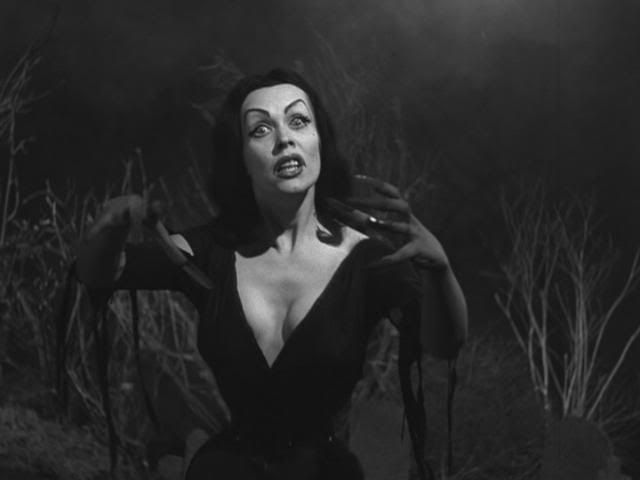
Vampira, out of her Morticia Addams-style drag) reciting a poem in The Beat
Generation (1959) and wearing a pet rat as a fashion accessory. Sadly, the audio quality not so great on this one. I do love Nurmi's restless, swaying body language in the clip -- like someone on amphetamines. You can watch
the whole film on Youtube.
What links these two clips? The presence of character actor Jackie Coogan (Uncle Fester in The Addams Family!) in both.In High School Confidential he's accompanying Fallon on piano; in The Beat Generation he's tough guy / cop Steve Cochran's partner
The emcee this time was Ebeneezer Valentine (think surly
Scottish escapee from Trainspotting). There were two burlesque artistes and
models: Frankie Von Flirter and Millie Dollar. For Frankie’s first pose I dove
into eerie 1950s Cool Jazz (the sound of one finger snapping in an echo-y morgue)
with a David Lynch-ian twist, starting with doomed heroin-ravaged Cool Jazz
icon Chet Baker’s “You’re My Thrill” (he did a great vocal version of this jazz
standard, but at Dr Sketchy I always play the instrumental that appears on his
1965 album Baker’s Holiday: Plays and Sings Billie Holiday. It has a sexy
bump-and-grind burlesque rhythm), and then followed it with two songs from
Lynch soundtracks. “Up in Flames” appeared in Wild at Heart (1990), memorably sung
by raspy-voiced blues mama Koko Taylor. I opted for the more ghostly Julee
Cruise interpretation, as featured on her underrated (and long out of print) 1993
The Voice of Love album (I snapped it up on CD at Amoeba Records when I was in San Francisco in April. What a coup!). Milt Buckner’s slinky “The Beast” (a perennial Dr
Sketchy favourite) appears in Mulholland Drive (2001).
In the second half, Frankie appeared in drag king mode for
her Top Gun-inspired routine. Because of her military uniform, Clare Marie (Dr
Sketchy’s ornately tattooed glamazon promoter) requested military-inspired music for
these poses, which explains Dietrich’s “Give Me the Man” (she’s pining for a
Foreign Legion soldier, ideally as played by young Gary Cooper in Morocco) and
the Sadomasochism-tinged “I’d Love to Take Orders from You” by Mildred Bailey.
I’d never worked with Millie Dollar at a Dr Sketchy before,
and I loved her hard-boiled, tattooed old-school stripper persona. Her big
number ended with her twirling her pasties individually, and then ensemble –
talented woman. Her orange spangly costume (the colour of a tequila sunrise!) had a belly dancer / harem girl look,
which inspired me to journey into Middle Eastern / Turkish exotica for her
poses: “Turkish Coffee” by Omar Kay, Eartha Kitt’s “Uska Dara”, “The Maharajah
of Magdor” by The Blue Echos. (I also like to think I was being timely and topical, and showing solidarity with the Turkish protesters in Istanbul!).
As well as the usual vintage sleaze, I raised the tone a bit
by playing some foreign language Continental artistes: France’s Serge
Gainsbourg and Juliette Greco, Germany’s Hildegard Knef (I love her world-weary, sixty cigarettes-a-day guttural voice). For one of Millie’s
poses I also played Anouk Aimée’s musical number from the key nouvelle vague
film Lola (1961). A friend of mine went to Paris recently and kindly brought me
back a boxed set of CDs entitled Nouvelle Vague: Chansons et musiques de films,
which includes this song. I've always treasured Aiméeas one of the most
haunting and beautiful of French actresses (I've already blogged about Aimée’s
performance in Fellini’s La Dolce Vita – and her sensational cat’s eye
sunglasses). She gives her career-best performance in Lola as a naive,
love-struck cabaret chanteuse and single mother. Normally Aimée was called upon to be enigmatic,
or to suffer eloquently (something her sorrowful dark eyes were ideal at
conveying) but in Lola she plays against type, channeling effervescent Marilyn
Monroe at her most childlike, and is beguiling.
I've always loved Aimée’s
delivery of this song in her sexy showgirl outfit – so it was quite
disillusioning to get the CD and see that in fact, it’s not Aimée singing at
all! It certainly sounds like Aimée'sown hesitant, whisper-soft voice, but she’d
been dubbed by professional singer Jacqueline
Danno! The liner notes explain that the director Jacques Demy knew he wanted a
musical sequence for the film, and filmed Aimée“speak” the lyrics like reciting a poem –
and then later on, his composer Michel Legrand knocked-up the accompanying music
and Danno painstakingly sang along to Aimée's lip movements so they could be
synced. Sounds chaotic, but that’s probably why the best 1960s French nouvelle vague
films still feel so fresh, playful and spontaneous: they were cobbled together in a haphazard fashion and on a tight budget.
Anyway, that’s show biz! I probably won't be DJ'ing again now until 13 July 2013 -- the next Lobotomy Room night at Paper Dress Vintage! Details here. In the meantime, follow me on tumblr -- although perhaps not from your work PC! (NSFW alert!).
Taita Inty (Virgin of the Sun God) - Yma Sumac
The Girlfriend of the Whirling Dervish - Martin Denny
Kismiaz - The Cramps
Se Acabo - The Del Rio Bros
The Monkey Bird (Conga Twist) - The Revels
C'mon-a My House (in Japanese) - Eartha Kitt
One Mint Julep - Sarah Vaughan
Slow Walk - Sil Austin
Night Walk - The Swingers
Welfare Cheese - Emanuel Laskey
You're Driving Me Crazy - Dorothy Berry
One Monkey Don't Stop No Show - Big Maybelle
I Can't Sleep - Tini Williams and The Skyliners
Beaver Shot - The Hollywood Hurricanes
Little Queenie - The Bill Black Combo
Greasy Chicken - Andre Williams
Mama's Place - Bing Day
Beat Generation - Mamie Van Doren
Intoxica - The Centurions
Wiped-Out - The Escorts
Hanky Panky - Nancy Sit
Margaya - The Fender Four
I Walk Like Jayne Mansfield - The 5,6,7,8s
Scorpion - The Carnations
Night Scene - The Rumblers
Last Call for Whiskey - Choker Campbell
I Ain't Drunk, I'm Just Drinkin' - Jimmy Liggins
The Sneak - Jimmy Oliver
La Valse des Si - Juliette Greco
La Fille de Hambourg - Hildegard Knef
You're My Thrill - Chet Baker (instrumental version)
Up in Flames - Julee Cruise
The Beast - Milt Buckner
Are You Nervous? The Instrumentals
Wait A Minute, Baby - Esquerita
He's The One - Ike and Tina Turner
Rockin' Out The Blues - The Musical Linn Twins
I'm a Bad, Bad Girl - Little Esther
Lola - Jacqueline Danno
The Immediate Pleasure - John Barry (Beat Girl soundtrack)
Some Small Chance - Serge Gainsbourg (Strip-tease soundtrack)
Turkish Coffee - Omar Kay
Uska Dara - Eartha Kitt (1960s version)
The Maharajah of Magador - The Blue Echoes
Beat Party - Ritchie and The Squires
Pass The Hatchet - Roger and The Gypsies
Chattanooga Choo Choo - Denise Darcel
Boss - The Rumblers
Club Delight - Jack Jolly
Cocktails for Two - Cliff Duphiney
Give Me the Man - Marlene Dietrich
I'd Love To Take Orders from You - Mildred Bailey
Two Little Girls from Little Rock - Marilyn Monroe and Jane Russell
Bikini with No Top on the Top - Mamie Van Doren and June Wilkinson
The Whip - The Frantics
Thirteen Men - Ann-Margret
The Girl Can't Help It - Little Richard
Begin the Beguine - Billy Fury
Drummin' Up A Storm - Sandy Nelson
Viens danser le twist - Johnny Hallyday
Handclappin' Time - The Fabulous Raiders
Suey - Jayne Mansfield
Tina's Dilemma - Ike and Tina Turner
Just got back from a typical Sunday afternoon chez my old friends Petra and Rob’s: Vintage French chanson records (Piaf, Juliette Greco, Gilbert Becaud) playing on the vintage record player. Ice-cold Cava served in vintage glasses (are you catching a theme here?). Three languid cats prowling around or drowsing. Except this time, there was a baby in the room!
Petra gave birth to a strapping, healthy 9 1b baby boy Dorival Lino Swanson on 25 April 2012, and this was my first chance to meet my new “nephew.” Before this, I’d only seen a few photos on Facebook. While I was there, Dorival (the name is Brazilian. Both Petra and Rob are crazy about Brazil, have travelled there pretty extensively and love Samba and bossa nova music) was a bit cranky and clingy (with both Petra and Rob) and also seemed ravenously hungry. I didn’t attempt to hold him on my lap this time, but I did manage to kiss him on his tiny pink sea shell-like ear. I can confirm he is the personification of “adorable” and fascinating to watch (even when he’s sleeping!). He has a thick thatch of jet black hair, dark blue eyes (although they’re liable to change colour in coming months; all babies are born with blue eyes) and a very cherubic face. So far he looks like his dark-eyed, dark-haired German mutti more than his British father, but that also could change as he gets older.
Dorival as a newborn still in the hospital
Dorival as a newborn with Mama Petra
Dorival as a newborn with vati Rob (these three photos swiped from Petra's Facebook profile!)
Rob was saying Dorival seems to find music soothing: when Rob strums bossa nova songs on his acoustic guitar, or spins French chanson on the stereo, Dorival stops fussing (maybe he likes the sound of accordions?). They intend for him to grow up fluent in English, German and Portuguese (and maybe even Spanish; his mother speaks these languages like a native), so Dorival is destined to be a true cosmopolitan, globe-trotting homme du monde at this rate.
With such chic parents, it’s not surprising that Dorival is already a stylish baby. His red and white-striped babygrow references the Breton-striped sailor / nautical look. Rob also suggests it makes him look like a convict in a striped uniform. Maybe we should call it his Jean Genet look?
Petra and Rob seem to be taking to parenthood completely naturally in their own serene and laidback way. Petra in particular is like a beatnik earth mother crossed with Morticia Addams (when I think of Petra and Rob as parents, my reference points are Gomez and Morticia Addams, or Fred and Lily Munster).
Dorival and Rob
Angelic: Dorival sleeping in his Moses basket
Finally! A shot of Dorival sitting up with his eyes open! Dorival and his beautiful mutti. The cloth on Petra's shoulder is because Dorival pukes a lot
Even the cats are coping with the traumatic arrival of a newborn baby surprisingly well. When his crying grows too shrill and annoying, they simply leave the room. Sometimes they have to be shooed out of Dorival’s Moses basket and pram, which they seem to find really inviting to curl up in. The volatile and sensitive Fernando (Petra rescued him as a stray from Spain years ago; he’s like a temperamental Spanish prince) seemed hungrier for affection than usual. He loves male attention, and jumped on Rob’s lap as soon as Dorival was off it. He was even sweet and cuddly with me (he can turn violent when I pet him too much. Last New Year’s Eve he gave me such a savage mauling it looked like I’d been self-mutilating!).
An atypically mellow Fernando snoozing on my leg
Anyway, I look forward to spending more time with my beautiful new nephew.
(Petra and Rob long ago reconciled themselves to the fact that I’m the Diane Arbus / Nan Goldin / Larry Clark figure in their lives, documenting everything with my digital camera. See many years worth of beatnik parties at their various flats over the years here. The fabulous Fernando (aka Fernandito) has his own album here)
Cast your mind back to Season 1, episode 8 of Mad Men (for me, the only TV show that matters. Here in the UK, evil tycoon Rupert "Montgomery Burns" Murdoch has poached Mad Men from the BBC for his Sky Atlantic cable station. Which I don’t subscribe to – so how the hell I’ll ever see the much-yearned for Season 5 I’ll never know. But I digress).
Anyway, in this episode outwardly suave but inwardly tormented Brylcreemed ad exec Don Draper swings by a party thrown by his volatile beatnik mistress Midge, where the bohemian East Village guests lounge around listening to 1950s Cool Jazz (Kind of Blue by Miles Davis, to be precise) and smoke reefer. When Don arrives at the Beat party, the door to Midge’s apartment is opened by ... me?
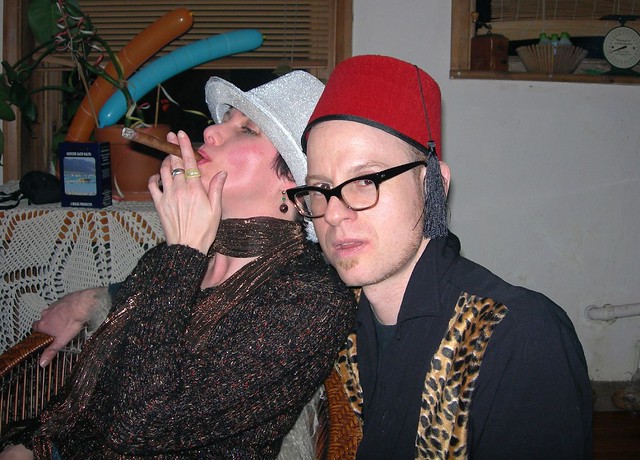
OK, so this actor (I've done a cursory Google search and can't find a screen credit for him) is considerably more handsome than me (and inevitably taller. At 5'6", I'm jockey sized). And I wouldn't touch that earth-toned paisley shirt with a barge pole. But the scruffy ginger facial hair. The vintage horn-rimmed glasses. The pasty complexion. It’s not even like I’m averse to donning a fez on occasion ...
(New Year's Eve 2009: International sex kitten Magda and I. Dig those phallic balloons in the background!)
(Another shot from New Year's Eve 2009)
Before this, the closest I’ve had to a doppelganger in real life was the first time I ever went to the Viva Las Vegas rockabilly weekender in 2003. That weekend a female friend told me that she’d seen me coming down the escalator, went to say Hi and when she got closer she gasped – it looked exactly like me, but wasn’t me. Turns out my lookalike was French, and his name was Jean-Paul. Before the end of the weekend, my friend managed to introduce us. I don’t think he was flattered by the comparison! That was nine years ago – I think I look more like Jean-Paul now than I did then. On that weekend (my dream holiday I’d been looking forward to and saving for, my first time in Vegas) I was stricken with shingles! When the rash erupted it was like a Biblical curse, disgusting and painful. Luckily it happened towards the end of the weekend rather than the beginning. After returning from the doctor’s office, I collapsed in bed tripping on a cocktail of ultra powerful antiviral medication and prescription pain killers. The TV was on in the hotel room, tuned into CNN. While I lay there delirious, hair drenched in sweat, I heard a newscaster’s voice solemnly announce, “Jazz and blues legend Nina Simone has died aged 70 ...” So that’s how I always know exactly what I was doing on 21 April 2003.
Early 1960s Ann-Margret: distilled essence of sex kitten
For once I have some photos from the day to post: my old pal Melissa Houston was in attendance armed with a seriously impressive big-ass photojournalist camera, and it turns out she’s a pretty damn good photographer . Seriously – who knew Melissa had any talent? She also had a good (crotch-level) seat right by the front of the stage – oh, the sights she must have seen that afternoon!
Las Vagueness: Me behind the DJ booth, lost in thought -- or just blank?
This nicely laidback and boozy Saturday afternoon Dr Sketchy at The Old Queen’s Head in Angel featured the ever-soigné Dusty Limits as emcee, Bomb Voyage modelling and Bettsie Bon Bon performing a bump-and-grind striptease routine and modelling.
Dusty Limits
The dazzling Bettsie Bon Bon knows how to make a real impression: rather than stripping down to her pasties and g-string and stopping, she kept going ... disrobing until just a tiny glittery silver heart-shaped merkin was left to preserve her modesty!
Bettsie Bon Bon
The ornately-tattooed Bomb Voyage is definitely one of our punkier and edgier models. On this occasion she posed while wielding a baseball bat, so I cranked-up the aggression and confrontation musically. “She is My Witch” is pretty much Bomb’s theme tune; the knuckle-dragging piano and unearthly screams of Esquerita’s blood-curdling “Esquerita and the Voola” suggests the soundtrack to a Santería voodoo ritual -- or human sacrifice.
Bomb Voyage
Later, Dusty asked for a Beatnik-style art-y jazz instrumental. Needless to say I dusted-off "A Cruise to the Moon" from Lydia Lunch's 1979 death-jazz Queen of Siam album, over which Dusty improvised some finger-snapping Beat poetry. It worked dreamily, daddio.
Beatnik Poetry, Part 1 (Note: that's Uncle Fester from The Addams Family on piano -- I shit you not).
Beatnik Poetry, Part 2
Towards the end of the day, I improvised a little mini-tribute to Sylvia Robinson of 1960s rhythm and blues duo Mickey and Sylvia, who died on 29 September 2011, aged 75. Robinson had a fascinating and long career on pop’s fringes as a singer, songwriter and producer: after her musical partnership with Mickey Baker ended, the durable Robinson went on to have disco hits in the 1970s (like "Pillow Talk") and was a key figure in the emergence of hip hop in the early 1980s. Obviously it’s her early R&B I prefer. I played the snarling “No Good Lover” by Mickey and Sylvia, Johnny Thunders and Patti Paladin’s cover version of “Love is Strange” and her sassy early solo song (when she was billed as "Little Sylvia")“Drive, Daddy, Drive.”
A pretty girl is like a melody: Bettsie Bon Bon and Bomb Voyage pose together
Afterwards, Mel and I went on a bar crawl, from The Old Queen’s Head to The Joiners Arms to The George and Dragon. It got messy. Let’s stop here ...
Watermelon Gin - Florence Joelle's Kiss of Fire Little Ole Wine Drinker Me - Robert Mitchum Souvenir, Souvenir - Johnny Hallyday Friction Heat - Bonnie Lou Leave Married Women Alone - Jimmy Cavallo The Flirt - Shirley and Lee Get Back, Baby - Esquerita I Ain't in the Mood - Helen Humes Greasy Chicken - Andre Williams Fever - Nancy Sit Baby Let Me Bang Your Box - The Bangers Beaver Shot - The Periscopes Poon Tang - The Treniers Nosey Joe - Bull Moose Jackson Eager Beaver Baby - Johnny Burnette Cafe Bohemian - The Enchanters I Gotta Right to Sing the Blues - Billie Holiday You're Driving Me Crazy - Chet Baker Angel Face - Billy Fury Shangri-La - Spike Jones New Band Go Slow - Julie London Traume - Francoise Hardy Ford Mustang - Serge Gainsbourg Night Walk - The Swingers She's My Witch - The Earls of Suave The Rat - The Ventures Rigor Mortis - The Gravestone Four Esquerita and The Voola - Esquerita A Cruise to the Moon - Lydia Lunch Beat Generation - Mamie van Doren Beat Party - Ritchie & The Squires Elle est Terrible - Johnny Hallyday Drums A Go-Go - The Hollywood Persuaders My Daddy Rocks Me - Mae West 8 Ball - The Hustlers Blues in My Heart - The John Buzon Trio C'est Si Bon - April Stevens Teach Me Tonight - Dinah Washington Mack the Knife - Eartha Kitt Chattanooga Choo Choo - Denise Darcel Drive-In - The Jaguars Beat Girl - Adam Faith The Coo - Wayne Cochran I Learn a Merengue, Mama - Robert Mitchum Go, Calypso! - Mamie van Doren Rum and Coca-Cola - Wanda Jackson Groovy - The Groovers Frenzy - The Hindus Rockin' Bongos - Chaino Train to Nowhere - The Champs You Don't Know Baby - Wanda Jackson Boss - The Rumblers Rip it Up - Little Richard No Good Lover - Mickey and Sylvia Love is Strange - Johnny Thunders and Patti Paladin Drive, Daddy, Drive - Little Sylvia Happy, Happy Birthday Baby - The Tune Weavers Stop and Listen - Mickey and Ludella Chicken Grabber - The Nite Hawks Devil in Disguise - Elvis Presley Begin the Beguine - Billy Fury Love for Sale - Hildegard Knef
/ Juliette Greco in the 1960s: trademark black dress and black eyeliner /
“When I was a young girl, Juliette Greco was my absolute idol ... If I want to be anybody, I want to be Juliette Greco.” Marianne Faithfull
I last saw Juliette Greco perform in June 2000 at The Barbican – one of the most mesmerising concerts I’ve ever seen. After a decade-long gap, she returned to London to cast another spell, this time at The Royal Festival Hall on 21 November 2010 to conclude the 2010 London Jazz Festival. My initial impression at seeing the now 83-year old grand dame of French chanson take the stage was to note that she looks regal but frail– until she opened her mouth. Greco’s impossibly deep and sensual voice, saturated in a lifetime of Gauloises (or Gitanes?) smoke and vin rouge, is still lacerating. (Someone once described Marlene Dietrich’s voice as sounding like autumn leaves being crunched under leather boots. It equally applies to Greco’s expressive throaty rasp). Then, that she is reassuringly still beautiful and her incredible charisma and sense of drama more potent than ever. Onstage, chanson’s great living exponent remains a torrent of seething emotion and volcanic intensity.
A quick summary for any newcomers to the magic of Juliette Greco: She emerged from the smoky cellar dives of post-war Left Bank Paris like Le Tabou and La Rose Rouge to achieve international stardom as both a chanteuse and an actress. Greco and her family had been active in the French Resistance, and her music and image are steeped in the rebellious, politicised bohemian French intellectual life centred around Saint-Germain-des-Prés. From early on she was encouraged to sing by the likes of by Jean-Paul Sartre and Boris Vian, and besotted leading French poets and philosophers wrote lyrics specially tailored for her (wonderful songs like “"Si tu t'imagines”, her first hit), establishing Greco as the black-clad high priestess of existentialism and a strong, enduring female presence in French popular culture. In the late 1940s she began an interracial affair with visiting American jazz star Miles Davis. Author Lewis MacAdams argues “the offspring of their three-year, long-distance liaison – of the marriage of bebop and existentialism – was the birth of cool.”
/ Beatnik icon: a very young Greco at the beginning of her career in the early fifties /
/ The birth of cool: Miles Davis and Juliette Greco in the fifties /
But hey I’m superficial, so it doesn’t hurt that in the 1950s Greco was lusciously, wantonly beautiful and nailed a timeless, striking almost Morticia Addams-esque look: tousled mane of dark hair, all-black wardrobe, kohl-blackened eyes under a Bettie Page fringe. The liner notes to one of her 1950s albums swoons about “the fascinating child-woman with the wild black hair and the deep-set burning eyes ...” Greco’s magnetic image set the template for female beatniks worldwide, who ironed their hair and donned winged black Cleopatra eyeliner and black polo neck sweaters in emulation. (As a fashion icon Greco belongs up there with countrywoman Brigitte Bardot and Edie Sedgwick. These days, fashion stylists and photographers probably reference the Greco style without realising where it originated).
/ Juliette Greco eyeliner technique /
/ Juliette Greco paper doll: weirdly, there's no black dress in the wardrobe selection! /
/ Various Greco faces over the years (during her fifties Hollywood stint, she had two nose jobs, which dramatically changed her appearance) /
/ Greco in Hollywood: co-starring with Richard Todd in the 1958 film The Naked Earth /
Anyway, it could have been a nostalgic trawl through Greco’s greatest hits, written for her by the likes of Jacques Brel and Serge Gainsbourg – which would still have been spellbinding. Instead it was an evening of stark minimalism: a black stage, Greco in her signature severe black dress (a floor-length bat wing-sleeved velvet shroud worthy of Vampira), and the formidable Greco songbook stripped down to just accordion (accordionist Jean-Louis Matinier) and piano (her husband and long-time accompanist Gérard Jouannest, who composed the music for many of Jacques Brel’s classics).
And while Greco has over 60 years of songs to chose from (she made her singing debut in 1949), she obviously chose the songs that have the greatest personal meaning for her, drawing largely from her majestic late-period work (like 1998’s Un jour d’ete et quelques nuits... and 2006’s Le temps d’une chanson) rather than solely 1950s and 60s crowd-pleasing material (for example, no “Sous les ciels de Paris”, and instead of "Les feuilles mortes", she sang Gainsbourg’s song about “Les feuilles mortes”,” La Chanson de Prevert”), although the set was certainly generously studded with Greco’s classics.
With her commanding theatrical gestures, Greco is as much an actress as she is a singer. Certainly she acts as much as she “sings”: melody definitely isn’t one of her priorities. Over the years Greco’s voice has coarsened and darkened, and is noticeably harsher and more guttural than on her old recordings. But it’s something she works to her advantage: Greco belongs to that elite group of female song stylists whose husky ravaged tones were powerful rather than pretty, and ideal for conveying romantic suffering and world weariness: think late-period Billie Holiday, Nina Simone, Hildegard Knef, Lotte Lenya, Dietrich, and younger singers like Nico and Marianne Faithfull, who very much followed in Greco’s tradition.
Greco hurled herself into every song, transforming each one into performance art. Her songs evoke a variety of moods: she tore into Brel’s "Bruxelles" with an almost angry glee, whereas Gainsbourg’s “La Javanaise” was spine-tingling, slowed-down and delicate. One thing she demonstrated is that at 83 she still retains her sensuality. Introducing “Deshabillez Moi” (Undress Me) she joked she really shouldn’t be singing it at her age, but it’s such a great song she will anyway – and then became the consummate self-mocking sex kitten, which she maintained for the rousing “Jolie Mome” and “L'Accordeon” (during which she played her own body with her fingertips as if it were an accordeon). Greco still has the erotic confidence of a great beauty (whose admirers included Miles Davis, Marlon Brando, Prince Aly Khan, Serge Gainsbourg, Sacha Distel and the film mogul Darryl F Zanuck, who tried to launch her as a Hollywood star in the 1950s), and clearly doesn’t doubt her allure. (In this regard, she reminded me of another slinky octogenarian chanteuse of the same vintage,Eartha Kitt, who we saw perform in 2007).
Ultimately, though, Greco is the consummate tragedienne and the most affecting songs were the bleak dirges. The old Edith Piaf standard “Les Amants d’un Jour” told the eerie story of the suicide pact between two doomed lovers. In her intro to “C’Etait un Train de Nuit” she explained that torture, war and death are all encompassed in the song, and then sang it with her eyes squeezed shut as if in horror. In it, she repeatedly gasps, “Je me souviens” (“I remember ...”) and describes scenes of prisoners on a train en route to a concentration camp. Brel’s tender “La chanson des vieux amants” ended with her covering her face in her hands as if in agony. Greco originally recorded another Brel masterpiece, “J’Arrive” in 1970, but the song – in which she confronts death, imploring, “Pourquoi moi? Pourquoi déjà?”(Why me? Why now?) -- obviously has added poignancy and greater intimations of mortality now that she’s singing it towards the end of her own life.
/ Greco performing "La chanson de vieux amants" in 2004 at The Olympia in Paris /
/ Autumn Leaves: Greco photographed by Pierre et Gilles in the eighties /
After seeing one of Marlene Dietrich’s last concerts in the 1970s, the film critic Kevin Thomas reflected, “she regarded her talent as a rare and precious wine that she would pour out drop by drop, and until it was gone it would be the most perfect, most refined of all.” Before Greco’s 2000 Barbican concert, she hadn’t performed in London since 1989 and then she waited a decade before returning. It was bittersweet knowing it was unlikely we’d ever see Greco again. For her Royal Festival Hall finale she sang a devastating “Ne Me Quitte Pas”. Greco’s is the angriest version you’ll ever hear of this Brel standard, shredding the elegant melody until it’s a savage plea (she virtually stamps her foot and shakes her fist when she sings it). Afterwards, drinking at the bar and reflecting on Greco’s artistry, commitment and urgency, we appreciated that we may have been born in the wrong era to have seen Edith Piaf, Billie Holiday or Dietrich perform, but we got to see Juliette Greco – every bit their equal. If this is the defiant but vulnerable Juliette Greco’s last performance in London, it was one none of us who saw it will ever forget.
/ Greco singing "Ne me quitte pas" on Italian TV /
/ Obviously photography was strictly forbidden, but at the very end of the night when La Greco came back out to take her curtain calls (and got a standing ovation), I managed to snatch this shot./
/ And Christian took this one: /
/ Someone shot this surprisingly good video of Greco performing "Avec le temps" at The Royal Festival Hall /
/ Strange, interesting litte clip of Greco filmed in 1966 in which she sings two of the songs she performed at The Royal Festival Hall: "Jolie Mome" and "Un Petit Poisson, Un Petit Oiseau." Most fascinating is the glimpses of her backstage in her dressing room, applying her thick black Cleopatra eyeliner /
A LOOK AT JULIETTE GRECO
The Royal Festival Hall concert didn't get much coverage in the press, but it got reviewed in The Telegraph. Not exactly the hippest publication (!), but you can read it here. To their credit they also interviewed her.
Excellent, very thorough overview of Greco's career here
I wrote this piece about Greco for the American punk website Razorcake way back in the early 2000s. I'd write it very differently now -- but here it is
On 20 March 2010 I went to a book signing at Foyle's bookstore at The Southbank in Waterloo: Patti Smith was in London autographing copies of her memoirs Just Kids about her relationship with photographer Robert Mapplethorpe and their early years together as struggling artists in NYC. I would say she's one of my punk heroes -- but Patti Smith is one of everyone's punk heroes!
Before the signing she sang a few songs accompanying herself on guitar and read a bit from the book. I couldn't actually see her performance as the queue was so long and she was just standing at the front of the store, not elevated on a stage but she was in lacerating voice. It felt incredible to meet Patti Smith even if only for a few fleeting moments -- she's so charismatic and such a legend. As you can see she graciously let me take her photo too.
The Key (La chiave, 1983)
-
*The Key* (*La chiave*) is a 1983 erotic/romantic drama written and
directed by Tinto Brass.
After his nightmarish experiences in the 70s with *Salon Kitt...
NEGATIVES 1968
-
Spoiler Alert. This is a critical essay, not a review, so plot points are
revealed for discussion
*Vivien: “Something is going on, and I want to know what...
The end is near
-
Cookie has, for some time now, thought about closing up shop on this blog.
I mean DHTiSH has had a good run, but after 15 years, it's time for a
diff...
Grace Jones
-
Artist: Grace Jones
LP: 7" single
Song: "I've Seen That Face Before (Liber Tango)"
[ listen ]
The incredible Grace Jones turned 76 one month ago today. ...
National Silent Movie Day: Manhandled (1924)
-
Wednesday, Sept. 29, 2021, is National Silent Movie Day. New York City's
beloved Film Forum is celebrating with a screening of Allan Dwan's 1924
silent...
SHABLAM:
-
While we are speaking in onomatopoeia,
"Girl, what did that girl just say, girl?" This queen is giving basic boot
camp for drag queens as she throws an a...
Who was Tamara Matul?
-
[image: Marlene Dietrich, Josef von Sternberg, Rudolf Sieber, Tamara Matul
at Olympic Auditorium, Los Angeles, 1934]
Rudolf Sieber, Tamara Matul, Marlene...
-
Welcome Refugees from tumblr!
[image: Christofascists.]
I'm busy exporting what's left of Drifting over the Ether & A Long Lunch. I
will be posting upda...
My Baking Supervisor
-
Meet Mr. Caspurr Burgers. He says:
"I helped you get up three hours earlier than usual this morning and this
is how you repay me? What is with this glass...
Béatrice Dalle Day
-
'Driving south on the A7 from Lyon to Marseille, I find my thoughts turning
to some of the scenes associated with the name of Béatrice Dalle. They
incl...
A BOGUS SPEECH BY A BOGUS PRESIDENT
-
Yesterday, Obama spoke in New Orleans at the 10 year anniversary of
Katrina. I'm not quite sure why we celebrate disasters' anniversaries, but
it was a ch...
DJ. Journalist. Greaser punk. Malcontent. Jack of all trades, master of none. Like the Shangri-Las song, I'm good-bad, but not evil. I revel in trashiness