Saturday, 15 September 2018

Reflections on ... The Beauty Jungle (1964)


“From the Boardwalk... to Monte Carlo Villas... the inside story of the men behind the beauty racket!”
Recently watched: The Beauty Jungle (1964), a fabulously seedy and tawdry long-forgotten British melodrama. Filmed in garish colour, it’s a sensational exposé into the exploitative and degrading secret world of the beauty contest con. 

Janette Scott stars as naïve young typist Shirley. On a seaside holiday with her girlfriends in Weston-Super-Mare, Shirley is “discovered” by hustling, hard-bitten local reporter-on-the-make Dan (Ian Hendry). Taking more than a professional interest in the leggy beauty and eager for some column inches, Dan encourages her to enter a small-time boardwalk beauty competition. From there, Shirley becomes addicted to the glamour, artifice and attention and Dan (now her manager) falls helplessly in love with her. 


Courtesy of campy hairdresser Lucius (an outrageous old-school gay stereotype), Shirley goes from demure brunette to Jayne Mansfield-esque platinum blonde sex goddess with a cotton candy bouffant ‘do. Abandoning her disapproving family, priggish but dependable fiancé and job in the typing pool in Bristol, Shirley plunges headlong into the mad whirl of beauty pageants, graduating from local contests like Cardiff's Brigitte Bardot and Pontypool's Crumpet Quest to glitzy big-scale national competitions like the Rose of England Beauty Pageant and finally the pinnacle – the Miss Globe contest in Cannes! Just how ruthless the corrupt dog-eat-dog realm of beauty pageants is comes as a nasty shock to poor disillusioned Shirley and The Beauty Jungle builds to a devastating climax! 


Like many movies of its vintage, The Beauty Jungle promises more tantalizing sexploitation thrills than it can possibly deliver. The film is tame by contemporary standards (it frequently resembles an early Carry On movie. Note that Sid James gets fourth billing on some posters but in fact he makes only a fleeting cameo appearance, playing himself) but evokes a nicely sleazy atmosphere. The print screened on TV was evocatively faded, scratched and grainy - as if viewed through a retro Instagram filter! The rise-and-fall show biz cautionary tale theme (whereby the heroine learns she should never have left her home town in the first place) is certainly overly-familiar. Completely overlooked today, Janette Scott was a popular leading lady of the time – and the daughter of national treasure / character actress Thora Hird! Scott retired from films by 1966 when she married jazz crooner Mel Tormé.  Her performance - a bit hesitant, a bit remote and detached - is beguiling in the Kim Novak acting style. The film is almost stolen from her, though, by Edmund Purdom as slick, perma-smiling lounge lizard movie star Rex Carrick - who has a dark secret! I was totally unfamiliar with this handsome, dimpled British actor who was briefly a promising “golden boy” leading man at MGM in the mid-fifties (he co-starred with Lana Turner in The Prodigal in 1955!). Purdom’s reputation for being difficult, scandals (he had an affair with Tyrone Powers wife!) plus a series of box office flops curtailed his Hollywood stint and he spent the rest of his career making European cheapies (like this one!). The Beauty Jungle is such a great lurid pulp-y title (invoking the 1955 Jayne Mansfield crime drama Female Jungle), but when the film was released for the American exploitation / grindhouse circuit it was re-titled to the far more innocuous Contest Girl!


Saturday, 8 September 2018

Reflections on ... Viva Las Vegas (1964)


From the Facebook event page:

Elvis Presley died on 16 August 1977. In theory, Lobotomy Room should have organized a 40th anniversary tribute last year – but it totally slipped our minds until it was too late! Instead – ever perverse – we’re commemorating the 41st anniversary of The King’s death at the August film club on 15 August with a screening of Viva Las Vegas (1964)! 

Let’s face it: ALL Elvis Presley films are terrible - but Viva Las Vegas is easily the least worst! It’s filmed in glorious lurid Technicolour, features some sensational musical numbers and is set in glittering, neon-lit “old Vegas” in its kitsch atomic-era prime. (Trust me: Las Vegas does NOT look like this anymore!). Best of all, Viva Las Vegas co-stars Presley’s greatest leading lady – definitive sex kitten-gone-berserk, that red-headed vixen Ann-Margret! 

Lobotomy Room Goes to the Movies is the FREE monthly film club downstairs at Fontaine’s bar devoted to Bad Movies We Love (our motto: Bad Movies for Bad People), specializing in the kitsch, the cult and the camp! Doors to the basement Bamboo Lounge open at 8 pm. Film starts at 8:30 pm prompt. We can accommodate thirty people maximum on film nights. Arrive early to grab a seat and order a drink! There will be a special Elvis-themed peanut butter-and-banana cocktail on the night!


Yes, Elvis’ cinematic oeuvre is notoriously bad but this one is the best by a long shot. Viva Las Vegas was Elvis' most commercially successful film, it looks spectacular (it's got that luxe better-than-life, candy-coloured Technicolour look of the era.  Ann-Margret’s shade of orange-y pink strawberry blonde hair, for example, exists nowhere in nature), memorable songs (plus some undeniably mediocre ones) and it offers a glorious glimpse of what glittering Las Vegas looked like in the early 1960s. (Pretty much every casino glimpsed here has been razed long ago. Their neon signs are probably preserved in Vegas' neon graveyard). 


Most significantly, there is genuine smoldering chemistry between Elvis and his definitive leading lady Ann-Margret, who more than matches him for charisma, sensuality and wanton shake appeal. (His second greatest leading lady would be white-lipsticked pop siren Nancy Sinatra in Speedway (1968) four years later. Having said that, I’ve never seen Wild in the Country (1961) which intriguingly partners Elvis with pouty and perverse nymphette Tuesday Weld).


Elvis and Ann-Margret famously had a romantic relationship during the making of Viva Las Vegas. This has always put Ann-Margret in a tricky position: you get the impression she yearns to openly discuss their romance (and perhaps claim she was the great love of his life), but Elvis was engaged to Priscilla Beaulieu at the time, making Ann-Margret "the other woman" in this triangle. (Elvis and Priscilla would marry in 1967.  Elvis would apparently confess he regretted never marrying Ann-Margret. I wonder how that made Priscilla feel?). At the very least, Viva Las Vegas initiated a 14-year friendship that lasted until the end of Elvis' life. He would send Ann-Margret an elaborate guitar-shaped floral arrangement every time she opened a new show in Vegas for the rest of his life. Ann-Margret was also reportedly the only Hollywood co-star to attend Elvis’ funeral in 1977.


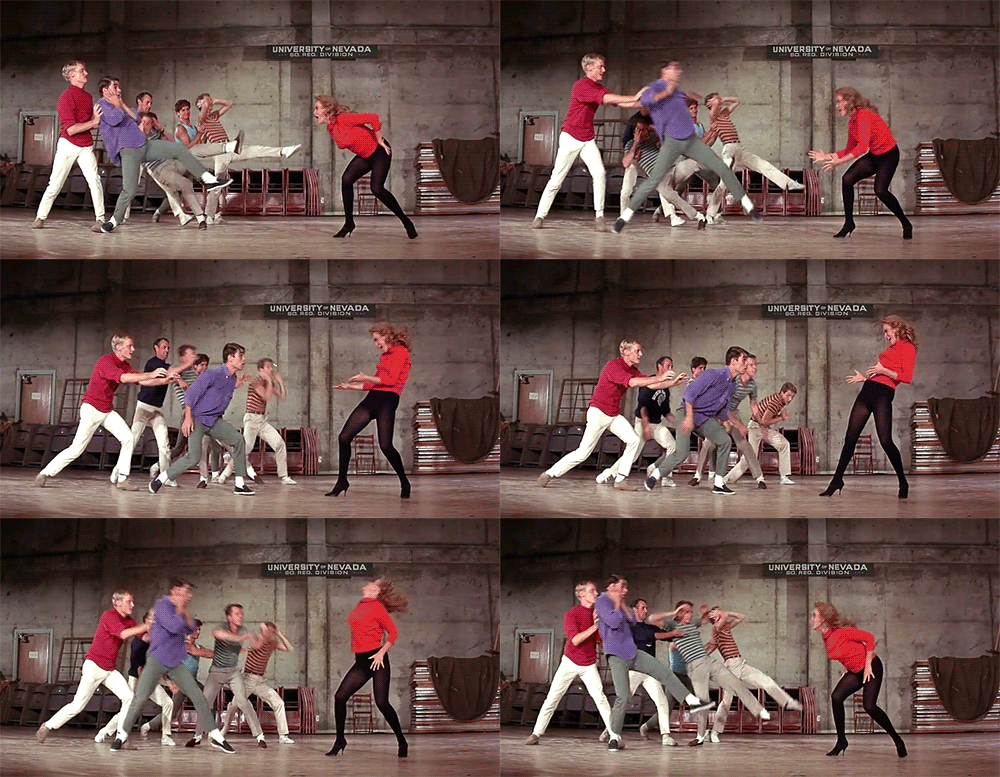
The plot of Viva Las Vegas feels perfunctory, an afterthought, something that could have been scrawled on the back of a cocktail napkin. Narrative strands are introduced and dropped. Elvis Presley is Lucky Jackson and Ann-Margret is Rusty Martin. (Those names!). It begins as a romantic triangle with Lucky and his suave rival Count Elmo Mancini (Cesare Denova) vying for the affections of pert swimming instructor Rusty. This is quickly forgotten: in an Elvis Presley film, there’s never any real doubt over who will get the girl and the Count seems to just shrug good naturedly in defeat. Rusty and Lucky’s first date montage is sublimely kitsch. It encompasses multiple costume changes, a helicopter ride over the Hoover dam, doing wildly dangerous death wish motorcycle stunts (Ann-Margret climbs atop her moving bike to do the Watusi!), having an inexplicable faux Western shoot-out and water-skiing (I cherish the ultra-fake rear projection behind them during the water-skiing segment!). Aspiring race car driver Lucky, though, urgently needs money to buy a new engine for his car, so he can compete in the upcoming Grand Prix Race. He hopes to win it by entering the hotel’s talent contest. (He’s been working as a waiter at the same hotel where Rusty gives swimming lessons. I forgot to mention that). But Rusty has entered it too, so they’re competing directly against each other, which in theory should threaten their burgeoning romance! SPOILER ALERT: Lucky wins and Rusty comes in second – but it doesn’t really impact their relationship in any meaningful way. (In the talent competition Elvis belts the glorious title tune surrounded by showgirls and Ann-Margret performs the jaw-droppingly camp “Appreciation” burlesque in white fur backed by male dancers. This is meant to be a lowly amateur talent contest for hotel employees, but their musical numbers are lavish, huge-budget extravaganzas!). The finale ramps-up the suspense by focusing on Lucky racing in the Las Vegas Grand Prix.  Gee – do you think Elvis will win?


It may sound surprising now, but in pop culture terms, Ann-Margret was a hotter property in ‘63 than Elvis himself. Viva Las Vegas was only her fourth film and there was a buzz of excitement over this incendiary emergent starlet (whose image then was a hybrid of "female Elvis" and "new Marilyn Monroe"). Elvis himself had made his film debut in 1956 and already had a slew of forgettable movies under his belt (Viva Las Vegas was already his 15th film. To give an indication of how fast Elvis was cranking ‘em out at the time, in the same year as Viva Las Vegas Elvis also released two more films: Kissin’ Cousins and Roustabout).


Elvis' corrupt manager Colonel Parker was keenly aware of Ann-Margret's "threat" to his client's primacy and resented director George Sidney including so many adoring, lingering close-ups of the female lead. (It didn’t help that Sidney had directed Ann-Margret in her triumphant breakthrough role in Bye, Bye Birdie the year before). Parker wanted to ensure Elvis was the centre of attention! This was meant to be an Elvis Presley film, not an Ann-Margret one! As Penny Stallings writes in her 1978 book Flesh and Fantasy: “Elvis Presley, for instance, was absolutely crazy for Ann-Margret while they were making Viva Las Vegas together till one of the film’s assistant directors became so smitten with the lady himself that he ended up virtually cutting Elvis out of the movie. Elvis eventually warmed up to his co-star again once the Colonel had the lovesick assistant canned.” Elvis may have been in love with Ann-Margret, but business is business and reportedly some of her screen time wound-up on the cutting room floor to restore balance. An example: we see Elvis croon the ballad “Today, Tomorrow and Forever” alone. That was originally meant to be a duet between them.


/ Above: the talent contest /


Some unexpectedly sexist moments in Viva Las Vegas: Rusty is introduced shapely legs first, rising to a brazen crotch and ass shot of Ann-Margret mincing past in tiny white hotpants. It’s a moment as lecherous as anything out of a Russ Meyer sexploitation film! (She’s taken her car into the garage where Lucky works. Her first line in the film is, “Excuse me. Can you check my motor? It’s whistling”). And for no good reason, Rusty’s whole demeanour changes mid-way through the film. When Lucky first pursues her, she’s sassy, smart and independent (in “The Lady Loves Me” duet, she pushes him in the swimming pool – guitar and all - for making advances!). Towards the end, with the big race impending, out of nowhere Rusty turns into a silly nuisance getting in the men’s way, the red-headed equivalent of the dumb blonde stereotype. Character consistency and development is not a priority in an Elvis film!


Really, I hadn’t re-visited Viva Las Vegas for many years before scheduling it for the Lobotomy Room cinema club in August and it’s much better than I remembered. In fact, it’s 85-minutes of escapist bliss! If you haven’t watched Elvis onscreen in a while, it’s a revelation what a good, relaxed and self-mocking comedic performer he can be given the chance. A particular highlight is when Elvis sings the Ray Charles rhythm-and-blues song' "What'd I Say?" in a nightclub where the dance floor is a giant roulette wheel. (It’s been noted that in this sequence Elvis plays an electric guitar which isn’t plugged-in). Elvis and Ann-Margret frolic wearing coordinated pale creamy lemon-yellow outfits (a suit and cocktail dress, respectively) and look so incomparably gorgeous together they single handedly give heteronormativity a good name. With her manic energy, Ann-Margret devours the screen! In particular, she attacks her musical numbers. Witness the unforgettably sexy spectacle of tigress Ann-Margret cavorting in complete abandon in nothing but a tight sweater and black leotard at her dance class. (This bit anticipates her freak-outs in Ken Russell's Tommy (1975)). It was interesting gauging the audiences’ reactions afterwards. Maybe it was the after-effects of Fontaine’s potent peanut butter-and-banana cocktails, but I think everyone left with a crush on Ann-Margret. The film vividly captures her when she just may have been the prettiest girl in the world. In fact, maybe Viva Las Vegas is an Ann-Margret film after all!


Further reading:

I saw Ann-Margret perform at The Stardust Casino in 2005 - one of the kitschiest, campiest experiences of my life! It was like a fever dream! She was 64 at the time and still every inch a sex kitten. She sang two Elvis songs: "A Little Less Conversation" and - yes! - "Viva Las Vegas." (She also sang Shania Twain's "Man I Feel Like a Woman" while go-go dancing around a Harley Davidson). Read the full scene report here.


In 2016 we screened the truly wild Ann-Margret juvenile delinquent b-movie Kitten with a Whip (1964). Read about it here.

I recently spoke my brains to To Do List website about Lobotomy Room, the cinema club - and my determination to return a bit of raunch and "adult situations" to London nightlife! Read it here.

Dates for your social calendar:


International supermodel. Warhol Superstar. Moon Goddess. Velvet Underground chanteuse. Heroin-ravaged punk diva. Possessor of the most haunting wraith cheekbones of the 20th century. The eternally enigmatic Nico (née Christa Päffgen) was all of these and more! 2018 represents a double anniversary for the inscrutable Marlene Dietrich of Punk: she was born 80 years ago (16 October 1938) and died 30 years ago (18 July 1988). On Wednesday 19 September the Lobotomy Room film club pays tribute to the doomed femme fatale’s memory with a screening of the 1995 documentary Nico Icon

Hosted by Graham Russell, Lobotomy Room Goes to the Movies is the FREE monthly film club downstairs at Fontaine’s bar in Dalston devoted to Bad Movies We Love (our motto: Bad Movies for Bad People), specializing in the kitsch, the cult and the queer! Doors to the basement Bamboo Lounge open at 8 pm. Film starts at 8:30 pm prompt. We can accommodate thirty people maximum on film nights. Arrive early to grab a seat and order a drink! NOTE: this screening is looking full already! Details.


Revel in sleaze, voodoo and rock’n’roll - when incredibly strange dance party Lobotomy Room returns to the basement Bamboo Lounge of Dalston’s most unique nite spot Fontaine’s! Friday 28 September!

Lobotomy Room! Where sin lives! A punkabilly booze party! Sensual and depraved! A spectacle of decadence! A Mondo Trasho evening of Beat, Beat Beatsville Beatnik Rock’n’Roll! Bad Music for Bad People! Rockabilly Psychosis! Wailing Rhythm and Blues! Twisted Tittyshakers! Punk cretin hops! White Trash Rockers! Kitsch! Exotica! Curiosities and Other Weird Shit! Think John Waters soundtracks, or Songs the Cramps Taught Us, hosted by Graham Russell. Expect desperate stabs from the jukebox jungle! Savage rhythms to make you writhe and rock! Vintage erotica projected on the big screen all night for your adult viewing pleasure! 


One FREE signature Lobotomy Room cocktail for the first twenty entrants! 

Admission: gratuit - that’s French for FREE!

Lobotomy Room: Faster. Further. Filthier.

It’s sleazy. It’s grubby. It’s trashy - you’ll love it!

A tawdry good time guaranteed! 
Details

Monday, 27 August 2018

Reflections on ... Mademoiselle (1968)


Mademoiselle (1968, Tony Richardson). The wildest screenplay I can remember written by none other than Saint Jean Genet himself. In a remote French farming village lives a frustrated school mistress (Jeanne Moreau) whose suppressed sexual desires explode into secret wanton acts of violence. She delights in smashing birds’ nests, poisoning the farm animals’ drinking water, drowning pigs and setting fire to her neighbor’s houses, all in the name of sexual gratification. But the village blames the new stud in town for all her mayhem, so Jeanne springs into action. She lures him into a field and, in what is easily the most startling scene in the film, seduces him by crawling on all fours like a dog and licking his hands and boots. That accomplished, Jeanne immediately cries rape and the villagers stone him to death. A heroine only Jean Genet could create in this midnight movie way before its time.”

From John Waters’ book Crackpot: The Obsessions of John Waters (1983).


I would have read Waters’ intriguing description of Mademoiselle when I was still in my teens but only just now got around to watching it. (When Jeanne Moreau – one of the essential faces of mid-century European art cinema - died last year, I added loads of her films to my Cinema Paradiso wish list). Mademoiselle is less lurid and sensational than Waters makes it sound – it’s actually a punishingly austere and slow-moving, bleak art movie. But boy, it’s still genuinely bizarre and disturbing! (Especially the images of animals in torment. Apparently, the audience booed at Mademoiselle’s Cannes premiere in '68. I can kind of understand why!).  Genet’s script explores his recurring preoccupations: the nature of evil, sadomasochism, violence, Catholic hypocrisy. The school teacher’s thwarted erotic obsession with the Italian lumberjack finds a twisted expression in acts of deliberate destruction: sexual and emotional repression unleashes evil. Interestingly, Genet wrote the script with Anouk Aimee in mind.  Much as I love Aimee, who else but Moreau – with her hints of perversity and eerily aloof self-possession - could essay a role like this? I love her secret Mona Lisa-like half-smirk as she surveys the chaos and flames she’s created. (In real life, Mademoiselle’s director Tony Richardson was then married to Vanessa Redgrave but would abandon her to be with Moreau). Richardson wanted Marlon Brando for the male lead but thank god it went instead to the insanely rugged and handsome Ettore Manni. He’s so sexy you can understand why Moreau goes berserk over him! Mademoiselle was a French-English co-production: the Italian characters speak in Italian with English subtitles while the French peasants are dubbed in English, with British-accents, which feels weird. The film’s message about anti-immigrant prejudice and the scapegoating of minorities certainly feels timely. Fifty years later, time has not mellowed Mademoiselle!


Further reading: many years later Moreau would star in another Jean Genet adaptation - Querelle (1982), R W Fassbinder's last film.

Read my epic 2010 interview with John Waters here.

Thursday, 2 August 2018

Reflections on ... A Dirty Shame (2004)


“Her name is Caprice and she has shingles!”

“I’m sorry I spoke so harshly about your vagina this morning”

“I’m just a horny woman with a head injury.”

“What’s good about a morning with dildos in it?”


Recently watched: A Dirty Shame (2004) by John Waters. I hadn’t seen it in many years and my boyfriend Pal had never seen it, so I decided to re-visit A Dirty Shame, Prince of Puke John Waters’ last film to date (it bombed so comprehensively no one will finance another film. The budget was $15 million and it earned just $1.9 million at the box office).

I actually first saw A Dirty Shame in its brief UK theatrical release with my friends (and fellow Waters obsessives) Petra and Rob 14 years ago. I’d love to say it’s improved over time! The first thirty or forty minutes feel like a delirious, wildly enjoyable return to Waters’ gleefully trashy and perverse bad-taste prime. Tracey Ullman stars as Sylvia Stickles, a prim and frumpy middle-aged housewife in Baltimore’s suburban Harford Road. Chris Isaak is Vaughn, her sexually-frustrated husband (which stretches the imagination. Can you imagine being married to Chris Isaak and not regularly jumping his bones?). Selma Blair co-stars as their freakishly buxom bad girl go-go dancer daughter Caprice (stripper name: Ursula Udders), currently being held under house arrest after being charged with public indecency for the third time. (Her crimes include nude loitering and nude drunk driving. “I wasn’t drunk!” Caprice protests. “I was on pills!” Had A Dirty Shame been made in the seventies, Caprice would have been portrayed by Cookie Mueller). En route to work at the convenience store, the prudish Sylvia is concussed in a freak accident – and is transformed into a raving, insatiable nymphomaniac. (“My pussy is on fire!”). She joins forces with tow truck driver Ray-Ray (Johnny Knoxville), leader of the local sex addicts, to bring about a sexual revolution on Harford Road.


The pluses: some of the kinky dialogue is glorious. The sublime cast re-unites many of the familiar veteran faces from Waters’ movies, including Mink Stole, Alan J Wendl, Jean Hill, Mary Vivian Pearce and Ricki Lake.  Brilliant character actress Jackie Hoffman (aka Mamacita from Feud: Bette and Joan) crops-up as a masturbation addict and almost steals the whole film. The exquisite soundtrack – perhaps Waters’ best - encompasses rockabilly, rhythm and blues, surf instrumentals and obscure dirty novelty songs. Best of all, rubber-faced Ullman’s wildly game, fearless and juicy performance as perennially horny, hot-pool-of-woman need Sylvia makes you wish she and Waters got the chance to collaborate again.

The minuses: Waters had apparently read an article about how victims of head injuries often lose sexual inhibitions afterwards and he built a film around that single premise. So it’s a comedy about brain damage? It’s a one-joke film that rapidly runs out of steam and becomes a chore as it progresses.  The writing and direction fatally slackens, with characters being repeatedly hit on the head and chasing each other back and forth for no particular reason. By the end, it feels frantically, wearyingly and almost offensively unfunny. A Dirty Shame isn’t Waters’ worst film (that’s Cecil B Demented), but let’s hope he gets another chance to direct so that it isn’t his cinematic epitaph.


Further reading: read my epic 2010 interview with John Waters here

Tuesday, 24 July 2018

Lobotomy Room DJ Set List at Fontaine's 29 June 2018


/ Hair hoppers are welcome at Lobotomy Room! /

From the Facebook event page:

Revel in sleaze, voodoo and rock’n’roll - when incredibly strange dance party Lobotomy Room returns to the basement Bamboo Lounge of Dalston’s most unique nite spot Fontaine’s! Friday 29 June!

Lobotomy Room! Where sin lives! A punkabilly booze party! Sensual and depraved! Bad Music for Bad People! A spectacle of decadence! A Mondo Trasho evening of Beat, Beat Beatsville Beatnik Rock’n’Roll! Rockabilly Psychosis! Wailing Rhythm and Blues! Twisted Tittyshakers! Punk cretin hops! White Trash Rockers! Kitsch! Exotica! Curiosities and Other Weird Shit! Think John Waters soundtracks, or Songs the Cramps Taught Us, hosted by Graham Russell. Expect desperate stabs from the jukebox jungle! Savage rhythms to make you writhe and rock! Vintage erotica projected on the big screen all night for your adult entertainment!

One FREE signature Lobotomy Room cocktail for the first twenty entrants! 

Admission: gratuit - that’s French for FREE!

Lobotomy Room: Faster. Further. Filthier.

It’s sleazy. It’s grubby. It’s trashy - you’ll love it!

A tawdry good time guaranteed!


I won’t lie - this post is a rush job! The next Lobotomy Room is fast-approaching (Friday 27 July! THIS Friday!). My broadband at home is on the blink (this will be the third EE engineer to come out to investigate since May), which makes me feel like I’m losing my mind. (Think of all the gay porn I’m currently NOT seeing on Tumblr! It won’t look at itself, you know!).  And I’m a sun-baked human wreck at the moment. (Pal and I went to the beach in Margate on Saturday and I am shocking lobster-pink over much of my body. Ouch! I also now have water trapped in one of my ears and am practically deaf on one side. If I was your pet, having the vet put me down would be the compassionate thing to do).  

The May 2018 Lobotomy Room felt like a triumph. The June 2018 one was much more challenging. None of my regulars or friends came, but we did get a group of middle-aged rockabillies. At one point the sole male of the group approached the DJ booth and requested I play some rockabilly so they could dance. At that moment I was actually playing hardcore rockabilly (“Let’s Go Baby” by Billy Eldridge), so I asked him if he had anything in particular in mind. He replied, “Elvis. Gene Vincent. Eddie Cochran.” So their knowledge of rockabilly didn’t extend far beyond the well-worn classics and their tastes were decidedly conservative. Trying to second-guess what they wanted was difficult! A lot of what I thought would please them met a dead response. If they liked and recognized a song, they’d jump-up and dance (or the women would stroll). To their credit, they danced to “Juvenile Delinquent” by Ronnie Allen. If they didn’t dig what I was playing, they’d whip-out their phones and start scrolling, radiating disapproval in my direction! When I’d drop a punk cover version of a rockabilly song, you could see their brains whirring in confusion. Tough crowd!  I have to admit, it stressed me out and cramped my style. I like to whip-together punk, surf instrumentals, rhythm and blues, tittyshakers and weird, abrasive kitsch novelty stuff as well as frantic, more obscure rockabilly but found myself compromising in order to please this contingent. There’s usually considerably more melanin in my playlists!

On the plus side, my friend Ejole (aka “Little E”) from San Francisco surprised me by turning up (I knew he was going to be in London but didn’t know he was coming to Lobotomy Room that night). Because I was DJ’ing, I didn’t get to actually hang out, though! 


/ I dropped this eternal camp classick ... /


/ What a glorious duo! I also played tracks by Jayne Mansfield (Patron Saint of Lobotomy Room) and Billy "Crash" Craddock /

Road Runner - The 5,6,7,8s
Drive, Daddy, Drive - Little Sylvia
Little Darlin' - Masaaki Hirao
Hey Little Star - Ann-Margret
Blue Velvet - Bobby Vinton
Adult Books - X
Savin' My Love - Wanda Jackson
Mau Mau - The Fabulous Wailers
Kismiaz - The Cramps
Monkey Bird - The Revels
Drummin' Up a Storm - Sandy Nelson
Fever - Nancy Sit
Jaguar - The Jaguars
Hot Licks - The Rendells
Wild Wild Party - Charlie Feathers
Jukebox Babe - Alan Vega
Atomic Bongos - Lydia Lunch
Here Comes the Bug - The Rumblers
Riding with a Movie Star - L7
Wiped Out - The Escorts
Ring of Fire - The Earls of Suave
I Don't Need You No More - The Rumblers
Let's Go Baby - Billy Eldridge
Bikini with No Top on the Top - Mamie Van Doren and June Wilkinson
Sweetie Pie - Eddie Cochran
Bop Pills - Macy Skip Skipper
Juvenile Delinquent - Ronnie Allen
Strychnine - The Sonics
Vampira - Bobby Bare
Save It - Mel Robbins
Boss - The Rumblers
Love Me - The Phantom
Rock Around the Clock - The Sex Pistols
Little Girl - John and Jackie
Fools Rush In - Ricky Nelson
Devil in Disguise - Elvis Presley
Bottle to the Baby - Charlie Feathers
Blitzkreig Bop - The Ramonetures
The Swag - Link Wray
Funnel of Love - Wanda Jackson
Breathless - X
C'mon Everybody - Sid Vicious
Be Bop a Lula - Alan Vega
Whistle Bait - Larry Collins
Action Packed - Ronnie Dee
Jim Dandy - Ann-Margret
Rock-A-Bop - Sparkle Moore
Domino - Roy Orbison
What's Inside a Girl? The Cramps
Chicken Walk - Hasil Adkins
Wood Pecker Rock - Nat Couty and The Braves
Poor Little Baby - Billy "Crash" Craddock
Margaya - The Fender Four
Viva Las Vegas - Nina Hagen
Surf Rat - The Rumblers
Pedro Pistolas Twist - Los Twisters
Suey - Jayne Mansfield
Treat Me Right - Mae West
Three Cool Chicks - The 5,6,7,8s
Woo-Hoo - The Rock-A-Teens
Hoy Hoy - The Collins Kids
Bombora - The Original Surfaris
Teenage Lobotomy - The Ramones
Nothing Means Nothing Anymore - The Alley Cats
Year 1 - X
Party Lights - Claudine Clark
He's The One - Ike and Tina Turner
One Night of Sin - Elvis Presley

In other news: there were no photos taken at the July 2018 installment of Lobotomy Room – but my friend Rachael (Yorkshire’s finest!) celebrated her birthday in The Bamboo Lounge the following night and I DJ’d there again! Here’s a bonus "glamour shot" of me with the fierce, fabulous and forty-year old Rachael (the TRUE “angel of the north!”).  See more paparazzi pics from her party here.


There’s a Lobotomy Room playlist on Spotify! You can finally hear the strange and sleazy sounds of Lobotomy Room online! I should have sorted this out myself years ago, but in the meantime my friend Louise (that red-headed vixen!) pieced this together based on my May 2018 Lobotomy Room DJ set list. 


/ Next Lobotomy Room club: Friday 27 July 2018! Full squalid details on event page! /

Further reading:

Follow me on Tumblr for all your kitsch, camp, retro vintage sleaze and fifties homoerotica needs!

Follow me on twitter!

"Like" and follow the official Lobotomy Room page on Facebook if you dare! 
 

Monday, 16 July 2018

Reflections on ... Cindy Sherman Exhibit at Sprüth Magers


“In the large-scale colour portraits, the artist imagines herself as a cast of 'grandes dames' from the Golden Age of 1920s Hollywood cinema. Differing from Sherman’s earlier series, these actresses are presented outside of the filmic narrative, posing instead for what seem to be formal publicity shots. Despite their elaborate garb, coiffed hairdos and painted faces, the leading ladies are clearly in their twilight years, and the grave stoicism of their expressions gives way to instances of poignant vulnerability: fine lines emerge through caked-on make-up, and sinewy, aged hands seem at odds with the smooth polish of their owners’ faces. The actresses pose against digitally manipulated backgrounds that are suggestive of the film sets and backdrops of yesteryear. Skyscrapers, a busy café scene, manicured gardens and a classical landscape all feature within the series. One photograph created earlier this year, displays four actresses in different coloured tulle costumes. Seated together, they reference the historic popularity of sister acts in the entertainment industry.” 
From Sprüth Magers’ catalogue
“Some play with scarves to hide their wrinkles, others rely on a brave, haughty or mysterious expression. All could quite clearly carry off once more whatever roles they played on the silver screen until age edged them out of the system. But in each case there are a hundred more nuances, of doubt, pride, suffering, foolishness, survival, courage, learned from the life and irrepressible even in these supposed publicity shots for films that will never be made.” 
From The Guardian’s review


I visited the new Cindy Sherman exhibit at Sprüth Magers’ gallery in Mayfair on Saturday 7 July. In it, the masterful American artist and photographer completely transforms herself into a series of powdered and bewigged veteran show biz divas of a certain age in eerie, powerful and riveting self-portraits. The focus is on liver-spotted hands clutching chiffon and the whole arsenal of artifice: plucked-out eyebrows, scarlet lips painted into a cupid’s bow. The vibe is very ruined glamour, Kenneth Anger’s Hollywood Babylon, decaying Hollywood Mansions, Sunset Boulevard / Whatever Happened to Baby Jane? 

Looking at them, you can’t help but associate the photos with the doomed flapper Clara Bow, Mary Pickford’s reclusive alcoholic later years, or the botched face lift of Hedy Lamar. The show is about aging, but also about haughty defiance (or denial) towards aging, and a commitment to glamour at all costs despite aging. (And the show is inevitably about the aging of Sherman herself, who is now 64. Those unretouched liver-spotted hands belong to her!). The exhibit is free and runs until 1 September 2018.


Further reading:read my scene report from John Water's 2015 exhibit Beverley Hills John at Sprüth Magers here.

Thursday, 12 July 2018

Reflections on ... Lauren Bacall in Young Man with a Horn (1950)


Recently watched: Young Man with a Horn (1950).  Directed by Michael Curtiz (Casablanca, Mildred Pierce), it covers the rise and fall of an idealistic, uncompromising young jazz trumpeter Rick Martin (Kirk Douglas) in the hard-bitten, dog-eat-dog neon jungle of New York’s nightlife. Doris Day co-stars as Jo, the wholesome and sympathetic big band singer who’s in love with Rick. If he only he could see she’s perfect for him! The dramatic black and white film noir photography is spectacular and it gets wildly, pleasurably overwrought as it progresses, encompassing alcoholism, nervous breakdowns and pneumonia. Note: your enjoyment of Young Man with a Horn will depend on how much you can tolerate watching Douglas mime playing trumpet in the frequent musical sequences.

BUT mid-way through the film Lauren Bacall – that smoky-eyed Siamese cat-in-human form – rocks-up as Amy North, Douglas’ frosty, frigid rich bitch socialite wife and blows everything apart. Perennially wreathed in cigarette smoke and meant to represent the polar opposite of Doris Day, Bacall’s sleek and soignée appearance belies a roiling, wildly dysfunctional (possibly mentally ill) interior.  Amy is cultured and worldly, sexually ambivalent, independent, speaks Latin and is studying to be a psychiatrist: in the context of the film, her intellect is depicted as off-putting and unappealing. Worst of all – she admits she doesn’t actually like jazz! There are hints of repressed lesbianism: Rick and Amy are seen to sleep in separate single beds, and she’s subtly coded as queer recognizable to contemporary 1950 audiences in the way that characters played by, say, Peter Lorre or Sydney Greenstreet would also have been understood as gay. As Ian Scott Todd writes in his blog Primal Scenes:

“Amy is neurotic, withholding, passive-aggressive, and anal-retentive, to name only four of her "symptoms."  All of the other familiar lesbian signifiers are here, too, in her elegant but mannish suits, her stand-offish demeanor, and the sophisticated décor of her apartment.  Bacall’s Amy North is what Halberstam might classify as a predatory dyke: calculating, urbane, aloof.  She matches her interior space, with its hard, sleek, coldly elegant surfaces, off-set by touches of the bizarre, such as a pet cockatoo to which she refers—ominously—as her “best friend” … Amy is an example of the predatory dyke as femme fatale, trapped within the gilded cage of her own sexual “perversity,” someone to run away from, preferably into the arms of a “real” woman.  And yet, like all femme fatales, Amy’s dangerous sexuality makes her infinitely more attractive than the blandly chipper Jo, whose normality is, indeed, terrible.” 


Towards the end, Amy casually tells Rick, “I’ve met a girl – an artist. We might go to Paris together.” Here Bacall suddenly anticipates Cate Blanchet in Carol (2015). “You’re a sick girl, Amy!” Rick finally shouts as their marriage unravels. “I’m sick of you trying to touch me!” she screams.

The ostensibly unsympathetic but compelling and complex Amy represents the late Bacall’s strangest, most intense performance and she steals the film from Douglas and Day. I don’t recall her ever being asked about Young Man with a Horn in any interviews. I’d love to know how Curtiz and Bacall conceived and discussed the part. Did Bacall even know her character was meant to be gay? In any case, her portrayal should be included as at least a footnote in any discussion about LGBTQ representation in Golden Age Hollywood cinema.