For the first Lobotomy Room film club of
2020, let’s bask in some old-school pagan diva worship! As is tradition, the
first film club of the New Year stars eternal Lobotomy Room favourite - Golden
Age Hollywood’s bitch goddess extraordinaire Joan Crawford! (In January 2018 we
screened Strait-Jacket. In January 2019, Sudden Fear).
If you enjoy watching the reliably intense
Crawford suffering in mink, irresistibly tawdry noir melodrama The Damned Don’t
Cry (1950) is the movie for you! Thursday 16 January! Hear her snarl hard-boiled dialogue like “Don’t talk to me about self-respect! That’s something you tell
yourself you’ve got when you’ve got nothing else!” No spoilers, but it begins
with Crawford as downtrodden housewife from the wrong side of the tracks Edith
Whitehead, who climbs to the top of high society … one man at a time! (Edith’s
mantra: “I want something more than what I’ve had out of life. And I’m going to
get it!”). Unfortunately – she soon finds herself embroiled in the murky realm
of organized crime (and sexy gangster Steve Cochran!).
Lobotomy Room Goes to the Movies is the
FREE monthly film club downstairs at Fontaine’s bar (Dalston’s most unique nite
spot!) devoted to Bad Movies We Love (our motto: Bad Movies for Bad People),
specializing in the kitsch, the cult and the camp! Third Thursday night of the
month. Doors to the basement Bamboo Lounge open at 8 pm. Film starts at 8:30 pm
prompt! We can accommodate 30 people maximum on film nights. Remember: the film
is FREE so you can buy more cocktails! (One drink minimum).
/ "She’s as tempting as a cupcake - and as tough as a 75-cent steak!” /
It was never intentional, but in recent
years it’s become a Lobotomy Room film club ritual to screen a Joan Crawford
film to usher in the new year. Maybe it’s a subconscious act of pagan goddess
worship? Anyway, we showed Strait-Jacket in January 2018, Sudden Fear in
January 2019 and now The Damned Don’t Cry in January 2020. When I introduced
Damned onstage, I quoted Crawford’s line of dialogue from the film, “I want
something more than what I’ve had out of life - and I’m going to get it!” and
urged the audience to embrace this mission statement as their new year’s
resolution for 2020.
/ “Call me CHEAP?” Nothing’s cheap when you pay the price she's paying! /
After Crawford’s Oscar-winning,
career-reviving comeback victory with Mildred Pierce (1945), her studio Warner
Bros clearly decided: don’t mess with the formula. Subsequent films like Flamingo
Road (1949), The Damned Don’t Cry (1950) and This Woman is Dangerous (1952) are
all increasingly threadbare and repetitive variations of the Mildred Pierce
template, cleaving to the same essential noir crime melodrama style and theme. As The
Chiseler concisely summarizes, the narratives of these Crawford pictures all “follow
a woman as she claws her way out of dreary poverty, attains a pinnacle of
penthouse luxury, and plunges from there into the abyss”. So yes, it’s a
formula - but hell, it’s a juicy, lurid and insanely enjoyable formula, and
these films are understandably embraced today as both exemplars of mid-century
“women’s pictures” and camp classics. Think
of it this way: imagine there was an all-night Joan Crawford film marathon on
TV. If you started watching The Damned Don’t Cry, fell asleep mid-way through,
woke up in middle of This Woman is Dangerous and continued watching, you
probably wouldn’t notice any discrepancy. (It helps that Crawford co-stars with
silver fox David Brian Flamingo Road, Damned and This Woman is Dangerous!).

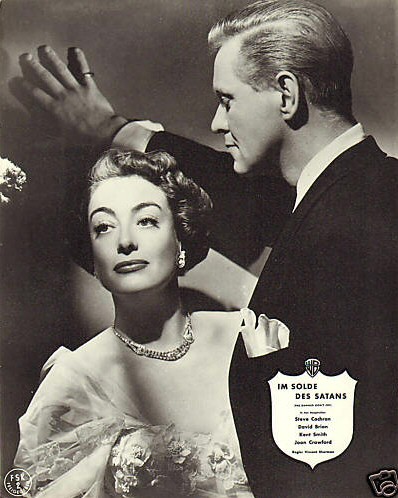
/ Joan Crawford with David Brian in
The Damned Don't Cry /
As a Joan Crawford star vehicle par
excellence,
Damned certainly delivers on showcasing the diva’s considerable
mid-period strengths. It ticks all the boxes: Crawford gets beautifully lit and flattering close-ups, copious
costume changes (charting her trajectory from drab housewife to upper-crust socialite),
gets to have big emotional confrontations, snarl hard-boiled dialogue and slap men’s
faces. (Just to shake things up, in
Damned, Crawford herself also gets slapped
around and roughed-up a lot). Characteristically of this period, Crawford’s leading
men are mostly secondary considerations, with minimal threat of challenging her
dominance. (The exception: smoldering
noir tough guy Steve Cochran. More of him
later).
/ Suffering in mink: Joan Crawford in
The Damned Don't Cry /
/ Check out those gams! Yes! Scary diva Joan Crawford at full voltage in torrid melodrama The Damned Don’t Cry (1950) /
Vincent Sherman directs Damned with verve
and economy, ensuring the story unfolds in broad strokes and dramatic
flourishes. Boiling with ambition and hunger, Crawford swaps identities with
remarkable ease, swiftly re-inventing herself from frumpy small town hausfrau
Edith Whitehead to elegant heiress Lorna Hansen Forbes (“the darling of café
society”) under the tutelage of her new friend, shifty posh-voiced grifter
Patricia Longworth (exquisitely performed with the perfect amount of patrician anxiety
by scene-stealing Selena Royle). Sherman neatly contrasts the visual signifiers of
Crawford’s new realm (cocktails (vermouth and cassis!), gold cigarette cases, mink
coats, orchids, swimming pools) and her discarded working-class origins (derricks
pumping in the Texas oil fields belching sooty plumes of pollution, blue collar
men in hardhats and overalls, a wardrobe of cloth coats and aprons, no make-up,
scraped-back hair).
Initially Damned positions Crawford in a
conventional romantic triangle. Edith / Lorna must choose between impoverished,
honest (and dull) accountant Marty Blackford (Kent Smith) or sociopathic but
rich and suave organized crime kingpin George Castleman (David Brian). But then
mid-way through the film Castleman’s dangerously volatile mobster associate Nick
Prenta (Steve Cochran) arrives and explodes the movie apart. If you’re unfamiliar
with hirsute and broodingly handsome Cochran (1917 - 1965), he’ll be a revelation.
Probably best-remembered for the film White Heat (1949), Cochran is worthy of
comparison to peer Robert Mitchum: both invested unexpected complexity and
humanity to their portrayals of sexy noir thugs.
/ “A woman who crossed the paths of many men … and double-crossed every one of them!” Steve Cochran and Joan Crawford in The Damned Don't Cry /
Great as Crawford is – she is never
less than majestic and mesmerizing to watch here – she is also sticking with
what she already knows in
Damned. (By 1950 Crawford could play a role like Edith
/ Lorna with her eyes closed). I’d argue
Damned really belongs to Cochran, whose
performance feels modern, nuanced and surprising. For a macho gangster, Nick (as
Cochran plays him) reveals intriguing fissures of sensitivity and insecurity seething
below the surface. At times, Cochran almost suggests Nick is a little boy
playing
at being a mobster. For example, even while Nick strives to maintain his taciturn
demeanor, it’s also clear he’s astounded a classy high falutin' dame like Lorna could be romantically
interested in him (watch the way Nick proudly escorts her through his swanky Palm Springs nightclub, hoping to impress her), and he’s quick to bristle with offense when he suspects she’s
belittling him. Cochran does nothing to solicit the audience’s sympathy – and yet Nick
is easily
Damned’s most compelling character. He’s also sex on legs: watch for
the poolside scenes of Cochran in clingy swimming trunks or a terry cloth robe,
with his impressive chest pelt on full display. The cruel and sensual face, lush dark brows
and mane of oiled, combed-back black hair also anticipates Elvis Presley. Read more about essential noir icon Cochran in
this lyrical, perceptive essay.
Speaking of male pulchritude, Cochran is
rivaled here by Richard Egan (1921 – 1987) as Roy Whitehead, the laborer husband
who Edith abandons. Egan's appearance is fleeting but –
phew! – memorable.
With his brawny physique, stubbled face, leather jacket, pomaded hair and
visible chest hair, Egan suggests a hunky escapee from a Bob Mizer / Athletic
Model Guild beefcake photo shoot. Interestingly, there is reason to believe that various
points, the cougar-ish Crawford was romantically involved with virtually every man
involved in
The Damned Don’t Cry. She’s been "linked" to director Vincent Sherman
and leading men David Brian, Steve Cochran
and Egan.
/ Above: Egan with Crawford in
The Damned Don't Cry (1950) and below in a candid social shot from what appears to be the early sixties /
/ Above: as a bonus for reading this far, some beefcake pin-ups of the wondrous Richard Egan. You're welcome! Read more about him
here /
/ Two things: apparently at some point Crawford had off-screen "intimate knowledge" of each of her leading men in this shot (
and director Sherman). And I love how this smiling publicity photo wildly misrepresents
The Damned Don't Cry as a romantic comedy /
/ Portrait of a bitch goddess extraordinaire: Joan Crawford in
The Damned Don't Cry /
To the surprise of no one, now that London is on lock-down with the dreaded Coronavirus, the monthly film club is on indefinite hiatus. (We were meant to screen
Desert Fury in March). But as god as my witness, Lobotomy Room (and Fontaine's bar)
will be back! Watch this space.
Further Reading
Read my analysis of the Joan Crawford films
Sudden Fear (1952) and
Autumn Leaves (1956).